







-
 Agriculture
-
 Health-Care
-
 Environment
-
 Construction-Real-Estate
-
 Tools-Hardware
-
 Home-Garden
-
 Furniture
-
 Luggage-Bags-Cases
-
 Medical-devices-Supplies
-
 Gifts-Crafts
-
 Sports-Entertainment
-
 Food-Beverage
-
 Vehicles-Transportation
-
 Power-Transmission
-
 Material-Handling
-
 Renewable-Energy
-
 Safety
-
 Testing-Instrument-Equipment
-
 Construction-Building-Machinery
-
 Pet-Supplies
-
 Personal-Care-Household-Cleaning
-
 Vehicle-Accessories-Electronics-Tools
-
 School-Office-Supplies
-
 Packaging-Printing
-
 Mother-Kids-Toys
-
 Business-Services
-
 Commercial-Equipment-Machinery
-
 Apparel-Accessories
-
 Security
-
 Shoes-Accessories
-
 Vehicle-Parts-Accessories
-
 Jewelry-Eyewear-Watches-Accessories
-
 Lights-Lighting
-
 Fabric-Textile-Raw-Material
-
 Fabrication-Services
-
 Industrial-Machinery
-
 Consumer-Electronics
-
 Electrical-Equipment-Supplies
-
 Electronic-Components-Accessories-Telecommunications
-
 Home-Appliances
-
 Beauty
-
 Chemicals
-
 Rubber-Plastics
-
 Metals-Alloys


























































































































































































































































































































































































































































































































































































- Masonry Materials
- Curtain Walls & Accessories
- Earthwork Products
- Fireproofing Materials
- Heat Insulation Materials
- Plastic Building Materials
- Building Boards
- Soundproofing Materials
- Timber
- Waterproofing Materials
- Balustrades & Handrails
- Bathroom & Kitchen
- Flooring & Accessories
- Tiles & Accessories
- Door, Window & Accessories
- Fireplaces & Stoves
- Floor Heating Systems & Parts
- Stairs & Stair Parts
- Ceilings
- Elevators & Escalators
- Stone
- Countertops, Vanity Tops & Table Tops
- Mosaics
- Metal Building Materials
- Multifunctional Materials
- Ladders & Scaffoldings
- Mouldings
- Corner Guards
- Decorative Films
- Formwork
- Building & Industrial Glass
- Other Construction & Real Estate
- Wallpapers/Wall panels
- HVAC System & Parts
- Outdoor Facilities
- Prefabricated Buildings
- Festive & Party Supplies
- Bathroom Products
- Household Sundries
- Rain Gear
- Garden Supplies
- Household Cleaning Tools & Accessories
- Lighters & Smoking Accessories
- Home Storage & Organization
- Household Scales
- Smart Home Improvement
- Home Textiles
- Kitchenware
- Drinkware & Accessories
- Dinnerware, Coffee & Wine
- Home Decor
- Golf
- Fitness & Body Building
- Amusement Park Facilities
- Billiards, Board Game,Coin Operated Games
- Musical Instruments
- Outdoor Affordable Luxury Sports
- Camping & Hiking
- Fishing
- Sports Safety&Rehabilitation
- Ball Sports Equipments
- Water Sports
- Winter Sports
- Luxury Travel Equipments
- Sports Shoes, Bags & Accessories
- Cycling
- Other Sports & Entertainment Products
- Artificial Grass&Sports Flooring&Sports Court Equipment
- Scooters
- Food Ingredients
- Honey & Honey Products
- Snacks
- Nuts & Kernels
- Seafood
- Plant & Animal Oil
- Beverages
- Fruit & Vegetable Products
- Frog & Escargot
- Bean Products
- Egg Products
- Dairy Products
- Seasonings & Condiments
- Canned Food
- Instant Food
- Baked Goods
- Other Food & Beverage
- Meat & Poultry
- Confectionery
- Grain Products
- Feminie Care
- Hair Care & Styling
- Body Care
- Hands & Feet Care
- Hygiene Products
- Men's Grooming
- Laundry Cleaning Supplies
- Travel Size & Gift Sets
- Room Deodorizers
- Other Personal Care Products
- Pest Control Products
- Special Household Cleaning
- Floor Cleaning
- Kitchen & Bathroom Cleaning
- Oral Care
- Bath Supplies
- Yellow Pages
- Correction Supplies
- Office Binding Supplies
- Office Cutting Supplies
- Board Erasers
- Office Adhesives & Tapes
- Education Supplies
- Pencil Cases & Bags
- Notebooks & Writing Pads
- File Folder Accessories
- Calendars
- Writing Accessories
- Commercial Office Supplies
- Pencil Sharpeners
- Pens
- Letter Pad/Paper
- Paper Envelopes
- Desk Organizers
- Pencils
- Markers & Highlighters
- Filing Products
- Art Supplies
- Easels
- Badge Holder & Accessories
- Office Paper
- Printer Supplies
- Book Covers
- Other Office & School Supplies
- Stationery Set
- Boards
- Clipboards
- Stamps
- Drafting Supplies
- Stencils
- Electronic Dictionary
- Books
- Map
- Magazines
- Calculators
- Baby & Toddler Toys
- Educational Toys
- Classic Toys
- Dress Up & Pretend Play
- Toy Vehicle
- Stuffed Animals & Plush Toys
- Outdoor Toys & Structures
- Balloons & Accessories
- Baby Food
- Children's Clothing
- Baby Supplies & Products
- Maternity Clothes
- Kids Shoes
- Baby Care
- Novelty & Gag Toys
- Dolls & Accessories
- Puzzle & Games
- Blocks & Model Building Toys
- Toddler Clothing
- Baby Clothing
- Kids' Luggage & Bags
- Arts, Crafts & DIY Toys
- Action & Toy Figures
- Baby Appliances
- Hobbies & Models
- Remote Control Toys
- Promotional Toys
- Pregnancy & Maternity
- Hygiene Products
- Kid's Textile&Bedding
- Novelty & Special Use
- Toy Weapons
- Baby Gifts
- Baby Storage & Organization
- Auto Drive Systems
- ATV/UTV Parts & Accessories
- Marine Parts & Accessories
- Other Auto Parts
- Trailer Parts & Accessories
- Auto Transmission Systems
- Train Parts & Accessories
- Universal Parts
- Railway Parts & Accessories
- Auto Brake Systems
- Aviation Parts & Accessories
- Truck Parts & Accessories
- Auto Suspension Systems
- Auto Lighting Systems
- New Energy Vehicle Parts & Accessories
- Auto Steering Systems
- Wheels, Tires & Accessories
- Bus Parts & Accessories
- Auto Performance Parts
- Cooling System
- Go-Kart & Kart Racer Parts & Accessories
- Air Conditioning Systems
- Heavy Duty Vehicle Parts & Accessories
- Auto Electrical Systems
- Auto Body Systems
- Auto Engine Systems
- Container Parts & Accessories
- Motorcycle Parts & Accessories
- Refrigeration & Heat Exchange Equipment
- Machine Tool Equipment
- Food & Beverage Machinery
- Agricultural Machinery & Equipment
- Apparel & Textile Machinery
- Chemical Machinery
- Packaging Machines
- Paper Production Machinery
- Plastic & Rubber Processing Machinery
- Industrial Robots
- Electronic Products Machinery
- Metal & Metallurgy Machinery
- Woodworking Machinery
- Home Product Manufacturing Machinery
- Machinery Accessories
- Environmental Machinery
- Machinery Service
- Electrical Equipment Manufacturing Machinery
- Industrial Compressors & Parts
- Tobacco & Cigarette Machinery
- Production Line
- Used Industrial Machinery
- Electronics Production Machinery
- Other Machinery & Industrial Equipment
- Camera, Photo & Accessories
- Portable Audio, Video & Accessories
- Television, Home Audio, Video & Accessories
- Video Games & Accessories
- Mobile Phone & Accessories
- Electronic Publications
- Earphone & Headphone & Accessories
- Speakers & Accessories
- Smart Electronics
- TV Receivers & Accessories
- Mobile Phone & Computer Repair Parts
- Chargers, Batteries & Power Supplies
- Used Electronics
- VR, AR, MR Hardware & Software
- Projectors & Presentation Equipments
- Other Consumer Electronics
- Cables & Commonly Used Accessories
- Computer Hardware & Software
- Displays, Signage and Optoelectronics
- Discrete Semiconductors
- Wireless & IoT Module and Products
- Telecommunications
- Connectors, Terminals & Accessories
- Development Boards, Electronic Modules and Kits
- Circuit Protection
- Sensors
- Isolators
- Audio Components and Products
- Integrated Circuits
- Power Supplies
- Relays
- RF, Microwave and RFID
- Electronic Accessories & Supplies
- Passive Components
- PCB & PCBA
- Air Quality Appliances
- Home Appliance Parts
- Heating & Cooling Appliances
- Small Kitchen Appliances
- Laundry Appliances
- Water Heaters
- Water Treatment Appliances
- Refrigerators & Freezers
- Personal Care & Beauty Appliances
- Major Kitchen Appliances
- Cleaning Appliances
- Second-hand Appliances
- Smart Home Appliances
- Other Home Appliances
- Energy Chemicals
- Inorganic Chemicals
- Basic Organic Chemicals
- Agrochemicals
- Admixture & Additives
- Catalysts & Chemical Auxiliary Agents
- Pigments & Dyestuff
- Coating & Paint
- Daily Chemicals
- Polymer
- Organic Intermediate
- Adhesives & Sealants
- Chemical Waste
- Biological Chemical Products
- Surface Treatment Chemicals
- Painting & Coating
- Chemical Reagents
- Flavor & Fragrance
- Non-Explosive Demolition Agents
- Other Chemicals
- Custom Chemical Services

A Strategic Guide to Substituting Lithium Manganese Batteries: When and Why to Switch Chemistries
Understanding When to Transition from Lithium Manganese Cells
Although lithium manganese dioxide (Li/MnO2) power sources are celebrated for their 3.0V nominal voltage and high energy density—making them standard choices for IoT hardware, smart locks, and keyless entry systems—they are not always the most practical or economical option. Device designers and procurement managers frequently evaluate alternative chemistries when operational parameters require standard 1.5V voltage profiles, budget-friendly high-volume production, constant voltage discharge, or eco-conscious reusability.
Key Takeaways for Battery Replacement Selection
- Economic Efficiency for Mass Production: Shifting from lithium coin cells to alkaline manganese or lead-free zinc chloride series delivers significant cost savings for standard household electronics like television remotes, wall clocks, and doorbells.
- Precision Voltage Output: High-accuracy tools such as medical pulse oximeters, digital multimeters, and quartz timepieces achieve enhanced voltage stability using mercury-free silver oxide button cells.
- Sustainable Power Solutions: High-frequency devices like wireless computer mice, headlamps, and portable audio gear benefit from USB rechargeable formats, eliminating single-use cell waste.
- Compliance & Quality Standards: Choosing replacement power sources certified under ISO 9001:2015, IATF 16949:2016, and UL guidelines guarantees international market safety compliance across global export channels.
Comparative Analysis of Battery Chemistries
| Battery Chemistry | Nominal Voltage | Primary Application Scenarios | Shelf Life / Key Features | Economic & Operating Profile |
|---|---|---|---|---|
| Manganese Dioxide Lithium | 3.0V | Smart door locks, TPMS sensors, IoT nodes, security cameras | High energy density, extended shelf life, UL certified | High unit energy; higher initial cost |
| Alkaline Manganese Dry Battery | 1.5V / 9V | Wireless mice, TV remotes, flashlights, blood pressure monitors | 5 years shelf life, lowest internal resistance, leak-resistant | Cost-effective for medium to high drain |
| 0% Lead Zinc Chloride | 1.5V / 9V | Gas stove igniters, doorbells, wall clocks, simple toys | Environmentally friendly, 0% lead added | Budget option for basic low-drain hardware |
| 0% Mercury Silver Oxide | 1.55V | Quartz watches, medical monitoring, precision timers | Stable discharge voltage, 0% mercury added | High precision output for compact electronics |
| USB Rechargeable Battery | 1.2V - 3.7V Equivalent | Walkie-talkies, high-intensity flashlights, wireless audio | Reusable charging cycles, USB port integration | Higher initial cost, zero single-use cell disposal |
Technical Evaluation of Alternative Battery Chemistries
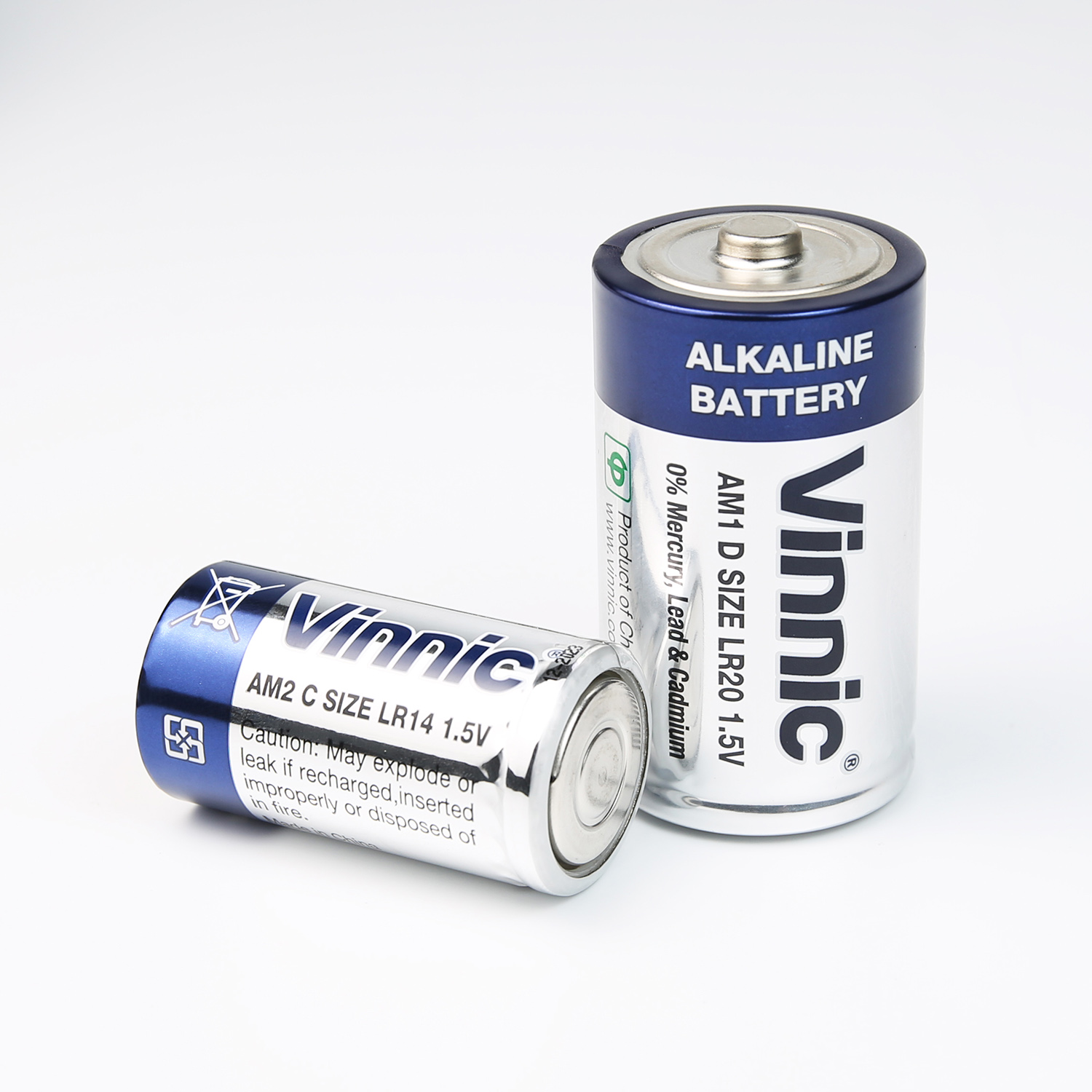
When device specs call for a 1.5V profile rather than 3.0V, Vinnic Alkaline Manganese Dry Battery models (including AM1/LR20, AM2/LR14, AM3/LR6, AM4/LR03, and AM9VF/6LR61) offer low internal resistance, robust leak resistance, and a reliable 5-year shelf life.

For cost-sensitive applications with basic low-drain demands—such as gas stove igniters and simple alarms—0% Lead Zinc Chloride Batteries (SUM1, SUM2, SUM3, SUM4, SUM5, SUM9V) present a highly economical alternative. Conversely, precision medical and laboratory equipment (electronic wrist blood pressure monitors, finger pulse oximeters, lab timers) depend on 0% Mercury Silver Oxide Button Cells (357, 386, 389, SR626SW) to maintain flat, predictable discharge curves without voltage drops during operation.
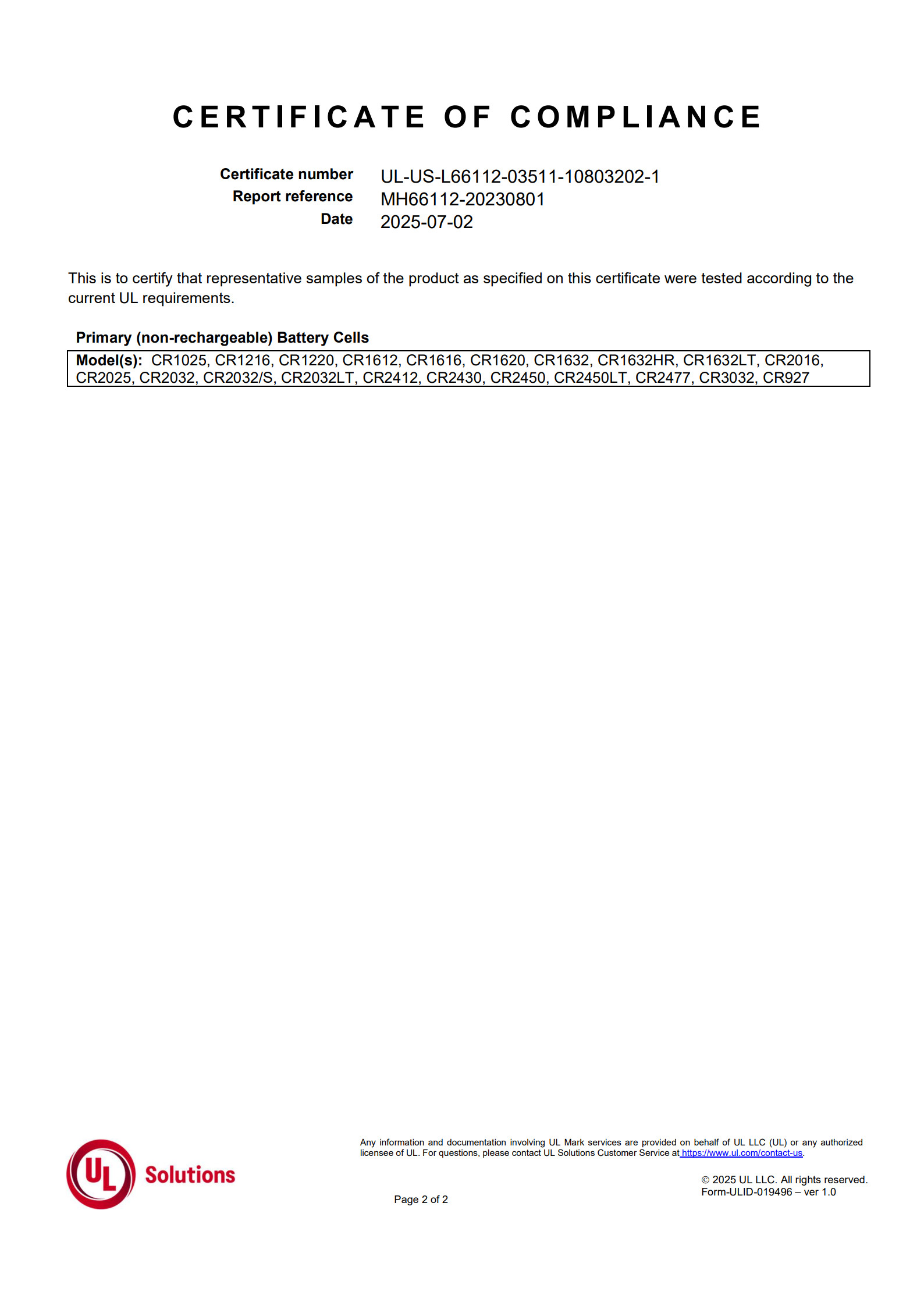
To ensure strict quality standards across all production batches, manufacturing procedures at CHUNG PAK (GUANG DONG)BATTERY INDUSTRIAL CO., LTD incorporate a comprehensive triple-stage quality control framework, including raw material verification, 100% inline assembly checks, and lab sampling. For lithium applications requiring verified safety compliance, UL certificate UL-US-L66112-03511-10803202-1 confirms adherence to US safety benchmarks.
Frequently Asked Questions (FAQ)
Q1: What triggers a switch from 3.0V lithium coin cells to 1.5V alkaline options?
A1: Transitions are recommended when device circuitry operates on 1.5V input or when lowering bulk component procurement costs is a primary goal, provided the hardware power design supports the lower voltage profile.
Q2: Why are silver oxide button cells preferred over lithium manganese in precision healthcare devices?
A2: Silver oxide cells feature an exceptionally flat discharge curve throughout their service life, preventing voltage-related measurement drift in diagnostic instruments like blood glucose meters, digital thermometers, and oximeters.
Q3: How does rigorous manufacturing quality control preserve shelf life and prevent leakage?
A3: End-to-end quality inspection—spanning incoming material audits to 100% inline testing—minimizes internal resistance variance, preventing leakage and sustaining a stable 5-year shelf life across alkaline product ranges.
Summary & Ordering Information
Selecting the ideal battery chemistry depends on operating voltage parameters, equipment discharge traits, and target unit economics. While lithium manganese cells remain critical for 3.0V long-life devices like IoT nodes and keyless entry systems, adopting alkaline manganese, zinc chloride, or silver oxide chemistries optimizes operating expenses for standard 1.5V applications. Comprehensive industrial supply capabilities support custom bulk production starting at a minimum order quantity (MOQ) of 10,000 units with regular 30-day sea freight delivery schedules. For technical support or customized quotes, reach out via vinnic@chungpak.com.
Company Overview
Founded in 1980, CHUNG PAK (GUANG DONG)BATTERY INDUSTRIAL CO., LTD has evolved from a battery producer into a diversified manufacturing leader, supplying paper separators, zinc materials, metal plastic parts, and specialized tooling. Spanning a 170-acre production footprint powered by over 1,000 employees, the company achieves an annual capacity exceeding 1.8 billion units certified to ISO 9001:2015, ISO 14001:2015, and IATF 16949:2016 international standards.

REPORT