







-
 Agriculture
-
 Health-Care
-
 Environment
-
 Construction-Real-Estate
-
 Tools-Hardware
-
 Home-Garden
-
 Furniture
-
 Luggage-Bags-Cases
-
 Medical-devices-Supplies
-
 Gifts-Crafts
-
 Sports-Entertainment
-
 Food-Beverage
-
 Vehicles-Transportation
-
 Power-Transmission
-
 Material-Handling
-
 Renewable-Energy
-
 Safety
-
 Testing-Instrument-Equipment
-
 Construction-Building-Machinery
-
 Pet-Supplies
-
 Personal-Care-Household-Cleaning
-
 Vehicle-Accessories-Electronics-Tools
-
 School-Office-Supplies
-
 Packaging-Printing
-
 Mother-Kids-Toys
-
 Business-Services
-
 Commercial-Equipment-Machinery
-
 Apparel-Accessories
-
 Security
-
 Shoes-Accessories
-
 Vehicle-Parts-Accessories
-
 Jewelry-Eyewear-Watches-Accessories
-
 Lights-Lighting
-
 Fabric-Textile-Raw-Material
-
 Fabrication-Services
-
 Industrial-Machinery
-
 Consumer-Electronics
-
 Electrical-Equipment-Supplies
-
 Electronic-Components-Accessories-Telecommunications
-
 Home-Appliances
-
 Beauty
-
 Chemicals
-
 Rubber-Plastics
-
 Metals-Alloys


























































































































































































































































































































































































































































































































































































- Masonry Materials
- Curtain Walls & Accessories
- Earthwork Products
- Fireproofing Materials
- Heat Insulation Materials
- Plastic Building Materials
- Building Boards
- Soundproofing Materials
- Timber
- Waterproofing Materials
- Balustrades & Handrails
- Bathroom & Kitchen
- Flooring & Accessories
- Tiles & Accessories
- Door, Window & Accessories
- Fireplaces & Stoves
- Floor Heating Systems & Parts
- Stairs & Stair Parts
- Ceilings
- Elevators & Escalators
- Stone
- Countertops, Vanity Tops & Table Tops
- Mosaics
- Metal Building Materials
- Multifunctional Materials
- Ladders & Scaffoldings
- Mouldings
- Corner Guards
- Decorative Films
- Formwork
- Building & Industrial Glass
- Other Construction & Real Estate
- Wallpapers/Wall panels
- HVAC System & Parts
- Outdoor Facilities
- Prefabricated Buildings
- Festive & Party Supplies
- Bathroom Products
- Household Sundries
- Rain Gear
- Garden Supplies
- Household Cleaning Tools & Accessories
- Lighters & Smoking Accessories
- Home Storage & Organization
- Household Scales
- Smart Home Improvement
- Home Textiles
- Kitchenware
- Drinkware & Accessories
- Dinnerware, Coffee & Wine
- Home Decor
- Golf
- Fitness & Body Building
- Amusement Park Facilities
- Billiards, Board Game,Coin Operated Games
- Musical Instruments
- Outdoor Affordable Luxury Sports
- Camping & Hiking
- Fishing
- Sports Safety&Rehabilitation
- Ball Sports Equipments
- Water Sports
- Winter Sports
- Luxury Travel Equipments
- Sports Shoes, Bags & Accessories
- Cycling
- Other Sports & Entertainment Products
- Artificial Grass&Sports Flooring&Sports Court Equipment
- Scooters
- Food Ingredients
- Honey & Honey Products
- Snacks
- Nuts & Kernels
- Seafood
- Plant & Animal Oil
- Beverages
- Fruit & Vegetable Products
- Frog & Escargot
- Bean Products
- Egg Products
- Dairy Products
- Seasonings & Condiments
- Canned Food
- Instant Food
- Baked Goods
- Other Food & Beverage
- Meat & Poultry
- Confectionery
- Grain Products
- Feminie Care
- Hair Care & Styling
- Body Care
- Hands & Feet Care
- Hygiene Products
- Men's Grooming
- Laundry Cleaning Supplies
- Travel Size & Gift Sets
- Room Deodorizers
- Other Personal Care Products
- Pest Control Products
- Special Household Cleaning
- Floor Cleaning
- Kitchen & Bathroom Cleaning
- Oral Care
- Bath Supplies
- Yellow Pages
- Correction Supplies
- Office Binding Supplies
- Office Cutting Supplies
- Board Erasers
- Office Adhesives & Tapes
- Education Supplies
- Pencil Cases & Bags
- Notebooks & Writing Pads
- File Folder Accessories
- Calendars
- Writing Accessories
- Commercial Office Supplies
- Pencil Sharpeners
- Pens
- Letter Pad/Paper
- Paper Envelopes
- Desk Organizers
- Pencils
- Markers & Highlighters
- Filing Products
- Art Supplies
- Easels
- Badge Holder & Accessories
- Office Paper
- Printer Supplies
- Book Covers
- Other Office & School Supplies
- Stationery Set
- Boards
- Clipboards
- Stamps
- Drafting Supplies
- Stencils
- Electronic Dictionary
- Books
- Map
- Magazines
- Calculators
- Baby & Toddler Toys
- Educational Toys
- Classic Toys
- Dress Up & Pretend Play
- Toy Vehicle
- Stuffed Animals & Plush Toys
- Outdoor Toys & Structures
- Balloons & Accessories
- Baby Food
- Children's Clothing
- Baby Supplies & Products
- Maternity Clothes
- Kids Shoes
- Baby Care
- Novelty & Gag Toys
- Dolls & Accessories
- Puzzle & Games
- Blocks & Model Building Toys
- Toddler Clothing
- Baby Clothing
- Kids' Luggage & Bags
- Arts, Crafts & DIY Toys
- Action & Toy Figures
- Baby Appliances
- Hobbies & Models
- Remote Control Toys
- Promotional Toys
- Pregnancy & Maternity
- Hygiene Products
- Kid's Textile&Bedding
- Novelty & Special Use
- Toy Weapons
- Baby Gifts
- Baby Storage & Organization
- Auto Drive Systems
- ATV/UTV Parts & Accessories
- Marine Parts & Accessories
- Other Auto Parts
- Trailer Parts & Accessories
- Auto Transmission Systems
- Train Parts & Accessories
- Universal Parts
- Railway Parts & Accessories
- Auto Brake Systems
- Aviation Parts & Accessories
- Truck Parts & Accessories
- Auto Suspension Systems
- Auto Lighting Systems
- New Energy Vehicle Parts & Accessories
- Auto Steering Systems
- Wheels, Tires & Accessories
- Bus Parts & Accessories
- Auto Performance Parts
- Cooling System
- Go-Kart & Kart Racer Parts & Accessories
- Air Conditioning Systems
- Heavy Duty Vehicle Parts & Accessories
- Auto Electrical Systems
- Auto Body Systems
- Auto Engine Systems
- Container Parts & Accessories
- Motorcycle Parts & Accessories
- Refrigeration & Heat Exchange Equipment
- Machine Tool Equipment
- Food & Beverage Machinery
- Agricultural Machinery & Equipment
- Apparel & Textile Machinery
- Chemical Machinery
- Packaging Machines
- Paper Production Machinery
- Plastic & Rubber Processing Machinery
- Industrial Robots
- Electronic Products Machinery
- Metal & Metallurgy Machinery
- Woodworking Machinery
- Home Product Manufacturing Machinery
- Machinery Accessories
- Environmental Machinery
- Machinery Service
- Electrical Equipment Manufacturing Machinery
- Industrial Compressors & Parts
- Tobacco & Cigarette Machinery
- Production Line
- Used Industrial Machinery
- Electronics Production Machinery
- Other Machinery & Industrial Equipment
- Camera, Photo & Accessories
- Portable Audio, Video & Accessories
- Television, Home Audio, Video & Accessories
- Video Games & Accessories
- Mobile Phone & Accessories
- Electronic Publications
- Earphone & Headphone & Accessories
- Speakers & Accessories
- Smart Electronics
- TV Receivers & Accessories
- Mobile Phone & Computer Repair Parts
- Chargers, Batteries & Power Supplies
- Used Electronics
- VR, AR, MR Hardware & Software
- Projectors & Presentation Equipments
- Other Consumer Electronics
- Cables & Commonly Used Accessories
- Computer Hardware & Software
- Displays, Signage and Optoelectronics
- Discrete Semiconductors
- Wireless & IoT Module and Products
- Telecommunications
- Connectors, Terminals & Accessories
- Development Boards, Electronic Modules and Kits
- Circuit Protection
- Sensors
- Isolators
- Audio Components and Products
- Integrated Circuits
- Power Supplies
- Relays
- RF, Microwave and RFID
- Electronic Accessories & Supplies
- Passive Components
- PCB & PCBA
- Air Quality Appliances
- Home Appliance Parts
- Heating & Cooling Appliances
- Small Kitchen Appliances
- Laundry Appliances
- Water Heaters
- Water Treatment Appliances
- Refrigerators & Freezers
- Personal Care & Beauty Appliances
- Major Kitchen Appliances
- Cleaning Appliances
- Second-hand Appliances
- Smart Home Appliances
- Other Home Appliances
- Energy Chemicals
- Inorganic Chemicals
- Basic Organic Chemicals
- Agrochemicals
- Admixture & Additives
- Catalysts & Chemical Auxiliary Agents
- Pigments & Dyestuff
- Coating & Paint
- Daily Chemicals
- Polymer
- Organic Intermediate
- Adhesives & Sealants
- Chemical Waste
- Biological Chemical Products
- Surface Treatment Chemicals
- Painting & Coating
- Chemical Reagents
- Flavor & Fragrance
- Non-Explosive Demolition Agents
- Other Chemicals
- Custom Chemical Services

Auto Lighting Systems
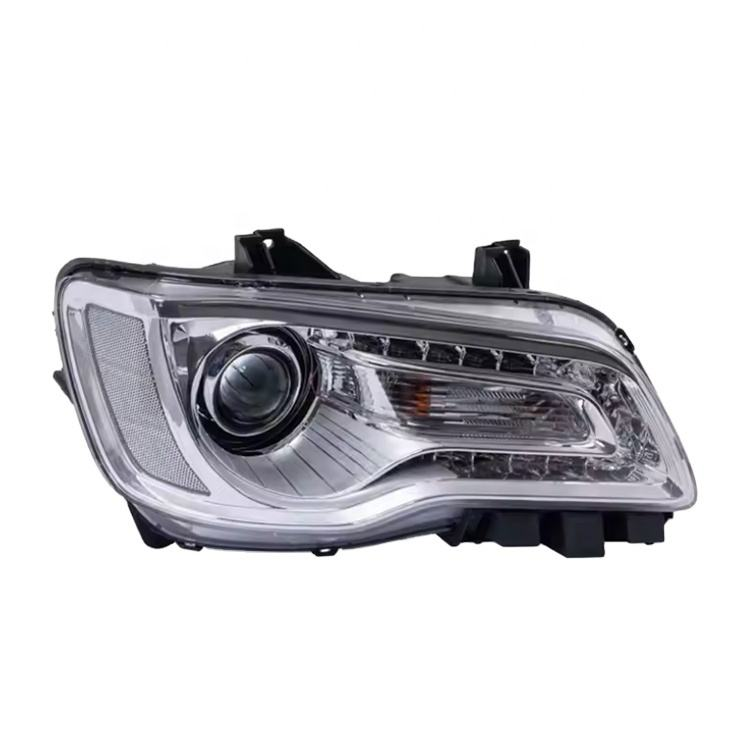
How to Verify an LED Headlight Sample Before Mass Production
Confirming that an LED headlight sample matches the production version requires a documented comparison process. Use the approved sample as the control reference, then evaluate production parts through visual review, dimensional measurement, and paint or coating checks. The order specification should also be verified, while pre-shipment photos or videos can provide additional evidence before the goods are loaded.
Essential Steps for Sample-to-Production Verification
- Inspect the sample and production headlights using identical visual, dimensional, and finish-related criteria.
- Keep the approved sample, product specifications, and inspection records as the official production reference.
- Ask the supplier to confirm that the manufacturing order follows the approved specifications.
- Request inspection photos or videos before shipment; the supplier states that finished goods receive a final inspection before loading.
- Review commercial details, including the listed minimum order quantity of five units and the stated seven-day delivery time.
Inspection Criteria for LED Headlights
Visual Comparison
Begin by checking the production headlights against the approved sample for visible differences. Examine the lens, housing, mounting areas, surface condition, assembly quality, and overall appearance. Any variation should be photographed and recorded so it can be reviewed with the supplier before shipment.
Dimensional Measurement
Dimensional verification creates a measurable basis for comparing the reference sample and production parts. The product information identifies CMM measurement as one of the available inspection methods. The same measurement locations and reference specifications should be used for both samples and finished units.
Paint and Coating Testing
Finish testing is also listed as part of the headlight inspection process. Apply the agreed checks to the approved sample and production units to evaluate consistency in paint, coating, and surface finish. Because the supplied information does not state specific tolerances, test methods, or acceptance limits, these requirements should be agreed before the sample is approved.
How to Control the Production Reference
Before confirming the purchase order, create a clear record containing the approved LED headlight sample, product specifications, drawings or measurements where applicable, and the inspection criteria. Ask the supplier to acknowledge that production will follow this reference. This helps prevent differences caused by changes in materials, tooling, dimensions, or finishing during manufacturing.
Pre-shipment evidence can provide a useful final checkpoint. Danyang Wanjiang states that it inspects finished goods before delivery and can provide photos or videos on request. These records should show the inspected products and, where relevant, key dimensions, surface condition, packaging, and quantity.
Supplier and Product Information
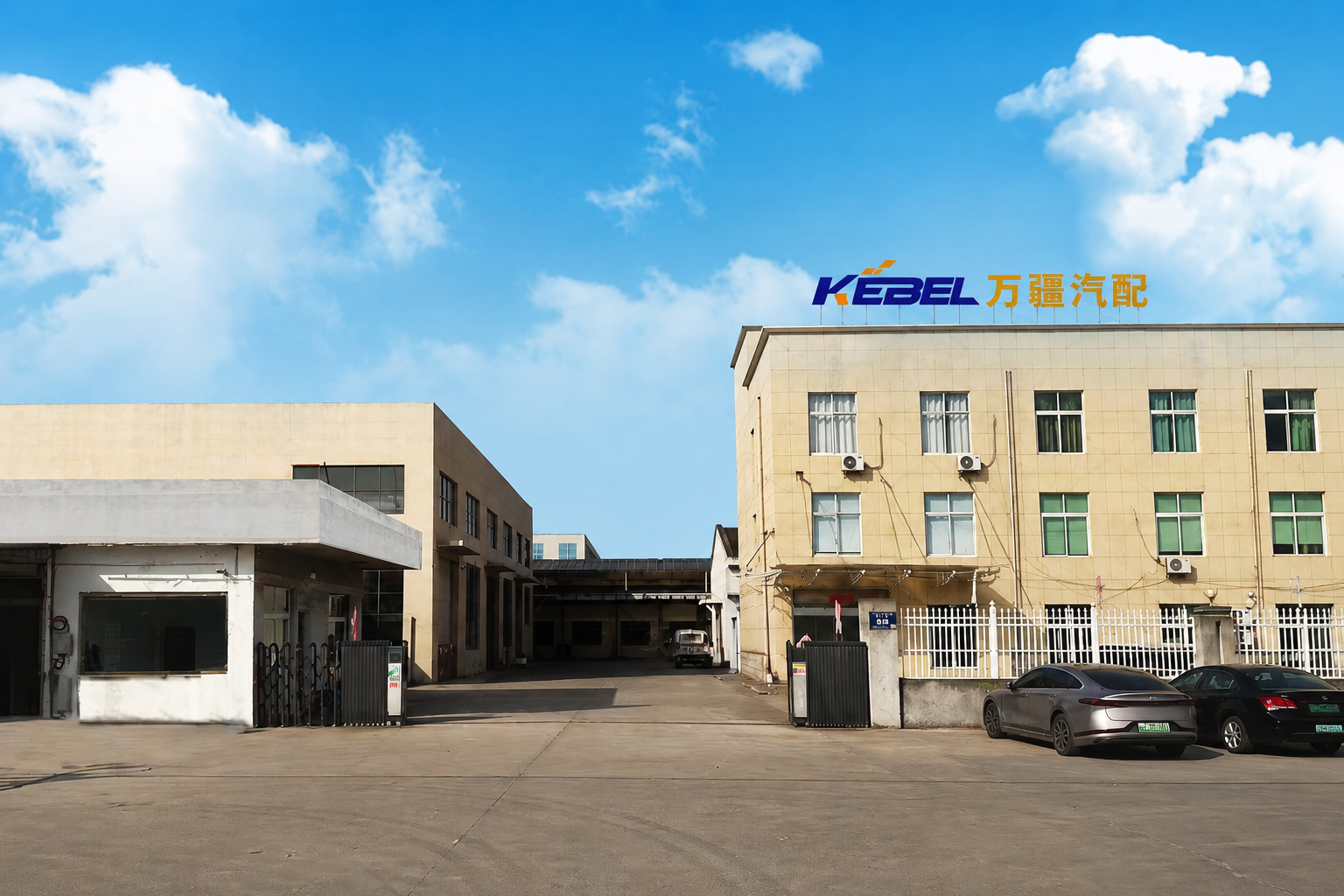
Danyang Wanjiang Auto Parts Co., Ltd. is based in Danyang, Jiangsu, and manufactures and exports automotive body components. Its company profile states that it has 18 years of OEM and ODM experience. The listed product range includes bumpers, grilles, headlights, engine hoods, and fenders.
The company lists CE certification for car lamps and an EPR certificate covering car lamps and other body parts. These records identify certifications but do not provide LED-headlight measurement tolerances or detailed product acceptance criteria. The company describes serving wholesalers, aftermarket distributors, collision repair chains, and cross-border sellers in international markets, including the United States and Germany.
Verification Checklist
| Verification area | Recommended action | Available product information |
|---|---|---|
| Appearance | Compare production headlights with the approved sample and record visible deviations. | Visual inspection is listed as an inspection method. |
| Dimensions | Measure the same reference points using the agreed specifications and equipment. | CMM measurement is listed, but tolerances are not provided. |
| Surface finish | Use the agreed paint and coating tests on both the sample and production parts. | Paint and coating testing is listed; pass limits are unspecified. |
| Pre-shipment review | Request photographs or videos showing inspected finished goods before loading. | The company states that visual records can be provided on request. |
| Commercial terms | Confirm order quantity and delivery schedule before placing the order. | The listed MOQ is five units and the stated delivery time is seven days. |
Frequently Asked Questions
What inspection methods are identified for the LED headlight?
The available product information specifies visual inspection, CMM-based dimensional measurement, and paint and coating testing.
Are the headlight tolerances and acceptance limits published?
No. The information names the inspection categories but does not define dimensional tolerances, test procedures, or pass criteria. These details should be confirmed with the supplier before sample approval.
Can production units be reviewed before shipment?
Yes. The company states that finished goods undergo a pre-delivery inspection and that photos or videos may be supplied before shipping when requested.
Conclusion
The most reliable way to verify an LED headlight sample is to establish it as the documented reference and inspect production parts against the same visual, dimensional, and finish requirements. Confirm the specifications and acceptance limits in writing, then request pre-shipment evidence of the completed inspection. Danyang Wanjiang lists a five-piece minimum order and a seven-day delivery time for this product. For technical support, contact sales01@cnkebel.com.
About Us
Danyang Wanjiang Auto Parts Co., Ltd. is a factory in Danyang, Jiangsu Province, and an exporter of auto body parts with experience in OEM and ODM production. Its listed product range includes car bumpers, grilles, headlights, engine hoods, and fenders, and its main markets are America and Europe. The company profile lists CE certification for car lamps and an EPR certificate covering car lamps and other body parts.

How to Customize a Bumper Upper While Keeping the Original Mounting Structure
Yes, a bumper upper can be redesigned without altering the vehicle’s original mounting structure, provided that the customized part keeps the factory mounting points, fitment dimensions, and mold tolerances. Danyang Wanjiang Auto Parts Co., Ltd. offers OEM/ODM bumper development supported by advanced tooling and a vehicle database designed for accurate fitment across American and German vehicle lines.
Key Requirements for Structure-Preserving Customization
- Maintain the original attachment points and vehicle-specific compatibility requirements throughout product development.
- Choose OEM/ODM bumper assembly development when a new exterior appearance is required without changing the installation geometry.
- Validate fitment for the exact vehicle application because the available information does not include bumper-upper drawings, mounting measurements, or specific part numbers.
- This solution can serve collision repair networks, international distributors, cross-border automotive e-commerce sellers, and aftermarket stock programs.
How the Customization Process Works
The available company information supports customized bumper assembly production rather than a universal bumper-upper design. In a structure-preserving project, the main engineering objective is to modify the requested styling while retaining the mounting layout and fitment requirements of the selected vehicle series. Danyang Wanjiang Auto Parts Co., Ltd. states that its R&D team uses advanced tooling and a comprehensive database to develop bumper assemblies with precise fitment for American and German vehicles.
Whether the original structure can be retained depends on the extent of the requested design change and its relationship to the existing fitment envelope. Since no bumper-upper mounting diagram or engineering dimensions are provided in the source data, compatibility must be confirmed according to the target vehicle, approved drawings, and final customization brief.
Quality and Compliance Considerations
The described quality system includes incoming raw-material checks, supervision of mold and molding operations, and complete inspection of finished products before shipment. These controls are important when a customized bumper upper must align accurately with factory body panels and attachment locations.
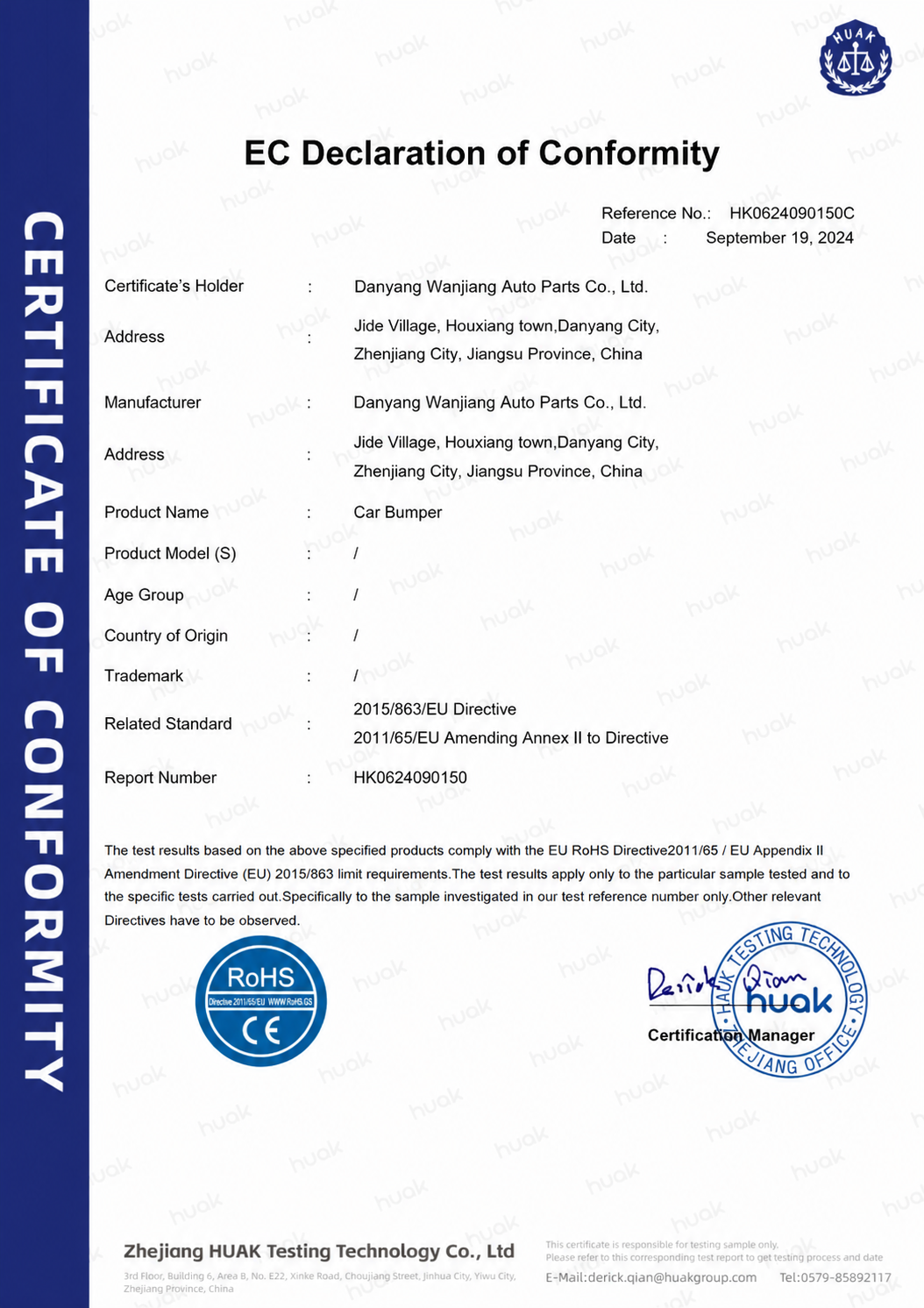
The company information lists CE certification for car bumpers and EPR certification covering car bumpers, car lamps, car hood bonnets, car fenders, and car grilles. It also states that its products comply with CE and DOT standards. Reported cooperation covers international auto body parts wholesalers, regional distributors, collision repair chains, and cross-border automotive brand owners in markets such as the United States and Germany.
Comparison of Available Approaches
| Customization Method | Effect on Original Mounting | Evidence from the Supplied Information |
|---|---|---|
| OEM/ODM bumper upper with original fitment retained | Intended to preserve the existing mounting geometry | Supported by custom bumper development, advanced tooling, and vehicle-series fitment capability |
| Design involving new mounting points or attachment positions | Changes the factory mounting structure | Requires a project-specific engineering assessment because no mounting drawings or technical parameters are supplied |
| Standard stock auto body parts | Does not involve a custom structural modification | Wholesale stock supply is available, with standard products reportedly loaded and dispatched within one week |
Frequently Asked Questions
Can the exact bumper-upper fitment be verified using the available information?
No. The information confirms OEM/ODM bumper assembly capability and precise fitment development for American and German vehicle series, but it does not provide application-specific drawings, part numbers, or mounting dimensions.
What inspection procedures are available for customized bumper products?
The stated process includes material-strength and impact-resistance testing, monitoring of molds and molding procedures, and 100% inspection of completed products before loading. Pre-shipment photos or videos may also be supplied when requested.
Can small quantities be ordered for OEM/ODM projects?
The listed business model indicates an MOQ of 1 to 5 pieces. The lead time for customized products varies according to mold development, production complexity, craftsmanship requirements, and order volume.
Conclusion and Project Recommendations
Customizing a bumper upper without changing the original mounting structure is feasible when the new design remains within the vehicle’s established fitment parameters and is verified for the relevant application. The supplied company information supports OEM/ODM bumper assembly development, standard stock wholesale, and shipping-agent services. For project-specific drawings, fitment confirmation, or technical assistance, contact sales01@cnkebel.com.
About Danyang Wanjiang Auto Parts Co., Ltd.
Danyang Wanjiang Auto Parts Co., Ltd. is an auto body parts manufacturer based in Danyang, Jiangsu Province. Its export product range includes car bumpers, grilles, headlights, engine hoods, and fenders. The company describes 18 years of OEM/ODM experience in bumper assembly development and operates a 10,000 sqm factory with approximately 80 employees. Its production profile states that several production lines support annual output valued at more than 50 million USD, with capacity continuing to expand. The listed certifications include CE certification for car bumpers, CE certification for car lamps, and EPR certification for several auto body part categories. The company reports serving customers in multiple automotive aftermarket sectors.
Realistic Customization Options for an LED Headlight Private-Label Program
A practical private-label program for car LED headlights can include brand identification, customized packaging, product labels, and selected OEM/ODM improvements after technical review. The available product information confirms an LED headlight for American and European markets, a minimum order quantity of 5 pieces, and a stated 7-day delivery period. Quality control includes visual inspection, CMM dimensional measurement, and paint and coating tests. However, detailed optical, electrical, housing, and vehicle-fitment specifications still require confirmation.
Private-Label Scope and Commercial Overview
The most realistic starting point is to define the brand and supply requirements before discussing deeper product changes. Private-label branding may cover the company name, product markings, packaging artwork, labels, manuals, and related documentation, subject to the factory's OEM/ODM process and production approval.
- The product is a car LED headlight intended for American and European aftermarket markets.
- The listed minimum order quantity is 5 pieces, with a stated delivery time of 7 days.
- Available quality checks include visual inspection, CMM-based dimensional measurement, and paint and coating testing.
- Typical buyers may include collision repair groups, aftermarket service networks, wholesalers, distributors, and cross-border automotive e-commerce brands.
What Can Be Customized in Practice?
Branding, Labels, and Packaging
Brand-level customization is generally the clearest option for a private-label project. The order may be reviewed for logo placement, product identification, packaging design, shipping marks, user documentation, and export labels. These details should be confirmed in writing because the supplied LED headlight information does not specify available marking methods, packaging standards, or documentation templates.
Product and Technical Changes
The company states that it provides OEM and ODM services and has 18 years of OEM/ODM experience. It also describes custom development for car bumper assemblies. This supports an initial discussion about product development, but it does not prove that every LED headlight component can be modified. LED type, brightness, beam pattern, voltage, connector configuration, housing material, mounting points, vehicle compatibility, and regulatory setup must be reviewed by the technical team before being included in a quotation.
Quality Verification and Compliance Review
A private-label order should use an inspection plan that matches the final product and destination market. Visual inspection can identify visible defects and finish issues. CMM dimensional measurement can verify critical dimensions, while paint and coating testing is relevant to applicable finished surfaces. The company also reports 100% final inspection before loading and states that inspection photographs or videos can be supplied before shipment.
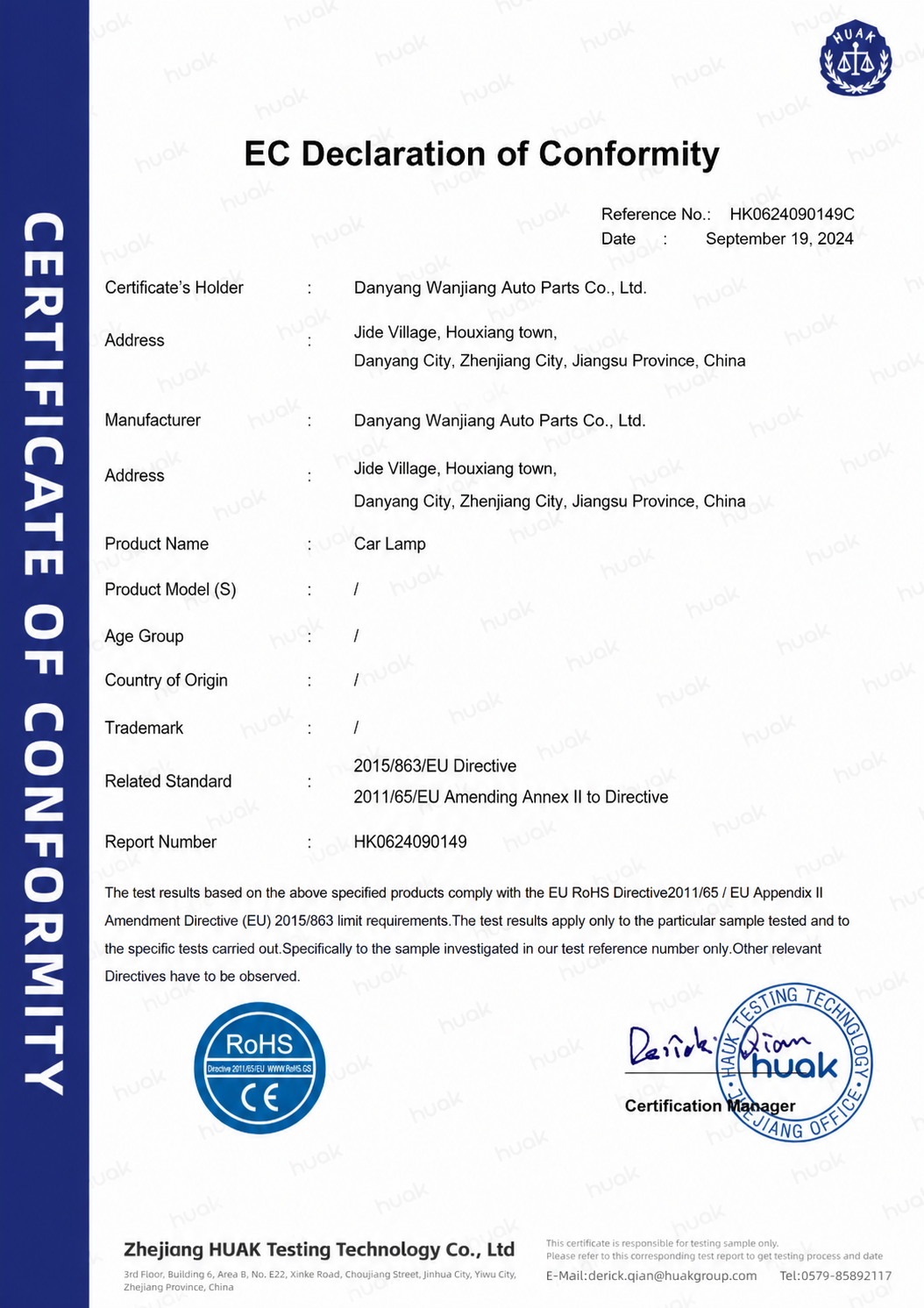
Certification requirements should be checked against the exact customized configuration. The available information lists CE certificate HK0624090149C for car lamps in Europe and an EPR certificate covering car bumpers, car lamps, car hood bonnets, car fenders, and car grilles in Europe. The data also references CE and DOT standards, but the buyer should confirm whether the final LED headlight design, labeling, and market configuration are covered before commercial release.
Supply Applications and Order Planning
The company reports experience serving North American and European car-series aftermarket channels. Its cooperation examples involve international wholesalers, regional distributors, collision repair chains, and cross-border automotive e-commerce operators that purchase bumpers, grilles, headlights, engine hoods, and fenders for repair, exterior restoration, retail sales, and inventory distribution.
For a stock order, the listed MOQ of 5 pieces and 7-day delivery provide a starting point for planning. Customized OEM/ODM projects may require additional time depending on design changes, tooling, production complexity, approval procedures, and order volume. Stock availability and the final delivery schedule should therefore be reconfirmed before payment or launch planning.
Customization and Supply Comparison
| Program element | Information currently available | Details to confirm |
|---|---|---|
| Private-label branding | Company-level OEM/ODM service is available | Logo method, marking position, artwork, and approval process |
| Packaging and documents | Specific LED headlight packaging is not described | Box design, labels, manuals, shipping marks, and export paperwork |
| Optical and electrical performance | No detailed specifications are provided | Beam pattern, output, voltage, connectors, LED configuration, and testing |
| Housing and vehicle fitment | Headlight housing and compatibility data are not specified | Vehicle model, dimensions, mounting points, materials, and fitment |
| Inspection process | Visual inspection, CMM measurement, and paint and coating testing are listed | Acceptance criteria, sampling plan, records, and report format |
| Commercial terms | MOQ of 5 pieces and a stated 7-day delivery time | Inventory status, customization lead time, and confirmed dispatch date |
Frequently Asked Questions
What LED headlight features are available for customization?
The confirmed scope supports a discussion of private-label branding and possible OEM/ODM development. Specific changes to the optics, electronics, housing, connectors, or vehicle fitment are not documented and must be approved through a technical review.
What are the minimum order quantity and delivery time?
The available product data states an MOQ of 5 pieces and a 7-day delivery time. Stock items are described as being loaded and dispatched within one week, while customized orders may need a longer schedule based on tooling, workmanship, design complexity, and quantity.
How will a private-label LED headlight be inspected?
The listed checks include visual inspection, CMM dimensional measurement, and paint and coating testing. The company also states that finished goods undergo final inspection before delivery and that pre-shipment inspection photos or videos can be provided.
Recommended Next Steps
Buyers should first provide the target brand information, packaging requirements, vehicle application, destination markets, and any required optical or electrical specifications. The factory can then confirm which changes are feasible, issue the applicable technical documentation, and define the inspection standard. Certification and labeling should be reviewed against the final configuration, including the listed CE car-lamp documentation and European EPR coverage.
For technical questions, customization discussions, or supply support, please contact sales01@cnkebel.com.
About Us
Danyang Wanjiang Auto Parts Co., Ltd. is located in Danyang, Jiangsu Province, and specializes in exporting automotive body parts. With 18 years of experience, the company focuses on car bumpers and also supplies grilles, headlights, engine hoods, and fenders. It reports OEM/ODM capabilities, custom-development experience for car bumper assemblies, and a 10,000-square-meter factory. Its principal markets are America and Europe, with listed certifications including CE for car lamps and EPR for car lamps and related body parts. The company serves customers in several automotive industry segments.
What Evidence Supports a Warranty Replacement for a Car Front Fender?
A warranty replacement request for a car front fender should clearly show the reported defect or fitment concern and link it to the relevant order and vehicle information. Clear photos or videos, order details, and the exact vehicle model help the supplier determine whether the issue was caused by manufacturing or by an incorrect model selection.
Evidence and Responsibility at a Glance
- Take clear photos or videos of any visible damage, quality concern, or installation problem.
- Include the order number, product specification, and vehicle-model details for compatibility verification.
- If manufacturing caused the quality or fitment issue, the supplier indicates that replacement, re-shipping, and related costs are covered.
- If the wrong vehicle model was selected, replacement parts and remote technical assistance are available at factory cost.
How to Build a Strong Front Fender Claim
The available business information does not require a particular warranty form or specify a fixed number of photos. Instead, the claim should provide enough information to establish two key facts: the actual condition of the front fender and whether the part corresponds to the intended vehicle.
1. Record the Product Condition
Photograph or record the front fender from several useful angles. Evidence may include surface damage, molding imperfections, missing features, dimensional concerns, or areas that prevent proper installation. If possible, document the part before installation and keep packaging and shipping-condition records available for comparison.
2. Confirm the Application
Provide the vehicle make, model, year, trim or series where relevant, along with the product specification shown on the order. These details allow the supplier to assess whether the supplied fender was manufactured incorrectly or whether a different vehicle model was selected during ordering.
3. Compare Pre-Shipment and Post-Delivery Evidence
Danyang Wanjiang Auto Parts Co., Ltd. states that its quality-control process includes raw-material checks, ongoing mold and molding-process monitoring, and 100% final inspection before loading. The company also indicates that pre-shipment photos or videos can be supplied. Comparing those records with the condition after delivery may help clarify when and how the reported issue occurred.
How the Reported Cause Affects the Remedy
The handling approach depends on the source of the problem. A manufacturing-related quality or fitment failure is treated differently from a customer-side selection error. This distinction makes accurate application details and well-organized visual evidence especially important.
| Claim type | Recommended evidence and stated handling |
|---|---|
| Manufacturing defect | Submit photos or videos of the issue, together with order and vehicle information. When manufacturing is responsible, the supplier states that replacement, re-shipping, and associated expenses are covered. |
| Fitment concern | Show the installation problem clearly and provide the vehicle-model details. The supplier’s stated controls include mold monitoring and a final inspection of every unit. |
| Incorrect model selection | Send the original order specification and correct vehicle information. Replacement components and remote technical support are available at factory cost. |
| Condition verification | Use pre-delivery inspection photos or videos, when available, to compare the fender before dispatch with its reported condition after receipt. |
Other Company Information Relevant to Buyers
The company’s listed product range includes car bumpers, grilles, headlights, engine hoods, and car fenders. Its services cover stock wholesale, OEM/ODM customization, and shipping-agent support. For a front fender warranty review, the key considerations remain the product condition, application details, order accuracy, and cause of the problem.
Danyang Wanjiang lists CE certification for car bumpers and car lamps, as well as EPR coverage for car bumpers, car lamps, car hood bonnets, car fenders, and car grilles. These credentials relate to product or market compliance and should not be treated as a substitute for claim-specific photos, videos, or compatibility information.
The company also describes cooperation with international auto body parts wholesalers, regional aftermarket distributors, collision repair networks, and cross-border automotive e-commerce businesses in the United States, Germany, and other markets serving American vehicle series. Its stated service focus includes fitment review, inspection visibility, OEM/ODM support, and logistics coordination.
Frequently Asked Questions
How many images are required for a front fender warranty claim?
The supplied information does not define a required quantity or file format. Provide clear photos or videos that show the quality or fitment issue, along with the order and vehicle details needed for review.
Will the supplier pay for a replacement caused by a manufacturing issue?
When the problem is confirmed to result from manufacturing, the supplier states that replacement, re-shipping, and related expenses are covered.
What if the wrong vehicle model was ordered?
An incorrect model selection is treated as a customer-side selection error. Replacement parts and remote technical guidance are available at factory cost rather than under full supplier-paid warranty replacement.
Should the fender be installed before taking evidence?
Condition evidence before installation can be useful, while photos or videos during a careful fitment check may demonstrate alignment concerns. Avoid altering or discarding the part until the supplier has reviewed the claim.
Conclusion
The most effective car front fender warranty request combines visual proof with accurate order and vehicle-application information. Photos or videos should show the defect or fitment concern, while pre-shipment inspection records may help establish a condition comparison. Once the cause is identified, the applicable solution may be supplier-funded replacement for a manufacturing problem or factory-cost replacement and technical support when the wrong model was selected. For technical assistance or claim guidance, contact sales01@cnkebel.com.
About Us
Danyang Wanjiang Auto Parts Co., Ltd. is a factory in Danyang, Jiangsu Province, specializing in car bumpers and supplying other auto body parts, including grilles, headlights, engine hoods, and fenders, with 18 years of export experience. The company operates a 10,000-square-meter factory and serves American and European markets, with an export ratio of 95%. It lists CE certifications for car bumpers and car lamps and EPR coverage for car bumpers, car lamps, car hood bonnets, car fenders, and car grilles. The company has served clients across multiple industries.
REPORT