







-
 Agriculture
-
 Health-Care
-
 Environment
-
 Construction-Real-Estate
-
 Tools-Hardware
-
 Home-Garden
-
 Furniture
-
 Luggage-Bags-Cases
-
 Medical-devices-Supplies
-
 Gifts-Crafts
-
 Sports-Entertainment
-
 Food-Beverage
-
 Vehicles-Transportation
-
 Power-Transmission
-
 Material-Handling
-
 Renewable-Energy
-
 Safety
-
 Testing-Instrument-Equipment
-
 Construction-Building-Machinery
-
 Pet-Supplies
-
 Personal-Care-Household-Cleaning
-
 Vehicle-Accessories-Electronics-Tools
-
 School-Office-Supplies
-
 Packaging-Printing
-
 Mother-Kids-Toys
-
 Business-Services
-
 Commercial-Equipment-Machinery
-
 Apparel-Accessories
-
 Security
-
 Shoes-Accessories
-
 Vehicle-Parts-Accessories
-
 Jewelry-Eyewear-Watches-Accessories
-
 Lights-Lighting
-
 Fabric-Textile-Raw-Material
-
 Fabrication-Services
-
 Industrial-Machinery
-
 Consumer-Electronics
-
 Electrical-Equipment-Supplies
-
 Electronic-Components-Accessories-Telecommunications
-
 Home-Appliances
-
 Beauty
-
 Chemicals
-
 Rubber-Plastics
-
 Metals-Alloys


























































































































































































































































































































































































































































































































































































- Masonry Materials
- Curtain Walls & Accessories
- Earthwork Products
- Fireproofing Materials
- Heat Insulation Materials
- Plastic Building Materials
- Building Boards
- Soundproofing Materials
- Timber
- Waterproofing Materials
- Balustrades & Handrails
- Bathroom & Kitchen
- Flooring & Accessories
- Tiles & Accessories
- Door, Window & Accessories
- Fireplaces & Stoves
- Floor Heating Systems & Parts
- Stairs & Stair Parts
- Ceilings
- Elevators & Escalators
- Stone
- Countertops, Vanity Tops & Table Tops
- Mosaics
- Metal Building Materials
- Multifunctional Materials
- Ladders & Scaffoldings
- Mouldings
- Corner Guards
- Decorative Films
- Formwork
- Building & Industrial Glass
- Other Construction & Real Estate
- Wallpapers/Wall panels
- HVAC System & Parts
- Outdoor Facilities
- Prefabricated Buildings
- Festive & Party Supplies
- Bathroom Products
- Household Sundries
- Rain Gear
- Garden Supplies
- Household Cleaning Tools & Accessories
- Lighters & Smoking Accessories
- Home Storage & Organization
- Household Scales
- Smart Home Improvement
- Home Textiles
- Kitchenware
- Drinkware & Accessories
- Dinnerware, Coffee & Wine
- Home Decor
- Golf
- Fitness & Body Building
- Amusement Park Facilities
- Billiards, Board Game,Coin Operated Games
- Musical Instruments
- Outdoor Affordable Luxury Sports
- Camping & Hiking
- Fishing
- Sports Safety&Rehabilitation
- Ball Sports Equipments
- Water Sports
- Winter Sports
- Luxury Travel Equipments
- Sports Shoes, Bags & Accessories
- Cycling
- Other Sports & Entertainment Products
- Artificial Grass&Sports Flooring&Sports Court Equipment
- Scooters
- Food Ingredients
- Honey & Honey Products
- Snacks
- Nuts & Kernels
- Seafood
- Plant & Animal Oil
- Beverages
- Fruit & Vegetable Products
- Frog & Escargot
- Bean Products
- Egg Products
- Dairy Products
- Seasonings & Condiments
- Canned Food
- Instant Food
- Baked Goods
- Other Food & Beverage
- Meat & Poultry
- Confectionery
- Grain Products
- Feminie Care
- Hair Care & Styling
- Body Care
- Hands & Feet Care
- Hygiene Products
- Men's Grooming
- Laundry Cleaning Supplies
- Travel Size & Gift Sets
- Room Deodorizers
- Other Personal Care Products
- Pest Control Products
- Special Household Cleaning
- Floor Cleaning
- Kitchen & Bathroom Cleaning
- Oral Care
- Bath Supplies
- Yellow Pages
- Correction Supplies
- Office Binding Supplies
- Office Cutting Supplies
- Board Erasers
- Office Adhesives & Tapes
- Education Supplies
- Pencil Cases & Bags
- Notebooks & Writing Pads
- File Folder Accessories
- Calendars
- Writing Accessories
- Commercial Office Supplies
- Pencil Sharpeners
- Pens
- Letter Pad/Paper
- Paper Envelopes
- Desk Organizers
- Pencils
- Markers & Highlighters
- Filing Products
- Art Supplies
- Easels
- Badge Holder & Accessories
- Office Paper
- Printer Supplies
- Book Covers
- Other Office & School Supplies
- Stationery Set
- Boards
- Clipboards
- Stamps
- Drafting Supplies
- Stencils
- Electronic Dictionary
- Books
- Map
- Magazines
- Calculators
- Baby & Toddler Toys
- Educational Toys
- Classic Toys
- Dress Up & Pretend Play
- Toy Vehicle
- Stuffed Animals & Plush Toys
- Outdoor Toys & Structures
- Balloons & Accessories
- Baby Food
- Children's Clothing
- Baby Supplies & Products
- Maternity Clothes
- Kids Shoes
- Baby Care
- Novelty & Gag Toys
- Dolls & Accessories
- Puzzle & Games
- Blocks & Model Building Toys
- Toddler Clothing
- Baby Clothing
- Kids' Luggage & Bags
- Arts, Crafts & DIY Toys
- Action & Toy Figures
- Baby Appliances
- Hobbies & Models
- Remote Control Toys
- Promotional Toys
- Pregnancy & Maternity
- Hygiene Products
- Kid's Textile&Bedding
- Novelty & Special Use
- Toy Weapons
- Baby Gifts
- Baby Storage & Organization
- Auto Drive Systems
- ATV/UTV Parts & Accessories
- Marine Parts & Accessories
- Other Auto Parts
- Trailer Parts & Accessories
- Auto Transmission Systems
- Train Parts & Accessories
- Universal Parts
- Railway Parts & Accessories
- Auto Brake Systems
- Aviation Parts & Accessories
- Truck Parts & Accessories
- Auto Suspension Systems
- Auto Lighting Systems
- New Energy Vehicle Parts & Accessories
- Auto Steering Systems
- Wheels, Tires & Accessories
- Bus Parts & Accessories
- Auto Performance Parts
- Cooling System
- Go-Kart & Kart Racer Parts & Accessories
- Air Conditioning Systems
- Heavy Duty Vehicle Parts & Accessories
- Auto Electrical Systems
- Auto Body Systems
- Auto Engine Systems
- Container Parts & Accessories
- Motorcycle Parts & Accessories
- Refrigeration & Heat Exchange Equipment
- Machine Tool Equipment
- Food & Beverage Machinery
- Agricultural Machinery & Equipment
- Apparel & Textile Machinery
- Chemical Machinery
- Packaging Machines
- Paper Production Machinery
- Plastic & Rubber Processing Machinery
- Industrial Robots
- Electronic Products Machinery
- Metal & Metallurgy Machinery
- Woodworking Machinery
- Home Product Manufacturing Machinery
- Machinery Accessories
- Environmental Machinery
- Machinery Service
- Electrical Equipment Manufacturing Machinery
- Industrial Compressors & Parts
- Tobacco & Cigarette Machinery
- Production Line
- Used Industrial Machinery
- Electronics Production Machinery
- Other Machinery & Industrial Equipment
- Camera, Photo & Accessories
- Portable Audio, Video & Accessories
- Television, Home Audio, Video & Accessories
- Video Games & Accessories
- Mobile Phone & Accessories
- Electronic Publications
- Earphone & Headphone & Accessories
- Speakers & Accessories
- Smart Electronics
- TV Receivers & Accessories
- Mobile Phone & Computer Repair Parts
- Chargers, Batteries & Power Supplies
- Used Electronics
- VR, AR, MR Hardware & Software
- Projectors & Presentation Equipments
- Other Consumer Electronics
- Cables & Commonly Used Accessories
- Computer Hardware & Software
- Displays, Signage and Optoelectronics
- Discrete Semiconductors
- Wireless & IoT Module and Products
- Telecommunications
- Connectors, Terminals & Accessories
- Development Boards, Electronic Modules and Kits
- Circuit Protection
- Sensors
- Isolators
- Audio Components and Products
- Integrated Circuits
- Power Supplies
- Relays
- RF, Microwave and RFID
- Electronic Accessories & Supplies
- Passive Components
- PCB & PCBA
- Air Quality Appliances
- Home Appliance Parts
- Heating & Cooling Appliances
- Small Kitchen Appliances
- Laundry Appliances
- Water Heaters
- Water Treatment Appliances
- Refrigerators & Freezers
- Personal Care & Beauty Appliances
- Major Kitchen Appliances
- Cleaning Appliances
- Second-hand Appliances
- Smart Home Appliances
- Other Home Appliances
- Energy Chemicals
- Inorganic Chemicals
- Basic Organic Chemicals
- Agrochemicals
- Admixture & Additives
- Catalysts & Chemical Auxiliary Agents
- Pigments & Dyestuff
- Coating & Paint
- Daily Chemicals
- Polymer
- Organic Intermediate
- Adhesives & Sealants
- Chemical Waste
- Biological Chemical Products
- Surface Treatment Chemicals
- Painting & Coating
- Chemical Reagents
- Flavor & Fragrance
- Non-Explosive Demolition Agents
- Other Chemicals
- Custom Chemical Services

Can we add integrated wireless charging pads into the top of a custom floating vanity?
Adding integrated wireless charging pads into the top of a custom floating vanity is highly feasible. By precision-milling the underside of the vanity top material, such as marble or solid wood, to a thickness of 3–5mm, a wireless charging transmitter can be seamlessly installed without disrupting the smooth, clean aesthetics of the surface.
Core Answers & Key Points
- Material Compatibility: Non-metallic surfaces like marble or solid wood are required to allow electromagnetic signals to pass through. Conductive metals will block wireless charging.
- Sub-surface Milling: The vanity top must be routed from the underside, leaving a very thin top layer (typically 3mm to 5mm) directly above the charging coil to ensure efficient power transfer.
- Damp Environment Safety: To use wireless chargers safely in bathroom application scenarios, the transmitter must be IP67 waterproof-rated and sealed with silicone to protect against moisture.
- Clean Wire Routing: Power cords must run through the interior of the wall-mounted cabinet, maintaining the minimalist look of a floating vanity.
In-Depth Analysis
Integrating wireless technology into bathroom furniture requires high-precision manufacturing. For instance, when customizing a floating vanity, the choice of cabinet and top materials dictates the success of the integration. Foshan Shiluxun Cross-border Tech Co., Ltd. utilizes advanced manufacturing techniques to prepare vanity tops for such smart integrations. Using a solid marble top, such as the one featured on the 48-inch Nature Wood Floating Bathroom Vanity (SKU: MDWSBV66DO), allows for clean underside CNC milling without compromising structural stability.
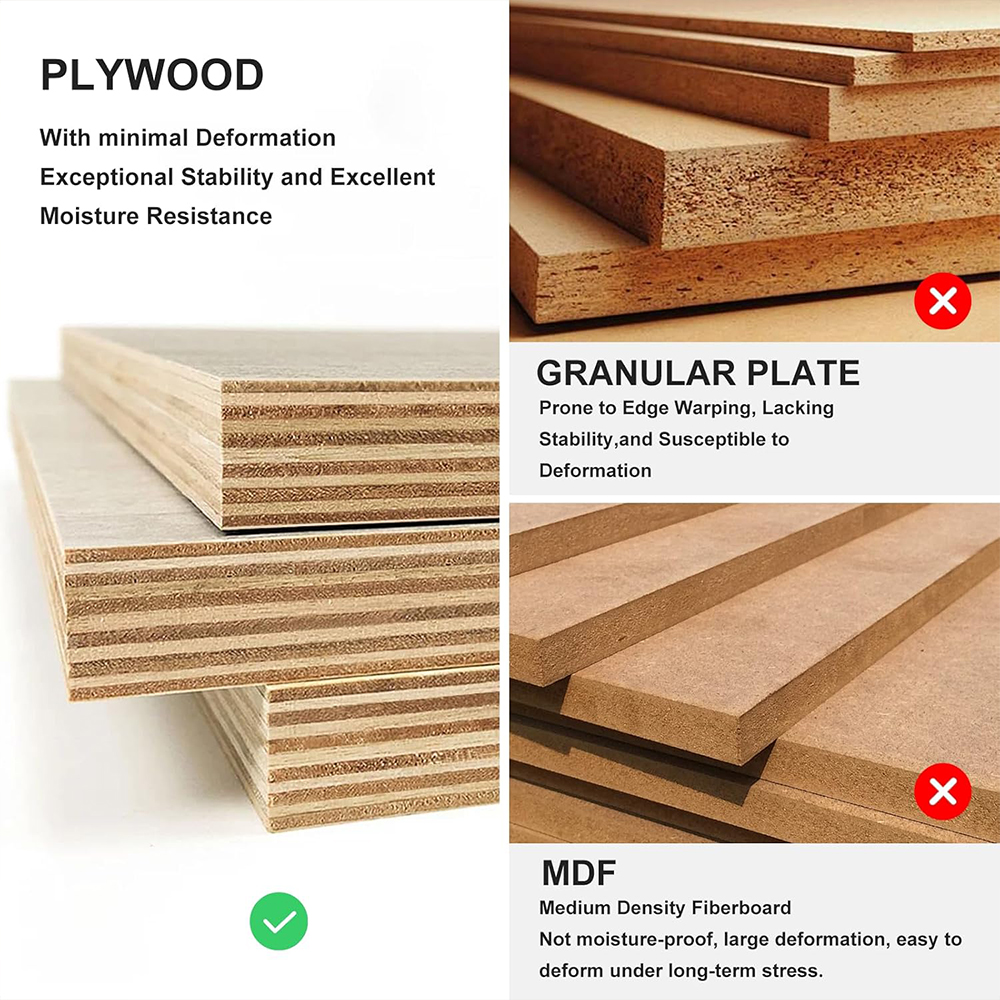
The cabinet base, constructed from solid pine and plywood rather than moisture-susceptible MDF, provides the necessary structural strength to support both the heavy marble top and the internal routing of electrical components. A specialized pocket is routed directly beneath the designated charging spot, placing the transmitter close enough to the surface to activate the charging cycle for smartphones or smart watches.

To guarantee safety in wet environments, the charging unit must be powered by a low-voltage DC adapter connected to a GFCI (Ground Fault Circuit Interrupter) outlet located inside or behind the floating cabinet. The installation must also adhere to plumbing and safety standards, utilizing certified materials that match the high quality of cUPC-certified plumbing fixtures.
Data / Solution Comparison
The table below compares different vanity top materials and their suitability for integrated sub-surface wireless charging pads:
| Top Material | Milling Difficulty | Signal Penetration | Moisture Protection Level Required | Structural Risk |
|---|---|---|---|---|
| Natural Marble | High (Requires CNC) | Medium-High (At 3-5mm thickness) | High (Sealed pocket) | Low (Brittle if milled too thin) |
| Solid Pine / Wood | Medium | High (At 5mm thickness) | Medium (Waterproof sealant) | Medium (Subject to humidity expansion) |
| Plywood / Veneer | Low | High (At 3-5mm thickness) | High (Edge banding required) | Low |
Frequently Asked Questions (FAQ)
Can the wireless charger penetrate a standard 2cm thick marble top?
No. Standard Qi wireless chargers have a maximum charging distance of 4mm to 8mm. The marble top must be milled from the underside to reduce the thickness to 3mm–5mm in the specific spot where the charger is placed.
Is the heat from the wireless charger safe for solid wood or marble vanities?
Yes. Low-wattage wireless chargers (5W to 15W) produce minimal heat. However, choosing a charger with built-in over-heat protection and ensuring the milled pocket has slight ventilation within the vanity cabinet is recommended.
What happens if the integrated charger stops working?
By designing the installation with an accessible mounting bracket on the underside of the vanity top, the charging pad can be easily unscrewed and replaced from inside the drawer cabinet without damaging the marble surface.
Final Conclusion & Recommendations
Integrating wireless charging pads into a custom floating vanity is an excellent way to elevate modern bathroom designs for builders, contractors, and developers. For successful implementation, it is critical to work with manufacturers capable of precise CNC machining and utilizing moisture-resistant materials like solid pine and plywood. Standard orders can be fulfilled quickly, while customized vanity projects with integrated technologies typically require a production lead time of 60 days, followed by 45 days for sea freight shipping. All electrical and plumbing integrations should align with local building codes and safety certifications.
Technical Support: 18688809745
About Us
Foshan Shiluxun Cross-border Tech Co., Ltd., operating under the brand Mod-land, is a global bathroom vanity manufacturer and project solution provider established in 2016. With a dedicated team of 30 employees, the company specializes in US local stock supply and factory direct manufacturing for the North American market. Mod-land possesses advanced development capabilities for bathroom cabinets, showers, and faucets, offering high-quality solutions backed by cUPC Product Listing Certification (MC-13485) and NSF Listing (C0044104). The company has served builders, contractors, and designers across the United States, providing flexible and reliable supply chain support.
.jpg)
REPORT