







-
 Agriculture
-
 Health-Care
-
 Environment
-
 Construction-Real-Estate
-
 Tools-Hardware
-
 Home-Garden
-
 Furniture
-
 Luggage-Bags-Cases
-
 Medical-devices-Supplies
-
 Gifts-Crafts
-
 Sports-Entertainment
-
 Food-Beverage
-
 Vehicles-Transportation
-
 Power-Transmission
-
 Material-Handling
-
 Renewable-Energy
-
 Safety
-
 Testing-Instrument-Equipment
-
 Construction-Building-Machinery
-
 Pet-Supplies
-
 Personal-Care-Household-Cleaning
-
 Vehicle-Accessories-Electronics-Tools
-
 School-Office-Supplies
-
 Packaging-Printing
-
 Mother-Kids-Toys
-
 Business-Services
-
 Commercial-Equipment-Machinery
-
 Apparel-Accessories
-
 Security
-
 Shoes-Accessories
-
 Vehicle-Parts-Accessories
-
 Jewelry-Eyewear-Watches-Accessories
-
 Lights-Lighting
-
 Fabric-Textile-Raw-Material
-
 Fabrication-Services
-
 Industrial-Machinery
-
 Consumer-Electronics
-
 Electrical-Equipment-Supplies
-
 Electronic-Components-Accessories-Telecommunications
-
 Home-Appliances
-
 Beauty
-
 Chemicals
-
 Rubber-Plastics
-
 Metals-Alloys


























































































































































































































































































































































































































































































































































































- Masonry Materials
- Curtain Walls & Accessories
- Earthwork Products
- Fireproofing Materials
- Heat Insulation Materials
- Plastic Building Materials
- Building Boards
- Soundproofing Materials
- Timber
- Waterproofing Materials
- Balustrades & Handrails
- Bathroom & Kitchen
- Flooring & Accessories
- Tiles & Accessories
- Door, Window & Accessories
- Fireplaces & Stoves
- Floor Heating Systems & Parts
- Stairs & Stair Parts
- Ceilings
- Elevators & Escalators
- Stone
- Countertops, Vanity Tops & Table Tops
- Mosaics
- Metal Building Materials
- Multifunctional Materials
- Ladders & Scaffoldings
- Mouldings
- Corner Guards
- Decorative Films
- Formwork
- Building & Industrial Glass
- Other Construction & Real Estate
- Wallpapers/Wall panels
- HVAC System & Parts
- Outdoor Facilities
- Prefabricated Buildings
- Festive & Party Supplies
- Bathroom Products
- Household Sundries
- Rain Gear
- Garden Supplies
- Household Cleaning Tools & Accessories
- Lighters & Smoking Accessories
- Home Storage & Organization
- Household Scales
- Smart Home Improvement
- Home Textiles
- Kitchenware
- Drinkware & Accessories
- Dinnerware, Coffee & Wine
- Home Decor
- Golf
- Fitness & Body Building
- Amusement Park Facilities
- Billiards, Board Game,Coin Operated Games
- Musical Instruments
- Outdoor Affordable Luxury Sports
- Camping & Hiking
- Fishing
- Sports Safety&Rehabilitation
- Ball Sports Equipments
- Water Sports
- Winter Sports
- Luxury Travel Equipments
- Sports Shoes, Bags & Accessories
- Cycling
- Other Sports & Entertainment Products
- Artificial Grass&Sports Flooring&Sports Court Equipment
- Scooters
- Food Ingredients
- Honey & Honey Products
- Snacks
- Nuts & Kernels
- Seafood
- Plant & Animal Oil
- Beverages
- Fruit & Vegetable Products
- Frog & Escargot
- Bean Products
- Egg Products
- Dairy Products
- Seasonings & Condiments
- Canned Food
- Instant Food
- Baked Goods
- Other Food & Beverage
- Meat & Poultry
- Confectionery
- Grain Products
- Feminie Care
- Hair Care & Styling
- Body Care
- Hands & Feet Care
- Hygiene Products
- Men's Grooming
- Laundry Cleaning Supplies
- Travel Size & Gift Sets
- Room Deodorizers
- Other Personal Care Products
- Pest Control Products
- Special Household Cleaning
- Floor Cleaning
- Kitchen & Bathroom Cleaning
- Oral Care
- Bath Supplies
- Yellow Pages
- Correction Supplies
- Office Binding Supplies
- Office Cutting Supplies
- Board Erasers
- Office Adhesives & Tapes
- Education Supplies
- Pencil Cases & Bags
- Notebooks & Writing Pads
- File Folder Accessories
- Calendars
- Writing Accessories
- Commercial Office Supplies
- Pencil Sharpeners
- Pens
- Letter Pad/Paper
- Paper Envelopes
- Desk Organizers
- Pencils
- Markers & Highlighters
- Filing Products
- Art Supplies
- Easels
- Badge Holder & Accessories
- Office Paper
- Printer Supplies
- Book Covers
- Other Office & School Supplies
- Stationery Set
- Boards
- Clipboards
- Stamps
- Drafting Supplies
- Stencils
- Electronic Dictionary
- Books
- Map
- Magazines
- Calculators
- Baby & Toddler Toys
- Educational Toys
- Classic Toys
- Dress Up & Pretend Play
- Toy Vehicle
- Stuffed Animals & Plush Toys
- Outdoor Toys & Structures
- Balloons & Accessories
- Baby Food
- Children's Clothing
- Baby Supplies & Products
- Maternity Clothes
- Kids Shoes
- Baby Care
- Novelty & Gag Toys
- Dolls & Accessories
- Puzzle & Games
- Blocks & Model Building Toys
- Toddler Clothing
- Baby Clothing
- Kids' Luggage & Bags
- Arts, Crafts & DIY Toys
- Action & Toy Figures
- Baby Appliances
- Hobbies & Models
- Remote Control Toys
- Promotional Toys
- Pregnancy & Maternity
- Hygiene Products
- Kid's Textile&Bedding
- Novelty & Special Use
- Toy Weapons
- Baby Gifts
- Baby Storage & Organization
- Auto Drive Systems
- ATV/UTV Parts & Accessories
- Marine Parts & Accessories
- Other Auto Parts
- Trailer Parts & Accessories
- Auto Transmission Systems
- Train Parts & Accessories
- Universal Parts
- Railway Parts & Accessories
- Auto Brake Systems
- Aviation Parts & Accessories
- Truck Parts & Accessories
- Auto Suspension Systems
- Auto Lighting Systems
- New Energy Vehicle Parts & Accessories
- Auto Steering Systems
- Wheels, Tires & Accessories
- Bus Parts & Accessories
- Auto Performance Parts
- Cooling System
- Go-Kart & Kart Racer Parts & Accessories
- Air Conditioning Systems
- Heavy Duty Vehicle Parts & Accessories
- Auto Electrical Systems
- Auto Body Systems
- Auto Engine Systems
- Container Parts & Accessories
- Motorcycle Parts & Accessories
- Refrigeration & Heat Exchange Equipment
- Machine Tool Equipment
- Food & Beverage Machinery
- Agricultural Machinery & Equipment
- Apparel & Textile Machinery
- Chemical Machinery
- Packaging Machines
- Paper Production Machinery
- Plastic & Rubber Processing Machinery
- Industrial Robots
- Electronic Products Machinery
- Metal & Metallurgy Machinery
- Woodworking Machinery
- Home Product Manufacturing Machinery
- Machinery Accessories
- Environmental Machinery
- Machinery Service
- Electrical Equipment Manufacturing Machinery
- Industrial Compressors & Parts
- Tobacco & Cigarette Machinery
- Production Line
- Used Industrial Machinery
- Electronics Production Machinery
- Other Machinery & Industrial Equipment
- Camera, Photo & Accessories
- Portable Audio, Video & Accessories
- Television, Home Audio, Video & Accessories
- Video Games & Accessories
- Mobile Phone & Accessories
- Electronic Publications
- Earphone & Headphone & Accessories
- Speakers & Accessories
- Smart Electronics
- TV Receivers & Accessories
- Mobile Phone & Computer Repair Parts
- Chargers, Batteries & Power Supplies
- Used Electronics
- VR, AR, MR Hardware & Software
- Projectors & Presentation Equipments
- Other Consumer Electronics
- Cables & Commonly Used Accessories
- Computer Hardware & Software
- Displays, Signage and Optoelectronics
- Discrete Semiconductors
- Wireless & IoT Module and Products
- Telecommunications
- Connectors, Terminals & Accessories
- Development Boards, Electronic Modules and Kits
- Circuit Protection
- Sensors
- Isolators
- Audio Components and Products
- Integrated Circuits
- Power Supplies
- Relays
- RF, Microwave and RFID
- Electronic Accessories & Supplies
- Passive Components
- PCB & PCBA
- Air Quality Appliances
- Home Appliance Parts
- Heating & Cooling Appliances
- Small Kitchen Appliances
- Laundry Appliances
- Water Heaters
- Water Treatment Appliances
- Refrigerators & Freezers
- Personal Care & Beauty Appliances
- Major Kitchen Appliances
- Cleaning Appliances
- Second-hand Appliances
- Smart Home Appliances
- Other Home Appliances
- Energy Chemicals
- Inorganic Chemicals
- Basic Organic Chemicals
- Agrochemicals
- Admixture & Additives
- Catalysts & Chemical Auxiliary Agents
- Pigments & Dyestuff
- Coating & Paint
- Daily Chemicals
- Polymer
- Organic Intermediate
- Adhesives & Sealants
- Chemical Waste
- Biological Chemical Products
- Surface Treatment Chemicals
- Painting & Coating
- Chemical Reagents
- Flavor & Fragrance
- Non-Explosive Demolition Agents
- Other Chemicals
- Custom Chemical Services

Essential Quality Records for Ensuring Double-End Saw Batch Consistency: A Buyer's Inspection Guide
Securing uniform quality across multi-unit orders of woodworking machinery is critical for seamless panel furniture and wooden door manufacturing. To guarantee double-end saw batch consistency, buyers must insist on individual, machine-specific verification records rather than relying on generalized single-unit demonstrations. Evaluating standardized data across every piece of equipment ensures predictable precision and reliable downstream assembly.
Key Verification Takeaways for Quality Assurance
- Individual Documentation: Demand dedicated inspection logs for every single double-end saw, detailing precision calibration, electrical stability, and program logic checks.
- Extended Load Testing: Verify performance under both no-load conditions and extended full-load operation to uncover latent mechanical or thermal issues.
- Standardized Reporting: Implement a uniform inspection format across the entire batch to quickly spotlight deviations or unrectified defects.
- Application-Driven Criteria: Align target tolerances with your specific operational needs, such as high-repeatability panel cutting or wooden door edge processing.
In-Depth Technical Inspection & Performance Criteria
Evaluating batch consistency requires analyzing specific hardware components and functional parameters across all manufactured units. A robust quality protocol audits key structural features, including the upper saw's 4 kW electric spindle (operating at 6000-8000 rpm) and the lower saw's 2.2 kW electric spindle with an explosion-proof edge, matching the same speed capability.
Functional verification reports must document the performance of frequency-converter speed regulators, touch-screen-enabled servo width adjustment via ball screws, the 2.2 kW variable-speed conveyor mechanism, and precise feeding-point positioning setups. Furthermore, test files should confirm smooth operation for auxiliary tables, material cutting adjustments, and electric workpiece pressing systems. Comparing these unit-level measurements highlights any variance in mechanical assembly or electronic tuning.
Factory Testing Protocols & Pre-Shipment Inspection (PSI)
Before leaving the facility, each double-end saw should undergo systematic factory-level trials. Essential checks include no-load running, prolonged full-load endurance runs, precision remeasurements, vibration analysis, noise monitoring, and electrical stability assessments. Any recorded issues—such as loose fasteners, surface paint blemishes, dimensional variances, or power fluctuations—must include documented rework status and final sign-off.
The final Pre-Shipment Inspection (PSI) acts as an essential safeguard before container loading. A complete PSI checklist verifies machine completeness, spare parts, cutting consumables, tooling accessories, and packaging integrity. It confirms that surface scratches, structural dents, moisture damage, or missing paperwork are fully resolved before sealing the shipment.
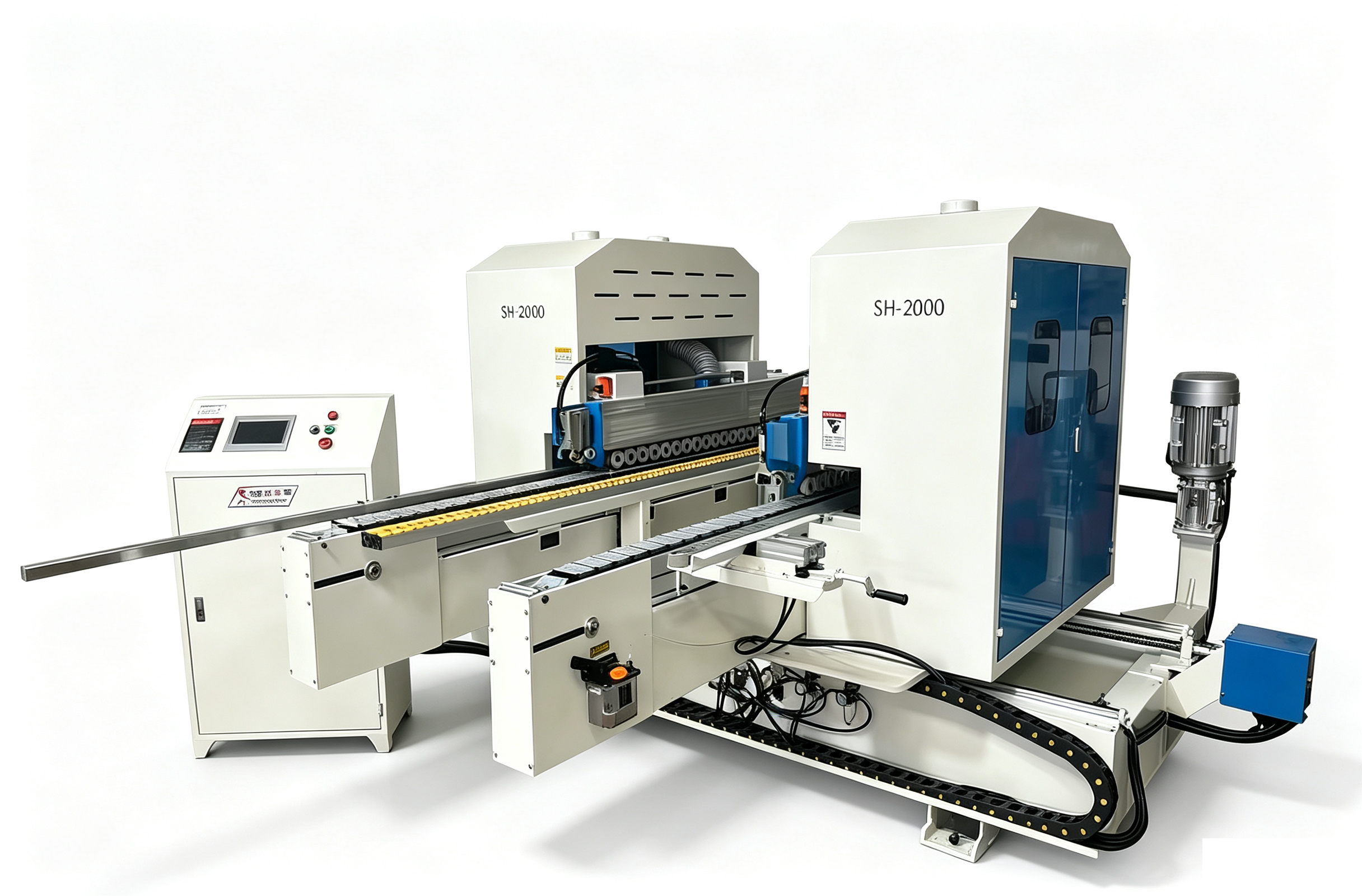
Batch Inspection Data Breakdown
| Inspection Report Required | Core Verification Objective | Batch Consistency Value |
|---|---|---|
| Precision Calibration & Remeasurement | Confirms operational accuracy and tolerance adherence | Enables direct cross-unit tolerance comparison |
| Clearance & Positioning Verification | Validates mechanical tolerances and servo adjustments | Exposes individual units deviating from design norms |
| No-Load & Extended Full-Load Runs | Tests motor heating, drive stability, and mechanical endurance | Ensures all machines sustain performance under stress |
| Vibration, Noise & Electrical Checks | Detects structural imbalance or power fluctuations | Tracks unit-by-unit corrective actions and refits |
| PSI Packaging & Quantity Checklist | Ensures complete accessories, documentation, and surface finish | Guarantees order completeness prior to dispatch |
Real-World Operational Context & Quality Systems
Industrial experience demonstrates the value of strict batch standards. For example, a door manufacturing enterprise in India deployed a 19-machine setup for a new production line, while a wood processing facility in the UAE commissioned 10 units. Both projects demonstrated that rigorous pre-shipment testing yields operational stability, superior daily productivity, and smoother integration into automated workflows.
To support high-consistency production, Foshan Sun Hunt Woodworking Machinery Co.,Ltd. utilizes a seven-tier management structure covering material sourcing, core-parameter manufacturing controls, inventory storage, protective packaging, QC testing, final PSI audits, and comprehensive customer service.
Frequently Asked Questions
What are the most critical test reports to request for double-end saw batches?
Prioritize precision calibration reports, servo positioning accuracy logs, control software checks, full-load operating data, noise/vibration readings, and electrical stability test results for every unit.
Why is single-machine testing insufficient for bulk orders?
Testing only one machine can mask manufacturing variances. Individual reports for each unit ensure that defects, mechanical tolerance stack-ups, or uncompleted reworks on specific machines are caught before delivery.
What items must be listed in the Pre-Shipment Inspection (PSI)?
The PSI should cover main machine units, auxiliary tables, spare components, consumables, matching tools, documentation, overall cosmetic finish, moisture protection, and packaging integrity.
Summary & Purchasing Recommendations
To ensure long-term operational success, require your equipment supplier to provide a complete, traceable inspection dossier for every double-end saw in your order. Establishing clear benchmarks across mechanical, electrical, and operational parameters protects your investment and streamlines factory installation. Foshan Sun Hunt supports single-unit orders, custom non-standard machinery, and complete production line installations, typically delivering within 20 to 35 days. For inquiries and technical consultation, reach out to Vincent Guo at vincent@fsshmachine.cn.
About the Manufacturer
Foshan Sun Hunt Woodworking Machinery Co.,Ltd. is based in Lunjiao Subdistrict, Shunde District, Foshan City. Founded in 2014, the company operates a 2,000-square-meter facility with an in-house R&D and technical management team focused on woodworking innovations. Serving major markets across the Middle East, North America, and Africa, their machinery catalog features Panel Saws, Edge Banding Machines, Planer Machines, Drilling Equipment, CNC Router Machines, and Double-End Saw Series.

REPORT