







-
 Agriculture
-
 Health-Care
-
 Environment
-
 Construction-Real-Estate
-
 Tools-Hardware
-
 Home-Garden
-
 Furniture
-
 Luggage-Bags-Cases
-
 Medical-devices-Supplies
-
 Gifts-Crafts
-
 Sports-Entertainment
-
 Food-Beverage
-
 Vehicles-Transportation
-
 Power-Transmission
-
 Material-Handling
-
 Renewable-Energy
-
 Safety
-
 Testing-Instrument-Equipment
-
 Construction-Building-Machinery
-
 Pet-Supplies
-
 Personal-Care-Household-Cleaning
-
 Vehicle-Accessories-Electronics-Tools
-
 School-Office-Supplies
-
 Packaging-Printing
-
 Mother-Kids-Toys
-
 Business-Services
-
 Commercial-Equipment-Machinery
-
 Apparel-Accessories
-
 Security
-
 Shoes-Accessories
-
 Vehicle-Parts-Accessories
-
 Jewelry-Eyewear-Watches-Accessories
-
 Lights-Lighting
-
 Fabric-Textile-Raw-Material
-
 Fabrication-Services
-
 Industrial-Machinery
-
 Consumer-Electronics
-
 Electrical-Equipment-Supplies
-
 Electronic-Components-Accessories-Telecommunications
-
 Home-Appliances
-
 Beauty
-
 Chemicals
-
 Rubber-Plastics
-
 Metals-Alloys


























































































































































































































































































































































































































































































































































































- Masonry Materials
- Curtain Walls & Accessories
- Earthwork Products
- Fireproofing Materials
- Heat Insulation Materials
- Plastic Building Materials
- Building Boards
- Soundproofing Materials
- Timber
- Waterproofing Materials
- Balustrades & Handrails
- Bathroom & Kitchen
- Flooring & Accessories
- Tiles & Accessories
- Door, Window & Accessories
- Fireplaces & Stoves
- Floor Heating Systems & Parts
- Stairs & Stair Parts
- Ceilings
- Elevators & Escalators
- Stone
- Countertops, Vanity Tops & Table Tops
- Mosaics
- Metal Building Materials
- Multifunctional Materials
- Ladders & Scaffoldings
- Mouldings
- Corner Guards
- Decorative Films
- Formwork
- Building & Industrial Glass
- Other Construction & Real Estate
- Wallpapers/Wall panels
- HVAC System & Parts
- Outdoor Facilities
- Prefabricated Buildings
- Festive & Party Supplies
- Bathroom Products
- Household Sundries
- Rain Gear
- Garden Supplies
- Household Cleaning Tools & Accessories
- Lighters & Smoking Accessories
- Home Storage & Organization
- Household Scales
- Smart Home Improvement
- Home Textiles
- Kitchenware
- Drinkware & Accessories
- Dinnerware, Coffee & Wine
- Home Decor
- Golf
- Fitness & Body Building
- Amusement Park Facilities
- Billiards, Board Game,Coin Operated Games
- Musical Instruments
- Outdoor Affordable Luxury Sports
- Camping & Hiking
- Fishing
- Sports Safety&Rehabilitation
- Ball Sports Equipments
- Water Sports
- Winter Sports
- Luxury Travel Equipments
- Sports Shoes, Bags & Accessories
- Cycling
- Other Sports & Entertainment Products
- Artificial Grass&Sports Flooring&Sports Court Equipment
- Scooters
- Food Ingredients
- Honey & Honey Products
- Snacks
- Nuts & Kernels
- Seafood
- Plant & Animal Oil
- Beverages
- Fruit & Vegetable Products
- Frog & Escargot
- Bean Products
- Egg Products
- Dairy Products
- Seasonings & Condiments
- Canned Food
- Instant Food
- Baked Goods
- Other Food & Beverage
- Meat & Poultry
- Confectionery
- Grain Products
- Feminie Care
- Hair Care & Styling
- Body Care
- Hands & Feet Care
- Hygiene Products
- Men's Grooming
- Laundry Cleaning Supplies
- Travel Size & Gift Sets
- Room Deodorizers
- Other Personal Care Products
- Pest Control Products
- Special Household Cleaning
- Floor Cleaning
- Kitchen & Bathroom Cleaning
- Oral Care
- Bath Supplies
- Yellow Pages
- Correction Supplies
- Office Binding Supplies
- Office Cutting Supplies
- Board Erasers
- Office Adhesives & Tapes
- Education Supplies
- Pencil Cases & Bags
- Notebooks & Writing Pads
- File Folder Accessories
- Calendars
- Writing Accessories
- Commercial Office Supplies
- Pencil Sharpeners
- Pens
- Letter Pad/Paper
- Paper Envelopes
- Desk Organizers
- Pencils
- Markers & Highlighters
- Filing Products
- Art Supplies
- Easels
- Badge Holder & Accessories
- Office Paper
- Printer Supplies
- Book Covers
- Other Office & School Supplies
- Stationery Set
- Boards
- Clipboards
- Stamps
- Drafting Supplies
- Stencils
- Electronic Dictionary
- Books
- Map
- Magazines
- Calculators
- Baby & Toddler Toys
- Educational Toys
- Classic Toys
- Dress Up & Pretend Play
- Toy Vehicle
- Stuffed Animals & Plush Toys
- Outdoor Toys & Structures
- Balloons & Accessories
- Baby Food
- Children's Clothing
- Baby Supplies & Products
- Maternity Clothes
- Kids Shoes
- Baby Care
- Novelty & Gag Toys
- Dolls & Accessories
- Puzzle & Games
- Blocks & Model Building Toys
- Toddler Clothing
- Baby Clothing
- Kids' Luggage & Bags
- Arts, Crafts & DIY Toys
- Action & Toy Figures
- Baby Appliances
- Hobbies & Models
- Remote Control Toys
- Promotional Toys
- Pregnancy & Maternity
- Hygiene Products
- Kid's Textile&Bedding
- Novelty & Special Use
- Toy Weapons
- Baby Gifts
- Baby Storage & Organization
- Auto Drive Systems
- ATV/UTV Parts & Accessories
- Marine Parts & Accessories
- Other Auto Parts
- Trailer Parts & Accessories
- Auto Transmission Systems
- Train Parts & Accessories
- Universal Parts
- Railway Parts & Accessories
- Auto Brake Systems
- Aviation Parts & Accessories
- Truck Parts & Accessories
- Auto Suspension Systems
- Auto Lighting Systems
- New Energy Vehicle Parts & Accessories
- Auto Steering Systems
- Wheels, Tires & Accessories
- Bus Parts & Accessories
- Auto Performance Parts
- Cooling System
- Go-Kart & Kart Racer Parts & Accessories
- Air Conditioning Systems
- Heavy Duty Vehicle Parts & Accessories
- Auto Electrical Systems
- Auto Body Systems
- Auto Engine Systems
- Container Parts & Accessories
- Motorcycle Parts & Accessories
- Refrigeration & Heat Exchange Equipment
- Machine Tool Equipment
- Food & Beverage Machinery
- Agricultural Machinery & Equipment
- Apparel & Textile Machinery
- Chemical Machinery
- Packaging Machines
- Paper Production Machinery
- Plastic & Rubber Processing Machinery
- Industrial Robots
- Electronic Products Machinery
- Metal & Metallurgy Machinery
- Woodworking Machinery
- Home Product Manufacturing Machinery
- Machinery Accessories
- Environmental Machinery
- Machinery Service
- Electrical Equipment Manufacturing Machinery
- Industrial Compressors & Parts
- Tobacco & Cigarette Machinery
- Production Line
- Used Industrial Machinery
- Electronics Production Machinery
- Other Machinery & Industrial Equipment
- Camera, Photo & Accessories
- Portable Audio, Video & Accessories
- Television, Home Audio, Video & Accessories
- Video Games & Accessories
- Mobile Phone & Accessories
- Electronic Publications
- Earphone & Headphone & Accessories
- Speakers & Accessories
- Smart Electronics
- TV Receivers & Accessories
- Mobile Phone & Computer Repair Parts
- Chargers, Batteries & Power Supplies
- Used Electronics
- VR, AR, MR Hardware & Software
- Projectors & Presentation Equipments
- Other Consumer Electronics
- Cables & Commonly Used Accessories
- Computer Hardware & Software
- Displays, Signage and Optoelectronics
- Discrete Semiconductors
- Wireless & IoT Module and Products
- Telecommunications
- Connectors, Terminals & Accessories
- Development Boards, Electronic Modules and Kits
- Circuit Protection
- Sensors
- Isolators
- Audio Components and Products
- Integrated Circuits
- Power Supplies
- Relays
- RF, Microwave and RFID
- Electronic Accessories & Supplies
- Passive Components
- PCB & PCBA
- Air Quality Appliances
- Home Appliance Parts
- Heating & Cooling Appliances
- Small Kitchen Appliances
- Laundry Appliances
- Water Heaters
- Water Treatment Appliances
- Refrigerators & Freezers
- Personal Care & Beauty Appliances
- Major Kitchen Appliances
- Cleaning Appliances
- Second-hand Appliances
- Smart Home Appliances
- Other Home Appliances
- Energy Chemicals
- Inorganic Chemicals
- Basic Organic Chemicals
- Agrochemicals
- Admixture & Additives
- Catalysts & Chemical Auxiliary Agents
- Pigments & Dyestuff
- Coating & Paint
- Daily Chemicals
- Polymer
- Organic Intermediate
- Adhesives & Sealants
- Chemical Waste
- Biological Chemical Products
- Surface Treatment Chemicals
- Painting & Coating
- Chemical Reagents
- Flavor & Fragrance
- Non-Explosive Demolition Agents
- Other Chemicals
- Custom Chemical Services

Holland Velvet vs. Suede vs. Corduroy: Appearance, Uses, and Durability Considerations
Holland Velvet, Suede, and Corduroy each create a distinct visual and tactile effect. Their differences are most apparent in surface construction: Holland Velvet has a dense, plush pile, Suede offers a leather-inspired finish, and Corduroy features recognizable raised ribs. While the available product information explains their appearance and typical uses, it does not provide material-specific abrasion ratings or a definitive durability ranking.
Quick Comparison of the Three Fabrics
Selecting between these materials should begin with the desired appearance, touch, and end-use environment. Holland Velvet is suited to projects requiring a smooth, soft pile. Suede is appropriate where a refined leather-like texture is preferred. Corduroy provides a structured, striped look that is especially associated with apparel.
- Holland Velvet is offered in 210 gsm, 280 gsm, and double-sided constructions.
- Suede is a faux-suede fabric with a leather-like look and feel.
- Corduroy is a velvet-based textile distinguished by its raised parallel ribs.
- Application-specific testing is necessary before making durability comparisons between the three materials.
Surface Appearance and Material Character
Holland Velvet: Plush and Full-Pile
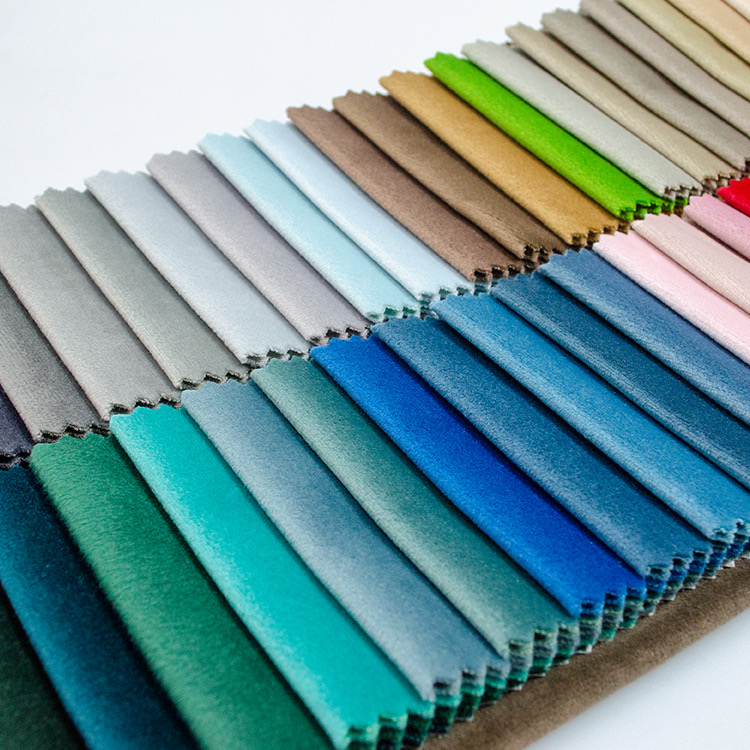
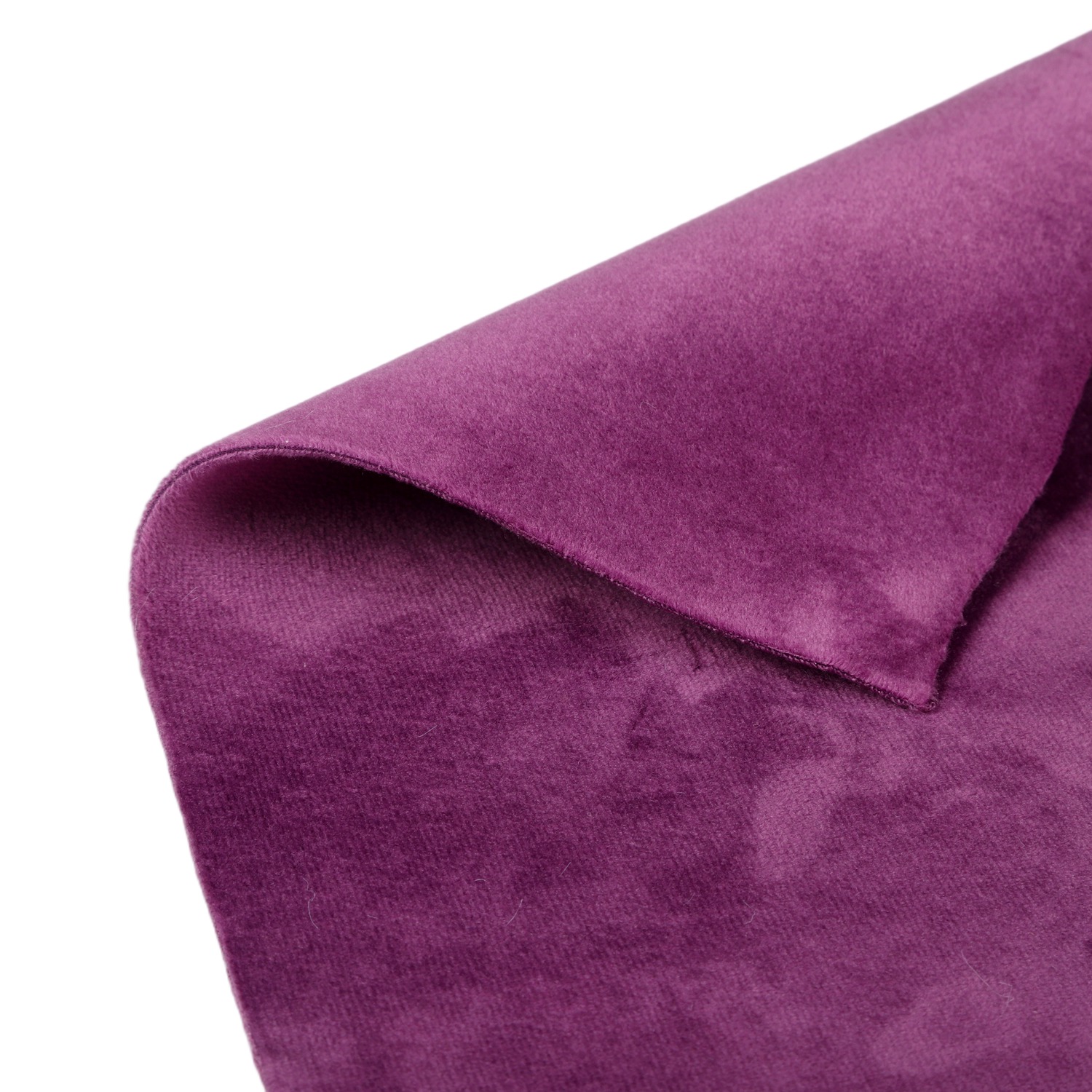
Holland Velvet is defined by its continuous full-pile face, which gives the fabric a soft, rich, and visually even finish. The stated 210 gsm and 280 gsm options, together with a double-sided version, allow buyers to choose a construction that fits different design needs. Its listed applications include apparel, bedding, sofa coverings, curtains, and packaging.
Suede: Leather-Like and Refined
Suede has a different visual identity from velvet and corduroy. Described in the supplied information as faux suede, it creates a leather-like surface and texture rather than a clearly ribbed pattern or a visibly deep full pile. It is used for packaging, decorative applications, linings, garments, and bags where a polished tactile finish is important.
Corduroy: Textured Raised Ribs
Corduroy is identified as a ribbed velvet fabric. Its linear raised channels create depth and direction across the surface, making it visually distinct from the uniform pile of Holland Velvet and the leather-like character of Suede. Based on the available information, apparel is its principal application.
What the Available Information Says About Durability
No product-level wear rating, abrasion result, or predicted service life is supplied for Holland Velvet, Suede, or Corduroy. As a result, it would not be accurate to label one as more durable than the others based solely on the provided details. Fabric weight, backing, finishing, frequency of use, and the specific application can all affect real-world performance.
Mingqian Flocking reports a four-step quality-control process that covers raw-material inspection, in-process monitoring, finished-product testing, and pre-shipment inspection. The stated testing program may include color fastness, pile adhesion, abrasion resistance, dimensional accuracy, formaldehyde, azo dyes, and peel strength for self-adhesive materials. General abrasion verification is reported from 500 cycles for standard products up to 100,000 cycles for functional products, but those figures are not assigned individually to Holland Velvet, Suede, or Corduroy.
Material Comparison Table
| Material | Visual and tactile qualities | Listed applications | Available durability data |
|---|---|---|---|
| Holland Velvet | Soft touch with a smooth, full-pile surface; available in 210 gsm, 280 gsm, and double-sided options | Apparel, bedding, sofas, curtains, and packaging | No specific abrasion rating or service-life result provided |
| Suede | Faux-suede finish with a leather-like appearance and texture | Packaging, decoration, linings, apparel, and bags | No specific abrasion rating or service-life result provided |
| Corduroy | Velvet structure with visible raised ribs | Mainly apparel | No specific abrasion rating or service-life result provided |
| Supplier quality testing | Includes appearance checks and dimensional control | Used throughout manufacturing and final inspection | General abrasion range is 500 to 100,000 cycles, without a direct connection to these three fabrics |
Frequently Asked Questions
Which fabric has the softest plush look?
Holland Velvet is the strongest match for a plush appearance because its product description highlights a soft hand feel and a full pile surface.
Which option resembles leather?
Suede is the material described as having a leather-like appearance and texture.
Which fabric has visible ridges?
Corduroy has the ribbed surface. Its raised linear texture is the primary visual feature that separates it from Holland Velvet and Suede.
Choosing the Right Material
Choose Holland Velvet for soft, full-pile designs and where its 210 gsm, 280 gsm, or double-sided options suit the project. Select Suede for leather-like packaging, decorative work, linings, bags, or apparel. Consider Corduroy when a pronounced ribbed texture is the intended design feature, especially in clothing. Since direct durability data is unavailable, request relevant samples and define application-specific testing standards before confirming a material.
Mingqian Flocking provides OEM and ODM services, with a stated minimum order quantity of 1,000 yards and a 14-day delivery time. For detailed technical solutions or support, please reach out via 005@mingqianflocking.com.
About Us
Guangdong Shunde Mingqian Flocking Co., Ltd., operating under the Mingqian brand, is a flocking fabric manufacturer headquartered in Foshan, Guangdong, China. Founded in 2008, the company focuses on the development, manufacturing, and sale of flocking fabrics. It operates five flocking lines with a monthly capacity exceeding 3,000,000 yards and serves markets in North America, Southeast Asia, South Asia, and Europe. The company holds ISO 9001 and Global Recycled Standard certifications and has experience supporting customers in packaging, home appliances, automotive, furniture, eyewear, jewelry, and other sectors.

REPORT