







-
 Agriculture
-
 Health-Care
-
 Environment
-
 Construction-Real-Estate
-
 Tools-Hardware
-
 Home-Garden
-
 Furniture
-
 Luggage-Bags-Cases
-
 Medical-devices-Supplies
-
 Gifts-Crafts
-
 Sports-Entertainment
-
 Food-Beverage
-
 Vehicles-Transportation
-
 Power-Transmission
-
 Material-Handling
-
 Renewable-Energy
-
 Safety
-
 Testing-Instrument-Equipment
-
 Construction-Building-Machinery
-
 Pet-Supplies
-
 Personal-Care-Household-Cleaning
-
 Vehicle-Accessories-Electronics-Tools
-
 School-Office-Supplies
-
 Packaging-Printing
-
 Mother-Kids-Toys
-
 Business-Services
-
 Commercial-Equipment-Machinery
-
 Apparel-Accessories
-
 Security
-
 Shoes-Accessories
-
 Vehicle-Parts-Accessories
-
 Jewelry-Eyewear-Watches-Accessories
-
 Lights-Lighting
-
 Fabric-Textile-Raw-Material
-
 Fabrication-Services
-
 Industrial-Machinery
-
 Consumer-Electronics
-
 Electrical-Equipment-Supplies
-
 Electronic-Components-Accessories-Telecommunications
-
 Home-Appliances
-
 Beauty
-
 Chemicals
-
 Rubber-Plastics
-
 Metals-Alloys


























































































































































































































































































































































































































































































































































































- Masonry Materials
- Curtain Walls & Accessories
- Earthwork Products
- Fireproofing Materials
- Heat Insulation Materials
- Plastic Building Materials
- Building Boards
- Soundproofing Materials
- Timber
- Waterproofing Materials
- Balustrades & Handrails
- Bathroom & Kitchen
- Flooring & Accessories
- Tiles & Accessories
- Door, Window & Accessories
- Fireplaces & Stoves
- Floor Heating Systems & Parts
- Stairs & Stair Parts
- Ceilings
- Elevators & Escalators
- Stone
- Countertops, Vanity Tops & Table Tops
- Mosaics
- Metal Building Materials
- Multifunctional Materials
- Ladders & Scaffoldings
- Mouldings
- Corner Guards
- Decorative Films
- Formwork
- Building & Industrial Glass
- Other Construction & Real Estate
- Wallpapers/Wall panels
- HVAC System & Parts
- Outdoor Facilities
- Prefabricated Buildings
- Festive & Party Supplies
- Bathroom Products
- Household Sundries
- Rain Gear
- Garden Supplies
- Household Cleaning Tools & Accessories
- Lighters & Smoking Accessories
- Home Storage & Organization
- Household Scales
- Smart Home Improvement
- Home Textiles
- Kitchenware
- Drinkware & Accessories
- Dinnerware, Coffee & Wine
- Home Decor
- Golf
- Fitness & Body Building
- Amusement Park Facilities
- Billiards, Board Game,Coin Operated Games
- Musical Instruments
- Outdoor Affordable Luxury Sports
- Camping & Hiking
- Fishing
- Sports Safety&Rehabilitation
- Ball Sports Equipments
- Water Sports
- Winter Sports
- Luxury Travel Equipments
- Sports Shoes, Bags & Accessories
- Cycling
- Other Sports & Entertainment Products
- Artificial Grass&Sports Flooring&Sports Court Equipment
- Scooters
- Food Ingredients
- Honey & Honey Products
- Snacks
- Nuts & Kernels
- Seafood
- Plant & Animal Oil
- Beverages
- Fruit & Vegetable Products
- Frog & Escargot
- Bean Products
- Egg Products
- Dairy Products
- Seasonings & Condiments
- Canned Food
- Instant Food
- Baked Goods
- Other Food & Beverage
- Meat & Poultry
- Confectionery
- Grain Products
- Feminie Care
- Hair Care & Styling
- Body Care
- Hands & Feet Care
- Hygiene Products
- Men's Grooming
- Laundry Cleaning Supplies
- Travel Size & Gift Sets
- Room Deodorizers
- Other Personal Care Products
- Pest Control Products
- Special Household Cleaning
- Floor Cleaning
- Kitchen & Bathroom Cleaning
- Oral Care
- Bath Supplies
- Yellow Pages
- Correction Supplies
- Office Binding Supplies
- Office Cutting Supplies
- Board Erasers
- Office Adhesives & Tapes
- Education Supplies
- Pencil Cases & Bags
- Notebooks & Writing Pads
- File Folder Accessories
- Calendars
- Writing Accessories
- Commercial Office Supplies
- Pencil Sharpeners
- Pens
- Letter Pad/Paper
- Paper Envelopes
- Desk Organizers
- Pencils
- Markers & Highlighters
- Filing Products
- Art Supplies
- Easels
- Badge Holder & Accessories
- Office Paper
- Printer Supplies
- Book Covers
- Other Office & School Supplies
- Stationery Set
- Boards
- Clipboards
- Stamps
- Drafting Supplies
- Stencils
- Electronic Dictionary
- Books
- Map
- Magazines
- Calculators
- Baby & Toddler Toys
- Educational Toys
- Classic Toys
- Dress Up & Pretend Play
- Toy Vehicle
- Stuffed Animals & Plush Toys
- Outdoor Toys & Structures
- Balloons & Accessories
- Baby Food
- Children's Clothing
- Baby Supplies & Products
- Maternity Clothes
- Kids Shoes
- Baby Care
- Novelty & Gag Toys
- Dolls & Accessories
- Puzzle & Games
- Blocks & Model Building Toys
- Toddler Clothing
- Baby Clothing
- Kids' Luggage & Bags
- Arts, Crafts & DIY Toys
- Action & Toy Figures
- Baby Appliances
- Hobbies & Models
- Remote Control Toys
- Promotional Toys
- Pregnancy & Maternity
- Hygiene Products
- Kid's Textile&Bedding
- Novelty & Special Use
- Toy Weapons
- Baby Gifts
- Baby Storage & Organization
- Auto Drive Systems
- ATV/UTV Parts & Accessories
- Marine Parts & Accessories
- Other Auto Parts
- Trailer Parts & Accessories
- Auto Transmission Systems
- Train Parts & Accessories
- Universal Parts
- Railway Parts & Accessories
- Auto Brake Systems
- Aviation Parts & Accessories
- Truck Parts & Accessories
- Auto Suspension Systems
- Auto Lighting Systems
- New Energy Vehicle Parts & Accessories
- Auto Steering Systems
- Wheels, Tires & Accessories
- Bus Parts & Accessories
- Auto Performance Parts
- Cooling System
- Go-Kart & Kart Racer Parts & Accessories
- Air Conditioning Systems
- Heavy Duty Vehicle Parts & Accessories
- Auto Electrical Systems
- Auto Body Systems
- Auto Engine Systems
- Container Parts & Accessories
- Motorcycle Parts & Accessories
- Refrigeration & Heat Exchange Equipment
- Machine Tool Equipment
- Food & Beverage Machinery
- Agricultural Machinery & Equipment
- Apparel & Textile Machinery
- Chemical Machinery
- Packaging Machines
- Paper Production Machinery
- Plastic & Rubber Processing Machinery
- Industrial Robots
- Electronic Products Machinery
- Metal & Metallurgy Machinery
- Woodworking Machinery
- Home Product Manufacturing Machinery
- Machinery Accessories
- Environmental Machinery
- Machinery Service
- Electrical Equipment Manufacturing Machinery
- Industrial Compressors & Parts
- Tobacco & Cigarette Machinery
- Production Line
- Used Industrial Machinery
- Electronics Production Machinery
- Other Machinery & Industrial Equipment
- Camera, Photo & Accessories
- Portable Audio, Video & Accessories
- Television, Home Audio, Video & Accessories
- Video Games & Accessories
- Mobile Phone & Accessories
- Electronic Publications
- Earphone & Headphone & Accessories
- Speakers & Accessories
- Smart Electronics
- TV Receivers & Accessories
- Mobile Phone & Computer Repair Parts
- Chargers, Batteries & Power Supplies
- Used Electronics
- VR, AR, MR Hardware & Software
- Projectors & Presentation Equipments
- Other Consumer Electronics
- Cables & Commonly Used Accessories
- Computer Hardware & Software
- Displays, Signage and Optoelectronics
- Discrete Semiconductors
- Wireless & IoT Module and Products
- Telecommunications
- Connectors, Terminals & Accessories
- Development Boards, Electronic Modules and Kits
- Circuit Protection
- Sensors
- Isolators
- Audio Components and Products
- Integrated Circuits
- Power Supplies
- Relays
- RF, Microwave and RFID
- Electronic Accessories & Supplies
- Passive Components
- PCB & PCBA
- Air Quality Appliances
- Home Appliance Parts
- Heating & Cooling Appliances
- Small Kitchen Appliances
- Laundry Appliances
- Water Heaters
- Water Treatment Appliances
- Refrigerators & Freezers
- Personal Care & Beauty Appliances
- Major Kitchen Appliances
- Cleaning Appliances
- Second-hand Appliances
- Smart Home Appliances
- Other Home Appliances
- Energy Chemicals
- Inorganic Chemicals
- Basic Organic Chemicals
- Agrochemicals
- Admixture & Additives
- Catalysts & Chemical Auxiliary Agents
- Pigments & Dyestuff
- Coating & Paint
- Daily Chemicals
- Polymer
- Organic Intermediate
- Adhesives & Sealants
- Chemical Waste
- Biological Chemical Products
- Surface Treatment Chemicals
- Painting & Coating
- Chemical Reagents
- Flavor & Fragrance
- Non-Explosive Demolition Agents
- Other Chemicals
- Custom Chemical Services

How Can Buyers Verify the Capacity of a Self-Piercing Riveting System Factory?
When selecting a self-piercing riveting system supplier, buyers should look beyond a single production figure. A dependable factory should provide evidence covering standard output, customized manufacturing, lead times, facility scale, quality controls, engineering resources, and completed applications. Questok, for example, reports a 5,000-square-meter facility, monthly capacity of 800 standard sets and 500 customized sets, 100% inspection, and delivery within 3 days for qualifying standard orders below 100 sets.
What Capacity Evidence Should Include
A useful supplier evaluation should compare production capability with the technical support required for the project. Capacity information is most meaningful when it explains the difference between catalog products and engineered systems, identifies order conditions, and is supported by documented manufacturing and inspection procedures.
- Standard and customized capacities should be stated separately.
- Lead times should identify the applicable model type and order quantity.
- Factory size, equipment, process management, and workforce resources should support the reported output.
- Engineering capabilities should cover tooling, joining parameters, prototypes, testing, and production transfer.
- Application references should demonstrate experience in vehicle manufacturing, EV battery trays, cooling plates, or other relevant assemblies.
Production Volume and Delivery Commitments
Questok states that its manufacturing system can produce approximately 800 standard self-piercing riveting system sets per month and 500 customized sets per month. Presenting these figures independently helps buyers understand the supplier’s ability to repeat established designs as well as its capacity to handle application-specific requirements.
Delivery claims should always be read together with their commercial conditions. Questok reports delivery within 3 days for standard models and within 15 days for customized models when the order quantity is below 100 sets. Its product information also indicates a minimum order quantity of 1 set, with delivery in 3 days after payment for quantities below 50 standard sets and approximately 15 days for customized products. Buyers should confirm the applicable quantity, configuration, payment, and approval conditions before placing an order.
Factory Infrastructure and Manufacturing Readiness
Physical infrastructure provides context for a capacity statement. Questok identifies a 5,000-square-meter factory and describes investment in manufacturing technology, production equipment, and process optimization. These resources are intended to improve production efficiency, flexibility, and the ability to support both repeat orders and engineered solutions.

However, factory area alone does not prove production performance. Buyers should also review workflow organization, component sourcing, assembly controls, equipment maintenance, production scheduling, and the supplier’s ability to maintain consistent quality during higher-volume orders.
Engineering and Customization Capability
Self-piercing riveting projects often involve different materials, stack-up conditions, access limitations, and cycle-time targets. For this reason, a capable supplier should demonstrate more than assembly capacity. Questok describes engineering resources covering mechanical design, hydraulic systems, electrical controls, battery-powered tools, embedded software, fastening-process development, prototype testing, reliability verification, and manufacturing process engineering.
These capabilities support the full development path from initial sample evaluation to production-ready equipment. They can also help a supplier adjust riveting force, tooling, control logic, system layout, and process parameters for a customer’s specific application.
Application Experience as Practical Capacity Evidence
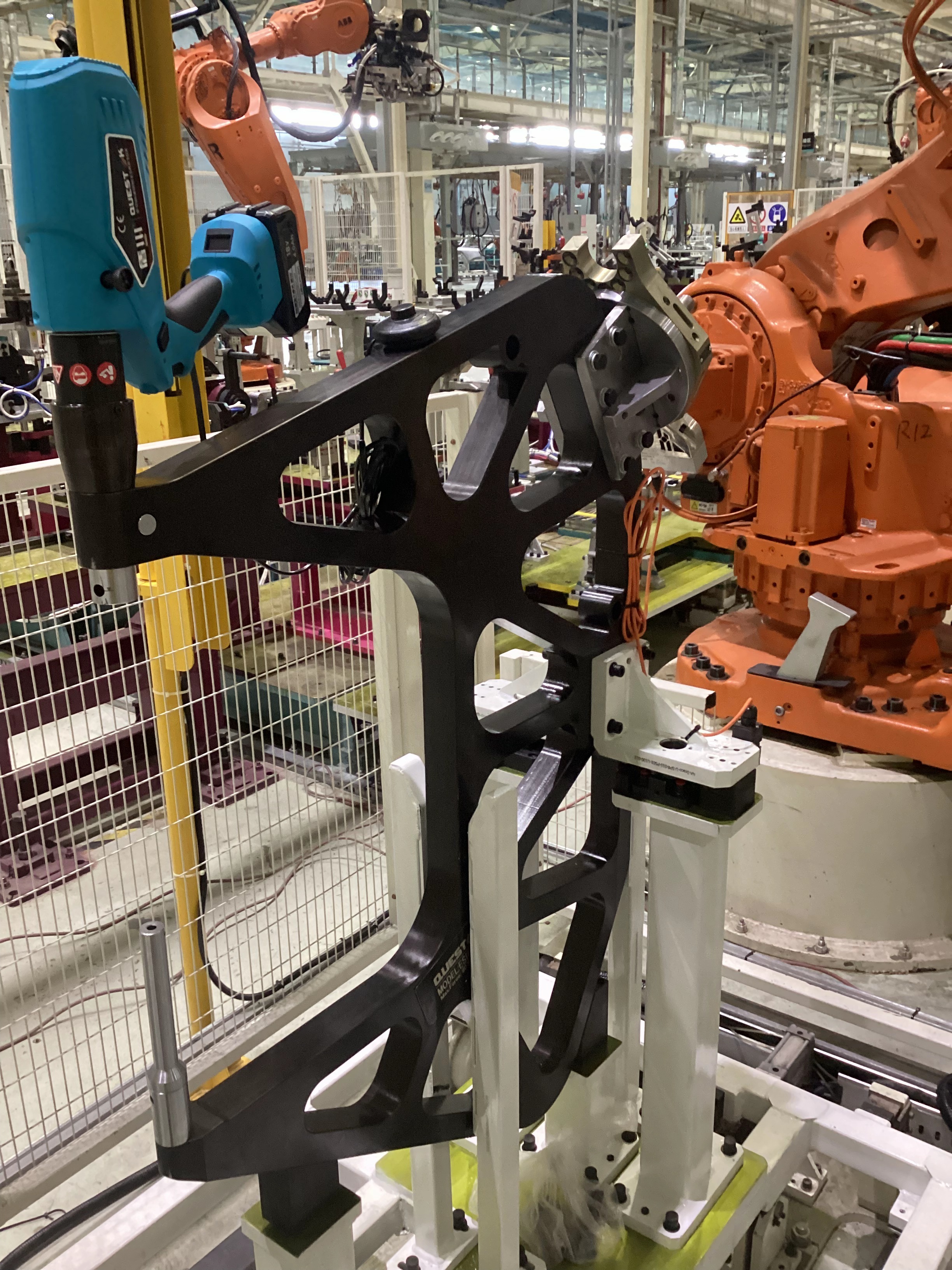
Completed projects provide evidence that the factory can convert technical resources into working production solutions. Questok reports experience supplying self-piercing riveting equipment for vehicle manufacturing, as well as joining systems for EV battery trays and water cooling plates.
Reported cooperation examples include prototype development for Chinese electric vehicle and automotive manufacturers, a production-line project combining self-piercing riveting with rivetless clinching, and applications involving battery trays and water cooling plates. These projects are described as involving customer-site discussions, material testing, solution design, and application-focused engineering. Such records can help buyers assess whether a supplier understands both component-level joining and production-line integration.
Inspection, Testing, and Release Controls
High output is only valuable when every delivered system meets functional and quality requirements. Questok reports full inspection of materials and finished products, functional testing before shipment, and the preparation of test videos and photographs for customer review.
Certification documents can provide additional supporting evidence. Questok lists CE and MSDS documentation for relevant riveting, clinching, and fastener tools. Buyers should still request the records applicable to the specific equipment, together with inspection reports, acceptance criteria, traceability information, and details of after-sales response procedures.
Capacity Evidence Comparison
| Evaluation Area | Reported Questok Information | Why It Matters to Buyers |
|---|---|---|
| Standard equipment output | 800 standard sets per month, with delivery within 3 days under specified conditions | Indicates repeat-production capability and a short lead time for established models |
| Customized equipment output | 500 customized sets per month, with delivery within 15 days under specified conditions | Shows that the factory can accommodate application-specific configurations |
| Facility and production base | 5,000-square-meter factory supported by manufacturing technology and process optimization | Provides operational context for the stated capacity |
| Quality assurance | 100% inspection, functional testing, and customer-facing test records | Links production volume with shipment and performance controls |
| Technical development | Prototype work, joining-process validation, reliability testing, and manufacturing engineering | Helps assess readiness for new materials, tooling, and production requirements |
Frequently Asked Questions
What figures should a self-piercing riveting system factory disclose?
The supplier should identify separate monthly capacities for standard and customized systems, minimum order quantities, delivery schedules, and the conditions behind those schedules. Questok reports 800 standard sets and 500 customized sets per month, with different lead times for each category.
How can buyers confirm that a stated capacity is credible?
Buyers should compare production figures with factory infrastructure, inspection coverage, functional testing, process controls, engineering staff, and completed application examples. Questok reports a 5,000-square-meter facility, full inspection, pre-shipment functional testing, and projects related to automotive and EV battery joining.
Why is customized production important for an SPR supplier?
Customization capability shows whether the supplier can adapt tooling, joining force, control settings, and system configuration to a specific component or line. Questok describes prototype development, material testing, process validation, and customized model production, with a reported 15-day delivery period for qualifying orders.
What additional documents should a buyer request?
Useful documents include inspection records, test results, applicable certifications, sample approval reports, process validation data, delivery terms, and after-sales support procedures. These records help confirm that the supplier’s capacity is supported by repeatable quality and service processes.
Conclusion
A reliable self-piercing riveting system factory should substantiate its claims with more than a headline production number. Standard and customized output, order-specific lead times, factory infrastructure, inspection procedures, engineering resources, certifications, and application references together provide a clearer basis for supplier evaluation.
Questok supports ODM and OBM cooperation, accepts orders from 1 set, and reports CE and MSDS certifications for applicable equipment. Buyers seeking a technical proposal or project support can contact jane@questok.com.
About Us
PHOTON TECHNOLOGY KUNSHAN CO.,LTD, operating under the Questok brand, develops fastening, joining, and assembly equipment for modern manufacturing. Its product range includes self-piercing riveting systems, self-piercing riveting guns, clinching equipment, fastener pressing tools, and integrated assembly solutions. Established in 2011, the company reports a 5,000-square-meter factory with monthly capacity of 800 standard models and 500 customized models. Its certifications include CE and MSDS, while its cooperation experience covers several industrial applications.

REPORT