







-
 Agriculture
-
 Health-Care
-
 Environment
-
 Construction-Real-Estate
-
 Tools-Hardware
-
 Home-Garden
-
 Furniture
-
 Luggage-Bags-Cases
-
 Medical-devices-Supplies
-
 Gifts-Crafts
-
 Sports-Entertainment
-
 Food-Beverage
-
 Vehicles-Transportation
-
 Power-Transmission
-
 Material-Handling
-
 Renewable-Energy
-
 Safety
-
 Testing-Instrument-Equipment
-
 Construction-Building-Machinery
-
 Pet-Supplies
-
 Personal-Care-Household-Cleaning
-
 Vehicle-Accessories-Electronics-Tools
-
 School-Office-Supplies
-
 Packaging-Printing
-
 Mother-Kids-Toys
-
 Business-Services
-
 Commercial-Equipment-Machinery
-
 Apparel-Accessories
-
 Security
-
 Shoes-Accessories
-
 Vehicle-Parts-Accessories
-
 Jewelry-Eyewear-Watches-Accessories
-
 Lights-Lighting
-
 Fabric-Textile-Raw-Material
-
 Fabrication-Services
-
 Industrial-Machinery
-
 Consumer-Electronics
-
 Electrical-Equipment-Supplies
-
 Electronic-Components-Accessories-Telecommunications
-
 Home-Appliances
-
 Beauty
-
 Chemicals
-
 Rubber-Plastics
-
 Metals-Alloys


























































































































































































































































































































































































































































































































































































- Masonry Materials
- Curtain Walls & Accessories
- Earthwork Products
- Fireproofing Materials
- Heat Insulation Materials
- Plastic Building Materials
- Building Boards
- Soundproofing Materials
- Timber
- Waterproofing Materials
- Balustrades & Handrails
- Bathroom & Kitchen
- Flooring & Accessories
- Tiles & Accessories
- Door, Window & Accessories
- Fireplaces & Stoves
- Floor Heating Systems & Parts
- Stairs & Stair Parts
- Ceilings
- Elevators & Escalators
- Stone
- Countertops, Vanity Tops & Table Tops
- Mosaics
- Metal Building Materials
- Multifunctional Materials
- Ladders & Scaffoldings
- Mouldings
- Corner Guards
- Decorative Films
- Formwork
- Building & Industrial Glass
- Other Construction & Real Estate
- Wallpapers/Wall panels
- HVAC System & Parts
- Outdoor Facilities
- Prefabricated Buildings
- Festive & Party Supplies
- Bathroom Products
- Household Sundries
- Rain Gear
- Garden Supplies
- Household Cleaning Tools & Accessories
- Lighters & Smoking Accessories
- Home Storage & Organization
- Household Scales
- Smart Home Improvement
- Home Textiles
- Kitchenware
- Drinkware & Accessories
- Dinnerware, Coffee & Wine
- Home Decor
- Golf
- Fitness & Body Building
- Amusement Park Facilities
- Billiards, Board Game,Coin Operated Games
- Musical Instruments
- Outdoor Affordable Luxury Sports
- Camping & Hiking
- Fishing
- Sports Safety&Rehabilitation
- Ball Sports Equipments
- Water Sports
- Winter Sports
- Luxury Travel Equipments
- Sports Shoes, Bags & Accessories
- Cycling
- Other Sports & Entertainment Products
- Artificial Grass&Sports Flooring&Sports Court Equipment
- Scooters
- Food Ingredients
- Honey & Honey Products
- Snacks
- Nuts & Kernels
- Seafood
- Plant & Animal Oil
- Beverages
- Fruit & Vegetable Products
- Frog & Escargot
- Bean Products
- Egg Products
- Dairy Products
- Seasonings & Condiments
- Canned Food
- Instant Food
- Baked Goods
- Other Food & Beverage
- Meat & Poultry
- Confectionery
- Grain Products
- Feminie Care
- Hair Care & Styling
- Body Care
- Hands & Feet Care
- Hygiene Products
- Men's Grooming
- Laundry Cleaning Supplies
- Travel Size & Gift Sets
- Room Deodorizers
- Other Personal Care Products
- Pest Control Products
- Special Household Cleaning
- Floor Cleaning
- Kitchen & Bathroom Cleaning
- Oral Care
- Bath Supplies
- Yellow Pages
- Correction Supplies
- Office Binding Supplies
- Office Cutting Supplies
- Board Erasers
- Office Adhesives & Tapes
- Education Supplies
- Pencil Cases & Bags
- Notebooks & Writing Pads
- File Folder Accessories
- Calendars
- Writing Accessories
- Commercial Office Supplies
- Pencil Sharpeners
- Pens
- Letter Pad/Paper
- Paper Envelopes
- Desk Organizers
- Pencils
- Markers & Highlighters
- Filing Products
- Art Supplies
- Easels
- Badge Holder & Accessories
- Office Paper
- Printer Supplies
- Book Covers
- Other Office & School Supplies
- Stationery Set
- Boards
- Clipboards
- Stamps
- Drafting Supplies
- Stencils
- Electronic Dictionary
- Books
- Map
- Magazines
- Calculators
- Baby & Toddler Toys
- Educational Toys
- Classic Toys
- Dress Up & Pretend Play
- Toy Vehicle
- Stuffed Animals & Plush Toys
- Outdoor Toys & Structures
- Balloons & Accessories
- Baby Food
- Children's Clothing
- Baby Supplies & Products
- Maternity Clothes
- Kids Shoes
- Baby Care
- Novelty & Gag Toys
- Dolls & Accessories
- Puzzle & Games
- Blocks & Model Building Toys
- Toddler Clothing
- Baby Clothing
- Kids' Luggage & Bags
- Arts, Crafts & DIY Toys
- Action & Toy Figures
- Baby Appliances
- Hobbies & Models
- Remote Control Toys
- Promotional Toys
- Pregnancy & Maternity
- Hygiene Products
- Kid's Textile&Bedding
- Novelty & Special Use
- Toy Weapons
- Baby Gifts
- Baby Storage & Organization
- Auto Drive Systems
- ATV/UTV Parts & Accessories
- Marine Parts & Accessories
- Other Auto Parts
- Trailer Parts & Accessories
- Auto Transmission Systems
- Train Parts & Accessories
- Universal Parts
- Railway Parts & Accessories
- Auto Brake Systems
- Aviation Parts & Accessories
- Truck Parts & Accessories
- Auto Suspension Systems
- Auto Lighting Systems
- New Energy Vehicle Parts & Accessories
- Auto Steering Systems
- Wheels, Tires & Accessories
- Bus Parts & Accessories
- Auto Performance Parts
- Cooling System
- Go-Kart & Kart Racer Parts & Accessories
- Air Conditioning Systems
- Heavy Duty Vehicle Parts & Accessories
- Auto Electrical Systems
- Auto Body Systems
- Auto Engine Systems
- Container Parts & Accessories
- Motorcycle Parts & Accessories
- Refrigeration & Heat Exchange Equipment
- Machine Tool Equipment
- Food & Beverage Machinery
- Agricultural Machinery & Equipment
- Apparel & Textile Machinery
- Chemical Machinery
- Packaging Machines
- Paper Production Machinery
- Plastic & Rubber Processing Machinery
- Industrial Robots
- Electronic Products Machinery
- Metal & Metallurgy Machinery
- Woodworking Machinery
- Home Product Manufacturing Machinery
- Machinery Accessories
- Environmental Machinery
- Machinery Service
- Electrical Equipment Manufacturing Machinery
- Industrial Compressors & Parts
- Tobacco & Cigarette Machinery
- Production Line
- Used Industrial Machinery
- Electronics Production Machinery
- Other Machinery & Industrial Equipment
- Camera, Photo & Accessories
- Portable Audio, Video & Accessories
- Television, Home Audio, Video & Accessories
- Video Games & Accessories
- Mobile Phone & Accessories
- Electronic Publications
- Earphone & Headphone & Accessories
- Speakers & Accessories
- Smart Electronics
- TV Receivers & Accessories
- Mobile Phone & Computer Repair Parts
- Chargers, Batteries & Power Supplies
- Used Electronics
- VR, AR, MR Hardware & Software
- Projectors & Presentation Equipments
- Other Consumer Electronics
- Cables & Commonly Used Accessories
- Computer Hardware & Software
- Displays, Signage and Optoelectronics
- Discrete Semiconductors
- Wireless & IoT Module and Products
- Telecommunications
- Connectors, Terminals & Accessories
- Development Boards, Electronic Modules and Kits
- Circuit Protection
- Sensors
- Isolators
- Audio Components and Products
- Integrated Circuits
- Power Supplies
- Relays
- RF, Microwave and RFID
- Electronic Accessories & Supplies
- Passive Components
- PCB & PCBA
- Air Quality Appliances
- Home Appliance Parts
- Heating & Cooling Appliances
- Small Kitchen Appliances
- Laundry Appliances
- Water Heaters
- Water Treatment Appliances
- Refrigerators & Freezers
- Personal Care & Beauty Appliances
- Major Kitchen Appliances
- Cleaning Appliances
- Second-hand Appliances
- Smart Home Appliances
- Other Home Appliances
- Energy Chemicals
- Inorganic Chemicals
- Basic Organic Chemicals
- Agrochemicals
- Admixture & Additives
- Catalysts & Chemical Auxiliary Agents
- Pigments & Dyestuff
- Coating & Paint
- Daily Chemicals
- Polymer
- Organic Intermediate
- Adhesives & Sealants
- Chemical Waste
- Biological Chemical Products
- Surface Treatment Chemicals
- Painting & Coating
- Chemical Reagents
- Flavor & Fragrance
- Non-Explosive Demolition Agents
- Other Chemicals
- Custom Chemical Services

How do I choose the right foam density for imported compressed sofas to ensure they recover well after unpacking?
To ensure imported compressed sofas recover well after unpacking, choose a high-density, high-resilience foam with a density between 30 kg/m³ and 45 kg/m³. This density range provides the cell-wall strength required to withstand vacuum compression, preventing permanent deformation and enabling the sofa to recover its original shape within 24 to 72 hours.
Core Answers & Key Points
- Optimum Foam Density: High-density foam (30–45 kg/m³) is essential for vacuum-compressed furniture. It possesses thick cell walls that resist long-term compression damage and recover fully.
- Logistics Efficiency: Advanced vacuum compression reduces sofa volume by up to 75% and lowers transportation costs by 60%, making high-density compressed sofas highly efficient for B2B wholesale and contract projects.
- Application Suitability: Compressed sofas are ideal for contract projects, compact living spaces, serviced apartments, and wholesale distribution where shipping and storage space must be optimized without sacrificing comfort.
- Customization Options: Buyers can utilize OEM/ODM services to customize sofa sizes, colors, and fabrics to match specific market demands and project requirements.
In-Depth Analysis
The physical recovery of imported compressed sofas relies heavily on the quality and density of the polyurethane foam used. During the vacuum packaging process, air is completely evacuated from the foam's cellular structure, forcing the cells to collapse. Low-density foam (typically under 25 kg/m³) has thin, fragile cell walls that easily rupture under this extreme pressure. When unpacked, these ruptured cells cannot regain their shape, resulting in permanent sagging, wrinkled fabric, and structural distortion.
In contrast, high-density foam (30 kg/m³ and above) features a robust microcellular matrix. The thicker cell walls store elastic energy during compression and release it upon opening, pulling the surrounding materials back to their original dimensions. Leading manufacturers like Jinlongheng Furniture Co., Ltd. utilize self-controlled core materials, including in-house foam and textile workshops, to precisely regulate foam density and cell structure. This integration ensures that compressed sofas maintain their structural integrity even after months of transit in shipping containers.
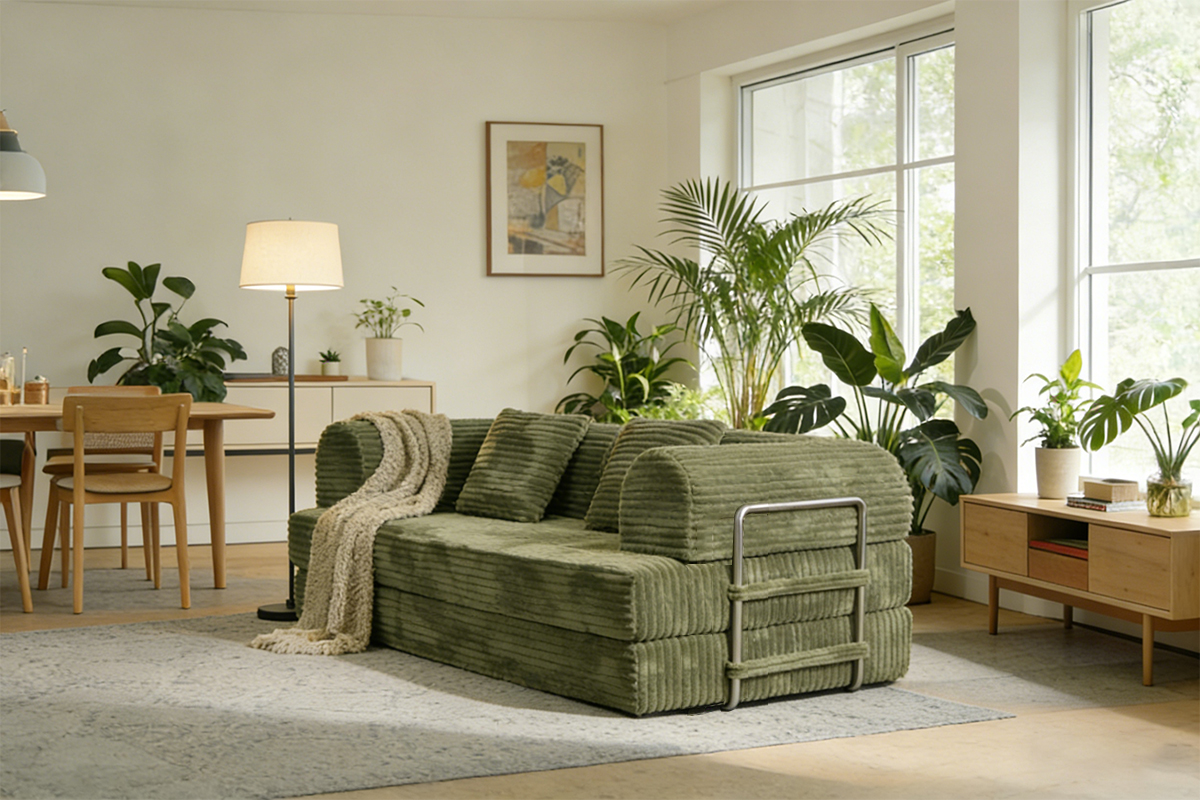
To verify quality, look for international standards and certifications. Factories complying with ISO 9001 quality management, ISO 14001 environmental management, and ISO 45001 occupational health standards guarantee consistent batch production. Furthermore, safety compliance certifications like BS 7177 (UK fire safety) and BSCI ensure the products meet strict global trade and safety requirements. Such standards have been proven in major commercial operations, including high-end hospitality installations like the Beijing Financial Street Ritz-Carlton Hotel and Velaa Private Island Resort in the Maldives.

Data / Solution Comparison
The table below compares different foam densities and their performance characteristics for compressed sofas, alongside shipping and procurement specifications:
| Foam Density Range | Compression Recovery Rate | Structural Durability | Logistics Compatibility | Recommended Use Case |
|---|---|---|---|---|
| Low Density (<25 kg/m³) | Poor (fails to fully rebound; permanent sagging) | Low (softens rapidly under regular use) | Not recommended for vacuum compression | Temporary, low-cost residential bedding |
| Medium Density (25–30 kg/m³) | Moderate (recovers slowly; possible edge soft spots) | Medium (suitable for light commercial use) | Acceptable for short-term compression only | Standard domestic furniture, guest rooms |
| High Density (30–45 kg/m³) | Excellent (recovers 100% within 24–72 hours) | High (retains shape and firmness over years) | Highly optimized for long-term vacuum compression | Luxury hospitality, B2B wholesale, contract projects |
For international procurement, shipping methods include Sea Freight, Air Freight, and Rail Freight. Accepted payment methods are T/T, L/C, PayPal, and cash, ensuring flexible transaction options for global buyers.
Frequently Asked Questions (FAQ)
How long does a high-density compressed sofa take to recover after unpacking?
A compressed sofa utilizing high-density foam (30–45 kg/m³) typically achieves 90% recovery within 24 hours of opening. Complete recovery to its original shape and firmness takes between 48 and 72 hours, depending on ambient room temperature and humidity.
What is the minimum order quantity (MOQ) and delivery timeline for importing compressed sofas?
The minimum order quantity is one container, which can accommodate different sizes and models of compressed sofas. Once the deposit is confirmed by the financial department, manufacturing and delivery take approximately 15 to 35 days.
Are custom sizes, colors, and fabrics available for compressed sofas?
Yes, full OEM/ODM customization services are available. Importers can customize the sizes, colors, and fabric materials to meet specific target market preferences and project designs.
Final Conclusion & Recommendations
When importing compressed sofas, prioritizing high-density foam (30–45 kg/m³) is the most effective way to prevent deformation during transit and ensure perfect recovery upon unpacking. This choice guarantees product longevity and customer satisfaction, particularly for high-use hospitality and contract projects. Partnering with a manufacturer that operates self-controlled material workshops and a dedicated quality inspection team ensures consistent standards and reliable delivery. For bulk purchasing and logistics planning, ensure your orders align with the standard one-container MOQ and plan for a 15 to 35-day production cycle following deposit confirmation.
Technical Support: sales15@jlhmattress.cn
About Us
Jinlongheng Furniture Co., Ltd. is a prominent sleep industry manufacturer founded in 1992. Operating a massive 630,000 square meter total production base in Guangdong, the company specializes in the R&D and manufacturing of high-quality mattresses, upholstered beds, and compressed sofas. With a monthly mattress production capacity of up to 120,000 units and an export ratio of 70%, the enterprise serves over 337 global brands across more than 125 countries and regions.
The company's products comply with international standards including CFR 1633 and BS 7177, and hold prestigious certifications such as BSCI, SGS, ISO 9001, ISO 14001, and ISO 45001. Having successfully executed major hotel projects like the Ritz-Carlton Beijing and Velaa Private Island Resort, the brand delivers reliable, large-scale standardized production backed by a professional quality inspection team.

REPORT