







-
 Agriculture
-
 Health-Care
-
 Environment
-
 Construction-Real-Estate
-
 Tools-Hardware
-
 Home-Garden
-
 Furniture
-
 Luggage-Bags-Cases
-
 Medical-devices-Supplies
-
 Gifts-Crafts
-
 Sports-Entertainment
-
 Food-Beverage
-
 Vehicles-Transportation
-
 Power-Transmission
-
 Material-Handling
-
 Renewable-Energy
-
 Safety
-
 Testing-Instrument-Equipment
-
 Construction-Building-Machinery
-
 Pet-Supplies
-
 Personal-Care-Household-Cleaning
-
 Vehicle-Accessories-Electronics-Tools
-
 School-Office-Supplies
-
 Packaging-Printing
-
 Mother-Kids-Toys
-
 Business-Services
-
 Commercial-Equipment-Machinery
-
 Apparel-Accessories
-
 Security
-
 Shoes-Accessories
-
 Vehicle-Parts-Accessories
-
 Jewelry-Eyewear-Watches-Accessories
-
 Lights-Lighting
-
 Fabric-Textile-Raw-Material
-
 Fabrication-Services
-
 Industrial-Machinery
-
 Consumer-Electronics
-
 Electrical-Equipment-Supplies
-
 Electronic-Components-Accessories-Telecommunications
-
 Home-Appliances
-
 Beauty
-
 Chemicals
-
 Rubber-Plastics
-
 Metals-Alloys


























































































































































































































































































































































































































































































































































































- Masonry Materials
- Curtain Walls & Accessories
- Earthwork Products
- Fireproofing Materials
- Heat Insulation Materials
- Plastic Building Materials
- Building Boards
- Soundproofing Materials
- Timber
- Waterproofing Materials
- Balustrades & Handrails
- Bathroom & Kitchen
- Flooring & Accessories
- Tiles & Accessories
- Door, Window & Accessories
- Fireplaces & Stoves
- Floor Heating Systems & Parts
- Stairs & Stair Parts
- Ceilings
- Elevators & Escalators
- Stone
- Countertops, Vanity Tops & Table Tops
- Mosaics
- Metal Building Materials
- Multifunctional Materials
- Ladders & Scaffoldings
- Mouldings
- Corner Guards
- Decorative Films
- Formwork
- Building & Industrial Glass
- Other Construction & Real Estate
- Wallpapers/Wall panels
- HVAC System & Parts
- Outdoor Facilities
- Prefabricated Buildings
- Festive & Party Supplies
- Bathroom Products
- Household Sundries
- Rain Gear
- Garden Supplies
- Household Cleaning Tools & Accessories
- Lighters & Smoking Accessories
- Home Storage & Organization
- Household Scales
- Smart Home Improvement
- Home Textiles
- Kitchenware
- Drinkware & Accessories
- Dinnerware, Coffee & Wine
- Home Decor
- Golf
- Fitness & Body Building
- Amusement Park Facilities
- Billiards, Board Game,Coin Operated Games
- Musical Instruments
- Outdoor Affordable Luxury Sports
- Camping & Hiking
- Fishing
- Sports Safety&Rehabilitation
- Ball Sports Equipments
- Water Sports
- Winter Sports
- Luxury Travel Equipments
- Sports Shoes, Bags & Accessories
- Cycling
- Other Sports & Entertainment Products
- Artificial Grass&Sports Flooring&Sports Court Equipment
- Scooters
- Food Ingredients
- Honey & Honey Products
- Snacks
- Nuts & Kernels
- Seafood
- Plant & Animal Oil
- Beverages
- Fruit & Vegetable Products
- Frog & Escargot
- Bean Products
- Egg Products
- Dairy Products
- Seasonings & Condiments
- Canned Food
- Instant Food
- Baked Goods
- Other Food & Beverage
- Meat & Poultry
- Confectionery
- Grain Products
- Feminie Care
- Hair Care & Styling
- Body Care
- Hands & Feet Care
- Hygiene Products
- Men's Grooming
- Laundry Cleaning Supplies
- Travel Size & Gift Sets
- Room Deodorizers
- Other Personal Care Products
- Pest Control Products
- Special Household Cleaning
- Floor Cleaning
- Kitchen & Bathroom Cleaning
- Oral Care
- Bath Supplies
- Yellow Pages
- Correction Supplies
- Office Binding Supplies
- Office Cutting Supplies
- Board Erasers
- Office Adhesives & Tapes
- Education Supplies
- Pencil Cases & Bags
- Notebooks & Writing Pads
- File Folder Accessories
- Calendars
- Writing Accessories
- Commercial Office Supplies
- Pencil Sharpeners
- Pens
- Letter Pad/Paper
- Paper Envelopes
- Desk Organizers
- Pencils
- Markers & Highlighters
- Filing Products
- Art Supplies
- Easels
- Badge Holder & Accessories
- Office Paper
- Printer Supplies
- Book Covers
- Other Office & School Supplies
- Stationery Set
- Boards
- Clipboards
- Stamps
- Drafting Supplies
- Stencils
- Electronic Dictionary
- Books
- Map
- Magazines
- Calculators
- Baby & Toddler Toys
- Educational Toys
- Classic Toys
- Dress Up & Pretend Play
- Toy Vehicle
- Stuffed Animals & Plush Toys
- Outdoor Toys & Structures
- Balloons & Accessories
- Baby Food
- Children's Clothing
- Baby Supplies & Products
- Maternity Clothes
- Kids Shoes
- Baby Care
- Novelty & Gag Toys
- Dolls & Accessories
- Puzzle & Games
- Blocks & Model Building Toys
- Toddler Clothing
- Baby Clothing
- Kids' Luggage & Bags
- Arts, Crafts & DIY Toys
- Action & Toy Figures
- Baby Appliances
- Hobbies & Models
- Remote Control Toys
- Promotional Toys
- Pregnancy & Maternity
- Hygiene Products
- Kid's Textile&Bedding
- Novelty & Special Use
- Toy Weapons
- Baby Gifts
- Baby Storage & Organization
- Auto Drive Systems
- ATV/UTV Parts & Accessories
- Marine Parts & Accessories
- Other Auto Parts
- Trailer Parts & Accessories
- Auto Transmission Systems
- Train Parts & Accessories
- Universal Parts
- Railway Parts & Accessories
- Auto Brake Systems
- Aviation Parts & Accessories
- Truck Parts & Accessories
- Auto Suspension Systems
- Auto Lighting Systems
- New Energy Vehicle Parts & Accessories
- Auto Steering Systems
- Wheels, Tires & Accessories
- Bus Parts & Accessories
- Auto Performance Parts
- Cooling System
- Go-Kart & Kart Racer Parts & Accessories
- Air Conditioning Systems
- Heavy Duty Vehicle Parts & Accessories
- Auto Electrical Systems
- Auto Body Systems
- Auto Engine Systems
- Container Parts & Accessories
- Motorcycle Parts & Accessories
- Refrigeration & Heat Exchange Equipment
- Machine Tool Equipment
- Food & Beverage Machinery
- Agricultural Machinery & Equipment
- Apparel & Textile Machinery
- Chemical Machinery
- Packaging Machines
- Paper Production Machinery
- Plastic & Rubber Processing Machinery
- Industrial Robots
- Electronic Products Machinery
- Metal & Metallurgy Machinery
- Woodworking Machinery
- Home Product Manufacturing Machinery
- Machinery Accessories
- Environmental Machinery
- Machinery Service
- Electrical Equipment Manufacturing Machinery
- Industrial Compressors & Parts
- Tobacco & Cigarette Machinery
- Production Line
- Used Industrial Machinery
- Electronics Production Machinery
- Other Machinery & Industrial Equipment
- Camera, Photo & Accessories
- Portable Audio, Video & Accessories
- Television, Home Audio, Video & Accessories
- Video Games & Accessories
- Mobile Phone & Accessories
- Electronic Publications
- Earphone & Headphone & Accessories
- Speakers & Accessories
- Smart Electronics
- TV Receivers & Accessories
- Mobile Phone & Computer Repair Parts
- Chargers, Batteries & Power Supplies
- Used Electronics
- VR, AR, MR Hardware & Software
- Projectors & Presentation Equipments
- Other Consumer Electronics
- Cables & Commonly Used Accessories
- Computer Hardware & Software
- Displays, Signage and Optoelectronics
- Discrete Semiconductors
- Wireless & IoT Module and Products
- Telecommunications
- Connectors, Terminals & Accessories
- Development Boards, Electronic Modules and Kits
- Circuit Protection
- Sensors
- Isolators
- Audio Components and Products
- Integrated Circuits
- Power Supplies
- Relays
- RF, Microwave and RFID
- Electronic Accessories & Supplies
- Passive Components
- PCB & PCBA
- Air Quality Appliances
- Home Appliance Parts
- Heating & Cooling Appliances
- Small Kitchen Appliances
- Laundry Appliances
- Water Heaters
- Water Treatment Appliances
- Refrigerators & Freezers
- Personal Care & Beauty Appliances
- Major Kitchen Appliances
- Cleaning Appliances
- Second-hand Appliances
- Smart Home Appliances
- Other Home Appliances
- Energy Chemicals
- Inorganic Chemicals
- Basic Organic Chemicals
- Agrochemicals
- Admixture & Additives
- Catalysts & Chemical Auxiliary Agents
- Pigments & Dyestuff
- Coating & Paint
- Daily Chemicals
- Polymer
- Organic Intermediate
- Adhesives & Sealants
- Chemical Waste
- Biological Chemical Products
- Surface Treatment Chemicals
- Painting & Coating
- Chemical Reagents
- Flavor & Fragrance
- Non-Explosive Demolition Agents
- Other Chemicals
- Custom Chemical Services

How Reliably Can a Toast Bread Packaging Line Run Through Long Shifts?
Long-shift reliability in a toast bread packaging line depends on how effectively the slicer, product infeed, bagging or wrapping unit, sealing equipment, and control system work together. The documented solution is designed for automatic operation and includes PLC and HMI controls, adjustable feeding, recipe storage, blade-break detection, and production testing with customer samples. Depending on the bread format and machine configuration, the stated integrated capacity is between 1,000 and 4,500 loaves per hour.
What Supports Stable Continuous Production?
A dependable packaging line must maintain consistent product movement while handling slicing, bag placement, closing, and discharge. The available configuration combines these operations in one continuous workflow, reducing manual transfers between individual machines.
- Toast bread can be sliced, bagged or flow wrapped, and sealed in a connected production sequence.
- Automatic feeding, PLC-based control, HMI operation, recipe management, and variable belt speeds help maintain repeatable performance.
- Blade-break monitoring with automatic stopping, removable crumb trays, food-grade stainless steel surfaces, and protected electrical components support safety and sanitation.
- For large food plants, a fully automatic setup can move loaves through the packaging process with limited operator handling. The supplied application information also covers automatic packaging for pharmaceutical products, snacks, pet food, and personal-care goods.
Machine Structure and Operating Principle
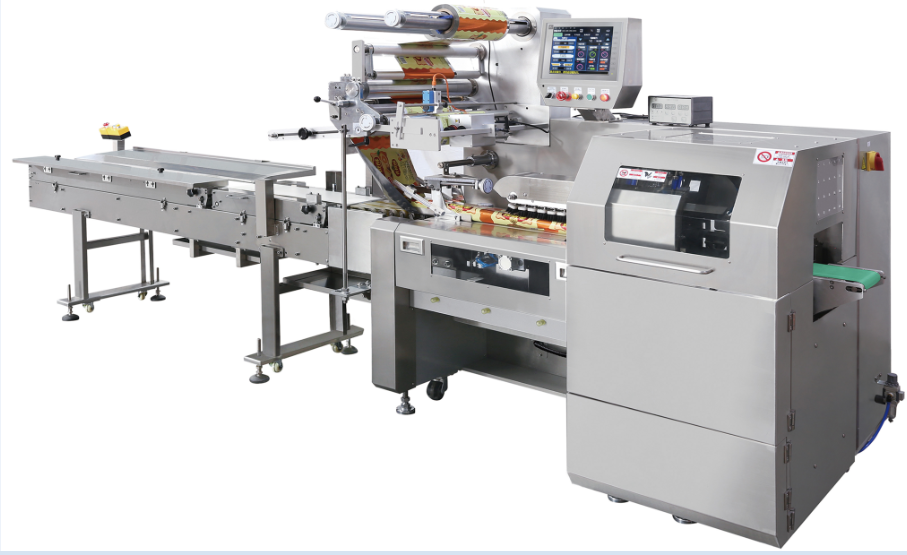
The line is built from coordinated processing sections. In the slicing unit, continuous band blades work with upper, lower, and side belts to guide the loaf. Inverter control allows the operator to adjust the operating speed according to product requirements. After slicing, the loaf enters either a pre-formed bagging unit or a flow-wrapper, where the package is formed or opened before being closed by sealing, clip-band closing, or twist-tie closing.
Maintaining a balanced transfer between these sections is essential during extended operation. The stated design includes automatic infeed phasing, adjustable bag tension, scoop-opening control, and recipe-based settings. These functions help operators repeat established parameters when changing products. In the listed configuration, a slicer-bagger combination may also use an automatic dual-wicket bag exchanger, allowing the bag supply to be replaced with minimal interruption.
Control, Safety, and Hygiene Features
Automatic protection functions help reduce the effect of common operating interruptions. The slicer is equipped with blade-break detection and an automatic stop function. PLC and HMI controls coordinate the machine sequence and give operators access to settings and production information. Optional devices may include metal detection, checkweighing, label application, and thermal printing, extending inspection and traceability without altering the main slicing and packaging process.
The general specifications identify a 380V to 400V, three-phase electrical supply at 50 to 60Hz and compressed air at 5 to 6 bar. Integrated equipment is built with food-grade AISI 304 stainless steel. Removable crumb trays, accessible machine construction, and IP-rated motors are intended to simplify cleaning and support hygienic operation. Actual performance over a long shift still depends on the loaf dimensions, package materials, selected speed, utilities, and conditions at the installation site.
Capacity and Pre-Delivery Verification
The product data indicates a total line capacity of 1,000 to 4,500 loaves per hour, with individual loaf weights ranging from 100 g to 1,500 g. The flow-wrapping section is listed at 20 to 120 bags per minute. The pre-formed bagging section is specified at 25 to 40 bags per minute and up to 75 loaves per minute in continuous flow. These figures apply to different configurations and should not be treated as a guaranteed output for every product or installation.
Before delivery, the equipment can be evaluated through 48-hour testing or testing with customer-provided samples. Sample trials are useful for checking the interaction of slicing, feeding, packaging, and sealing with the intended bread size and packaging material. The company knowledge base also identifies CE certification for applicable flow packaging machines, automatic packaging systems, cartoning equipment, and palletizing robots.
A documented chocolate pie cake packaging project for Orion further demonstrates the company’s experience with demanding bakery automation. That system combines forming, baking, filling, enrobing, wrapping, and robotic palletizing, showing how packaging equipment can be integrated into a broader production line.
Configuration Comparison
| Configuration | Typical Operating Characteristics | Features That Support Stability |
|---|---|---|
| Basic slicer and bagger | 25–40 packs per minute with separate slicing and bagging operations | Automatic operation and stainless steel construction |
| Integrated slicer-bagger combination | Up to 65 loaves per minute in the stated configuration | Recipe settings, automatic bag exchange, and blade-break detection |
| High-output automatic line | Up to 75 or more packs per minute in the comparison data, depending on the product | PLC and HMI control, recipe management, optional remote diagnostics, and inspection equipment |
| Crustless or decrusting bread line | Approximately 50 packs per minute in the specified configuration | Two decrusting stations, continuous blades, guarded sealing equipment, and touchscreen control |
Frequently Asked Questions
Is the toast bread packaging line suitable for long continuous shifts?
The design supports extended production through automatic feeding, coordinated slicing and packaging, PLC and HMI control, adjustable product flow, and automatic stopping when a blade problem is detected. However, the supplied information does not define one universal maximum shift duration. The appropriate operating schedule must be confirmed for the selected configuration, product, and site conditions.
Which conditions have the greatest effect on operating stability?
Loaf dimensions, weight, slice thickness, film or bag material, packaging speed, compressed-air pressure, electrical supply, and changeover settings all influence performance. Adjustable slice thickness, inverter-controlled feeding, recipe storage, and bag-tension control allow the line to be adapted to different production requirements.
How can the line be tested before shipment?
The product information states that the equipment may undergo a 48-hour run or a test using customer samples. Sample testing can verify slicing quality, transfer accuracy, package handling, sealing performance, and the suitability of the selected packaging format. Applicable automation and packaging equipment is also identified as having CE certification.
Conclusion and Selection Advice
A toast bread packaging line can provide consistent long-shift production when its slicing, feeding, bagging or flow-wrapping, sealing, and control components are correctly matched to the product. The line should be selected according to loaf weight, dimensions, slice thickness, package style, material, and required output. The highest published capacity should not be used as a universal target because actual results vary by configuration and operating conditions.
Ruipuhua provides manufacturing and OEM cooperation, with a listed minimum order quantity of one unit and engineer support for the equipment. For a product-specific technical proposal or operating guidance, contact lotuspack@ruipuhua.com.
About Us
Foshan Ruipuhua Machinery Equipment Co. Ltd manufactures automatic packaging and palletizing equipment for food, bakery, biscuit, snack, noodle, chocolate, soap, hardware, pharmaceutical, and daily chemical applications. Established in 2005, the company operates a 50,000-square-meter factory and combines research and development, manufacturing, installation, and technical after-sales service. Its customized solutions cover feeding, wrapping, secondary packaging, case packing, and palletizing. Listed credentials include CE certification M.2024.206.C107511, while documented project experience includes an integrated chocolate pie cake packaging system for Orion.

REPORT