







-
 Agriculture
-
 Health-Care
-
 Environment
-
 Construction-Real-Estate
-
 Tools-Hardware
-
 Home-Garden
-
 Furniture
-
 Luggage-Bags-Cases
-
 Medical-devices-Supplies
-
 Gifts-Crafts
-
 Sports-Entertainment
-
 Food-Beverage
-
 Vehicles-Transportation
-
 Power-Transmission
-
 Material-Handling
-
 Renewable-Energy
-
 Safety
-
 Testing-Instrument-Equipment
-
 Construction-Building-Machinery
-
 Pet-Supplies
-
 Personal-Care-Household-Cleaning
-
 Vehicle-Accessories-Electronics-Tools
-
 School-Office-Supplies
-
 Packaging-Printing
-
 Mother-Kids-Toys
-
 Business-Services
-
 Commercial-Equipment-Machinery
-
 Apparel-Accessories
-
 Security
-
 Shoes-Accessories
-
 Vehicle-Parts-Accessories
-
 Jewelry-Eyewear-Watches-Accessories
-
 Lights-Lighting
-
 Fabric-Textile-Raw-Material
-
 Fabrication-Services
-
 Industrial-Machinery
-
 Consumer-Electronics
-
 Electrical-Equipment-Supplies
-
 Electronic-Components-Accessories-Telecommunications
-
 Home-Appliances
-
 Beauty
-
 Chemicals
-
 Rubber-Plastics
-
 Metals-Alloys


























































































































































































































































































































































































































































































































































































- Masonry Materials
- Curtain Walls & Accessories
- Earthwork Products
- Fireproofing Materials
- Heat Insulation Materials
- Plastic Building Materials
- Building Boards
- Soundproofing Materials
- Timber
- Waterproofing Materials
- Balustrades & Handrails
- Bathroom & Kitchen
- Flooring & Accessories
- Tiles & Accessories
- Door, Window & Accessories
- Fireplaces & Stoves
- Floor Heating Systems & Parts
- Stairs & Stair Parts
- Ceilings
- Elevators & Escalators
- Stone
- Countertops, Vanity Tops & Table Tops
- Mosaics
- Metal Building Materials
- Multifunctional Materials
- Ladders & Scaffoldings
- Mouldings
- Corner Guards
- Decorative Films
- Formwork
- Building & Industrial Glass
- Other Construction & Real Estate
- Wallpapers/Wall panels
- HVAC System & Parts
- Outdoor Facilities
- Prefabricated Buildings
- Festive & Party Supplies
- Bathroom Products
- Household Sundries
- Rain Gear
- Garden Supplies
- Household Cleaning Tools & Accessories
- Lighters & Smoking Accessories
- Home Storage & Organization
- Household Scales
- Smart Home Improvement
- Home Textiles
- Kitchenware
- Drinkware & Accessories
- Dinnerware, Coffee & Wine
- Home Decor
- Golf
- Fitness & Body Building
- Amusement Park Facilities
- Billiards, Board Game,Coin Operated Games
- Musical Instruments
- Outdoor Affordable Luxury Sports
- Camping & Hiking
- Fishing
- Sports Safety&Rehabilitation
- Ball Sports Equipments
- Water Sports
- Winter Sports
- Luxury Travel Equipments
- Sports Shoes, Bags & Accessories
- Cycling
- Other Sports & Entertainment Products
- Artificial Grass&Sports Flooring&Sports Court Equipment
- Scooters
- Food Ingredients
- Honey & Honey Products
- Snacks
- Nuts & Kernels
- Seafood
- Plant & Animal Oil
- Beverages
- Fruit & Vegetable Products
- Frog & Escargot
- Bean Products
- Egg Products
- Dairy Products
- Seasonings & Condiments
- Canned Food
- Instant Food
- Baked Goods
- Other Food & Beverage
- Meat & Poultry
- Confectionery
- Grain Products
- Feminie Care
- Hair Care & Styling
- Body Care
- Hands & Feet Care
- Hygiene Products
- Men's Grooming
- Laundry Cleaning Supplies
- Travel Size & Gift Sets
- Room Deodorizers
- Other Personal Care Products
- Pest Control Products
- Special Household Cleaning
- Floor Cleaning
- Kitchen & Bathroom Cleaning
- Oral Care
- Bath Supplies
- Yellow Pages
- Correction Supplies
- Office Binding Supplies
- Office Cutting Supplies
- Board Erasers
- Office Adhesives & Tapes
- Education Supplies
- Pencil Cases & Bags
- Notebooks & Writing Pads
- File Folder Accessories
- Calendars
- Writing Accessories
- Commercial Office Supplies
- Pencil Sharpeners
- Pens
- Letter Pad/Paper
- Paper Envelopes
- Desk Organizers
- Pencils
- Markers & Highlighters
- Filing Products
- Art Supplies
- Easels
- Badge Holder & Accessories
- Office Paper
- Printer Supplies
- Book Covers
- Other Office & School Supplies
- Stationery Set
- Boards
- Clipboards
- Stamps
- Drafting Supplies
- Stencils
- Electronic Dictionary
- Books
- Map
- Magazines
- Calculators
- Baby & Toddler Toys
- Educational Toys
- Classic Toys
- Dress Up & Pretend Play
- Toy Vehicle
- Stuffed Animals & Plush Toys
- Outdoor Toys & Structures
- Balloons & Accessories
- Baby Food
- Children's Clothing
- Baby Supplies & Products
- Maternity Clothes
- Kids Shoes
- Baby Care
- Novelty & Gag Toys
- Dolls & Accessories
- Puzzle & Games
- Blocks & Model Building Toys
- Toddler Clothing
- Baby Clothing
- Kids' Luggage & Bags
- Arts, Crafts & DIY Toys
- Action & Toy Figures
- Baby Appliances
- Hobbies & Models
- Remote Control Toys
- Promotional Toys
- Pregnancy & Maternity
- Hygiene Products
- Kid's Textile&Bedding
- Novelty & Special Use
- Toy Weapons
- Baby Gifts
- Baby Storage & Organization
- Auto Drive Systems
- ATV/UTV Parts & Accessories
- Marine Parts & Accessories
- Other Auto Parts
- Trailer Parts & Accessories
- Auto Transmission Systems
- Train Parts & Accessories
- Universal Parts
- Railway Parts & Accessories
- Auto Brake Systems
- Aviation Parts & Accessories
- Truck Parts & Accessories
- Auto Suspension Systems
- Auto Lighting Systems
- New Energy Vehicle Parts & Accessories
- Auto Steering Systems
- Wheels, Tires & Accessories
- Bus Parts & Accessories
- Auto Performance Parts
- Cooling System
- Go-Kart & Kart Racer Parts & Accessories
- Air Conditioning Systems
- Heavy Duty Vehicle Parts & Accessories
- Auto Electrical Systems
- Auto Body Systems
- Auto Engine Systems
- Container Parts & Accessories
- Motorcycle Parts & Accessories
- Refrigeration & Heat Exchange Equipment
- Machine Tool Equipment
- Food & Beverage Machinery
- Agricultural Machinery & Equipment
- Apparel & Textile Machinery
- Chemical Machinery
- Packaging Machines
- Paper Production Machinery
- Plastic & Rubber Processing Machinery
- Industrial Robots
- Electronic Products Machinery
- Metal & Metallurgy Machinery
- Woodworking Machinery
- Home Product Manufacturing Machinery
- Machinery Accessories
- Environmental Machinery
- Machinery Service
- Electrical Equipment Manufacturing Machinery
- Industrial Compressors & Parts
- Tobacco & Cigarette Machinery
- Production Line
- Used Industrial Machinery
- Electronics Production Machinery
- Other Machinery & Industrial Equipment
- Camera, Photo & Accessories
- Portable Audio, Video & Accessories
- Television, Home Audio, Video & Accessories
- Video Games & Accessories
- Mobile Phone & Accessories
- Electronic Publications
- Earphone & Headphone & Accessories
- Speakers & Accessories
- Smart Electronics
- TV Receivers & Accessories
- Mobile Phone & Computer Repair Parts
- Chargers, Batteries & Power Supplies
- Used Electronics
- VR, AR, MR Hardware & Software
- Projectors & Presentation Equipments
- Other Consumer Electronics
- Cables & Commonly Used Accessories
- Computer Hardware & Software
- Displays, Signage and Optoelectronics
- Discrete Semiconductors
- Wireless & IoT Module and Products
- Telecommunications
- Connectors, Terminals & Accessories
- Development Boards, Electronic Modules and Kits
- Circuit Protection
- Sensors
- Isolators
- Audio Components and Products
- Integrated Circuits
- Power Supplies
- Relays
- RF, Microwave and RFID
- Electronic Accessories & Supplies
- Passive Components
- PCB & PCBA
- Air Quality Appliances
- Home Appliance Parts
- Heating & Cooling Appliances
- Small Kitchen Appliances
- Laundry Appliances
- Water Heaters
- Water Treatment Appliances
- Refrigerators & Freezers
- Personal Care & Beauty Appliances
- Major Kitchen Appliances
- Cleaning Appliances
- Second-hand Appliances
- Smart Home Appliances
- Other Home Appliances
- Energy Chemicals
- Inorganic Chemicals
- Basic Organic Chemicals
- Agrochemicals
- Admixture & Additives
- Catalysts & Chemical Auxiliary Agents
- Pigments & Dyestuff
- Coating & Paint
- Daily Chemicals
- Polymer
- Organic Intermediate
- Adhesives & Sealants
- Chemical Waste
- Biological Chemical Products
- Surface Treatment Chemicals
- Painting & Coating
- Chemical Reagents
- Flavor & Fragrance
- Non-Explosive Demolition Agents
- Other Chemicals
- Custom Chemical Services

How to Assess an Ethical and Capable Custom Sports Socks Factory
Choosing a supplier for custom sports socks involves more than reviewing product photos or receiving a low quotation. A dependable factory should be able to demonstrate responsible business practices, product-specific manufacturing capability, reliable sampling, and a clearly documented quality-control process. For grip socks in particular, buyers need to verify both knitting expertise and the equipment used to apply durable anti-slip patterns.
What to Verify Before Choosing a Custom Sock Manufacturer
A thorough factory review should combine paperwork, production evidence, physical samples, and realistic delivery planning. Certifications may support ethical and material claims, but they should be checked alongside the factory's actual production location, machinery, inspection standards, and ability to meet your product requirements.
- Validate ethical and textile-related certificates, including their numbers, expiry dates, and applicable production scope.
- Confirm that the supplier has machinery suited to the sock design, especially for jacquard knitting, toe closing, sewing, and grip dispensing.
- Order and inspect a pre-production sample before approving a bulk purchase.
- Request written quality standards, lead times, and defect-handling procedures.
- Review whether the factory has experience with the intended market, such as sports teams, Pilates studios, branded promotions, or fashion retail.
Start with Ethical and Material Documentation
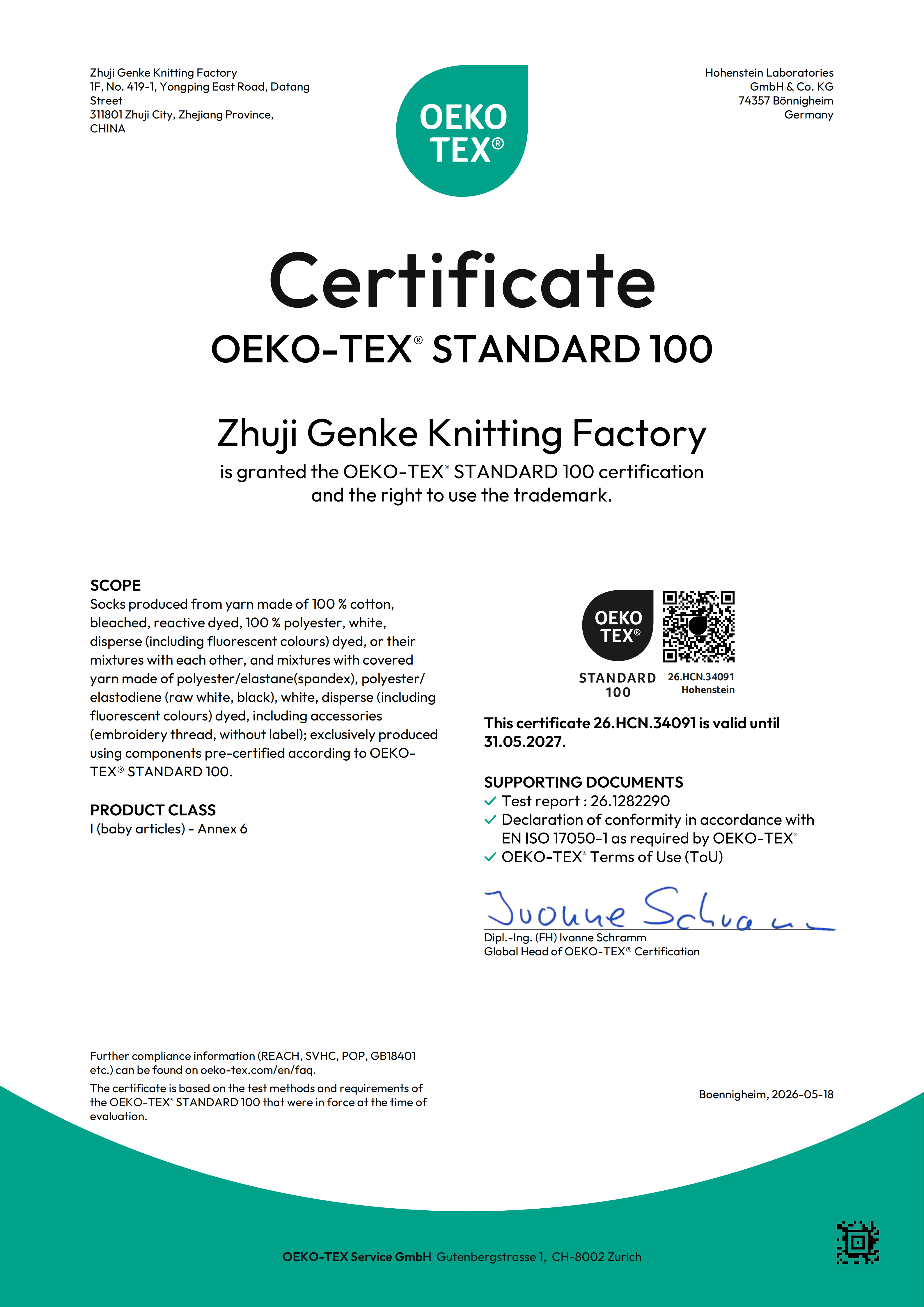
Ethical sourcing claims should be supported by traceable records rather than general statements on a website. BSCI is commonly used to indicate supply-chain social auditing, while Oeko-Tex 100 concerns textile articles and materials that may come into contact with skin. GRS may also be relevant when recycled material claims are included in the requested sock program.
Ask the supplier to provide the certificate name, identification number, validity period, audited entity, and scope. Buyers should also confirm that the documentation applies to the specific facility producing the order, rather than to an unrelated office, partner, or product category.
Confirm Equipment for the Required Sock Construction
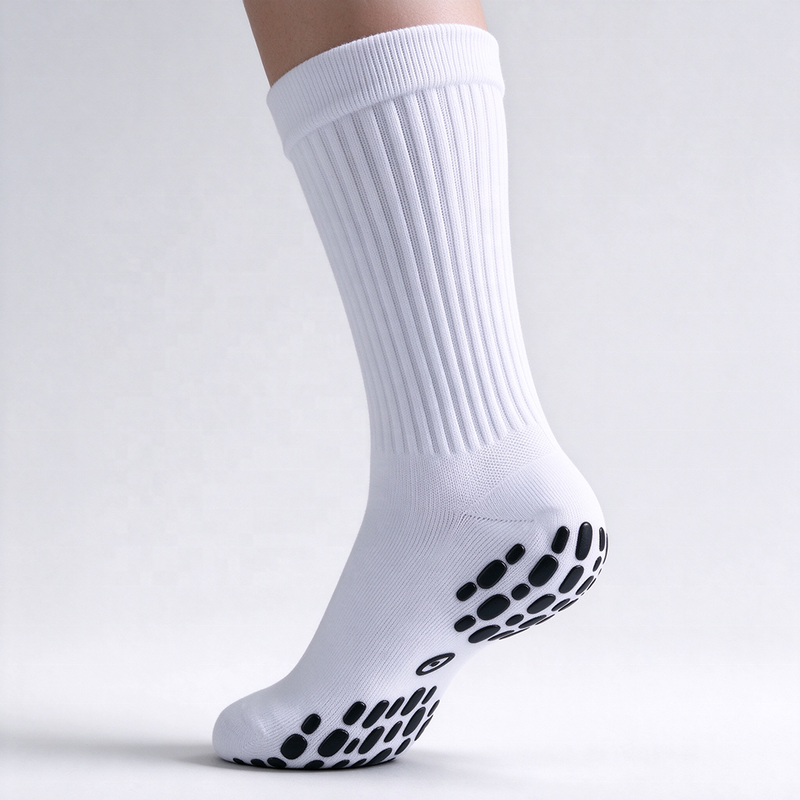
Manufacturing capability must match the construction of the sock you want to buy. A custom soccer grip sock, for example, may require a supportive ribbed leg, elastic cuff retention, breathable knit zones, reinforced high-wear areas, and anti-slip coverage across the sole and heel. A factory should be able to explain how every one of these components is produced.
For customized grip socks, the essential process normally includes computerized patterned knitting, toe closing, sewing or finishing, and silicone or PVC dispensing. The supplier should be able to document how it controls grip shape, dot density, placement, color, adhesion, and curing. It should also clarify available options for custom sizing, logo placement, yarn blends, packaging, private labels, and anti-slip layouts.
Questions to Ask About Production Capacity
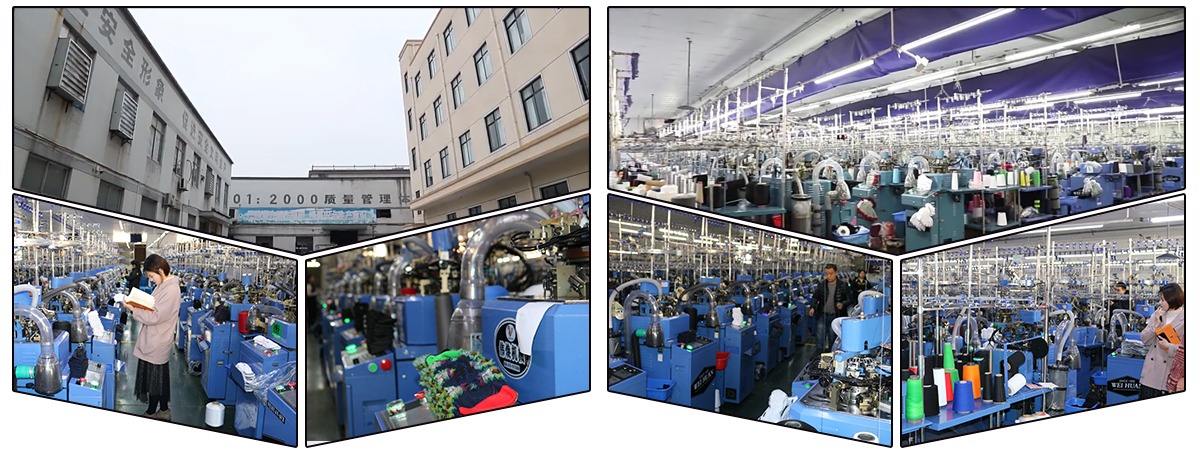
Request a clear explanation of the machinery and workflow used for your item. The stated production setup includes more than 200 computerized high-speed jacquard machines, automatic toe-closing and sewing machines, plus dedicated silicone or PVC dispensing equipment. Buyers can ask for factory photos, production videos, machine lists, or a live virtual inspection to confirm that these resources are available and relevant to the proposed sock style.
Use Sampling as the Practical Capability Test
A sample is the most useful way to determine whether a supplier can convert specifications into a commercially acceptable product. The stated sample lead time for custom grip socks is 7 to 10 business days. Before authorizing mass production, compare the sample carefully against an approved specification sheet or artwork file.
Inspect knit uniformity, yarn feel, stretch, recovery of the cuff, fit, breathability, color accuracy, logo clarity, toe finish, and overall appearance. For grip socks, pay particular attention to whether the sole and heel pattern is positioned correctly, consistently applied, and firmly adhered to the fabric. The approved sample should be retained as the production reference for the final order.
Review Quality Control in Operational Detail
A statement such as “100% manual inspection” is useful only when it is supported by a defined inspection routine. The product and factory information states that 100% manual inspection and multi-stage QC are used. Buyers should ask which checkpoints are included and how nonconforming pairs are identified, isolated, repaired, or replaced.
Useful questions include whether inspectors check size tolerance, color consistency, loose threads, knit defects, logo accuracy, grip adhesion, pair matching, packaging, and carton labeling. Request final inspection records where possible, and establish in writing how the supplier will handle defects discovered before shipment or after delivery.
Match Factory Experience to Your End Use
The best specification for socks varies by market. Athletic teams may prioritize compression, durability, moisture management, and secure traction. Yoga and Pilates studios often require strong grip coverage, comfort, and branded presentation. Corporate gift programs may focus on logo visibility and packaging, while fashion retailers may place greater emphasis on yarn texture, color development, and seasonal designs.
The company reports experience with North American boutique fitness chains, athletic teams, corporate marketing agencies, independent fashion retailers, and gift distributors. These use cases can help buyers evaluate whether its previous work is relevant to professional sports gear, studio grip socks, promotional merchandise, or retail sock collections.
Factory Verification Checklist
| Review Area | Available Evidence | Recommended Buyer Action |
|---|---|---|
| Ethical and material compliance | BSCI, Oeko-Tex 100, and GRS credentials are listed. | Check certificate numbers, validity, audited facility, and product scope. |
| Grip sock production | More than 200 computerized jacquard machines, automatic toe-closing and sewing equipment, and silicone or PVC dispensing machinery are stated. | Ask how knitting, grip application, curing, and finishing are managed for your design. |
| Customization and sampling | Custom yarn combinations, colors, logos, grip patterns, packaging, and private-label services are available; samples are stated to take 7 to 10 business days. | Approve a physical sample against written technical requirements before bulk production. |
| Quality assurance | 100% manual inspection is stated. | Confirm inspection points, defect limits, reporting methods, and reference-sample controls. |
| Delivery planning | Bulk production is stated as 15 to 25 business days after sample approval and deposit; repeat orders are stated as 10 to 20 business days. | Obtain a production schedule based on order quantity, yarn availability, customization complexity, and seasonal capacity. |
Frequently Asked Questions
Does BSCI certification guarantee that every order is ethically produced?
No. BSCI can be a valuable supply-chain auditing reference, but it does not remove the need for order-specific verification. Review the certificate carefully and make sure the named factory, address, and scope correspond with the facility responsible for your socks.
Which equipment is important for custom anti-slip sports socks?
The manufacturer should be able to handle patterned knitting, toe closing, sewing or finishing, and the application of anti-slip material. For grip socks, computerized jacquard knitting machines and specialized silicone or PVC dispensing equipment are particularly important.
What should be checked on a custom soccer grip sock sample?
Review cuff support, ribbed knit quality, size, breathability, sole and heel grip coverage, grip adhesion, logo placement, color matching, toe finishing, and consistency across the pair. Confirm that the signed-off sample will be used as the benchmark during bulk inspection.
Final Recommendations
To select a reliable custom sports socks factory, evaluate documents and operations together. Verify certifications, ensure the production equipment suits your product, test the supplier through sampling, define inspection requirements, and secure a written delivery schedule. Yiwu Genke Apparel Co., Ltd. states that it provides integrated manufacturing and high-end customization, with 100% manual inspection and listed BSCI, Oeko-Tex 100, and GRS credentials. For technical guidance or project support, contact happygu@cnleyoyo.com.
About Us
Yiwu Genke Apparel Co., Ltd. produces customized socks for sporting activities, promotional campaigns, yoga and Pilates studios, business programs, and fashion applications. Founded in 2016, the company states that it operates a 1200 sqm factory with annual capacity of 12,000,000 pairs. Its reported development resources include 30 professional R&D engineers and fashion designers, computerized jacquard knitting machines, seamless heat-transfer printing, and grip-pattern dispensing equipment. The company lists Oeko-Tex 100, BSCI, and GRS credentials and reports serving customers in multiple industries.
REPORT