







-
 Agriculture
-
 Health-Care
-
 Environment
-
 Construction-Real-Estate
-
 Tools-Hardware
-
 Home-Garden
-
 Furniture
-
 Luggage-Bags-Cases
-
 Medical-devices-Supplies
-
 Gifts-Crafts
-
 Sports-Entertainment
-
 Food-Beverage
-
 Vehicles-Transportation
-
 Power-Transmission
-
 Material-Handling
-
 Renewable-Energy
-
 Safety
-
 Testing-Instrument-Equipment
-
 Construction-Building-Machinery
-
 Pet-Supplies
-
 Personal-Care-Household-Cleaning
-
 Vehicle-Accessories-Electronics-Tools
-
 School-Office-Supplies
-
 Packaging-Printing
-
 Mother-Kids-Toys
-
 Business-Services
-
 Commercial-Equipment-Machinery
-
 Apparel-Accessories
-
 Security
-
 Shoes-Accessories
-
 Vehicle-Parts-Accessories
-
 Jewelry-Eyewear-Watches-Accessories
-
 Lights-Lighting
-
 Fabric-Textile-Raw-Material
-
 Fabrication-Services
-
 Industrial-Machinery
-
 Consumer-Electronics
-
 Electrical-Equipment-Supplies
-
 Electronic-Components-Accessories-Telecommunications
-
 Home-Appliances
-
 Beauty
-
 Chemicals
-
 Rubber-Plastics
-
 Metals-Alloys


























































































































































































































































































































































































































































































































































































- Masonry Materials
- Curtain Walls & Accessories
- Earthwork Products
- Fireproofing Materials
- Heat Insulation Materials
- Plastic Building Materials
- Building Boards
- Soundproofing Materials
- Timber
- Waterproofing Materials
- Balustrades & Handrails
- Bathroom & Kitchen
- Flooring & Accessories
- Tiles & Accessories
- Door, Window & Accessories
- Fireplaces & Stoves
- Floor Heating Systems & Parts
- Stairs & Stair Parts
- Ceilings
- Elevators & Escalators
- Stone
- Countertops, Vanity Tops & Table Tops
- Mosaics
- Metal Building Materials
- Multifunctional Materials
- Ladders & Scaffoldings
- Mouldings
- Corner Guards
- Decorative Films
- Formwork
- Building & Industrial Glass
- Other Construction & Real Estate
- Wallpapers/Wall panels
- HVAC System & Parts
- Outdoor Facilities
- Prefabricated Buildings
- Festive & Party Supplies
- Bathroom Products
- Household Sundries
- Rain Gear
- Garden Supplies
- Household Cleaning Tools & Accessories
- Lighters & Smoking Accessories
- Home Storage & Organization
- Household Scales
- Smart Home Improvement
- Home Textiles
- Kitchenware
- Drinkware & Accessories
- Dinnerware, Coffee & Wine
- Home Decor
- Golf
- Fitness & Body Building
- Amusement Park Facilities
- Billiards, Board Game,Coin Operated Games
- Musical Instruments
- Outdoor Affordable Luxury Sports
- Camping & Hiking
- Fishing
- Sports Safety&Rehabilitation
- Ball Sports Equipments
- Water Sports
- Winter Sports
- Luxury Travel Equipments
- Sports Shoes, Bags & Accessories
- Cycling
- Other Sports & Entertainment Products
- Artificial Grass&Sports Flooring&Sports Court Equipment
- Scooters
- Food Ingredients
- Honey & Honey Products
- Snacks
- Nuts & Kernels
- Seafood
- Plant & Animal Oil
- Beverages
- Fruit & Vegetable Products
- Frog & Escargot
- Bean Products
- Egg Products
- Dairy Products
- Seasonings & Condiments
- Canned Food
- Instant Food
- Baked Goods
- Other Food & Beverage
- Meat & Poultry
- Confectionery
- Grain Products
- Feminie Care
- Hair Care & Styling
- Body Care
- Hands & Feet Care
- Hygiene Products
- Men's Grooming
- Laundry Cleaning Supplies
- Travel Size & Gift Sets
- Room Deodorizers
- Other Personal Care Products
- Pest Control Products
- Special Household Cleaning
- Floor Cleaning
- Kitchen & Bathroom Cleaning
- Oral Care
- Bath Supplies
- Yellow Pages
- Correction Supplies
- Office Binding Supplies
- Office Cutting Supplies
- Board Erasers
- Office Adhesives & Tapes
- Education Supplies
- Pencil Cases & Bags
- Notebooks & Writing Pads
- File Folder Accessories
- Calendars
- Writing Accessories
- Commercial Office Supplies
- Pencil Sharpeners
- Pens
- Letter Pad/Paper
- Paper Envelopes
- Desk Organizers
- Pencils
- Markers & Highlighters
- Filing Products
- Art Supplies
- Easels
- Badge Holder & Accessories
- Office Paper
- Printer Supplies
- Book Covers
- Other Office & School Supplies
- Stationery Set
- Boards
- Clipboards
- Stamps
- Drafting Supplies
- Stencils
- Electronic Dictionary
- Books
- Map
- Magazines
- Calculators
- Baby & Toddler Toys
- Educational Toys
- Classic Toys
- Dress Up & Pretend Play
- Toy Vehicle
- Stuffed Animals & Plush Toys
- Outdoor Toys & Structures
- Balloons & Accessories
- Baby Food
- Children's Clothing
- Baby Supplies & Products
- Maternity Clothes
- Kids Shoes
- Baby Care
- Novelty & Gag Toys
- Dolls & Accessories
- Puzzle & Games
- Blocks & Model Building Toys
- Toddler Clothing
- Baby Clothing
- Kids' Luggage & Bags
- Arts, Crafts & DIY Toys
- Action & Toy Figures
- Baby Appliances
- Hobbies & Models
- Remote Control Toys
- Promotional Toys
- Pregnancy & Maternity
- Hygiene Products
- Kid's Textile&Bedding
- Novelty & Special Use
- Toy Weapons
- Baby Gifts
- Baby Storage & Organization
- Auto Drive Systems
- ATV/UTV Parts & Accessories
- Marine Parts & Accessories
- Other Auto Parts
- Trailer Parts & Accessories
- Auto Transmission Systems
- Train Parts & Accessories
- Universal Parts
- Railway Parts & Accessories
- Auto Brake Systems
- Aviation Parts & Accessories
- Truck Parts & Accessories
- Auto Suspension Systems
- Auto Lighting Systems
- New Energy Vehicle Parts & Accessories
- Auto Steering Systems
- Wheels, Tires & Accessories
- Bus Parts & Accessories
- Auto Performance Parts
- Cooling System
- Go-Kart & Kart Racer Parts & Accessories
- Air Conditioning Systems
- Heavy Duty Vehicle Parts & Accessories
- Auto Electrical Systems
- Auto Body Systems
- Auto Engine Systems
- Container Parts & Accessories
- Motorcycle Parts & Accessories
- Refrigeration & Heat Exchange Equipment
- Machine Tool Equipment
- Food & Beverage Machinery
- Agricultural Machinery & Equipment
- Apparel & Textile Machinery
- Chemical Machinery
- Packaging Machines
- Paper Production Machinery
- Plastic & Rubber Processing Machinery
- Industrial Robots
- Electronic Products Machinery
- Metal & Metallurgy Machinery
- Woodworking Machinery
- Home Product Manufacturing Machinery
- Machinery Accessories
- Environmental Machinery
- Machinery Service
- Electrical Equipment Manufacturing Machinery
- Industrial Compressors & Parts
- Tobacco & Cigarette Machinery
- Production Line
- Used Industrial Machinery
- Electronics Production Machinery
- Other Machinery & Industrial Equipment
- Camera, Photo & Accessories
- Portable Audio, Video & Accessories
- Television, Home Audio, Video & Accessories
- Video Games & Accessories
- Mobile Phone & Accessories
- Electronic Publications
- Earphone & Headphone & Accessories
- Speakers & Accessories
- Smart Electronics
- TV Receivers & Accessories
- Mobile Phone & Computer Repair Parts
- Chargers, Batteries & Power Supplies
- Used Electronics
- VR, AR, MR Hardware & Software
- Projectors & Presentation Equipments
- Other Consumer Electronics
- Cables & Commonly Used Accessories
- Computer Hardware & Software
- Displays, Signage and Optoelectronics
- Discrete Semiconductors
- Wireless & IoT Module and Products
- Telecommunications
- Connectors, Terminals & Accessories
- Development Boards, Electronic Modules and Kits
- Circuit Protection
- Sensors
- Isolators
- Audio Components and Products
- Integrated Circuits
- Power Supplies
- Relays
- RF, Microwave and RFID
- Electronic Accessories & Supplies
- Passive Components
- PCB & PCBA
- Air Quality Appliances
- Home Appliance Parts
- Heating & Cooling Appliances
- Small Kitchen Appliances
- Laundry Appliances
- Water Heaters
- Water Treatment Appliances
- Refrigerators & Freezers
- Personal Care & Beauty Appliances
- Major Kitchen Appliances
- Cleaning Appliances
- Second-hand Appliances
- Smart Home Appliances
- Other Home Appliances
- Energy Chemicals
- Inorganic Chemicals
- Basic Organic Chemicals
- Agrochemicals
- Admixture & Additives
- Catalysts & Chemical Auxiliary Agents
- Pigments & Dyestuff
- Coating & Paint
- Daily Chemicals
- Polymer
- Organic Intermediate
- Adhesives & Sealants
- Chemical Waste
- Biological Chemical Products
- Surface Treatment Chemicals
- Painting & Coating
- Chemical Reagents
- Flavor & Fragrance
- Non-Explosive Demolition Agents
- Other Chemicals
- Custom Chemical Services

How to Combine Pearl Velvet and Frosted Velvet in One Packaging Collection
Yes. Pearl Velvet and Frosted Velvet can be integrated into the same packaging collection when they are coordinated through color, base fabric, and finishing details. Pearl Velvet creates a raised, granular surface with a noticeable dimensional sheen, while Frosted Velvet is designed to display crisp embossed patterns. Used together, they can give different packaging components distinct tactile identities while preserving a unified brand appearance.
How Each Velvet Finish Supports the Collection
Pearl Velvet, also referred to as claimond veins velvet in the product range, is characterized by a bead-like pile that adds depth and visual texture. It is suitable when the packaging concept calls for a decorative surface with a strong tactile presence.
Frosted Velvet is produced with precision embossing on a flocking base. It can present recognizable patterns such as wood grain, diamond checks, snake skin, cloud shapes, polka dots, and scale effects. This makes it suitable for packaging that depends on clear pattern definition or embossed branding.
- Choose Pearl Velvet for textured, dimensional, and softly reflective packaging surfaces.
- Choose Frosted Velvet for detailed embossed motifs and structured decorative patterns.
- Coordinate both finishes with an approved Pantone color, matching base fabrics, and consistent logo treatments.
- Apply the combination to jewelry boxes, perfume and cosmetic gift boxes, gift bags, drawstring pouches, and other premium packaging formats.
Material and Production Coordination
A successful mixed-finish collection begins with a shared material specification. The Plain Velvet product information identifies spunlace, silk, and cotton-rayon as available base fabric options. The material is supplied at a stated width of 58 inches, with standard roll packaging ranging from 50 to 100 yards. Depending on the design and selected specification, production may include hot pressing, gold stamping, silk-screen printing, or paper mounting.
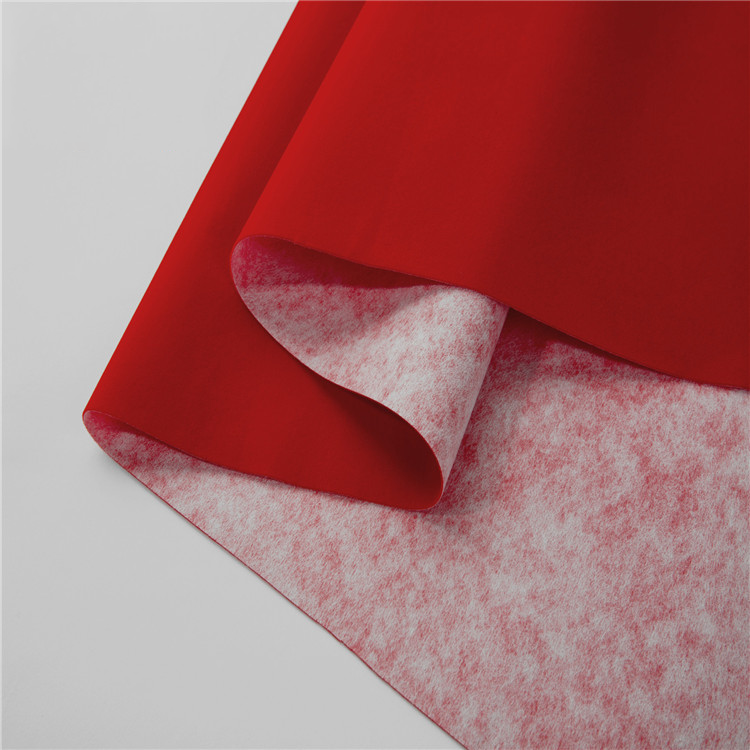
These shared processes help Pearl Velvet and Frosted Velvet appear as parts of one design system. For example, Pearl Velvet may be assigned to the lid or exterior panel to emphasize texture, while Frosted Velvet can be used on an insert, side panel, or logo area where an embossed pattern needs to remain easy to recognize.
Color control is equally important. Mingqian Flocking states that its color database contains more than 1,000 Pantone references. Standard orders target a Pantone Delta E of no more than 2.0, while custom orders target no more than 0.5. Using one approved color reference across both finishes helps maintain brand consistency even though their surface structures are different.
Application Considerations for Premium Packaging
Placement should be determined by the purpose of each packaging component. Jewelry boxes generally require a soft, fine pile with low shedding and suitable anti-tarnish performance. For these applications, reported controls include reactive sulfur below 5 parts per million, a pH range of 5.5 to 7.5, and a passed silver coupon accelerated corrosion test.
Cosmetic and perfume gift boxes can use tactile contrast more freely. A dense nylon pile or a faux cashmere-like surface may be combined with embossing, hot pressing, gold stamping, silk-screen printing, or laser-engraved positioning flocking. Pearl Velvet can communicate richness through its dimensional texture, whereas Frosted Velvet can direct attention to a pattern, monogram, or decorative brand element.
Before production, the buyer should confirm the required base fabric, pile specification, color standard, pattern depth, roll quantity, and finishing method for each component. The two finishes can share a collection concept without requiring every packaging part to use identical construction.
Quality and Certification Factors
Mingqian Flocking describes a quality process that includes incoming-material inspection, production monitoring, finished-product testing, and pre-shipment spot checks. Reported testing covers color fastness, peel strength, pile adhesion, abrasion resistance, dimensional accuracy, formaldehyde, and azo dyes. Quality records are digitally archived and traceable by batch number according to the product information.
The company also identifies ISO 9001 certification and Global Recycled Standard certification for flocking fabrics made with recycled polyester and nylon fibers. In one limited-edition perfume gift box project, custom black nylon flocking was matched to a Pantone Delta E of no more than 0.5, with sampling through delivery completed within five days. This example reflects the need to manage color, texture, and schedule together in premium packaging development.
Comparison of Pearl Velvet and Frosted Velvet
| Attribute | Pearl Velvet | Frosted Velvet |
|---|---|---|
| Surface character | Raised, granular pile with visible depth and luster | Defined embossed pattern formed on a flocking base |
| Primary design function | Adds tactile richness and a dimensional decorative effect | Displays recognizable motifs, textures, and pattern details |
| Finishing compatibility | Can be coordinated with hot pressing, gold stamping, printing, and selected embossing processes | Works with embossing and can be coordinated with hot pressing, gold stamping, and printing |
| Typical applications | Jewelry boxes, gift packaging, pouches, and decorative packaging components | Cosmetic and perfume boxes, gift packaging, pouches, and patterned decorative elements |
| Best collection role | Use on components where texture and dimensionality should be emphasized | Use where pattern visibility, branding, or structured surface detail is important |
Frequently Asked Questions
Can both finishes follow the same color specification?
Yes. A single approved Pantone reference or custom color card can be used to coordinate Pearl Velvet and Frosted Velvet. Because the pile and embossing reflect light differently, physical samples should still be reviewed before approval.
Are Pearl Velvet and Frosted Velvet suitable for jewelry boxes?
Both can be considered for jewelry packaging within the stated flocking fabric application range. The project specification should address pile stability, shedding, color fastness, and anti-tarnish performance. Mingqian Flocking reports a dedicated anti-tarnish control system for jewelry box linings.
Which material is preferable for embossed logos?
Frosted Velvet is generally the more direct choice when the logo depends on a clearly defined embossed pattern. Pearl Velvet can be used beside it to create a contrasting tactile surface. The final decision depends on the desired pattern sharpness, component location, and overall packaging concept.
Can a collection use different base fabrics?
Yes, provided that each material is verified for the intended finish and application. Spunlace, silk, and cotton-rayon are identified as applicable base fabrics for Plain Velvet, while other options may be available within the wider product range. Technical confirmation should be completed before sampling.
Conclusion and Production Recommendations
Pearl Velvet and Frosted Velvet can be combined effectively when the collection uses a common color strategy, compatible material specifications, and coordinated finishing treatments. Pearl Velvet is best suited to a raised, textured appearance, while Frosted Velvet offers sharper embossed pattern definition. Assigning each finish to the packaging components that benefit most from its visual and tactile properties can create variation without weakening brand cohesion.
Mingqian Flocking states that it provides OEM and ODM production, with a listed minimum order quantity of 1,000 yards and a 14-day delivery time for the referenced business model. Buyers planning a coordinated collection should request samples, confirm color and performance requirements, and review the production schedule before placing an order. Technical inquiries can be directed to 005@mingqianflocking.com.
About Mingqian Flocking
Guangdong Shunde Mingqian Flocking Co., Ltd., operating under the Mingqian brand, is a flocking fabric manufacturer headquartered in Foshan City, Guangdong Province, China. Established in 2008, the company focuses on the research, development, production, and sales of flocking fabrics. Its self-owned facility covers more than 12,000 square meters, with reported monthly capacity exceeding 3,000,000 yards. The company lists ISO 9001 and Global Recycled Standard certifications, and its cooperation experience spans several industries.

REPORT