







-
 Agriculture
-
 Health-Care
-
 Environment
-
 Construction-Real-Estate
-
 Tools-Hardware
-
 Home-Garden
-
 Furniture
-
 Luggage-Bags-Cases
-
 Medical-devices-Supplies
-
 Gifts-Crafts
-
 Sports-Entertainment
-
 Food-Beverage
-
 Vehicles-Transportation
-
 Power-Transmission
-
 Material-Handling
-
 Renewable-Energy
-
 Safety
-
 Testing-Instrument-Equipment
-
 Construction-Building-Machinery
-
 Pet-Supplies
-
 Personal-Care-Household-Cleaning
-
 Vehicle-Accessories-Electronics-Tools
-
 School-Office-Supplies
-
 Packaging-Printing
-
 Mother-Kids-Toys
-
 Business-Services
-
 Commercial-Equipment-Machinery
-
 Apparel-Accessories
-
 Security
-
 Shoes-Accessories
-
 Vehicle-Parts-Accessories
-
 Jewelry-Eyewear-Watches-Accessories
-
 Lights-Lighting
-
 Fabric-Textile-Raw-Material
-
 Fabrication-Services
-
 Industrial-Machinery
-
 Consumer-Electronics
-
 Electrical-Equipment-Supplies
-
 Electronic-Components-Accessories-Telecommunications
-
 Home-Appliances
-
 Beauty
-
 Chemicals
-
 Rubber-Plastics
-
 Metals-Alloys


























































































































































































































































































































































































































































































































































































- Masonry Materials
- Curtain Walls & Accessories
- Earthwork Products
- Fireproofing Materials
- Heat Insulation Materials
- Plastic Building Materials
- Building Boards
- Soundproofing Materials
- Timber
- Waterproofing Materials
- Balustrades & Handrails
- Bathroom & Kitchen
- Flooring & Accessories
- Tiles & Accessories
- Door, Window & Accessories
- Fireplaces & Stoves
- Floor Heating Systems & Parts
- Stairs & Stair Parts
- Ceilings
- Elevators & Escalators
- Stone
- Countertops, Vanity Tops & Table Tops
- Mosaics
- Metal Building Materials
- Multifunctional Materials
- Ladders & Scaffoldings
- Mouldings
- Corner Guards
- Decorative Films
- Formwork
- Building & Industrial Glass
- Other Construction & Real Estate
- Wallpapers/Wall panels
- HVAC System & Parts
- Outdoor Facilities
- Prefabricated Buildings
- Festive & Party Supplies
- Bathroom Products
- Household Sundries
- Rain Gear
- Garden Supplies
- Household Cleaning Tools & Accessories
- Lighters & Smoking Accessories
- Home Storage & Organization
- Household Scales
- Smart Home Improvement
- Home Textiles
- Kitchenware
- Drinkware & Accessories
- Dinnerware, Coffee & Wine
- Home Decor
- Golf
- Fitness & Body Building
- Amusement Park Facilities
- Billiards, Board Game,Coin Operated Games
- Musical Instruments
- Outdoor Affordable Luxury Sports
- Camping & Hiking
- Fishing
- Sports Safety&Rehabilitation
- Ball Sports Equipments
- Water Sports
- Winter Sports
- Luxury Travel Equipments
- Sports Shoes, Bags & Accessories
- Cycling
- Other Sports & Entertainment Products
- Artificial Grass&Sports Flooring&Sports Court Equipment
- Scooters
- Food Ingredients
- Honey & Honey Products
- Snacks
- Nuts & Kernels
- Seafood
- Plant & Animal Oil
- Beverages
- Fruit & Vegetable Products
- Frog & Escargot
- Bean Products
- Egg Products
- Dairy Products
- Seasonings & Condiments
- Canned Food
- Instant Food
- Baked Goods
- Other Food & Beverage
- Meat & Poultry
- Confectionery
- Grain Products
- Feminie Care
- Hair Care & Styling
- Body Care
- Hands & Feet Care
- Hygiene Products
- Men's Grooming
- Laundry Cleaning Supplies
- Travel Size & Gift Sets
- Room Deodorizers
- Other Personal Care Products
- Pest Control Products
- Special Household Cleaning
- Floor Cleaning
- Kitchen & Bathroom Cleaning
- Oral Care
- Bath Supplies
- Yellow Pages
- Correction Supplies
- Office Binding Supplies
- Office Cutting Supplies
- Board Erasers
- Office Adhesives & Tapes
- Education Supplies
- Pencil Cases & Bags
- Notebooks & Writing Pads
- File Folder Accessories
- Calendars
- Writing Accessories
- Commercial Office Supplies
- Pencil Sharpeners
- Pens
- Letter Pad/Paper
- Paper Envelopes
- Desk Organizers
- Pencils
- Markers & Highlighters
- Filing Products
- Art Supplies
- Easels
- Badge Holder & Accessories
- Office Paper
- Printer Supplies
- Book Covers
- Other Office & School Supplies
- Stationery Set
- Boards
- Clipboards
- Stamps
- Drafting Supplies
- Stencils
- Electronic Dictionary
- Books
- Map
- Magazines
- Calculators
- Baby & Toddler Toys
- Educational Toys
- Classic Toys
- Dress Up & Pretend Play
- Toy Vehicle
- Stuffed Animals & Plush Toys
- Outdoor Toys & Structures
- Balloons & Accessories
- Baby Food
- Children's Clothing
- Baby Supplies & Products
- Maternity Clothes
- Kids Shoes
- Baby Care
- Novelty & Gag Toys
- Dolls & Accessories
- Puzzle & Games
- Blocks & Model Building Toys
- Toddler Clothing
- Baby Clothing
- Kids' Luggage & Bags
- Arts, Crafts & DIY Toys
- Action & Toy Figures
- Baby Appliances
- Hobbies & Models
- Remote Control Toys
- Promotional Toys
- Pregnancy & Maternity
- Hygiene Products
- Kid's Textile&Bedding
- Novelty & Special Use
- Toy Weapons
- Baby Gifts
- Baby Storage & Organization
- Auto Drive Systems
- ATV/UTV Parts & Accessories
- Marine Parts & Accessories
- Other Auto Parts
- Trailer Parts & Accessories
- Auto Transmission Systems
- Train Parts & Accessories
- Universal Parts
- Railway Parts & Accessories
- Auto Brake Systems
- Aviation Parts & Accessories
- Truck Parts & Accessories
- Auto Suspension Systems
- Auto Lighting Systems
- New Energy Vehicle Parts & Accessories
- Auto Steering Systems
- Wheels, Tires & Accessories
- Bus Parts & Accessories
- Auto Performance Parts
- Cooling System
- Go-Kart & Kart Racer Parts & Accessories
- Air Conditioning Systems
- Heavy Duty Vehicle Parts & Accessories
- Auto Electrical Systems
- Auto Body Systems
- Auto Engine Systems
- Container Parts & Accessories
- Motorcycle Parts & Accessories
- Refrigeration & Heat Exchange Equipment
- Machine Tool Equipment
- Food & Beverage Machinery
- Agricultural Machinery & Equipment
- Apparel & Textile Machinery
- Chemical Machinery
- Packaging Machines
- Paper Production Machinery
- Plastic & Rubber Processing Machinery
- Industrial Robots
- Electronic Products Machinery
- Metal & Metallurgy Machinery
- Woodworking Machinery
- Home Product Manufacturing Machinery
- Machinery Accessories
- Environmental Machinery
- Machinery Service
- Electrical Equipment Manufacturing Machinery
- Industrial Compressors & Parts
- Tobacco & Cigarette Machinery
- Production Line
- Used Industrial Machinery
- Electronics Production Machinery
- Other Machinery & Industrial Equipment
- Camera, Photo & Accessories
- Portable Audio, Video & Accessories
- Television, Home Audio, Video & Accessories
- Video Games & Accessories
- Mobile Phone & Accessories
- Electronic Publications
- Earphone & Headphone & Accessories
- Speakers & Accessories
- Smart Electronics
- TV Receivers & Accessories
- Mobile Phone & Computer Repair Parts
- Chargers, Batteries & Power Supplies
- Used Electronics
- VR, AR, MR Hardware & Software
- Projectors & Presentation Equipments
- Other Consumer Electronics
- Cables & Commonly Used Accessories
- Computer Hardware & Software
- Displays, Signage and Optoelectronics
- Discrete Semiconductors
- Wireless & IoT Module and Products
- Telecommunications
- Connectors, Terminals & Accessories
- Development Boards, Electronic Modules and Kits
- Circuit Protection
- Sensors
- Isolators
- Audio Components and Products
- Integrated Circuits
- Power Supplies
- Relays
- RF, Microwave and RFID
- Electronic Accessories & Supplies
- Passive Components
- PCB & PCBA
- Air Quality Appliances
- Home Appliance Parts
- Heating & Cooling Appliances
- Small Kitchen Appliances
- Laundry Appliances
- Water Heaters
- Water Treatment Appliances
- Refrigerators & Freezers
- Personal Care & Beauty Appliances
- Major Kitchen Appliances
- Cleaning Appliances
- Second-hand Appliances
- Smart Home Appliances
- Other Home Appliances
- Energy Chemicals
- Inorganic Chemicals
- Basic Organic Chemicals
- Agrochemicals
- Admixture & Additives
- Catalysts & Chemical Auxiliary Agents
- Pigments & Dyestuff
- Coating & Paint
- Daily Chemicals
- Polymer
- Organic Intermediate
- Adhesives & Sealants
- Chemical Waste
- Biological Chemical Products
- Surface Treatment Chemicals
- Painting & Coating
- Chemical Reagents
- Flavor & Fragrance
- Non-Explosive Demolition Agents
- Other Chemicals
- Custom Chemical Services

How to Compare Cutlery Quotes with Different Piece Counts
Start with a Like-for-Like Quote
When cutlery set quotes list different numbers of pieces, the total set price alone can be misleading. First confirm what each set contains, then calculate the price per usable piece. After that, review specifications and commercial terms such as material, finish, packaging, minimum order quantity (MOQ), lead time, and shipping. This approach makes a smaller 16-piece set and a larger 24-piece set easier to evaluate on consistent terms.
Calculate the Comparable Piece Price
For each offer, divide the total quoted price by the number of sets, then divide the per-set result by the number of usable pieces in that set. This gives you a normalized price per piece. Keep freight, duties, payment charges, and other destination costs separate at first; compare those when the same shipping and landed-cost assumptions are available for every supplier.
Make a precise contents list before doing the calculation. Check whether knives, forks, spoons, serving utensils, kitchen tools, storage items, or a gift box are included. A lower-priced set may simply contain fewer usable items, while a larger set may offer a lower cost per piece despite its higher set price.
Review Product Specifications Separately
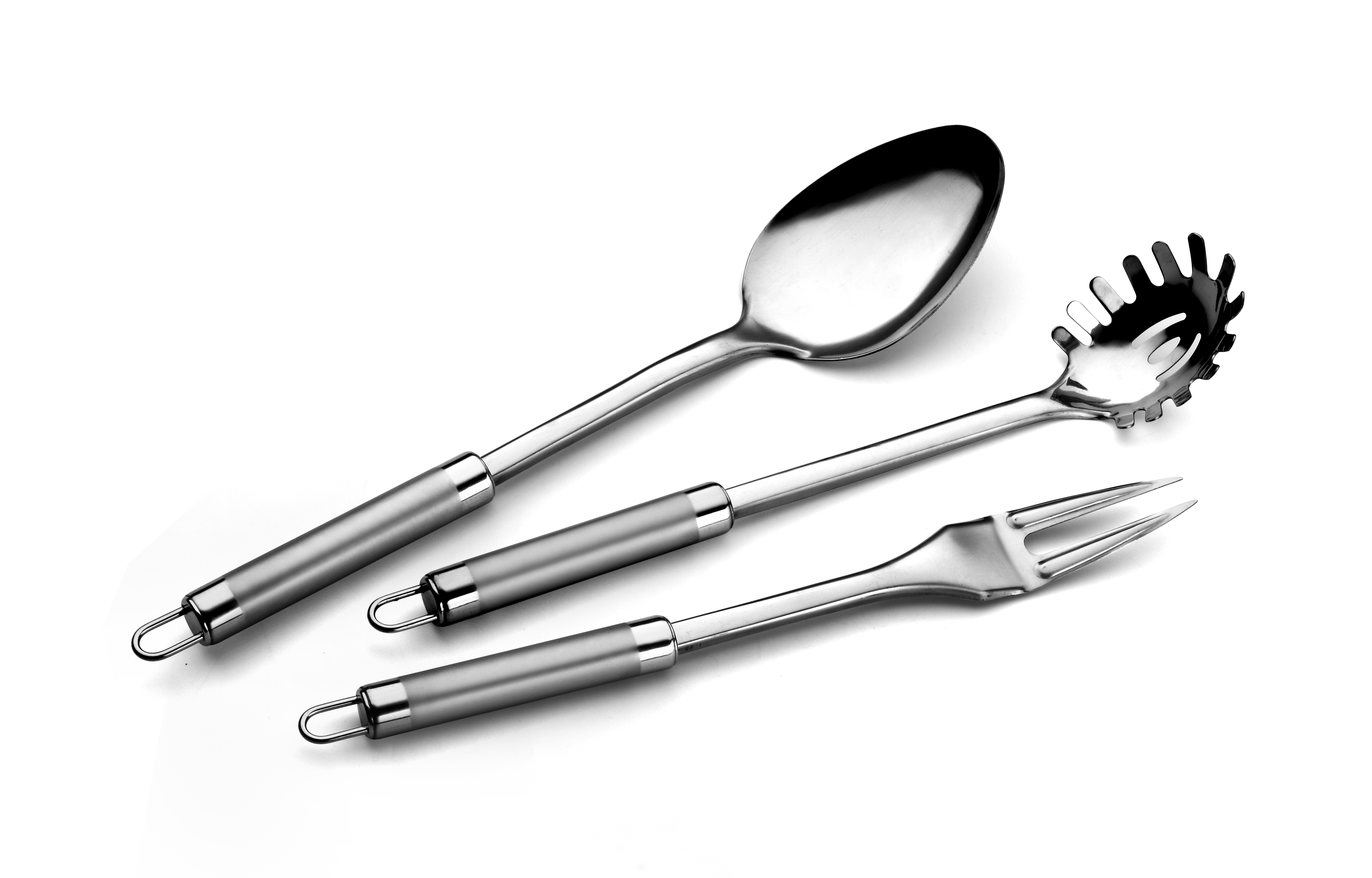
Price comparisons are meaningful only when the products are sufficiently similar. Record the stated material grade, construction, finish, handle details, and assembly standard for each quote. Avoid treating all stainless steel offers as equivalent: the listed Kitchen Utensil Set is available in 410, 430, or 304 stainless steel, has hollow handles, and specifies mirror polishing on the metal parts. Ask each supplier to identify the grade included in its price.
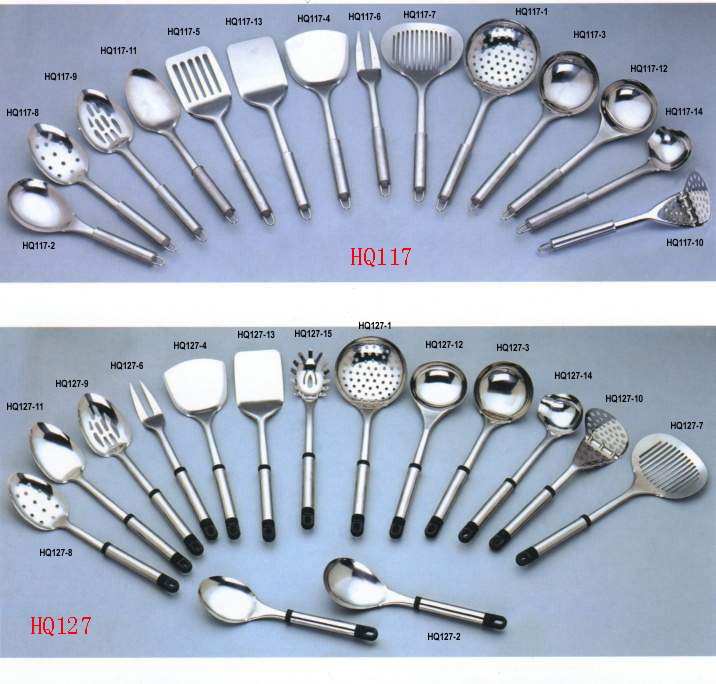
Finish and assembly can also affect value. For colored or plastic-handle products, confirm the handle material, color, coating or molding requirements, and assembly details. The listed Kitchen Utensil Set uses a customized color box, so compare box dimensions, artwork, inserts, and labeling before treating packaging costs as equivalent.
Check Order Terms, Timing, and Delivery Costs
MOQ and lead time can change the effective cost of an order. The product-specific information states an MOQ of 1,000 sets and a delivery time of 7–15 days. Broader factory-program references differ: they describe a standard MOQ of 2,000 pieces and a custom MOQ of 8,000 pieces, with requirements varying according to material and thickness. Confirm in writing which MOQ applies to the exact product, customization, and any mixed-batch request.
Lead-time figures also need context. The product record lists 7–15 days, while the broader business information gives a standard lead time of 25–40 days; mold development may take a further 7–15 days. Ask when the clock starts and whether the quoted period covers production, customized packaging, inspection, and shipment preparation.
Compare logistics using the same trade terms and shipment assumptions. Available options in the company information include full-container loads, less-than-container loads, express, air freight, and China-Europe Railway Express. FOB, CIF, and CFR are supported for applicable shipments. A lower ex-factory price may result in a higher landed cost if packing, shipment mode, or destination charges differ.
Match Compliance Documents to the Product
Certifications and test reports are part of the buying decision, not merely supporting paperwork. The listed product information names LFGB, FDA, BSCI, and ISO 9001. The company information also refers to ISO 14001, inspection certificates, SGS test reports, TÜV SÜD reports, Bureau Veritas testing, and food-contact-material testing for specified products and markets. Verify that each document applies to the quoted material, product configuration, and destination market.
Reported cooperation examples include discount retailers, home-goods distributors, cookware brands, furniture retailers, and multinational supermarket groups. These examples indicate experience with private-label cutlery, kitchen tools, promotional orders, replenishment programs, and regional requirements in Europe, Latin America, and other markets. Use them as context for due diligence, not as a substitute for reviewing the specific quote and documentation.
Quote Comparison Checklist
| Factor | What to compare | Available product information |
|---|---|---|
| Piece count and contents | List each included item and calculate price per usable piece | Kitchen Utensil Set; confirm the exact piece count and contents |
| Material and finish | Check stainless steel grade, handle construction, and polishing | 410/430/304 stainless steel; hollow handle; mirror polish |
| Packaging | Compare the box, artwork, inserts, and labeling | Customized color box |
| MOQ | Confirm the minimum for the same specification and customization | 1,000 sets for the listed product; broader standard MOQ of 2,000 pieces |
| Lead time | Clarify whether production, packaging, inspection, and mold work are included | 7–15 days for the listed product; mold development may require 7–15 days |
| Quality documents | Match certificates and reports to the product and destination market | LFGB, FDA, BSCI, and ISO 9001 listed for the product |
| Shipping and trade terms | Compare FCL, LCL, express, air, or rail costs under equivalent terms | FOB, CIF, and CFR for applicable shipments |
Frequently Asked Questions
Should I compare the set price or the price per piece?
Use both figures. The set price helps you plan the purchase budget, while the normalized price per usable piece allows comparison across different set sizes. Keep packaging, freight, and destination charges separate until the assumptions match.
How should different stainless steel grades be compared?
Keep 410, 430, and 304 stainless steel as distinct specifications. Record the grade included in each offer, then compare construction, finish, assembly, testing, and suitability for the intended market.
What should I verify before choosing the lowest offer?
Confirm the contents, material, MOQ, customized packaging, delivery schedule, inspection scope, applicable certificates, payment conditions, and shipping method. For batch quality issues, the listed product support includes free replacement or refund and a 24-hour response to customer complaints.
Practical Recommendation
Build a comparison sheet that records total set price, piece count, cost per usable piece, material, construction, packaging, MOQ, lead time, certification coverage, inspection, and shipping assumptions. For the listed Kitchen Utensil Set, treat the 1,000-set MOQ, 7–15-day delivery time, 410/430/304 material options, customized color box, and LFGB, FDA, BSCI, and ISO 9001 documentation as product-specific references, and confirm them for your order.
Huaqiang Metal offers direct-factory supply, OEM/ODM services, logo engraving, packaging customization, mixed-batch support, and payment options that include T/T, L/C at sight, O/A with SINOSURE for qualified long-term retail cooperation, and online payment for eligible small orders. For technical details or purchasing support, contact eyas2018@126.com.
About the Manufacturer
JIEYANG CITY HUAQIANG METAL INDUSTRY CO., LTD., operating under the EYAS brand, manufactures stainless steel tableware, cutlery, and kitchen tools in Jieyang City, Guangdong Province. Established in 2006, the company has a 16,000-square-meter factory area and combines mold development, production, quality control, and export order handling. Its certifications include BSCI, ISO 9001, and ISO 14001, and it serves customers in multiple industries.

REPORT