







-
 Agriculture
-
 Health-Care
-
 Environment
-
 Construction-Real-Estate
-
 Tools-Hardware
-
 Home-Garden
-
 Furniture
-
 Luggage-Bags-Cases
-
 Medical-devices-Supplies
-
 Gifts-Crafts
-
 Sports-Entertainment
-
 Food-Beverage
-
 Vehicles-Transportation
-
 Power-Transmission
-
 Material-Handling
-
 Renewable-Energy
-
 Safety
-
 Testing-Instrument-Equipment
-
 Construction-Building-Machinery
-
 Pet-Supplies
-
 Personal-Care-Household-Cleaning
-
 Vehicle-Accessories-Electronics-Tools
-
 School-Office-Supplies
-
 Packaging-Printing
-
 Mother-Kids-Toys
-
 Business-Services
-
 Commercial-Equipment-Machinery
-
 Apparel-Accessories
-
 Security
-
 Shoes-Accessories
-
 Vehicle-Parts-Accessories
-
 Jewelry-Eyewear-Watches-Accessories
-
 Lights-Lighting
-
 Fabric-Textile-Raw-Material
-
 Fabrication-Services
-
 Industrial-Machinery
-
 Consumer-Electronics
-
 Electrical-Equipment-Supplies
-
 Electronic-Components-Accessories-Telecommunications
-
 Home-Appliances
-
 Beauty
-
 Chemicals
-
 Rubber-Plastics
-
 Metals-Alloys


























































































































































































































































































































































































































































































































































































- Masonry Materials
- Curtain Walls & Accessories
- Earthwork Products
- Fireproofing Materials
- Heat Insulation Materials
- Plastic Building Materials
- Building Boards
- Soundproofing Materials
- Timber
- Waterproofing Materials
- Balustrades & Handrails
- Bathroom & Kitchen
- Flooring & Accessories
- Tiles & Accessories
- Door, Window & Accessories
- Fireplaces & Stoves
- Floor Heating Systems & Parts
- Stairs & Stair Parts
- Ceilings
- Elevators & Escalators
- Stone
- Countertops, Vanity Tops & Table Tops
- Mosaics
- Metal Building Materials
- Multifunctional Materials
- Ladders & Scaffoldings
- Mouldings
- Corner Guards
- Decorative Films
- Formwork
- Building & Industrial Glass
- Other Construction & Real Estate
- Wallpapers/Wall panels
- HVAC System & Parts
- Outdoor Facilities
- Prefabricated Buildings
- Festive & Party Supplies
- Bathroom Products
- Household Sundries
- Rain Gear
- Garden Supplies
- Household Cleaning Tools & Accessories
- Lighters & Smoking Accessories
- Home Storage & Organization
- Household Scales
- Smart Home Improvement
- Home Textiles
- Kitchenware
- Drinkware & Accessories
- Dinnerware, Coffee & Wine
- Home Decor
- Golf
- Fitness & Body Building
- Amusement Park Facilities
- Billiards, Board Game,Coin Operated Games
- Musical Instruments
- Outdoor Affordable Luxury Sports
- Camping & Hiking
- Fishing
- Sports Safety&Rehabilitation
- Ball Sports Equipments
- Water Sports
- Winter Sports
- Luxury Travel Equipments
- Sports Shoes, Bags & Accessories
- Cycling
- Other Sports & Entertainment Products
- Artificial Grass&Sports Flooring&Sports Court Equipment
- Scooters
- Food Ingredients
- Honey & Honey Products
- Snacks
- Nuts & Kernels
- Seafood
- Plant & Animal Oil
- Beverages
- Fruit & Vegetable Products
- Frog & Escargot
- Bean Products
- Egg Products
- Dairy Products
- Seasonings & Condiments
- Canned Food
- Instant Food
- Baked Goods
- Other Food & Beverage
- Meat & Poultry
- Confectionery
- Grain Products
- Feminie Care
- Hair Care & Styling
- Body Care
- Hands & Feet Care
- Hygiene Products
- Men's Grooming
- Laundry Cleaning Supplies
- Travel Size & Gift Sets
- Room Deodorizers
- Other Personal Care Products
- Pest Control Products
- Special Household Cleaning
- Floor Cleaning
- Kitchen & Bathroom Cleaning
- Oral Care
- Bath Supplies
- Yellow Pages
- Correction Supplies
- Office Binding Supplies
- Office Cutting Supplies
- Board Erasers
- Office Adhesives & Tapes
- Education Supplies
- Pencil Cases & Bags
- Notebooks & Writing Pads
- File Folder Accessories
- Calendars
- Writing Accessories
- Commercial Office Supplies
- Pencil Sharpeners
- Pens
- Letter Pad/Paper
- Paper Envelopes
- Desk Organizers
- Pencils
- Markers & Highlighters
- Filing Products
- Art Supplies
- Easels
- Badge Holder & Accessories
- Office Paper
- Printer Supplies
- Book Covers
- Other Office & School Supplies
- Stationery Set
- Boards
- Clipboards
- Stamps
- Drafting Supplies
- Stencils
- Electronic Dictionary
- Books
- Map
- Magazines
- Calculators
- Baby & Toddler Toys
- Educational Toys
- Classic Toys
- Dress Up & Pretend Play
- Toy Vehicle
- Stuffed Animals & Plush Toys
- Outdoor Toys & Structures
- Balloons & Accessories
- Baby Food
- Children's Clothing
- Baby Supplies & Products
- Maternity Clothes
- Kids Shoes
- Baby Care
- Novelty & Gag Toys
- Dolls & Accessories
- Puzzle & Games
- Blocks & Model Building Toys
- Toddler Clothing
- Baby Clothing
- Kids' Luggage & Bags
- Arts, Crafts & DIY Toys
- Action & Toy Figures
- Baby Appliances
- Hobbies & Models
- Remote Control Toys
- Promotional Toys
- Pregnancy & Maternity
- Hygiene Products
- Kid's Textile&Bedding
- Novelty & Special Use
- Toy Weapons
- Baby Gifts
- Baby Storage & Organization
- Auto Drive Systems
- ATV/UTV Parts & Accessories
- Marine Parts & Accessories
- Other Auto Parts
- Trailer Parts & Accessories
- Auto Transmission Systems
- Train Parts & Accessories
- Universal Parts
- Railway Parts & Accessories
- Auto Brake Systems
- Aviation Parts & Accessories
- Truck Parts & Accessories
- Auto Suspension Systems
- Auto Lighting Systems
- New Energy Vehicle Parts & Accessories
- Auto Steering Systems
- Wheels, Tires & Accessories
- Bus Parts & Accessories
- Auto Performance Parts
- Cooling System
- Go-Kart & Kart Racer Parts & Accessories
- Air Conditioning Systems
- Heavy Duty Vehicle Parts & Accessories
- Auto Electrical Systems
- Auto Body Systems
- Auto Engine Systems
- Container Parts & Accessories
- Motorcycle Parts & Accessories
- Refrigeration & Heat Exchange Equipment
- Machine Tool Equipment
- Food & Beverage Machinery
- Agricultural Machinery & Equipment
- Apparel & Textile Machinery
- Chemical Machinery
- Packaging Machines
- Paper Production Machinery
- Plastic & Rubber Processing Machinery
- Industrial Robots
- Electronic Products Machinery
- Metal & Metallurgy Machinery
- Woodworking Machinery
- Home Product Manufacturing Machinery
- Machinery Accessories
- Environmental Machinery
- Machinery Service
- Electrical Equipment Manufacturing Machinery
- Industrial Compressors & Parts
- Tobacco & Cigarette Machinery
- Production Line
- Used Industrial Machinery
- Electronics Production Machinery
- Other Machinery & Industrial Equipment
- Camera, Photo & Accessories
- Portable Audio, Video & Accessories
- Television, Home Audio, Video & Accessories
- Video Games & Accessories
- Mobile Phone & Accessories
- Electronic Publications
- Earphone & Headphone & Accessories
- Speakers & Accessories
- Smart Electronics
- TV Receivers & Accessories
- Mobile Phone & Computer Repair Parts
- Chargers, Batteries & Power Supplies
- Used Electronics
- VR, AR, MR Hardware & Software
- Projectors & Presentation Equipments
- Other Consumer Electronics
- Cables & Commonly Used Accessories
- Computer Hardware & Software
- Displays, Signage and Optoelectronics
- Discrete Semiconductors
- Wireless & IoT Module and Products
- Telecommunications
- Connectors, Terminals & Accessories
- Development Boards, Electronic Modules and Kits
- Circuit Protection
- Sensors
- Isolators
- Audio Components and Products
- Integrated Circuits
- Power Supplies
- Relays
- RF, Microwave and RFID
- Electronic Accessories & Supplies
- Passive Components
- PCB & PCBA
- Air Quality Appliances
- Home Appliance Parts
- Heating & Cooling Appliances
- Small Kitchen Appliances
- Laundry Appliances
- Water Heaters
- Water Treatment Appliances
- Refrigerators & Freezers
- Personal Care & Beauty Appliances
- Major Kitchen Appliances
- Cleaning Appliances
- Second-hand Appliances
- Smart Home Appliances
- Other Home Appliances
- Energy Chemicals
- Inorganic Chemicals
- Basic Organic Chemicals
- Agrochemicals
- Admixture & Additives
- Catalysts & Chemical Auxiliary Agents
- Pigments & Dyestuff
- Coating & Paint
- Daily Chemicals
- Polymer
- Organic Intermediate
- Adhesives & Sealants
- Chemical Waste
- Biological Chemical Products
- Surface Treatment Chemicals
- Painting & Coating
- Chemical Reagents
- Flavor & Fragrance
- Non-Explosive Demolition Agents
- Other Chemicals
- Custom Chemical Services

How to Detect Hidden Outsourcing in a UV Lamp Factory
When evaluating a UV lamp factory, buyers should look beyond product photos and sales claims. Vague manufacturing information, changing explanations about delivery, limited customization control, and weak inspection or certification records may indicate that production is being outsourced without clear disclosure. A reliable supplier should explain its manufacturing workflow, capacity, quality checks, customization arrangements, certification coverage, and after-sales responsibilities for UV/LED lash glue curing lamps.
How to Verify a Factory’s Production Transparency
The most practical approach is to compare what the supplier promises with the evidence it can provide for the exact product being offered. Buyers should review production scheduling, inspection procedures, customization capabilities, certificates, and application experience before placing a wholesale, private-label, or OEM/ODM order.
1. Examine Production Planning and Capacity
A factory with direct production control should be able to explain how orders are scheduled according to product type, quantity, stock status, and customization requirements. Guangzhou Ruiju states that its capacity can be adjusted based on these factors. Its supply information distinguishes stock orders from customized and private-label projects: stock orders generally require four days, while customized orders normally take around ten days, depending on quantity, packaging, and specifications.
If a supplier quotes identical lead times for every order or cannot explain the difference between stocked, customized, and private-label products, the actual production route may be difficult to verify. Inconsistent delivery explanations are therefore an important warning sign.
2. Trace Every Quality-Control Stage
A transparent UV lamp factory should be able to describe how materials and finished products are checked. The expected workflow may include incoming-material inspection, in-process quality control, finished-product testing, packaging inspection, and a final check before shipment. Guangzhou Ruiju identifies these stages within its supply operations.
Buyers should ask who performs each inspection, how defects are recorded, and how nonconforming products are handled. General statements such as “all products are tested” are less useful when they are not connected to a defined process or to the specific LED lash glue curing lamp being supplied.
3. Test the Supplier’s Customization Capability
Customization claims can reveal whether a supplier controls production or simply forwards requests to another facility. A capable factory should discuss practical details such as clamp-mounted or floor-standing designs, single-head and dual-head configurations, detachable lamp heads, working angles, adjustable spot sizes, ring-light combinations, labels, packaging, and product bundles.
Guangzhou Ruiju provides OEM/ODM and private-label services and supplies UV/LED lash equipment together with eyelash extensions, adhesives, and related accessories. Suppliers that promise broad customization but cannot explain how design changes affect tooling, scheduling, inspection, packaging, or minimum order quantities should be reviewed carefully.
4. Match Certificates to the Exact Product
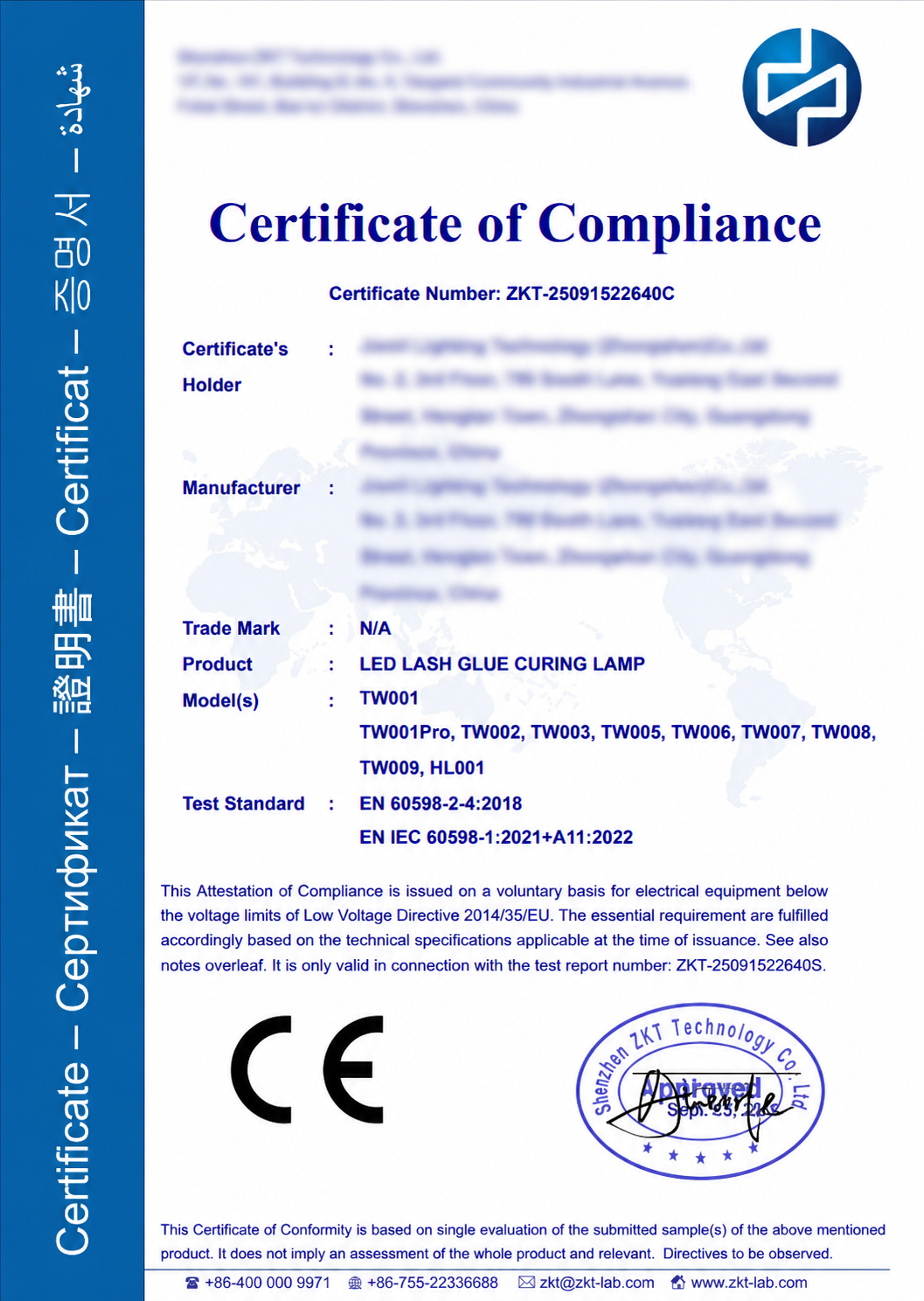
Certification documents should correspond directly to the model and application being offered. The available records include CE (LVD), certificate number ZKT-25091522640C, and CE (EMC), certificate number ZKT-25091522641C. Both are associated with an LED lash glue curing lamp for the European Union market.
These documents support compliance claims, but they do not independently prove that every production stage takes place inside the named factory. Buyers should compare the certificate holder, product description, model information, and supplier details with the actual lamp being quoted. A certificate that describes a different product or cannot be connected to the offered model requires further verification.
5. Use Market Experience as a Supporting Check
Application history can provide useful context, although it is not conclusive proof of internal manufacturing. The listed applications include professional lash salons, eyelash extension studios, lash training academies, and beauty schools. Cooperation records also describe a complete lash product sourcing project for salon services, professional training, and retail sales.
Buyers can use these examples to ask more specific questions: Where are the UV/LED lamps sourced? Who performs the final inspection? Who handles replacement units? Which company is responsible for defects after delivery? Clear, consistent answers are more valuable than application claims alone.
Verification Checklist for UV Lamp Buyers
| Verification area | Evidence from a transparent supplier | Possible outsourcing warning |
|---|---|---|
| Production capacity | Detailed scheduling based on product category, order volume, stock, and customization | Broad capacity statements with no identifiable production process |
| Quality control | Defined checks for materials, production, finished lamps, packaging, and shipment | No inspection sequence or unclear responsibility for defects |
| Customization | Specific answers about configurations, labels, packaging, and product combinations | OEM/ODM promises without operational explanations |
| Certification | Product-specific CE (LVD) and CE (EMC) documentation for the LED lash glue curing lamp | Certificates that do not clearly match the quoted model |
| Supply support | Clear arrangements for stock, private label, replacement, and after-sales service | Changing explanations about product origin or support responsibility |
Frequently Asked Questions
What is the strongest indication that a UV lamp factory is secretly outsourcing?
The strongest indication is a mismatch between its claimed production or customization ability and its failure to explain inspection, scheduling, certification, product origin, or after-sales responsibility for the exact lamp supplied.
Do CE certificates prove that the named factory manufactures the lamp?
No. The CE (LVD) and CE (EMC) records support compliance documentation for an LED lash glue curing lamp, but certification alone does not show who manufactured every component or completed each production step.
What should buyers ask before ordering a customized UV/LED lash lamp?
Ask which operations are performed directly, how materials and finished lamps are tested, how customization changes lead time, which certificate applies to the selected model, and who manages replacements or defect claims after delivery.
Conclusion
Reliable factory verification depends on consistent, product-specific evidence. Production planning, quality-control records, customization procedures, certification details, sourcing information, and after-sales policies should all support the supplier’s claims. Guangzhou Ruiju offers OEM/ODM customization, wholesale supply, private-label services, bulk purchasing, and flexible small-batch options, with quality checks extending from incoming materials to final shipment. For technical assistance or sourcing support, contact sales@ubemay.com.
About Guangzhou Ruiju
Guangzhou Ruiju E-Commerce Co., Ltd., operating under the UBEMAY brand, supplies eyelash extensions, eyelash adhesives, lash accessories, and UV/LED lash equipment for professional beauty applications. Founded in 2014, the company operates from a 5,000 sqm factory area and adjusts supply capacity according to product category, order volume, and customization needs. Its listed credentials include FDA Cosmetic Product Listing for UV Eyelash Extension Glue and CE (EMC) certification for an LED Lash Glue Curing Lamp. The company serves customers across multiple industries.

REPORT