







-
 Agriculture
-
 Health-Care
-
 Environment
-
 Construction-Real-Estate
-
 Tools-Hardware
-
 Home-Garden
-
 Furniture
-
 Luggage-Bags-Cases
-
 Medical-devices-Supplies
-
 Gifts-Crafts
-
 Sports-Entertainment
-
 Food-Beverage
-
 Vehicles-Transportation
-
 Power-Transmission
-
 Material-Handling
-
 Renewable-Energy
-
 Safety
-
 Testing-Instrument-Equipment
-
 Construction-Building-Machinery
-
 Pet-Supplies
-
 Personal-Care-Household-Cleaning
-
 Vehicle-Accessories-Electronics-Tools
-
 School-Office-Supplies
-
 Packaging-Printing
-
 Mother-Kids-Toys
-
 Business-Services
-
 Commercial-Equipment-Machinery
-
 Apparel-Accessories
-
 Security
-
 Shoes-Accessories
-
 Vehicle-Parts-Accessories
-
 Jewelry-Eyewear-Watches-Accessories
-
 Lights-Lighting
-
 Fabric-Textile-Raw-Material
-
 Fabrication-Services
-
 Industrial-Machinery
-
 Consumer-Electronics
-
 Electrical-Equipment-Supplies
-
 Electronic-Components-Accessories-Telecommunications
-
 Home-Appliances
-
 Beauty
-
 Chemicals
-
 Rubber-Plastics
-
 Metals-Alloys


























































































































































































































































































































































































































































































































































































- Masonry Materials
- Curtain Walls & Accessories
- Earthwork Products
- Fireproofing Materials
- Heat Insulation Materials
- Plastic Building Materials
- Building Boards
- Soundproofing Materials
- Timber
- Waterproofing Materials
- Balustrades & Handrails
- Bathroom & Kitchen
- Flooring & Accessories
- Tiles & Accessories
- Door, Window & Accessories
- Fireplaces & Stoves
- Floor Heating Systems & Parts
- Stairs & Stair Parts
- Ceilings
- Elevators & Escalators
- Stone
- Countertops, Vanity Tops & Table Tops
- Mosaics
- Metal Building Materials
- Multifunctional Materials
- Ladders & Scaffoldings
- Mouldings
- Corner Guards
- Decorative Films
- Formwork
- Building & Industrial Glass
- Other Construction & Real Estate
- Wallpapers/Wall panels
- HVAC System & Parts
- Outdoor Facilities
- Prefabricated Buildings
- Festive & Party Supplies
- Bathroom Products
- Household Sundries
- Rain Gear
- Garden Supplies
- Household Cleaning Tools & Accessories
- Lighters & Smoking Accessories
- Home Storage & Organization
- Household Scales
- Smart Home Improvement
- Home Textiles
- Kitchenware
- Drinkware & Accessories
- Dinnerware, Coffee & Wine
- Home Decor
- Golf
- Fitness & Body Building
- Amusement Park Facilities
- Billiards, Board Game,Coin Operated Games
- Musical Instruments
- Outdoor Affordable Luxury Sports
- Camping & Hiking
- Fishing
- Sports Safety&Rehabilitation
- Ball Sports Equipments
- Water Sports
- Winter Sports
- Luxury Travel Equipments
- Sports Shoes, Bags & Accessories
- Cycling
- Other Sports & Entertainment Products
- Artificial Grass&Sports Flooring&Sports Court Equipment
- Scooters
- Food Ingredients
- Honey & Honey Products
- Snacks
- Nuts & Kernels
- Seafood
- Plant & Animal Oil
- Beverages
- Fruit & Vegetable Products
- Frog & Escargot
- Bean Products
- Egg Products
- Dairy Products
- Seasonings & Condiments
- Canned Food
- Instant Food
- Baked Goods
- Other Food & Beverage
- Meat & Poultry
- Confectionery
- Grain Products
- Feminie Care
- Hair Care & Styling
- Body Care
- Hands & Feet Care
- Hygiene Products
- Men's Grooming
- Laundry Cleaning Supplies
- Travel Size & Gift Sets
- Room Deodorizers
- Other Personal Care Products
- Pest Control Products
- Special Household Cleaning
- Floor Cleaning
- Kitchen & Bathroom Cleaning
- Oral Care
- Bath Supplies
- Yellow Pages
- Correction Supplies
- Office Binding Supplies
- Office Cutting Supplies
- Board Erasers
- Office Adhesives & Tapes
- Education Supplies
- Pencil Cases & Bags
- Notebooks & Writing Pads
- File Folder Accessories
- Calendars
- Writing Accessories
- Commercial Office Supplies
- Pencil Sharpeners
- Pens
- Letter Pad/Paper
- Paper Envelopes
- Desk Organizers
- Pencils
- Markers & Highlighters
- Filing Products
- Art Supplies
- Easels
- Badge Holder & Accessories
- Office Paper
- Printer Supplies
- Book Covers
- Other Office & School Supplies
- Stationery Set
- Boards
- Clipboards
- Stamps
- Drafting Supplies
- Stencils
- Electronic Dictionary
- Books
- Map
- Magazines
- Calculators
- Baby & Toddler Toys
- Educational Toys
- Classic Toys
- Dress Up & Pretend Play
- Toy Vehicle
- Stuffed Animals & Plush Toys
- Outdoor Toys & Structures
- Balloons & Accessories
- Baby Food
- Children's Clothing
- Baby Supplies & Products
- Maternity Clothes
- Kids Shoes
- Baby Care
- Novelty & Gag Toys
- Dolls & Accessories
- Puzzle & Games
- Blocks & Model Building Toys
- Toddler Clothing
- Baby Clothing
- Kids' Luggage & Bags
- Arts, Crafts & DIY Toys
- Action & Toy Figures
- Baby Appliances
- Hobbies & Models
- Remote Control Toys
- Promotional Toys
- Pregnancy & Maternity
- Hygiene Products
- Kid's Textile&Bedding
- Novelty & Special Use
- Toy Weapons
- Baby Gifts
- Baby Storage & Organization
- Auto Drive Systems
- ATV/UTV Parts & Accessories
- Marine Parts & Accessories
- Other Auto Parts
- Trailer Parts & Accessories
- Auto Transmission Systems
- Train Parts & Accessories
- Universal Parts
- Railway Parts & Accessories
- Auto Brake Systems
- Aviation Parts & Accessories
- Truck Parts & Accessories
- Auto Suspension Systems
- Auto Lighting Systems
- New Energy Vehicle Parts & Accessories
- Auto Steering Systems
- Wheels, Tires & Accessories
- Bus Parts & Accessories
- Auto Performance Parts
- Cooling System
- Go-Kart & Kart Racer Parts & Accessories
- Air Conditioning Systems
- Heavy Duty Vehicle Parts & Accessories
- Auto Electrical Systems
- Auto Body Systems
- Auto Engine Systems
- Container Parts & Accessories
- Motorcycle Parts & Accessories
- Refrigeration & Heat Exchange Equipment
- Machine Tool Equipment
- Food & Beverage Machinery
- Agricultural Machinery & Equipment
- Apparel & Textile Machinery
- Chemical Machinery
- Packaging Machines
- Paper Production Machinery
- Plastic & Rubber Processing Machinery
- Industrial Robots
- Electronic Products Machinery
- Metal & Metallurgy Machinery
- Woodworking Machinery
- Home Product Manufacturing Machinery
- Machinery Accessories
- Environmental Machinery
- Machinery Service
- Electrical Equipment Manufacturing Machinery
- Industrial Compressors & Parts
- Tobacco & Cigarette Machinery
- Production Line
- Used Industrial Machinery
- Electronics Production Machinery
- Other Machinery & Industrial Equipment
- Camera, Photo & Accessories
- Portable Audio, Video & Accessories
- Television, Home Audio, Video & Accessories
- Video Games & Accessories
- Mobile Phone & Accessories
- Electronic Publications
- Earphone & Headphone & Accessories
- Speakers & Accessories
- Smart Electronics
- TV Receivers & Accessories
- Mobile Phone & Computer Repair Parts
- Chargers, Batteries & Power Supplies
- Used Electronics
- VR, AR, MR Hardware & Software
- Projectors & Presentation Equipments
- Other Consumer Electronics
- Cables & Commonly Used Accessories
- Computer Hardware & Software
- Displays, Signage and Optoelectronics
- Discrete Semiconductors
- Wireless & IoT Module and Products
- Telecommunications
- Connectors, Terminals & Accessories
- Development Boards, Electronic Modules and Kits
- Circuit Protection
- Sensors
- Isolators
- Audio Components and Products
- Integrated Circuits
- Power Supplies
- Relays
- RF, Microwave and RFID
- Electronic Accessories & Supplies
- Passive Components
- PCB & PCBA
- Air Quality Appliances
- Home Appliance Parts
- Heating & Cooling Appliances
- Small Kitchen Appliances
- Laundry Appliances
- Water Heaters
- Water Treatment Appliances
- Refrigerators & Freezers
- Personal Care & Beauty Appliances
- Major Kitchen Appliances
- Cleaning Appliances
- Second-hand Appliances
- Smart Home Appliances
- Other Home Appliances
- Energy Chemicals
- Inorganic Chemicals
- Basic Organic Chemicals
- Agrochemicals
- Admixture & Additives
- Catalysts & Chemical Auxiliary Agents
- Pigments & Dyestuff
- Coating & Paint
- Daily Chemicals
- Polymer
- Organic Intermediate
- Adhesives & Sealants
- Chemical Waste
- Biological Chemical Products
- Surface Treatment Chemicals
- Painting & Coating
- Chemical Reagents
- Flavor & Fragrance
- Non-Explosive Demolition Agents
- Other Chemicals
- Custom Chemical Services

How to Evaluate Cold Chain Packaging Samples Under Matched Temperature Conditions
A reliable cold chain packaging comparison depends on controlling every test variable that can affect thermal performance. Use the same target temperature, product load, coolant type and position, starting condition, test duration, sensor location, and recording schedule for each sample. Once the temperature results are documented, evaluate moisture management, seal quality, dimensions, handling performance, and label visibility. For insulated grocery bags, the bottom gusset, EPE foam, foil laminate, and closure design should also be reviewed individually.
Controlled Testing Priorities
The most important rule is to test every sample with an identical protocol. A change in gel-pack placement, payload, ambient environment, or measurement interval can influence the result and make one construction appear better or worse for reasons unrelated to its design.
- Set one temperature target and use the same exposure time for all samples.
- Keep the product load, gel-pack formulation, quantity, conditioning, and placement consistent.
- Measure from the same location with the same instrument and record readings at matching intervals.
- Review thermal retention together with condensation control, seal integrity, dimensions, stability, and label visibility.
- For insulated grocery bags, compare the foil laminate, closed-cell EPE core, food-contact layer, closure, gusset, and handle as separate construction elements.
Construction Details That Affect the Comparison
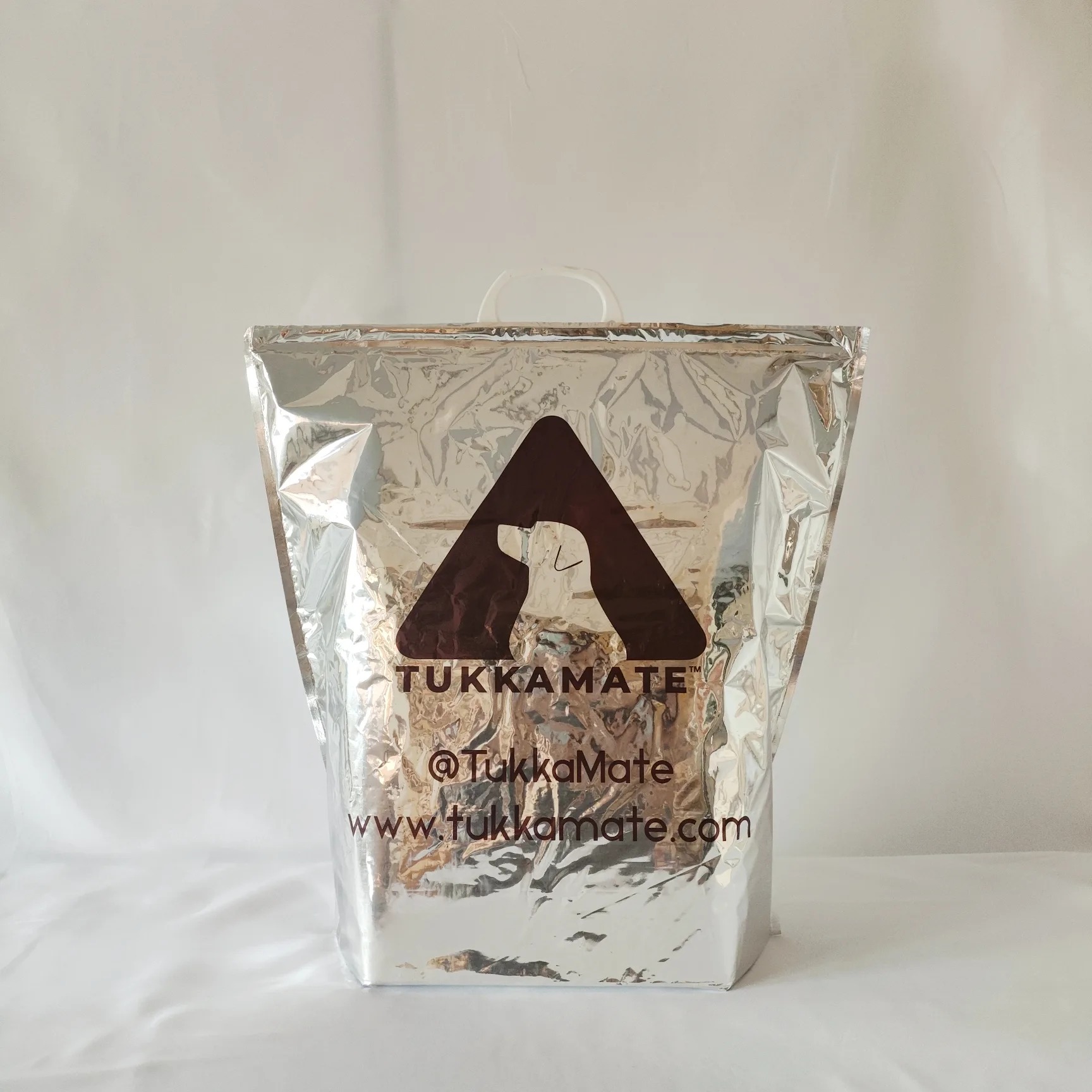
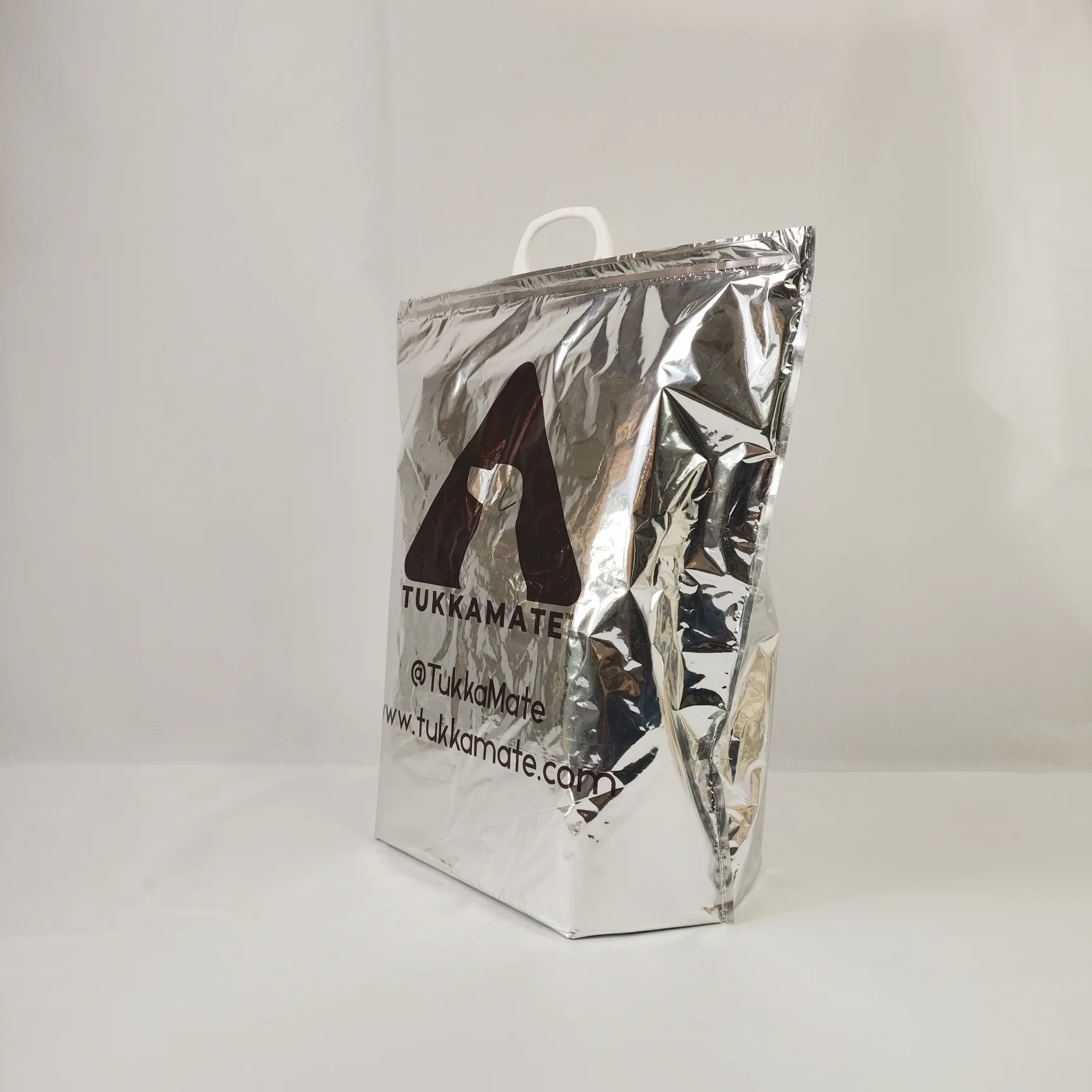
The reference bottom-gusset insulated grocery bag is made with a four-edge seal and can use an 8, 10, or 12 cm base depth, or another dimension specified for the order. Its outside surface uses an aluminium foil laminate with full-colour printing. Beneath this barrier is a 2-5 mm closed-cell EPE foam layer, while air bubble insulation can be supplied when requested. A food-grade PE sealant forms the contact layer.
The standard opening is heat sealed. Depending on the application, the design can instead include a zip track or tear notch. A moulded handle is welded into the upper seal, so attachment strength and carrying stability should be checked after the thermal test as well as during routine handling.
How to Record and Interpret Results
Prepare a test sheet before the comparison begins. Note the sample identification, target range, starting temperature, payload, coolant arrangement, sensor position, and observation times. Record when the internal temperature reaches important thresholds and when it leaves the agreed range. Using the same data format makes the results easier to compare and reduces interpretation errors.
After the temperature review, inspect the package for moisture accumulation, leaking thaw water, delamination, damaged foam, distorted dimensions, and weakened seals. Also confirm that the bottom gusset remains stable when loaded and that the handle is securely attached. A package that maintains temperature but becomes difficult to carry or obscures required information may not be suitable for operational delivery.
Application-Specific Requirements
Grocery and Last-Mile Delivery
For grocery distribution, the bag can include a dedicated gel-pack sleeve that keeps the coolant separated from the order. A waterproof inner membrane helps contain thaw water and condensation, while colour-coded temperature bands can support chilled and frozen order sorting. These features should be tested with a realistic payload because compartment design can affect both usable capacity and airflow around the products.
Pharmaceutical Cold Chain
For pharmacy shipments requiring a 2-8°C range, the insulated bag or mailer may be paired with a phase-change gel pack in its own sleeve. A flat, unprinted area can be reserved for a temperature-monitoring label, batch information, or shipping documentation. During evaluation, verify that the packaging keeps the monitoring label readable and allows the product, coolant, and records to remain together throughout delivery.
Manufacturer and Quality Information
Huizhou Ecopack Packaging Products Co., Ltd. is a flexible packaging manufacturer based in Guangdong, China. Established in 2011, the company produces custom composite pouches and bags in-house and supplies customers in more than 40 countries. Its structural design and tooling process maintains more than ten bag formats and provides a 3D structural drawing for approval before printing plates are produced.
The stated production capacity exceeds 500,000 pouches per day. Standard manufacturing generally requires 15 to 25 days after artwork approval, while sampling typically takes 3 to 5 working days. The company operates under an ISO 9001:2015 Quality Management System, certificate 24CN34510888Q, and holds FSC Chain of Custody certification, certificate RINA-COC-004326 (FSC A000532).
One USA distributor case involves the annual supply of 10 million insulated mailers for cold shipping. The stated purpose was to limit heat transfer and protect fragile or perishable products while reducing storage and shipping volume compared with rigid foam packaging.
Comparison Framework
| Evaluation area | Recommended controlled approach | Bottom-gusset bag reference |
|---|---|---|
| Thermal test conditions | Match the target temperature, payload, coolant type, placement, duration, sensor position, and reading intervals. | Can be tested with a defined gel-pack arrangement; final conditions should be confirmed with the buyer. |
| Insulation structure | Assess the barrier and insulation layers under identical environmental and loading conditions. | Aluminium foil laminate exterior with a 2-5 mm closed-cell EPE foam core. |
| Moisture and durability | Check condensation, thaw-water containment, seal condition, dimensions, carrying stability, and handle attachment. | Food-grade PE sealant, four-edge seal, bottom gusset, and moulded handle welded into the top seal. |
| Opening and closure | Use the same closure across all samples or report closure type as an independent variable. | Heat-sealed mouth as standard; zip track or tear notch available on request. |
| Quality verification | Apply one measurement method and document each sample using the same inspection record. | Incoming, in-process, and pre-shipment inspection under ISO 9001:2015, including AQL sampling for finished goods. |
Frequently Asked Questions
Which conditions must be identical when testing cold chain packaging?
Use the same temperature target, product load, coolant type and quantity, coolant location, starting condition, exposure time, sensor position, measurement method, and recording intervals. Any packaging difference should be documented separately.
What should be assessed besides internal temperature?
Inspect condensation control, moisture containment, seal integrity, foil and foam condition, dimensional stability, handle attachment, closure performance, gusset strength, and space for monitoring or batch labels.
What are the main specifications of the insulated grocery bag?
The design uses a bottom gusset without a side gusset and a four-edge seal. Base depth can be 8, 10, or 12 cm, or another ordered size. Standard dimensions range from 30 x 35 + 8 to 50 x 55 + 12 cm, with customization available for structure, dimensions, core, printing, and colour.
Conclusion and Recommendations
To obtain a meaningful result, compare cold chain packaging samples with one written protocol and separate temperature performance from moisture control, construction quality, closure design, handling, and labelling. Custom production quantities commonly begin at approximately 5,000 to 10,000 pieces depending on the size and structure, while standard sizes may be available from inventory.
Huizhou Ecopack Packaging Products Co., Ltd. supports direct manufacturer-exporter cooperation and provides documented quality and material credentials through ISO 9001:2015 and FSC Chain of Custody certifications. For technical specifications, sampling, or custom cold chain packaging support, contact manager@ecoppack.com.
About Us
Huizhou Ecopack Packaging Products Co., Ltd. is a flexible packaging manufacturer in Guangdong, China, making custom composite pouches and bags, including insulated mailers and thermal packaging, coffee packaging, pet food packaging, spout pouches, kraft and compostable formats, and ESD bags. Established in 2011, the company has 200+ employees and operates across more than 10000+ sqm of factory area. Its ISO 9001:2015 and FSC Chain of Custody certifications support its packaging production activities, and it has served clients across multiple industries.

REPORT