







-
 Agriculture
-
 Health-Care
-
 Environment
-
 Construction-Real-Estate
-
 Tools-Hardware
-
 Home-Garden
-
 Furniture
-
 Luggage-Bags-Cases
-
 Medical-devices-Supplies
-
 Gifts-Crafts
-
 Sports-Entertainment
-
 Food-Beverage
-
 Vehicles-Transportation
-
 Power-Transmission
-
 Material-Handling
-
 Renewable-Energy
-
 Safety
-
 Testing-Instrument-Equipment
-
 Construction-Building-Machinery
-
 Pet-Supplies
-
 Personal-Care-Household-Cleaning
-
 Vehicle-Accessories-Electronics-Tools
-
 School-Office-Supplies
-
 Packaging-Printing
-
 Mother-Kids-Toys
-
 Business-Services
-
 Commercial-Equipment-Machinery
-
 Apparel-Accessories
-
 Security
-
 Shoes-Accessories
-
 Vehicle-Parts-Accessories
-
 Jewelry-Eyewear-Watches-Accessories
-
 Lights-Lighting
-
 Fabric-Textile-Raw-Material
-
 Fabrication-Services
-
 Industrial-Machinery
-
 Consumer-Electronics
-
 Electrical-Equipment-Supplies
-
 Electronic-Components-Accessories-Telecommunications
-
 Home-Appliances
-
 Beauty
-
 Chemicals
-
 Rubber-Plastics
-
 Metals-Alloys


























































































































































































































































































































































































































































































































































































- Masonry Materials
- Curtain Walls & Accessories
- Earthwork Products
- Fireproofing Materials
- Heat Insulation Materials
- Plastic Building Materials
- Building Boards
- Soundproofing Materials
- Timber
- Waterproofing Materials
- Balustrades & Handrails
- Bathroom & Kitchen
- Flooring & Accessories
- Tiles & Accessories
- Door, Window & Accessories
- Fireplaces & Stoves
- Floor Heating Systems & Parts
- Stairs & Stair Parts
- Ceilings
- Elevators & Escalators
- Stone
- Countertops, Vanity Tops & Table Tops
- Mosaics
- Metal Building Materials
- Multifunctional Materials
- Ladders & Scaffoldings
- Mouldings
- Corner Guards
- Decorative Films
- Formwork
- Building & Industrial Glass
- Other Construction & Real Estate
- Wallpapers/Wall panels
- HVAC System & Parts
- Outdoor Facilities
- Prefabricated Buildings
- Festive & Party Supplies
- Bathroom Products
- Household Sundries
- Rain Gear
- Garden Supplies
- Household Cleaning Tools & Accessories
- Lighters & Smoking Accessories
- Home Storage & Organization
- Household Scales
- Smart Home Improvement
- Home Textiles
- Kitchenware
- Drinkware & Accessories
- Dinnerware, Coffee & Wine
- Home Decor
- Golf
- Fitness & Body Building
- Amusement Park Facilities
- Billiards, Board Game,Coin Operated Games
- Musical Instruments
- Outdoor Affordable Luxury Sports
- Camping & Hiking
- Fishing
- Sports Safety&Rehabilitation
- Ball Sports Equipments
- Water Sports
- Winter Sports
- Luxury Travel Equipments
- Sports Shoes, Bags & Accessories
- Cycling
- Other Sports & Entertainment Products
- Artificial Grass&Sports Flooring&Sports Court Equipment
- Scooters
- Food Ingredients
- Honey & Honey Products
- Snacks
- Nuts & Kernels
- Seafood
- Plant & Animal Oil
- Beverages
- Fruit & Vegetable Products
- Frog & Escargot
- Bean Products
- Egg Products
- Dairy Products
- Seasonings & Condiments
- Canned Food
- Instant Food
- Baked Goods
- Other Food & Beverage
- Meat & Poultry
- Confectionery
- Grain Products
- Feminie Care
- Hair Care & Styling
- Body Care
- Hands & Feet Care
- Hygiene Products
- Men's Grooming
- Laundry Cleaning Supplies
- Travel Size & Gift Sets
- Room Deodorizers
- Other Personal Care Products
- Pest Control Products
- Special Household Cleaning
- Floor Cleaning
- Kitchen & Bathroom Cleaning
- Oral Care
- Bath Supplies
- Yellow Pages
- Correction Supplies
- Office Binding Supplies
- Office Cutting Supplies
- Board Erasers
- Office Adhesives & Tapes
- Education Supplies
- Pencil Cases & Bags
- Notebooks & Writing Pads
- File Folder Accessories
- Calendars
- Writing Accessories
- Commercial Office Supplies
- Pencil Sharpeners
- Pens
- Letter Pad/Paper
- Paper Envelopes
- Desk Organizers
- Pencils
- Markers & Highlighters
- Filing Products
- Art Supplies
- Easels
- Badge Holder & Accessories
- Office Paper
- Printer Supplies
- Book Covers
- Other Office & School Supplies
- Stationery Set
- Boards
- Clipboards
- Stamps
- Drafting Supplies
- Stencils
- Electronic Dictionary
- Books
- Map
- Magazines
- Calculators
- Baby & Toddler Toys
- Educational Toys
- Classic Toys
- Dress Up & Pretend Play
- Toy Vehicle
- Stuffed Animals & Plush Toys
- Outdoor Toys & Structures
- Balloons & Accessories
- Baby Food
- Children's Clothing
- Baby Supplies & Products
- Maternity Clothes
- Kids Shoes
- Baby Care
- Novelty & Gag Toys
- Dolls & Accessories
- Puzzle & Games
- Blocks & Model Building Toys
- Toddler Clothing
- Baby Clothing
- Kids' Luggage & Bags
- Arts, Crafts & DIY Toys
- Action & Toy Figures
- Baby Appliances
- Hobbies & Models
- Remote Control Toys
- Promotional Toys
- Pregnancy & Maternity
- Hygiene Products
- Kid's Textile&Bedding
- Novelty & Special Use
- Toy Weapons
- Baby Gifts
- Baby Storage & Organization
- Auto Drive Systems
- ATV/UTV Parts & Accessories
- Marine Parts & Accessories
- Other Auto Parts
- Trailer Parts & Accessories
- Auto Transmission Systems
- Train Parts & Accessories
- Universal Parts
- Railway Parts & Accessories
- Auto Brake Systems
- Aviation Parts & Accessories
- Truck Parts & Accessories
- Auto Suspension Systems
- Auto Lighting Systems
- New Energy Vehicle Parts & Accessories
- Auto Steering Systems
- Wheels, Tires & Accessories
- Bus Parts & Accessories
- Auto Performance Parts
- Cooling System
- Go-Kart & Kart Racer Parts & Accessories
- Air Conditioning Systems
- Heavy Duty Vehicle Parts & Accessories
- Auto Electrical Systems
- Auto Body Systems
- Auto Engine Systems
- Container Parts & Accessories
- Motorcycle Parts & Accessories
- Refrigeration & Heat Exchange Equipment
- Machine Tool Equipment
- Food & Beverage Machinery
- Agricultural Machinery & Equipment
- Apparel & Textile Machinery
- Chemical Machinery
- Packaging Machines
- Paper Production Machinery
- Plastic & Rubber Processing Machinery
- Industrial Robots
- Electronic Products Machinery
- Metal & Metallurgy Machinery
- Woodworking Machinery
- Home Product Manufacturing Machinery
- Machinery Accessories
- Environmental Machinery
- Machinery Service
- Electrical Equipment Manufacturing Machinery
- Industrial Compressors & Parts
- Tobacco & Cigarette Machinery
- Production Line
- Used Industrial Machinery
- Electronics Production Machinery
- Other Machinery & Industrial Equipment
- Camera, Photo & Accessories
- Portable Audio, Video & Accessories
- Television, Home Audio, Video & Accessories
- Video Games & Accessories
- Mobile Phone & Accessories
- Electronic Publications
- Earphone & Headphone & Accessories
- Speakers & Accessories
- Smart Electronics
- TV Receivers & Accessories
- Mobile Phone & Computer Repair Parts
- Chargers, Batteries & Power Supplies
- Used Electronics
- VR, AR, MR Hardware & Software
- Projectors & Presentation Equipments
- Other Consumer Electronics
- Cables & Commonly Used Accessories
- Computer Hardware & Software
- Displays, Signage and Optoelectronics
- Discrete Semiconductors
- Wireless & IoT Module and Products
- Telecommunications
- Connectors, Terminals & Accessories
- Development Boards, Electronic Modules and Kits
- Circuit Protection
- Sensors
- Isolators
- Audio Components and Products
- Integrated Circuits
- Power Supplies
- Relays
- RF, Microwave and RFID
- Electronic Accessories & Supplies
- Passive Components
- PCB & PCBA
- Air Quality Appliances
- Home Appliance Parts
- Heating & Cooling Appliances
- Small Kitchen Appliances
- Laundry Appliances
- Water Heaters
- Water Treatment Appliances
- Refrigerators & Freezers
- Personal Care & Beauty Appliances
- Major Kitchen Appliances
- Cleaning Appliances
- Second-hand Appliances
- Smart Home Appliances
- Other Home Appliances
- Energy Chemicals
- Inorganic Chemicals
- Basic Organic Chemicals
- Agrochemicals
- Admixture & Additives
- Catalysts & Chemical Auxiliary Agents
- Pigments & Dyestuff
- Coating & Paint
- Daily Chemicals
- Polymer
- Organic Intermediate
- Adhesives & Sealants
- Chemical Waste
- Biological Chemical Products
- Surface Treatment Chemicals
- Painting & Coating
- Chemical Reagents
- Flavor & Fragrance
- Non-Explosive Demolition Agents
- Other Chemicals
- Custom Chemical Services

How to Evaluate the Financial Strength of a Lithium Manganese Battery Supplier
Before placing an order with a lithium manganese battery supplier, buyers should examine more than the quoted unit price. A practical financial review should cover the supplier’s legal identity, operating scale, production capacity, minimum order quantity, delivery reliability, quality systems, certifications, export experience, and after-sales support. For Vinnic Manganese Dioxide Lithium Battery, the stated 10,000-unit MOQ, 30-day delivery schedule, inspection procedures, certifications, international coverage, and application suitability should all be verified in writing.
Key Financial Checks for Battery Buyers
- Validate the supplier’s corporate identity, operating history, factory location, employee count, production footprint, and official contact information.
- Compare the commercial terms with your purchasing budget and cash-flow forecasts. The listed minimum order is 10,000 batteries and the stated delivery period is 30 days.
- Request evidence of manufacturing controls, including full production-line inspection, laboratory sampling, final testing, and incoming raw material checks.
- Confirm that the lithium manganese battery matches the intended equipment, including car key remotes, tire pressure monitoring systems, smart devices, medical instruments, or industrial sensors.
Assessing Supplier Stability and Operating Capacity
The first stage of a financial review is determining whether the supplier has the operating depth to support future orders. Chung Pak (Guang Dong) Battery Industrial Co., Ltd, which operates under the Vinnic brand, was established in 1980. Its published profile reports approximately 1,000 employees and a factory area of 170 acres. Buyers should verify these details through current business records, factory documentation, and official communication channels.
Capacity is also important when assessing delivery and continuity risk. The supplier reports annual production of more than 1.8 billion units, with exports representing 40% of its business. Its main overseas regions include America, Europe, Africa, and Southeast Asia. The listed export markets include the United States, Germany, the United Kingdom, Japan, Australia, India, Indonesia, South Korea, and Brazil. These claims should be compared with the battery model required, forecasted order volume, destination regulations, and the supplier’s ability to reserve production capacity.
Review Product Specifications and Application Risk
Financial exposure increases when a battery is not suitable for the end product. The Vinnic Manganese Dioxide Lithium Battery is described as compact and lightweight, with stable power output, very low self-discharge, and an operating temperature range of -20 °C to 60 °C. Before making a payment, request the applicable datasheet, test reports, shelf-life information, and performance limits for the exact model being purchased.

Published applications include car key remotes, tire pressure monitoring sensors, electronic vehicle tags, smart watches, Bluetooth trackers, blood glucose meters, digital thermometers, smart door locks, IoT nodes, security cameras using cylindrical CR123A cells, and industrial counting equipment. Matching the cell’s voltage, dimensions, discharge profile, temperature range, and service life to the application can help prevent returns, field replacements, and project delays.
Verify Quality and Compliance Documentation
Quality systems offer an additional indication of supply reliability. The supplier states that it performs 100% inspection on the production line, laboratory sampling and testing, and inspection of incoming raw materials. Buyers should ask for recent inspection records, test methods, acceptance criteria, defect statistics, and documentation linked to the specific purchase order.
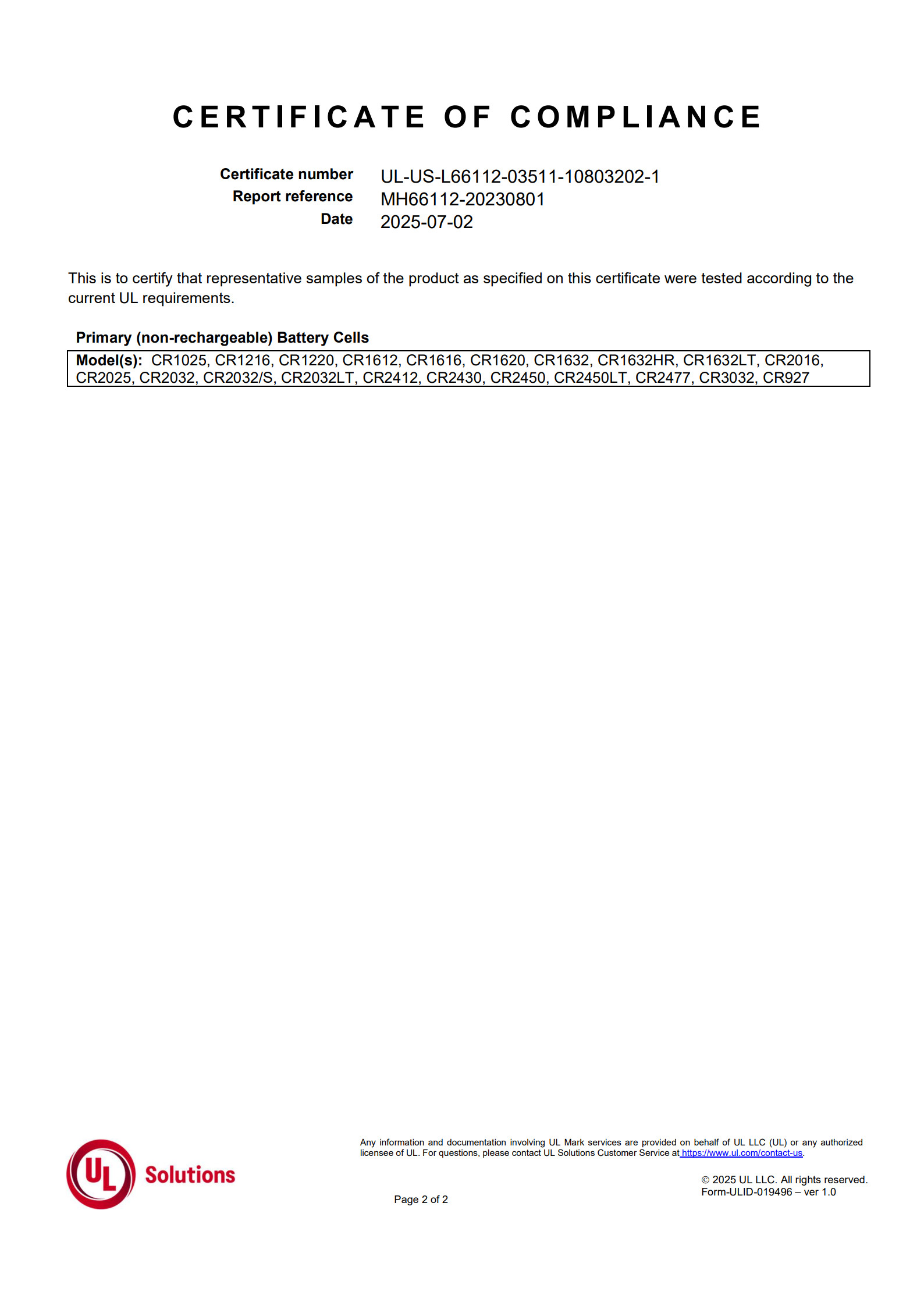
The listed certifications include ISO 9001:2015, IATF 16949:2016, ISO 14001:2015, UL certification for lithium battery products in the United States, and China AEO status. A certificate shown in a company profile should not be treated as complete proof of compliance. Confirm the certificate number, validity period, issuing organization, scope, manufacturing site, and relevance to the exact lithium manganese battery model.
Connect Commercial Terms With Cash-Flow Risk
The stated MOQ of 10,000 units should be evaluated against expected consumption, storage capacity, product shelf life, and available working capital. A 30-day delivery commitment should also be clarified: confirm whether the period begins after payment, purchase order approval, or final specification confirmation. The quotation should identify payment terms, packaging, shipping responsibilities, inspection rights, warranty coverage, and the financial consequences of late delivery or rejected goods.
The supplier describes its business model as combining an integrated industrial chain, distribution, and direct sales. It also reports a comprehensive after-sales service system for customer feedback and product issues. Buyers should convert these general statements into written contractual commitments, including a named service contact, complaint response time, replacement procedure, warranty period, and escalation process.
Supplier Financial Review Checklist
| Review Area | Published Supplier Information | Recommended Buyer Verification |
|---|---|---|
| Corporate stability | Established in 1980; approximately 1,000 employees; 170-acre factory area | Confirm the legal entity, operating address, registration records, and current factory information |
| Order commitment | Minimum order quantity of 10,000 batteries; delivery time of 30 days | Assess working-capital requirements, inventory risk, payment terms, and the meaning of the delivery deadline |
| Manufacturing capacity | Annual production capacity above 1.8 billion units | Check capacity for the required model, production allocation, and historical delivery performance |
| Quality assurance | 100% line inspection, laboratory sampling and testing, and incoming material inspection | Request inspection reports, test standards, traceability records, and product-specific acceptance criteria |
| Compliance coverage | ISO 9001:2015, IATF 16949:2016, ISO 14001:2015, UL, and China AEO listed | Verify certificate validity, scope, issuing body, manufacturing site, and model relevance |
| Market and export exposure | 40% export ratio with markets across America, Europe, Africa, Southeast Asia, and other regions | Confirm experience with the destination country, shipping documents, customs requirements, and applicable regulations |
| After-sales protection | Comprehensive customer feedback and after-sales service system stated | Include warranty, response times, replacement terms, and dispute procedures in the order documents |
A sound financial check combines corporate verification, order economics, manufacturing evidence, regulatory documentation, and application testing. For the Vinnic Manganese Dioxide Lithium Battery, buyers should validate every published claim against current records and written commercial terms before committing funds. This process helps reduce the risk of unsuitable products, unexpected inventory exposure, delivery delays, and inadequate support after shipment.
REPORT