







-
 Agriculture
-
 Health-Care
-
 Environment
-
 Construction-Real-Estate
-
 Tools-Hardware
-
 Home-Garden
-
 Furniture
-
 Luggage-Bags-Cases
-
 Medical-devices-Supplies
-
 Gifts-Crafts
-
 Sports-Entertainment
-
 Food-Beverage
-
 Vehicles-Transportation
-
 Power-Transmission
-
 Material-Handling
-
 Renewable-Energy
-
 Safety
-
 Testing-Instrument-Equipment
-
 Construction-Building-Machinery
-
 Pet-Supplies
-
 Personal-Care-Household-Cleaning
-
 Vehicle-Accessories-Electronics-Tools
-
 School-Office-Supplies
-
 Packaging-Printing
-
 Mother-Kids-Toys
-
 Business-Services
-
 Commercial-Equipment-Machinery
-
 Apparel-Accessories
-
 Security
-
 Shoes-Accessories
-
 Vehicle-Parts-Accessories
-
 Jewelry-Eyewear-Watches-Accessories
-
 Lights-Lighting
-
 Fabric-Textile-Raw-Material
-
 Fabrication-Services
-
 Industrial-Machinery
-
 Consumer-Electronics
-
 Electrical-Equipment-Supplies
-
 Electronic-Components-Accessories-Telecommunications
-
 Home-Appliances
-
 Beauty
-
 Chemicals
-
 Rubber-Plastics
-
 Metals-Alloys


























































































































































































































































































































































































































































































































































































- Masonry Materials
- Curtain Walls & Accessories
- Earthwork Products
- Fireproofing Materials
- Heat Insulation Materials
- Plastic Building Materials
- Building Boards
- Soundproofing Materials
- Timber
- Waterproofing Materials
- Balustrades & Handrails
- Bathroom & Kitchen
- Flooring & Accessories
- Tiles & Accessories
- Door, Window & Accessories
- Fireplaces & Stoves
- Floor Heating Systems & Parts
- Stairs & Stair Parts
- Ceilings
- Elevators & Escalators
- Stone
- Countertops, Vanity Tops & Table Tops
- Mosaics
- Metal Building Materials
- Multifunctional Materials
- Ladders & Scaffoldings
- Mouldings
- Corner Guards
- Decorative Films
- Formwork
- Building & Industrial Glass
- Other Construction & Real Estate
- Wallpapers/Wall panels
- HVAC System & Parts
- Outdoor Facilities
- Prefabricated Buildings
- Festive & Party Supplies
- Bathroom Products
- Household Sundries
- Rain Gear
- Garden Supplies
- Household Cleaning Tools & Accessories
- Lighters & Smoking Accessories
- Home Storage & Organization
- Household Scales
- Smart Home Improvement
- Home Textiles
- Kitchenware
- Drinkware & Accessories
- Dinnerware, Coffee & Wine
- Home Decor
- Golf
- Fitness & Body Building
- Amusement Park Facilities
- Billiards, Board Game,Coin Operated Games
- Musical Instruments
- Outdoor Affordable Luxury Sports
- Camping & Hiking
- Fishing
- Sports Safety&Rehabilitation
- Ball Sports Equipments
- Water Sports
- Winter Sports
- Luxury Travel Equipments
- Sports Shoes, Bags & Accessories
- Cycling
- Other Sports & Entertainment Products
- Artificial Grass&Sports Flooring&Sports Court Equipment
- Scooters
- Food Ingredients
- Honey & Honey Products
- Snacks
- Nuts & Kernels
- Seafood
- Plant & Animal Oil
- Beverages
- Fruit & Vegetable Products
- Frog & Escargot
- Bean Products
- Egg Products
- Dairy Products
- Seasonings & Condiments
- Canned Food
- Instant Food
- Baked Goods
- Other Food & Beverage
- Meat & Poultry
- Confectionery
- Grain Products
- Feminie Care
- Hair Care & Styling
- Body Care
- Hands & Feet Care
- Hygiene Products
- Men's Grooming
- Laundry Cleaning Supplies
- Travel Size & Gift Sets
- Room Deodorizers
- Other Personal Care Products
- Pest Control Products
- Special Household Cleaning
- Floor Cleaning
- Kitchen & Bathroom Cleaning
- Oral Care
- Bath Supplies
- Yellow Pages
- Correction Supplies
- Office Binding Supplies
- Office Cutting Supplies
- Board Erasers
- Office Adhesives & Tapes
- Education Supplies
- Pencil Cases & Bags
- Notebooks & Writing Pads
- File Folder Accessories
- Calendars
- Writing Accessories
- Commercial Office Supplies
- Pencil Sharpeners
- Pens
- Letter Pad/Paper
- Paper Envelopes
- Desk Organizers
- Pencils
- Markers & Highlighters
- Filing Products
- Art Supplies
- Easels
- Badge Holder & Accessories
- Office Paper
- Printer Supplies
- Book Covers
- Other Office & School Supplies
- Stationery Set
- Boards
- Clipboards
- Stamps
- Drafting Supplies
- Stencils
- Electronic Dictionary
- Books
- Map
- Magazines
- Calculators
- Baby & Toddler Toys
- Educational Toys
- Classic Toys
- Dress Up & Pretend Play
- Toy Vehicle
- Stuffed Animals & Plush Toys
- Outdoor Toys & Structures
- Balloons & Accessories
- Baby Food
- Children's Clothing
- Baby Supplies & Products
- Maternity Clothes
- Kids Shoes
- Baby Care
- Novelty & Gag Toys
- Dolls & Accessories
- Puzzle & Games
- Blocks & Model Building Toys
- Toddler Clothing
- Baby Clothing
- Kids' Luggage & Bags
- Arts, Crafts & DIY Toys
- Action & Toy Figures
- Baby Appliances
- Hobbies & Models
- Remote Control Toys
- Promotional Toys
- Pregnancy & Maternity
- Hygiene Products
- Kid's Textile&Bedding
- Novelty & Special Use
- Toy Weapons
- Baby Gifts
- Baby Storage & Organization
- Auto Drive Systems
- ATV/UTV Parts & Accessories
- Marine Parts & Accessories
- Other Auto Parts
- Trailer Parts & Accessories
- Auto Transmission Systems
- Train Parts & Accessories
- Universal Parts
- Railway Parts & Accessories
- Auto Brake Systems
- Aviation Parts & Accessories
- Truck Parts & Accessories
- Auto Suspension Systems
- Auto Lighting Systems
- New Energy Vehicle Parts & Accessories
- Auto Steering Systems
- Wheels, Tires & Accessories
- Bus Parts & Accessories
- Auto Performance Parts
- Cooling System
- Go-Kart & Kart Racer Parts & Accessories
- Air Conditioning Systems
- Heavy Duty Vehicle Parts & Accessories
- Auto Electrical Systems
- Auto Body Systems
- Auto Engine Systems
- Container Parts & Accessories
- Motorcycle Parts & Accessories
- Refrigeration & Heat Exchange Equipment
- Machine Tool Equipment
- Food & Beverage Machinery
- Agricultural Machinery & Equipment
- Apparel & Textile Machinery
- Chemical Machinery
- Packaging Machines
- Paper Production Machinery
- Plastic & Rubber Processing Machinery
- Industrial Robots
- Electronic Products Machinery
- Metal & Metallurgy Machinery
- Woodworking Machinery
- Home Product Manufacturing Machinery
- Machinery Accessories
- Environmental Machinery
- Machinery Service
- Electrical Equipment Manufacturing Machinery
- Industrial Compressors & Parts
- Tobacco & Cigarette Machinery
- Production Line
- Used Industrial Machinery
- Electronics Production Machinery
- Other Machinery & Industrial Equipment
- Camera, Photo & Accessories
- Portable Audio, Video & Accessories
- Television, Home Audio, Video & Accessories
- Video Games & Accessories
- Mobile Phone & Accessories
- Electronic Publications
- Earphone & Headphone & Accessories
- Speakers & Accessories
- Smart Electronics
- TV Receivers & Accessories
- Mobile Phone & Computer Repair Parts
- Chargers, Batteries & Power Supplies
- Used Electronics
- VR, AR, MR Hardware & Software
- Projectors & Presentation Equipments
- Other Consumer Electronics
- Cables & Commonly Used Accessories
- Computer Hardware & Software
- Displays, Signage and Optoelectronics
- Discrete Semiconductors
- Wireless & IoT Module and Products
- Telecommunications
- Connectors, Terminals & Accessories
- Development Boards, Electronic Modules and Kits
- Circuit Protection
- Sensors
- Isolators
- Audio Components and Products
- Integrated Circuits
- Power Supplies
- Relays
- RF, Microwave and RFID
- Electronic Accessories & Supplies
- Passive Components
- PCB & PCBA
- Air Quality Appliances
- Home Appliance Parts
- Heating & Cooling Appliances
- Small Kitchen Appliances
- Laundry Appliances
- Water Heaters
- Water Treatment Appliances
- Refrigerators & Freezers
- Personal Care & Beauty Appliances
- Major Kitchen Appliances
- Cleaning Appliances
- Second-hand Appliances
- Smart Home Appliances
- Other Home Appliances
- Energy Chemicals
- Inorganic Chemicals
- Basic Organic Chemicals
- Agrochemicals
- Admixture & Additives
- Catalysts & Chemical Auxiliary Agents
- Pigments & Dyestuff
- Coating & Paint
- Daily Chemicals
- Polymer
- Organic Intermediate
- Adhesives & Sealants
- Chemical Waste
- Biological Chemical Products
- Surface Treatment Chemicals
- Painting & Coating
- Chemical Reagents
- Flavor & Fragrance
- Non-Explosive Demolition Agents
- Other Chemicals
- Custom Chemical Services

How to Plan Service Life for Parts on a Patty Packaging Line
There is no reliable one-size-fits-all answer for the service life of common components on a patty packaging line. The available equipment information describes machine functions, materials, controls, and production capabilities, but it does not provide lifespan figures for belts, sealing assemblies, sensors, feeders, motors, or drives. Maintenance intervals should therefore be established from real operating conditions, inspection findings, downtime history, and documented part replacements.
What the Available Information Confirms
- No fixed service-life period is specified for common parts used on a patty packaging line.
- The documented packaging systems include feeding units, weighing equipment, vertical and horizontal packaging machines, date coders, conveyors, case packers, and palletizing systems.
- PLC and HMI platforms support recipe management, parameter changes, alarm handling, and production monitoring.
- For food and bakery production environments, condition-based maintenance is more dependable than applying an unsupported replacement timetable.
Equipment Architecture and Maintenance Scope
The supplied product information focuses on an automatic puffed-food packaging line rather than a dedicated patty line. Its configuration includes a vibrating feeding elevator, multi-head combination weigher, vertical form-fill-seal machine, date printer or coder, and finished-product conveyor. Product-contact components in this system are identified as food-grade 304 stainless steel.
A separate rice-cracker solution combines product separation, alignment, feeding, stacking, collating, and horizontal flow wrapping. Its control system uses PLC and HMI touchscreen operation. The wafer-stick solution adds automatic counting, multi-lane distribution, servo-controlled wrapping, heated sealing jaws, and an optional automatic film splicer.
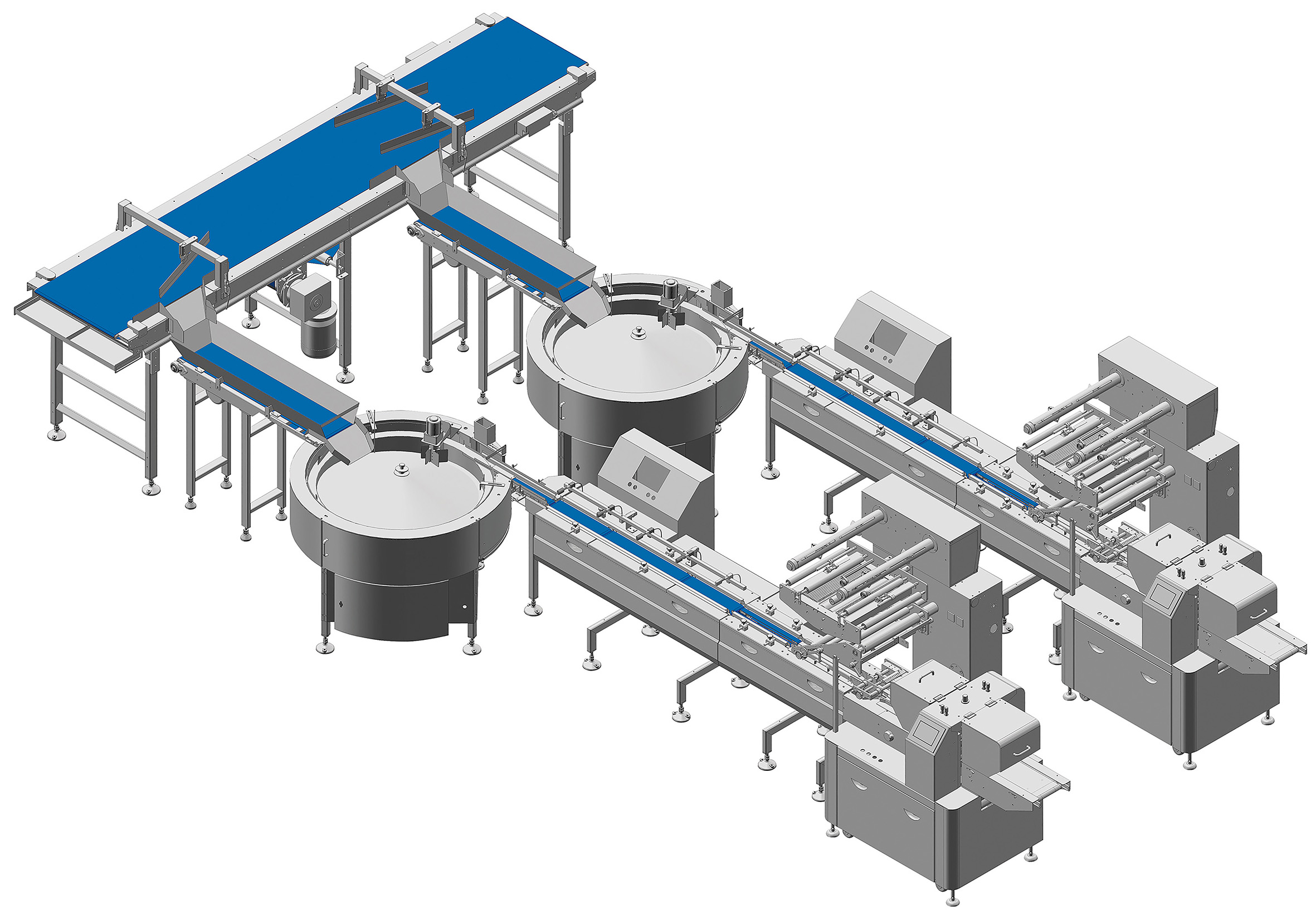
These configurations help define which assemblies should be monitored, including feeding, weighing, film transport, sealing, conveying, coding, and controls. However, they do not establish how long any individual component will operate. A meaningful replacement interval should only be created after collecting data for the actual product, line speed, packaging film, sanitation routine, and daily duty cycle.
How to Build a Practical Replacement Program
Track operating conditions
Record production hours, running speed, changeovers, cleaning exposure, film type, product characteristics, and abnormal loading. These factors can significantly affect wear on belts, bearings, sealing parts, sensors, and drive components.
Use inspection and performance records
Maintenance teams should document seal quality, weighing accuracy, feeding consistency, conveyor tracking, coding performance, alarms, temperature stability, and adjustment frequency. Repeated deviations can indicate that a component requires service before a complete failure occurs.
Set intervals from site evidence
Once inspection results and replacement history have been collected, the factory can establish inspection frequencies, critical spare-part levels, and planned replacement windows. This approach is more defensible than assigning a universal number of years to every line component.
Supplier and Application Background
Foshan Ruipuhua Machinery Equipment Co. Ltd states that its research and development activities cover synchronized feeding, packaging, secondary collating, case packing, and palletizing solutions. The company also states that its machinery is designed to meet CE and other international safety requirements. Its listed CE certification covers flow packaging machines, automatic packaging systems, cartoning machines, and palletizing robots.
One documented chocolate pie and cake packaging project was delivered for an international bakery customer. The integrated system included forming, baking, filling, enrobing, wrapping, and palletizing equipment. This example demonstrates experience with complete bakery packaging lines, although it does not specify the expected service life of individual parts.
Component Groups and What the Data Shows
| Component group | Documented functions or equipment | Maintenance conclusion |
|---|---|---|
| Feeding and conveying | Vibrating elevators, separating conveyors, distribution conveyors, and finished-product conveyors are included in the described systems. | No fixed lifespan is stated; evaluate wear and reliability through operating records. |
| Weighing and counting | Multi-head weighing, automatic counting, stacking, and collating functions are documented. | Monitor accuracy, throughput, and repeatability rather than relying on a predetermined replacement date. |
| Film handling and sealing | Servo film pulling, vertical sealing, horizontal flow wrapping, and temperature-controlled sealing jaws are specified. | Review seal strength, film tracking, temperature stability, and adjustment frequency to determine service needs. |
| Controls and coding | PLC, HMI touchscreen control, recipe storage, parameter adjustment, alarms, and date coding are described. | Keep records of faults, software or parameter changes, and recurring control issues; no component lifespan is provided. |
| Structural and product-contact parts | Food-grade 304 stainless steel is identified for product-contact construction in the puffed-food line. | The material specification confirms suitability, but it does not define a service-life duration. |
Frequently Asked Questions
How many years should common patty packaging-line parts last?
The supplied information does not provide a number of years. Actual life depends on production volume, sanitation, product properties, machine settings, film selection, and maintenance quality.
Which parts should be included in a maintenance review?
Review feeders, conveyors, weighers, counters, collating devices, wrapping machines, sealing assemblies, date coders, PLC and HMI controls, case packers, and palletizing equipment.
Can the listed machine specifications establish a replacement schedule?
No. The specifications identify equipment functions, materials, and control features, but they do not include part-life values, maintenance intervals, or patty-specific production records.
What is the safest way to determine service intervals?
Combine manufacturer recommendations, inspection results, fault history, product-quality data, and previous replacement records. Critical components may also require planned spares and condition monitoring.
Conclusion
The available data cannot support a numeric answer for the expected life of common parts on a patty packaging line. The appropriate strategy is to monitor feeding, weighing, conveying, film handling, sealing, coding, and control components under actual factory conditions. Establish inspection and replacement intervals only after collecting evidence from the specific line and production schedule.
Foshan Ruipuhua Machinery Equipment Co. Ltd operates as a packaging machinery manufacturer and OEM supplier, with documented capabilities in packaging, cartoning, case packing, and palletizing. For technical consultation or customized support, contact lotuspack@ruipuhua.com.
About Foshan Ruipuhua Machinery Equipment Co. Ltd
Foshan Ruipuhua Machinery Equipment Co. Ltd, also known as RPH or RAPIDPACK, was founded in 2005. The company integrates equipment research and development, manufacturing, installation, and technical after-sales service for automatic packaging and palletizing solutions. Its applications include food, bakery, biscuits, snacks, noodles, chocolate, soap, hardware, pharmaceuticals, and daily chemical products. The company states that it develops customized and synchronized packaging lines and exports equipment to more than 100 countries. Its listed credentials include CE certification for flow packaging machines, automatic packaging systems, cartoning machines, and palletizing robots, supported by cooperation with customers across several industries.

REPORT