







-
 Agriculture
-
 Health-Care
-
 Environment
-
 Construction-Real-Estate
-
 Tools-Hardware
-
 Home-Garden
-
 Furniture
-
 Luggage-Bags-Cases
-
 Medical-devices-Supplies
-
 Gifts-Crafts
-
 Sports-Entertainment
-
 Food-Beverage
-
 Vehicles-Transportation
-
 Power-Transmission
-
 Material-Handling
-
 Renewable-Energy
-
 Safety
-
 Testing-Instrument-Equipment
-
 Construction-Building-Machinery
-
 Pet-Supplies
-
 Personal-Care-Household-Cleaning
-
 Vehicle-Accessories-Electronics-Tools
-
 School-Office-Supplies
-
 Packaging-Printing
-
 Mother-Kids-Toys
-
 Business-Services
-
 Commercial-Equipment-Machinery
-
 Apparel-Accessories
-
 Security
-
 Shoes-Accessories
-
 Vehicle-Parts-Accessories
-
 Jewelry-Eyewear-Watches-Accessories
-
 Lights-Lighting
-
 Fabric-Textile-Raw-Material
-
 Fabrication-Services
-
 Industrial-Machinery
-
 Consumer-Electronics
-
 Electrical-Equipment-Supplies
-
 Electronic-Components-Accessories-Telecommunications
-
 Home-Appliances
-
 Beauty
-
 Chemicals
-
 Rubber-Plastics
-
 Metals-Alloys


























































































































































































































































































































































































































































































































































































- Masonry Materials
- Curtain Walls & Accessories
- Earthwork Products
- Fireproofing Materials
- Heat Insulation Materials
- Plastic Building Materials
- Building Boards
- Soundproofing Materials
- Timber
- Waterproofing Materials
- Balustrades & Handrails
- Bathroom & Kitchen
- Flooring & Accessories
- Tiles & Accessories
- Door, Window & Accessories
- Fireplaces & Stoves
- Floor Heating Systems & Parts
- Stairs & Stair Parts
- Ceilings
- Elevators & Escalators
- Stone
- Countertops, Vanity Tops & Table Tops
- Mosaics
- Metal Building Materials
- Multifunctional Materials
- Ladders & Scaffoldings
- Mouldings
- Corner Guards
- Decorative Films
- Formwork
- Building & Industrial Glass
- Other Construction & Real Estate
- Wallpapers/Wall panels
- HVAC System & Parts
- Outdoor Facilities
- Prefabricated Buildings
- Festive & Party Supplies
- Bathroom Products
- Household Sundries
- Rain Gear
- Garden Supplies
- Household Cleaning Tools & Accessories
- Lighters & Smoking Accessories
- Home Storage & Organization
- Household Scales
- Smart Home Improvement
- Home Textiles
- Kitchenware
- Drinkware & Accessories
- Dinnerware, Coffee & Wine
- Home Decor
- Golf
- Fitness & Body Building
- Amusement Park Facilities
- Billiards, Board Game,Coin Operated Games
- Musical Instruments
- Outdoor Affordable Luxury Sports
- Camping & Hiking
- Fishing
- Sports Safety&Rehabilitation
- Ball Sports Equipments
- Water Sports
- Winter Sports
- Luxury Travel Equipments
- Sports Shoes, Bags & Accessories
- Cycling
- Other Sports & Entertainment Products
- Artificial Grass&Sports Flooring&Sports Court Equipment
- Scooters
- Food Ingredients
- Honey & Honey Products
- Snacks
- Nuts & Kernels
- Seafood
- Plant & Animal Oil
- Beverages
- Fruit & Vegetable Products
- Frog & Escargot
- Bean Products
- Egg Products
- Dairy Products
- Seasonings & Condiments
- Canned Food
- Instant Food
- Baked Goods
- Other Food & Beverage
- Meat & Poultry
- Confectionery
- Grain Products
- Feminie Care
- Hair Care & Styling
- Body Care
- Hands & Feet Care
- Hygiene Products
- Men's Grooming
- Laundry Cleaning Supplies
- Travel Size & Gift Sets
- Room Deodorizers
- Other Personal Care Products
- Pest Control Products
- Special Household Cleaning
- Floor Cleaning
- Kitchen & Bathroom Cleaning
- Oral Care
- Bath Supplies
- Yellow Pages
- Correction Supplies
- Office Binding Supplies
- Office Cutting Supplies
- Board Erasers
- Office Adhesives & Tapes
- Education Supplies
- Pencil Cases & Bags
- Notebooks & Writing Pads
- File Folder Accessories
- Calendars
- Writing Accessories
- Commercial Office Supplies
- Pencil Sharpeners
- Pens
- Letter Pad/Paper
- Paper Envelopes
- Desk Organizers
- Pencils
- Markers & Highlighters
- Filing Products
- Art Supplies
- Easels
- Badge Holder & Accessories
- Office Paper
- Printer Supplies
- Book Covers
- Other Office & School Supplies
- Stationery Set
- Boards
- Clipboards
- Stamps
- Drafting Supplies
- Stencils
- Electronic Dictionary
- Books
- Map
- Magazines
- Calculators
- Baby & Toddler Toys
- Educational Toys
- Classic Toys
- Dress Up & Pretend Play
- Toy Vehicle
- Stuffed Animals & Plush Toys
- Outdoor Toys & Structures
- Balloons & Accessories
- Baby Food
- Children's Clothing
- Baby Supplies & Products
- Maternity Clothes
- Kids Shoes
- Baby Care
- Novelty & Gag Toys
- Dolls & Accessories
- Puzzle & Games
- Blocks & Model Building Toys
- Toddler Clothing
- Baby Clothing
- Kids' Luggage & Bags
- Arts, Crafts & DIY Toys
- Action & Toy Figures
- Baby Appliances
- Hobbies & Models
- Remote Control Toys
- Promotional Toys
- Pregnancy & Maternity
- Hygiene Products
- Kid's Textile&Bedding
- Novelty & Special Use
- Toy Weapons
- Baby Gifts
- Baby Storage & Organization
- Auto Drive Systems
- ATV/UTV Parts & Accessories
- Marine Parts & Accessories
- Other Auto Parts
- Trailer Parts & Accessories
- Auto Transmission Systems
- Train Parts & Accessories
- Universal Parts
- Railway Parts & Accessories
- Auto Brake Systems
- Aviation Parts & Accessories
- Truck Parts & Accessories
- Auto Suspension Systems
- Auto Lighting Systems
- New Energy Vehicle Parts & Accessories
- Auto Steering Systems
- Wheels, Tires & Accessories
- Bus Parts & Accessories
- Auto Performance Parts
- Cooling System
- Go-Kart & Kart Racer Parts & Accessories
- Air Conditioning Systems
- Heavy Duty Vehicle Parts & Accessories
- Auto Electrical Systems
- Auto Body Systems
- Auto Engine Systems
- Container Parts & Accessories
- Motorcycle Parts & Accessories
- Refrigeration & Heat Exchange Equipment
- Machine Tool Equipment
- Food & Beverage Machinery
- Agricultural Machinery & Equipment
- Apparel & Textile Machinery
- Chemical Machinery
- Packaging Machines
- Paper Production Machinery
- Plastic & Rubber Processing Machinery
- Industrial Robots
- Electronic Products Machinery
- Metal & Metallurgy Machinery
- Woodworking Machinery
- Home Product Manufacturing Machinery
- Machinery Accessories
- Environmental Machinery
- Machinery Service
- Electrical Equipment Manufacturing Machinery
- Industrial Compressors & Parts
- Tobacco & Cigarette Machinery
- Production Line
- Used Industrial Machinery
- Electronics Production Machinery
- Other Machinery & Industrial Equipment
- Camera, Photo & Accessories
- Portable Audio, Video & Accessories
- Television, Home Audio, Video & Accessories
- Video Games & Accessories
- Mobile Phone & Accessories
- Electronic Publications
- Earphone & Headphone & Accessories
- Speakers & Accessories
- Smart Electronics
- TV Receivers & Accessories
- Mobile Phone & Computer Repair Parts
- Chargers, Batteries & Power Supplies
- Used Electronics
- VR, AR, MR Hardware & Software
- Projectors & Presentation Equipments
- Other Consumer Electronics
- Cables & Commonly Used Accessories
- Computer Hardware & Software
- Displays, Signage and Optoelectronics
- Discrete Semiconductors
- Wireless & IoT Module and Products
- Telecommunications
- Connectors, Terminals & Accessories
- Development Boards, Electronic Modules and Kits
- Circuit Protection
- Sensors
- Isolators
- Audio Components and Products
- Integrated Circuits
- Power Supplies
- Relays
- RF, Microwave and RFID
- Electronic Accessories & Supplies
- Passive Components
- PCB & PCBA
- Air Quality Appliances
- Home Appliance Parts
- Heating & Cooling Appliances
- Small Kitchen Appliances
- Laundry Appliances
- Water Heaters
- Water Treatment Appliances
- Refrigerators & Freezers
- Personal Care & Beauty Appliances
- Major Kitchen Appliances
- Cleaning Appliances
- Second-hand Appliances
- Smart Home Appliances
- Other Home Appliances
- Energy Chemicals
- Inorganic Chemicals
- Basic Organic Chemicals
- Agrochemicals
- Admixture & Additives
- Catalysts & Chemical Auxiliary Agents
- Pigments & Dyestuff
- Coating & Paint
- Daily Chemicals
- Polymer
- Organic Intermediate
- Adhesives & Sealants
- Chemical Waste
- Biological Chemical Products
- Surface Treatment Chemicals
- Painting & Coating
- Chemical Reagents
- Flavor & Fragrance
- Non-Explosive Demolition Agents
- Other Chemicals
- Custom Chemical Services

How to Select Outdoor Handles for Comfort, Strength, and Stability
Outdoor handles need to feel secure in the hand and stay dependable through exposure to moisture, temperature changes, impact, and repeated use. Choose a handle by assessing its grip shape, body material, fastening method, finish, and the conditions where it will operate. For exposed or marine equipment, a corrosion-resistant stainless steel insert or stud can help maintain a durable connection.
Start with the Operating Environment
The handle body and its threaded hardware work together with the mounting surface. Consider the expected load, frequency of adjustment, exposure to water or chemicals, and operating temperature before selecting a design. Also check thread durability, insert depth, stud length, and pull-out resistance against the equipment’s requirements.
For general-purpose equipment, thermoplastics such as PA6, nylon, polyamide, polypropylene, and ABS offer low weight, impact and wear resistance, electrical insulation, and resistance to many chemicals. These materials are used on automation systems, packaging machinery, electronic equipment, and furniture hardware.
When adjustment involves greater torque or mechanical loads, reinforced polyamide and glass-fiber nylon provide increased strength. Their heat, oil, and solvent resistance can make them suitable for industrial machinery, CNC equipment, medical devices, and heavy-duty fixtures.
Choose the Grip and Fastening Style
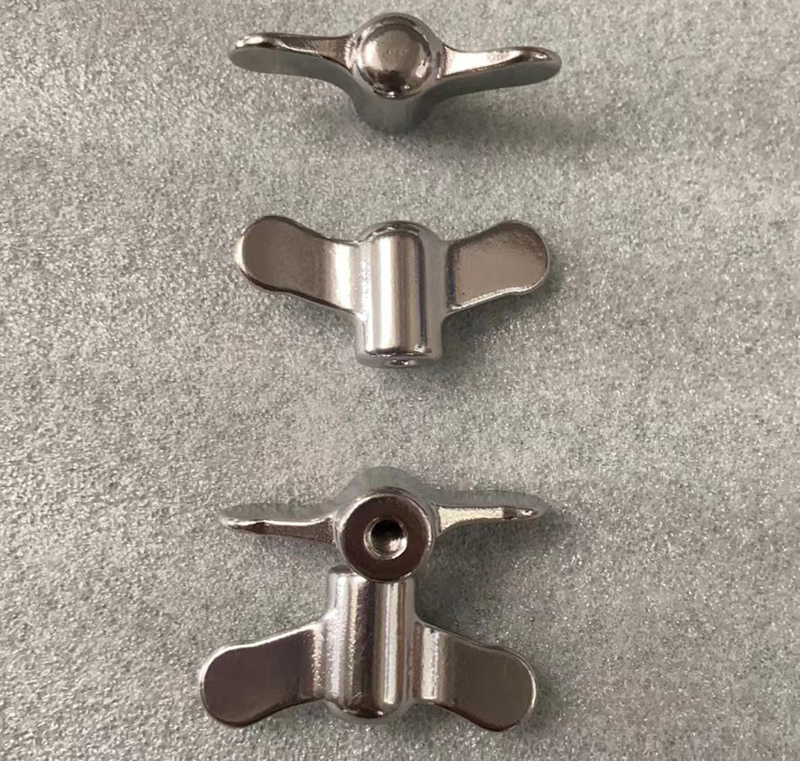
Handle geometry affects how comfortably and consistently a user can tighten or adjust equipment. Wing, star, knurled, and scalloped profiles provide different gripping surfaces and hand actions. Match the shape to the available clearance and the force needed during operation.
Mounting options include female threads in sizes such as M4, M5, M6, M8, M10, and M12; male threaded studs; and through-hole configurations. Through holes may be plain, reamed, or fitted with a keyway. Confirm the thread specification and the dimensions of the insert or stud so the handle remains secure under repeated use.
Compare Materials and Finishes
| Option | Characteristics and Typical Applications |
|---|---|
| Thermoplastic handle | Lightweight, impact- and wear-resistant, and resistant to many chemicals; a practical choice for general equipment adjustment. |
| Reinforced polyamide or glass-fiber nylon | Higher mechanical and torque strength, with heat, oil, and solvent resistance for more demanding industrial fixtures. |
| Aluminum handle | Combines low weight and strength with corrosion resistance; used on premium equipment, instrument panels, and medical devices. |
| Stainless steel insert or stud | Offers tensile strength and corrosion resistance for outdoor, marine, food-processing, and frequently fastened equipment. |
| Brass insert | Provides smooth threading and good machinability, making it useful for precision applications and repeated tightening. |
Stainless steel insert and stud options include SUS303, SUS304, and SUS316L. Select the grade according to the exposure conditions and confirm that the full handle assembly, not only its fastener, is appropriate for the application. Brass is another option where smooth thread engagement and machinability are priorities.
Surface finishes can also influence corrosion protection, appearance, and handling. Options include passivation, polishing, electropolishing, zinc, chrome, or nickel plating, black oxide, brushed or polished finishes, sandblasting, and aluminum anodizing. A listed operating-temperature example is -20 degrees C to 120 degrees C; verify the actual allowable range for the chosen material and product.
Quality, Customization, and Applications
The manufacturer describes a quality program that includes ISO 9001 certification, first-article and full dimensional inspections, material certificates, and RoHS and REACH compliance. Patent-protected designs are also listed as available. A marine-grade handwheel supplied for marine equipment illustrates why corrosion resistance and service life matter in exposed environments.
OEM and ODM options include custom dimensions, colors, Pantone colors, logos, packaging, thread specifications, insert materials, and stud lengths. Available configurations cover female threads, male studs, and through holes.
Frequently Asked Questions
What should I use in wet or saltwater conditions?
SUS304 or SUS316L stainless steel inserts and studs can provide corrosion resistance for outdoor and marine equipment. Check the material grade, handle body, finish, and assembly design against the specific exposure, especially where saltwater is present.
How do I make a handle easier to grip and more stable?
Choose a wing, star, knurled, or scalloped profile that suits the user’s hand action and available space. Then verify thread size, stud length, insert depth, and pull-out resistance to support a stable attachment.
Can handle specifications be customized?
Customization can cover colors, logos, dimensions, threads, insert materials, packaging, and stud lengths. Confirm the required mounting style and operating conditions when requesting a tailored design.
Recommendations
For a reliable outdoor handle, evaluate the complete assembly: grip comfort, body strength, corrosion resistance, fastening geometry, surface treatment, and temperature limits. Reinforced nylon is suited to lightweight, higher-load adjustment; aluminum offers a lightweight option for equipment; and stainless steel inserts or studs are worth considering for marine and exposed installations.
Zhejiang Dream Industry Limited offers OEM and ODM manufacturing, CNC machining, factory-direct supply, bulk production, and small-batch orders. Its stated quality processes include ISO 9001 certification, dimensional inspection, and first-article inspection. For technical support, contact the company at 86-15868979792.
About the Manufacturer
ZheJiang Dream Industry Limited has more than 20 years of precision manufacturing experience. The company produces custom CNC-machined parts and assemblies from stainless steel, aluminum, brass, copper, carbon steel, and engineering plastics. Its engineering and R&D capabilities include product design, structural optimization, precision machining, mold development, surface finishing, and customized production. Its product range includes handwheels, operator controls, bushings, pins, fasteners, couplings, gears, shafts, pipe fittings, and other metal and plastic components, serving customers in multiple industries.
REPORT