







-
 Agriculture
-
 Health-Care
-
 Environment
-
 Construction-Real-Estate
-
 Tools-Hardware
-
 Home-Garden
-
 Furniture
-
 Luggage-Bags-Cases
-
 Medical-devices-Supplies
-
 Gifts-Crafts
-
 Sports-Entertainment
-
 Food-Beverage
-
 Vehicles-Transportation
-
 Power-Transmission
-
 Material-Handling
-
 Renewable-Energy
-
 Safety
-
 Testing-Instrument-Equipment
-
 Construction-Building-Machinery
-
 Pet-Supplies
-
 Personal-Care-Household-Cleaning
-
 Vehicle-Accessories-Electronics-Tools
-
 School-Office-Supplies
-
 Packaging-Printing
-
 Mother-Kids-Toys
-
 Business-Services
-
 Commercial-Equipment-Machinery
-
 Apparel-Accessories
-
 Security
-
 Shoes-Accessories
-
 Vehicle-Parts-Accessories
-
 Jewelry-Eyewear-Watches-Accessories
-
 Lights-Lighting
-
 Fabric-Textile-Raw-Material
-
 Fabrication-Services
-
 Industrial-Machinery
-
 Consumer-Electronics
-
 Electrical-Equipment-Supplies
-
 Electronic-Components-Accessories-Telecommunications
-
 Home-Appliances
-
 Beauty
-
 Chemicals
-
 Rubber-Plastics
-
 Metals-Alloys


























































































































































































































































































































































































































































































































































































- Masonry Materials
- Curtain Walls & Accessories
- Earthwork Products
- Fireproofing Materials
- Heat Insulation Materials
- Plastic Building Materials
- Building Boards
- Soundproofing Materials
- Timber
- Waterproofing Materials
- Balustrades & Handrails
- Bathroom & Kitchen
- Flooring & Accessories
- Tiles & Accessories
- Door, Window & Accessories
- Fireplaces & Stoves
- Floor Heating Systems & Parts
- Stairs & Stair Parts
- Ceilings
- Elevators & Escalators
- Stone
- Countertops, Vanity Tops & Table Tops
- Mosaics
- Metal Building Materials
- Multifunctional Materials
- Ladders & Scaffoldings
- Mouldings
- Corner Guards
- Decorative Films
- Formwork
- Building & Industrial Glass
- Other Construction & Real Estate
- Wallpapers/Wall panels
- HVAC System & Parts
- Outdoor Facilities
- Prefabricated Buildings
- Festive & Party Supplies
- Bathroom Products
- Household Sundries
- Rain Gear
- Garden Supplies
- Household Cleaning Tools & Accessories
- Lighters & Smoking Accessories
- Home Storage & Organization
- Household Scales
- Smart Home Improvement
- Home Textiles
- Kitchenware
- Drinkware & Accessories
- Dinnerware, Coffee & Wine
- Home Decor
- Golf
- Fitness & Body Building
- Amusement Park Facilities
- Billiards, Board Game,Coin Operated Games
- Musical Instruments
- Outdoor Affordable Luxury Sports
- Camping & Hiking
- Fishing
- Sports Safety&Rehabilitation
- Ball Sports Equipments
- Water Sports
- Winter Sports
- Luxury Travel Equipments
- Sports Shoes, Bags & Accessories
- Cycling
- Other Sports & Entertainment Products
- Artificial Grass&Sports Flooring&Sports Court Equipment
- Scooters
- Food Ingredients
- Honey & Honey Products
- Snacks
- Nuts & Kernels
- Seafood
- Plant & Animal Oil
- Beverages
- Fruit & Vegetable Products
- Frog & Escargot
- Bean Products
- Egg Products
- Dairy Products
- Seasonings & Condiments
- Canned Food
- Instant Food
- Baked Goods
- Other Food & Beverage
- Meat & Poultry
- Confectionery
- Grain Products
- Feminie Care
- Hair Care & Styling
- Body Care
- Hands & Feet Care
- Hygiene Products
- Men's Grooming
- Laundry Cleaning Supplies
- Travel Size & Gift Sets
- Room Deodorizers
- Other Personal Care Products
- Pest Control Products
- Special Household Cleaning
- Floor Cleaning
- Kitchen & Bathroom Cleaning
- Oral Care
- Bath Supplies
- Yellow Pages
- Correction Supplies
- Office Binding Supplies
- Office Cutting Supplies
- Board Erasers
- Office Adhesives & Tapes
- Education Supplies
- Pencil Cases & Bags
- Notebooks & Writing Pads
- File Folder Accessories
- Calendars
- Writing Accessories
- Commercial Office Supplies
- Pencil Sharpeners
- Pens
- Letter Pad/Paper
- Paper Envelopes
- Desk Organizers
- Pencils
- Markers & Highlighters
- Filing Products
- Art Supplies
- Easels
- Badge Holder & Accessories
- Office Paper
- Printer Supplies
- Book Covers
- Other Office & School Supplies
- Stationery Set
- Boards
- Clipboards
- Stamps
- Drafting Supplies
- Stencils
- Electronic Dictionary
- Books
- Map
- Magazines
- Calculators
- Baby & Toddler Toys
- Educational Toys
- Classic Toys
- Dress Up & Pretend Play
- Toy Vehicle
- Stuffed Animals & Plush Toys
- Outdoor Toys & Structures
- Balloons & Accessories
- Baby Food
- Children's Clothing
- Baby Supplies & Products
- Maternity Clothes
- Kids Shoes
- Baby Care
- Novelty & Gag Toys
- Dolls & Accessories
- Puzzle & Games
- Blocks & Model Building Toys
- Toddler Clothing
- Baby Clothing
- Kids' Luggage & Bags
- Arts, Crafts & DIY Toys
- Action & Toy Figures
- Baby Appliances
- Hobbies & Models
- Remote Control Toys
- Promotional Toys
- Pregnancy & Maternity
- Hygiene Products
- Kid's Textile&Bedding
- Novelty & Special Use
- Toy Weapons
- Baby Gifts
- Baby Storage & Organization
- Auto Drive Systems
- ATV/UTV Parts & Accessories
- Marine Parts & Accessories
- Other Auto Parts
- Trailer Parts & Accessories
- Auto Transmission Systems
- Train Parts & Accessories
- Universal Parts
- Railway Parts & Accessories
- Auto Brake Systems
- Aviation Parts & Accessories
- Truck Parts & Accessories
- Auto Suspension Systems
- Auto Lighting Systems
- New Energy Vehicle Parts & Accessories
- Auto Steering Systems
- Wheels, Tires & Accessories
- Bus Parts & Accessories
- Auto Performance Parts
- Cooling System
- Go-Kart & Kart Racer Parts & Accessories
- Air Conditioning Systems
- Heavy Duty Vehicle Parts & Accessories
- Auto Electrical Systems
- Auto Body Systems
- Auto Engine Systems
- Container Parts & Accessories
- Motorcycle Parts & Accessories
- Refrigeration & Heat Exchange Equipment
- Machine Tool Equipment
- Food & Beverage Machinery
- Agricultural Machinery & Equipment
- Apparel & Textile Machinery
- Chemical Machinery
- Packaging Machines
- Paper Production Machinery
- Plastic & Rubber Processing Machinery
- Industrial Robots
- Electronic Products Machinery
- Metal & Metallurgy Machinery
- Woodworking Machinery
- Home Product Manufacturing Machinery
- Machinery Accessories
- Environmental Machinery
- Machinery Service
- Electrical Equipment Manufacturing Machinery
- Industrial Compressors & Parts
- Tobacco & Cigarette Machinery
- Production Line
- Used Industrial Machinery
- Electronics Production Machinery
- Other Machinery & Industrial Equipment
- Camera, Photo & Accessories
- Portable Audio, Video & Accessories
- Television, Home Audio, Video & Accessories
- Video Games & Accessories
- Mobile Phone & Accessories
- Electronic Publications
- Earphone & Headphone & Accessories
- Speakers & Accessories
- Smart Electronics
- TV Receivers & Accessories
- Mobile Phone & Computer Repair Parts
- Chargers, Batteries & Power Supplies
- Used Electronics
- VR, AR, MR Hardware & Software
- Projectors & Presentation Equipments
- Other Consumer Electronics
- Cables & Commonly Used Accessories
- Computer Hardware & Software
- Displays, Signage and Optoelectronics
- Discrete Semiconductors
- Wireless & IoT Module and Products
- Telecommunications
- Connectors, Terminals & Accessories
- Development Boards, Electronic Modules and Kits
- Circuit Protection
- Sensors
- Isolators
- Audio Components and Products
- Integrated Circuits
- Power Supplies
- Relays
- RF, Microwave and RFID
- Electronic Accessories & Supplies
- Passive Components
- PCB & PCBA
- Air Quality Appliances
- Home Appliance Parts
- Heating & Cooling Appliances
- Small Kitchen Appliances
- Laundry Appliances
- Water Heaters
- Water Treatment Appliances
- Refrigerators & Freezers
- Personal Care & Beauty Appliances
- Major Kitchen Appliances
- Cleaning Appliances
- Second-hand Appliances
- Smart Home Appliances
- Other Home Appliances
- Energy Chemicals
- Inorganic Chemicals
- Basic Organic Chemicals
- Agrochemicals
- Admixture & Additives
- Catalysts & Chemical Auxiliary Agents
- Pigments & Dyestuff
- Coating & Paint
- Daily Chemicals
- Polymer
- Organic Intermediate
- Adhesives & Sealants
- Chemical Waste
- Biological Chemical Products
- Surface Treatment Chemicals
- Painting & Coating
- Chemical Reagents
- Flavor & Fragrance
- Non-Explosive Demolition Agents
- Other Chemicals
- Custom Chemical Services

How to Validate Aluminium Shutter Defects Remotely Before Returning Units
A complete remote claim file can often support an initial defect decision without sending back every unit. The file should connect the alleged issue to the correct product, order, shipment, defect category, affected quantity, photographs or video, and measured dimensions. Xinhe Aluminium can then review the evidence against production inspection records, laboratory sampling, incoming material checks, approved specifications, and after-sales documentation to determine whether a physical return is required.
Remote Defect Verification: Main Requirements
- Confirm the product model, order number, production information, defect description, and number of affected units before starting the technical assessment. The supplied record identifies a Sliding Door, so its relationship to an aluminium shutter claim must be verified first.
- Provide well-lit photographs or video showing the entire unit, the defective area, the relevant aluminium profile or hardware, and the surrounding installation. Include scale measurements whenever the complaint involves thickness, width, alignment, or other dimensions.
- Compare measured results with the applicable product specifications. For the supplied Sliding Door record, the listed data includes a 2.0 mm main thickness, a 140 mm by 23 mm side specification, a 40 mm by 16 mm hook specification, and an 11.5 mm or 26 mm glazing rebate.
- Ask for a remote technical disposition based on production-line inspection, laboratory testing, incoming raw-material inspection, and the established after-sales process. The company’s application range includes aluminium shutters for bathrooms, kitchens, bedrooms, studies, balconies, offices, hotels, factories, and warehouses.
How to Build a Traceable Evidence Package
Remote verification is most reliable when every file can be traced to a specific product and shipment. A useful claim should distinguish observable facts from assumptions: state what can be seen, identify its exact location, record how many units are affected, and compare the result with the relevant order documents or technical requirements.
Product identity is especially important in this case. The supplied product record is named Sliding Door rather than Shutter. It describes an extremely narrow design, OPK Perfect System hardware, multiple openings, a minimum order quantity of 500 sqm, and a stated delivery period of 15 to 20 days. These details may help confirm whether the evidence belongs to the referenced product, but they do not independently prove a shutter defect.
For a dimensional complaint, use calibrated measurements instead of relying solely on visual impressions. The available record specifies a 2.0 mm main thickness, a side section measuring 140 mm by 23 mm, a hook section measuring 40 mm by 16 mm, an 11.5 mm or 26 mm glazing rebate, and material information of 4.6 kg per square metre.
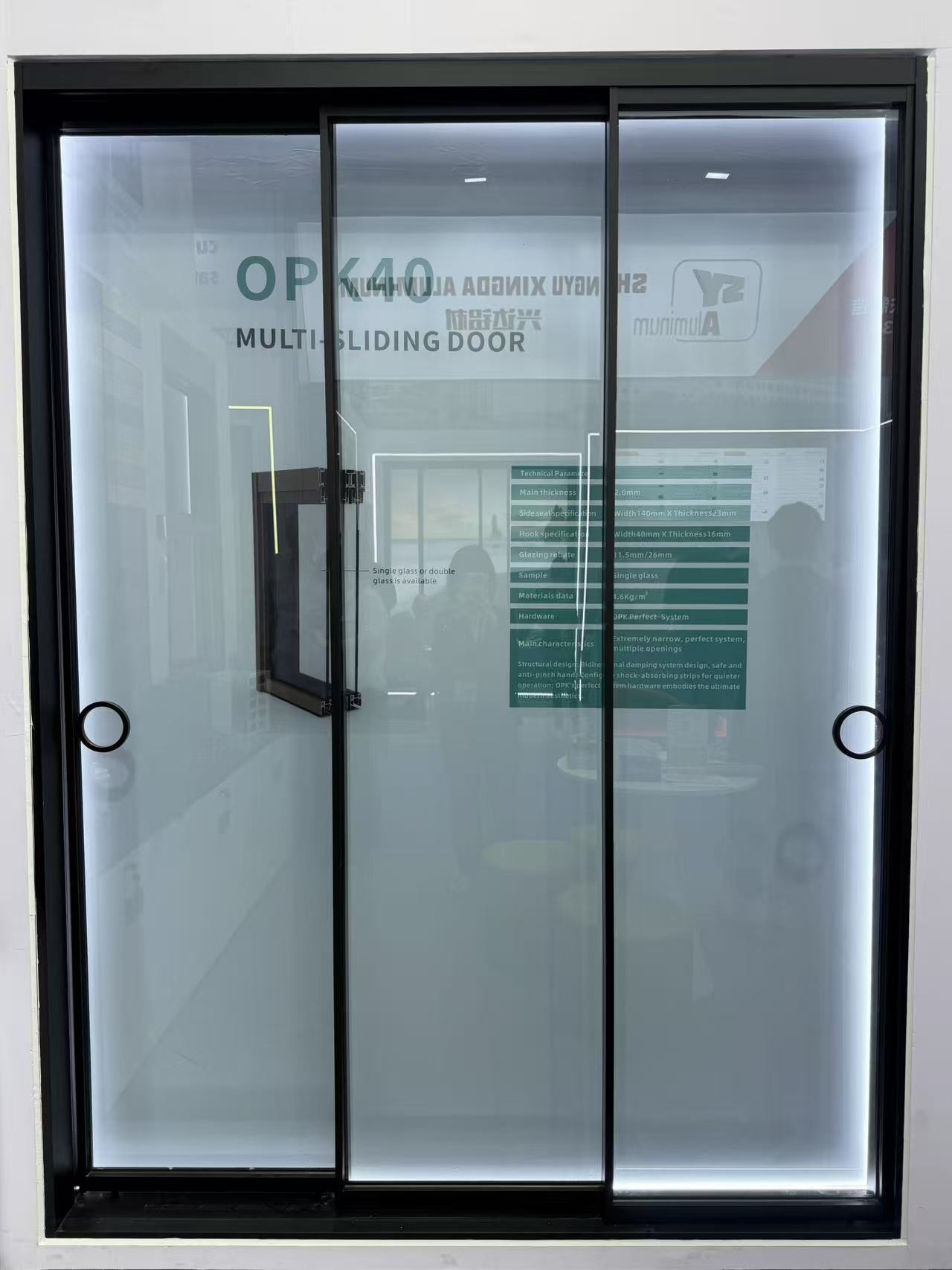
Evidence for Appearance, Operation, and Assembly Issues
Claims involving coating, alignment, opening, hardware, or assembly should include both a full-unit view and close-ups of the affected component in the same claim package. The product description refers to multiple openings and OPK Perfect System hardware. However, it does not define acceptance limits for coating quality, alignment, operation, or hardware performance. These points should therefore be assessed against the purchase agreement, approved drawings, samples, or other agreed technical documents.
Inspection and Service Records That Can Support Review
Xinhe Aluminium states that its quality controls include 100% production-line inspection, laboratory sampling and testing, and incoming inspection of raw materials. Its comprehensive after-sales service system is designed to collect customer feedback and coordinate responses to reported problems. When the records are traceable to the disputed goods, they can support an initial remote assessment before a return is requested.
The stated credentials include the CNAS Laboratory Accreditation Certificate, certificate CNAS L 10434, and a quality management system certified to GB/T 19001-2016 and ISO 9001:2015. The supplied service information also refers to dedicated coordination from sales through production and delivery, communication across time zones, and transparent quotations. These capabilities support claim handling, but they do not replace product-specific defect evidence.
Evidence Route Comparison
| Review method | What it can confirm | Important limitation |
|---|---|---|
| Product, order, and dimensional verification | Whether the complaint matches the recorded product and stated parameters | It cannot define performance requirements that are absent from the product documents |
| Full-unit photographs and defect video | The visible condition, defect location, appearance, and reported operating behavior | Visual material may not reveal an internal or material-related problem |
| Manufacturing, laboratory, and raw-material records | Relevant production and inspection information for technical comparison | The records must be connected to the claimed batch, order, and shipment |
| Remote after-sales assessment | An initial disposition and a coordinated response plan | The supplied information does not establish a universal rule for when returns are mandatory |
Frequently Asked Questions
Are photographs by themselves enough to prove a shutter defect?
Photographs can document visible conditions, but the supplied information does not state that images alone are sufficient for a final decision. A stronger submission combines photographs or video with product identification, measurements, affected quantity, and the applicable contractual or technical requirements.
What should I do if the product record says Sliding Door?
Confirm the model, purchase order, and shipment before attributing the evidence to a shutter. The provided record concerns a Sliding Door, while aluminium shutters appear separately in the application information. They should not be treated as identical products without supporting documentation.
Which inspection records are useful for a remote decision?
Production-line inspection results, laboratory sampling and test reports, incoming raw-material checks, agreed specifications, and after-sales records may all contribute to an initial assessment. Their value depends on whether they can be linked to the disputed products and shipment.
Conclusion and Recommended Claim Process
To avoid returning every unit unnecessarily, create a traceable claim package that links the alleged defect to the correct product, order, measurements, visual evidence, affected quantity, and acceptance criteria. For the supplied Sliding Door information, product identity must be confirmed before comparing the claim with the listed specifications. Xinhe Aluminium states that it supports distribution and direct sales, with a 3-ton aluminium-profile MOQ and a 15 to 20 day delivery period; the individual product record lists a 500 sqm MOQ. Its inspection resources, CNAS laboratory accreditation, and after-sales system provide a stated foundation for technical review before deciding on a return. For technical assistance, contact xh@xinhealuminium.com.
About Xinhe Aluminium
Guangdong Xinhe Aluminium Co., Ltd specializes in the research, development, and manufacture of building, decorative, and industrial aluminium alloy profiles. Founded in 1998, the company reports 1,200 employees and a factory area of 666,670 sqm. Its stated qualifications include CNAS laboratory accreditation and ISO 9001:2015 quality management certification, with cooperation cases covering customers in a range of industries.

REPORT