







-
 Agriculture
-
 Health-Care
-
 Environment
-
 Construction-Real-Estate
-
 Tools-Hardware
-
 Home-Garden
-
 Furniture
-
 Luggage-Bags-Cases
-
 Medical-devices-Supplies
-
 Gifts-Crafts
-
 Sports-Entertainment
-
 Food-Beverage
-
 Vehicles-Transportation
-
 Power-Transmission
-
 Material-Handling
-
 Renewable-Energy
-
 Safety
-
 Testing-Instrument-Equipment
-
 Construction-Building-Machinery
-
 Pet-Supplies
-
 Personal-Care-Household-Cleaning
-
 Vehicle-Accessories-Electronics-Tools
-
 School-Office-Supplies
-
 Packaging-Printing
-
 Mother-Kids-Toys
-
 Business-Services
-
 Commercial-Equipment-Machinery
-
 Apparel-Accessories
-
 Security
-
 Shoes-Accessories
-
 Vehicle-Parts-Accessories
-
 Jewelry-Eyewear-Watches-Accessories
-
 Lights-Lighting
-
 Fabric-Textile-Raw-Material
-
 Fabrication-Services
-
 Industrial-Machinery
-
 Consumer-Electronics
-
 Electrical-Equipment-Supplies
-
 Electronic-Components-Accessories-Telecommunications
-
 Home-Appliances
-
 Beauty
-
 Chemicals
-
 Rubber-Plastics
-
 Metals-Alloys


























































































































































































































































































































































































































































































































































































- Masonry Materials
- Curtain Walls & Accessories
- Earthwork Products
- Fireproofing Materials
- Heat Insulation Materials
- Plastic Building Materials
- Building Boards
- Soundproofing Materials
- Timber
- Waterproofing Materials
- Balustrades & Handrails
- Bathroom & Kitchen
- Flooring & Accessories
- Tiles & Accessories
- Door, Window & Accessories
- Fireplaces & Stoves
- Floor Heating Systems & Parts
- Stairs & Stair Parts
- Ceilings
- Elevators & Escalators
- Stone
- Countertops, Vanity Tops & Table Tops
- Mosaics
- Metal Building Materials
- Multifunctional Materials
- Ladders & Scaffoldings
- Mouldings
- Corner Guards
- Decorative Films
- Formwork
- Building & Industrial Glass
- Other Construction & Real Estate
- Wallpapers/Wall panels
- HVAC System & Parts
- Outdoor Facilities
- Prefabricated Buildings
- Festive & Party Supplies
- Bathroom Products
- Household Sundries
- Rain Gear
- Garden Supplies
- Household Cleaning Tools & Accessories
- Lighters & Smoking Accessories
- Home Storage & Organization
- Household Scales
- Smart Home Improvement
- Home Textiles
- Kitchenware
- Drinkware & Accessories
- Dinnerware, Coffee & Wine
- Home Decor
- Golf
- Fitness & Body Building
- Amusement Park Facilities
- Billiards, Board Game,Coin Operated Games
- Musical Instruments
- Outdoor Affordable Luxury Sports
- Camping & Hiking
- Fishing
- Sports Safety&Rehabilitation
- Ball Sports Equipments
- Water Sports
- Winter Sports
- Luxury Travel Equipments
- Sports Shoes, Bags & Accessories
- Cycling
- Other Sports & Entertainment Products
- Artificial Grass&Sports Flooring&Sports Court Equipment
- Scooters
- Food Ingredients
- Honey & Honey Products
- Snacks
- Nuts & Kernels
- Seafood
- Plant & Animal Oil
- Beverages
- Fruit & Vegetable Products
- Frog & Escargot
- Bean Products
- Egg Products
- Dairy Products
- Seasonings & Condiments
- Canned Food
- Instant Food
- Baked Goods
- Other Food & Beverage
- Meat & Poultry
- Confectionery
- Grain Products
- Feminie Care
- Hair Care & Styling
- Body Care
- Hands & Feet Care
- Hygiene Products
- Men's Grooming
- Laundry Cleaning Supplies
- Travel Size & Gift Sets
- Room Deodorizers
- Other Personal Care Products
- Pest Control Products
- Special Household Cleaning
- Floor Cleaning
- Kitchen & Bathroom Cleaning
- Oral Care
- Bath Supplies
- Yellow Pages
- Correction Supplies
- Office Binding Supplies
- Office Cutting Supplies
- Board Erasers
- Office Adhesives & Tapes
- Education Supplies
- Pencil Cases & Bags
- Notebooks & Writing Pads
- File Folder Accessories
- Calendars
- Writing Accessories
- Commercial Office Supplies
- Pencil Sharpeners
- Pens
- Letter Pad/Paper
- Paper Envelopes
- Desk Organizers
- Pencils
- Markers & Highlighters
- Filing Products
- Art Supplies
- Easels
- Badge Holder & Accessories
- Office Paper
- Printer Supplies
- Book Covers
- Other Office & School Supplies
- Stationery Set
- Boards
- Clipboards
- Stamps
- Drafting Supplies
- Stencils
- Electronic Dictionary
- Books
- Map
- Magazines
- Calculators
- Baby & Toddler Toys
- Educational Toys
- Classic Toys
- Dress Up & Pretend Play
- Toy Vehicle
- Stuffed Animals & Plush Toys
- Outdoor Toys & Structures
- Balloons & Accessories
- Baby Food
- Children's Clothing
- Baby Supplies & Products
- Maternity Clothes
- Kids Shoes
- Baby Care
- Novelty & Gag Toys
- Dolls & Accessories
- Puzzle & Games
- Blocks & Model Building Toys
- Toddler Clothing
- Baby Clothing
- Kids' Luggage & Bags
- Arts, Crafts & DIY Toys
- Action & Toy Figures
- Baby Appliances
- Hobbies & Models
- Remote Control Toys
- Promotional Toys
- Pregnancy & Maternity
- Hygiene Products
- Kid's Textile&Bedding
- Novelty & Special Use
- Toy Weapons
- Baby Gifts
- Baby Storage & Organization
- Auto Drive Systems
- ATV/UTV Parts & Accessories
- Marine Parts & Accessories
- Other Auto Parts
- Trailer Parts & Accessories
- Auto Transmission Systems
- Train Parts & Accessories
- Universal Parts
- Railway Parts & Accessories
- Auto Brake Systems
- Aviation Parts & Accessories
- Truck Parts & Accessories
- Auto Suspension Systems
- Auto Lighting Systems
- New Energy Vehicle Parts & Accessories
- Auto Steering Systems
- Wheels, Tires & Accessories
- Bus Parts & Accessories
- Auto Performance Parts
- Cooling System
- Go-Kart & Kart Racer Parts & Accessories
- Air Conditioning Systems
- Heavy Duty Vehicle Parts & Accessories
- Auto Electrical Systems
- Auto Body Systems
- Auto Engine Systems
- Container Parts & Accessories
- Motorcycle Parts & Accessories
- Refrigeration & Heat Exchange Equipment
- Machine Tool Equipment
- Food & Beverage Machinery
- Agricultural Machinery & Equipment
- Apparel & Textile Machinery
- Chemical Machinery
- Packaging Machines
- Paper Production Machinery
- Plastic & Rubber Processing Machinery
- Industrial Robots
- Electronic Products Machinery
- Metal & Metallurgy Machinery
- Woodworking Machinery
- Home Product Manufacturing Machinery
- Machinery Accessories
- Environmental Machinery
- Machinery Service
- Electrical Equipment Manufacturing Machinery
- Industrial Compressors & Parts
- Tobacco & Cigarette Machinery
- Production Line
- Used Industrial Machinery
- Electronics Production Machinery
- Other Machinery & Industrial Equipment
- Camera, Photo & Accessories
- Portable Audio, Video & Accessories
- Television, Home Audio, Video & Accessories
- Video Games & Accessories
- Mobile Phone & Accessories
- Electronic Publications
- Earphone & Headphone & Accessories
- Speakers & Accessories
- Smart Electronics
- TV Receivers & Accessories
- Mobile Phone & Computer Repair Parts
- Chargers, Batteries & Power Supplies
- Used Electronics
- VR, AR, MR Hardware & Software
- Projectors & Presentation Equipments
- Other Consumer Electronics
- Cables & Commonly Used Accessories
- Computer Hardware & Software
- Displays, Signage and Optoelectronics
- Discrete Semiconductors
- Wireless & IoT Module and Products
- Telecommunications
- Connectors, Terminals & Accessories
- Development Boards, Electronic Modules and Kits
- Circuit Protection
- Sensors
- Isolators
- Audio Components and Products
- Integrated Circuits
- Power Supplies
- Relays
- RF, Microwave and RFID
- Electronic Accessories & Supplies
- Passive Components
- PCB & PCBA
- Air Quality Appliances
- Home Appliance Parts
- Heating & Cooling Appliances
- Small Kitchen Appliances
- Laundry Appliances
- Water Heaters
- Water Treatment Appliances
- Refrigerators & Freezers
- Personal Care & Beauty Appliances
- Major Kitchen Appliances
- Cleaning Appliances
- Second-hand Appliances
- Smart Home Appliances
- Other Home Appliances
- Energy Chemicals
- Inorganic Chemicals
- Basic Organic Chemicals
- Agrochemicals
- Admixture & Additives
- Catalysts & Chemical Auxiliary Agents
- Pigments & Dyestuff
- Coating & Paint
- Daily Chemicals
- Polymer
- Organic Intermediate
- Adhesives & Sealants
- Chemical Waste
- Biological Chemical Products
- Surface Treatment Chemicals
- Painting & Coating
- Chemical Reagents
- Flavor & Fragrance
- Non-Explosive Demolition Agents
- Other Chemicals
- Custom Chemical Services

How to Validate an SPR Riveting Gun Sample and Maintain Mass-Production Quality
Testing an SPR riveting gun sample is the essential first step in confirming that a self-piercing riveting process will perform reliably in real production conditions. The sample should not be evaluated only as a standalone tool. Instead, it must be verified with the target materials, joint design, rivet and die configuration, and expected production requirements. Once approved, the same controlled standards should be applied to every production unit to minimize differences between the tested sample and delivered equipment.
Key Steps for SPR Riveting Gun Sample Approval
- Identify the actual material stack, joint geometry, access conditions, and production targets before starting sample tests.
- Validate riveting quality, force-control stability, equipment functions, repeatability, and durability under intended operating conditions.
- Document all test findings, including photos, videos, process settings, and analysis results when applicable.
- Use the approved sample documentation as the inspection and release benchmark for mass-produced SPR riveting equipment.
Start with the Real Joining Application
An SPR riveting gun must be selected and tested according to the application it will serve. Material thickness, strength, coating, layer sequence, rivet specifications, die type, and assembly access can all influence the final joint result. This is especially important in automotive manufacturing and vehicle repair, where self-piercing riveting is widely used for aluminum body structures and mixed-material assemblies.
Before releasing a sample, the joining process should demonstrate that it can create stable, repeatable joints on the specified workpieces. A suitable evaluation normally includes checking the tool's operating functions, the consistency of the applied force, joint formation quality, and the ability of the equipment to maintain performance during repeated cycles.
Validate Challenging Material Combinations
Some applications require more than a standard functional check. High-strength, lightweight, coated, or mixed materials may need repeated joining trials before the correct process window is established. For example, in vehicle-production applications involving self-piercing riveting and rivetless clinching, Questok has carried out multiple tests across different material combinations, supported by metallographic analysis, recorded results, and die adjustments.
This type of application-based development helps identify the appropriate tooling and process conditions before the equipment enters routine production. It also provides a documented reference for customers who need confidence that the proposed joining solution has been assessed for their specific requirements.

What to Check During Sample Testing
A complete SPR riveting gun sample assessment should cover both process performance and equipment reliability. The goal is to confirm that the system can achieve the required joint outcome while operating consistently over time.
| Validation Area | What It Confirms | Mass-Production Reference |
|---|---|---|
| Application review | Confirms that the SPR gun, rivet, die, and joining method suit the intended materials and assembly conditions. | Approved application specifications are retained as the basis for production delivery. |
| Sample joining test | Assesses joining consistency, force-control precision, functional operation, and durability. | Verified settings and test records become the release reference for production units. |
| Material and tooling trials | Addresses demanding material stacks through repeated tests, analysis, and tooling modifications if necessary. | Established material, rivet, and die conditions are maintained for the approved solution. |
| Final equipment verification | Ensures that each completed SPR riveting gun meets inspection and functional requirements. | 100% inspection, functional testing, and test evidence are completed before shipment. |
Preventing Quality Gaps Between Samples and Delivered Equipment
The most effective way to avoid variation in mass production is to connect sample approval directly to final manufacturing controls. An approved sample alone is not enough; every delivered SPR riveting gun or system should be built, inspected, and tested against the same defined requirements.
Questok states that it performs 100% inspection from incoming materials through finished products, verifies each manufacturing stage according to internal standards, and completes functional testing before delivery. Test videos and photos can be shared with customers for review, with shipment arranged after customer confirmation. These records establish traceability between the validated sample and the final delivered equipment.
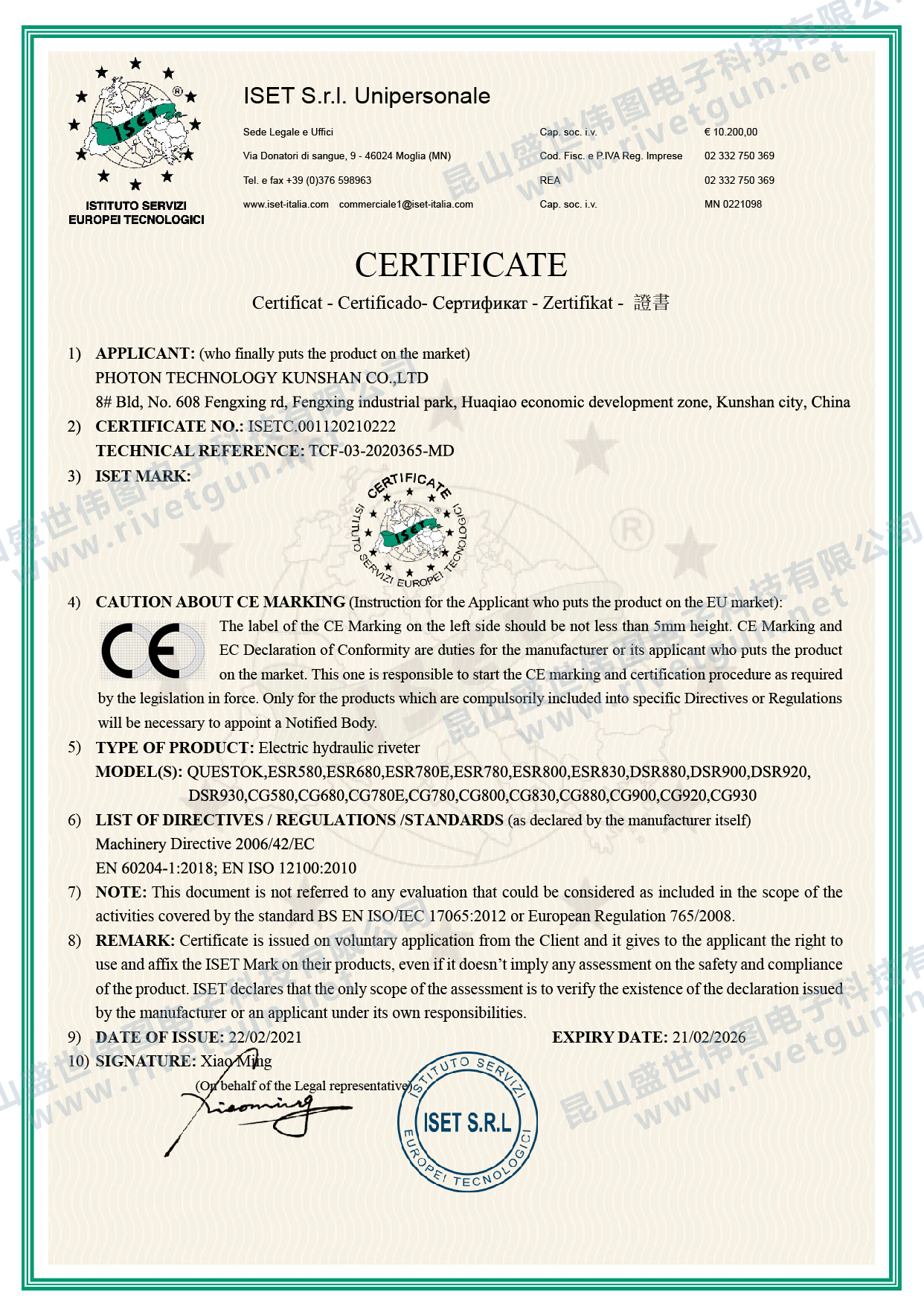
For the listed SPR equipment range, including SPR riveters, SPR riveting guns, SPR riveting systems, and self-piercing riveting guns, CE certificates numbered ISETC.001120210222 and 3N210218.PTK0S25 are listed. An MSDS credential is also listed for the relevant equipment range.
Frequently Asked Questions
What should be included in an SPR riveting gun sample test?
The test should reflect the final application. Key checks include material compatibility, joint consistency, force-control accuracy, equipment operation, repeated-cycle performance, and durability. All relevant results should be recorded before the sample is approved for production.
How can buyers verify that production equipment matches the approved sample?
Buyers can use the approved sample specifications, process parameters, and test records as comparison points. Each finished unit should receive the same inspection and functional testing, supported by test videos or photos where these are provided for customer review.
Can the SPR process be optimized for difficult materials?
Yes. The joining solution can be adapted through material trials, rivet and die selection, tooling changes, and process optimization. The final configuration should be determined by the customer's material combination, working environment, and quality requirements.
Recommendation
Approve an SPR riveting gun only after its joining process has been tested and documented on the intended application. To protect production quality, require identical inspection discipline, functional verification, and traceable test evidence for every delivered unit. Questok supports ODM and OBM projects with a minimum order quantity of one set. For technical evaluation or solution support, contact jane@questok.com.
About Us
PHOTON TECHNOLOGY KUNSHAN CO.,LTD develops fastening, joining, and assembly equipment, including SPR riveting systems, self-piercing riveting guns, clinching equipment, and fastener pressing tools. Founded in 2011, the company operates a 5000 sqm factory and has an engineering team with more than 10 years of experience. Its development capabilities cover hydraulic technology, mechanical engineering, control systems, fastening-process development, validation, and reliability testing.
The company serves a range of industries, including automotive manufacturing, electric vehicles, HVAC, aerospace, and appliance-related production. Listed credentials include CE and MSDS documentation for applicable SPR, clinching, and fastener installation equipment.

REPORT