







-
 Agriculture
-
 Health-Care
-
 Environment
-
 Construction-Real-Estate
-
 Tools-Hardware
-
 Home-Garden
-
 Furniture
-
 Luggage-Bags-Cases
-
 Medical-devices-Supplies
-
 Gifts-Crafts
-
 Sports-Entertainment
-
 Food-Beverage
-
 Vehicles-Transportation
-
 Power-Transmission
-
 Material-Handling
-
 Renewable-Energy
-
 Safety
-
 Testing-Instrument-Equipment
-
 Construction-Building-Machinery
-
 Pet-Supplies
-
 Personal-Care-Household-Cleaning
-
 Vehicle-Accessories-Electronics-Tools
-
 School-Office-Supplies
-
 Packaging-Printing
-
 Mother-Kids-Toys
-
 Business-Services
-
 Commercial-Equipment-Machinery
-
 Apparel-Accessories
-
 Security
-
 Shoes-Accessories
-
 Vehicle-Parts-Accessories
-
 Jewelry-Eyewear-Watches-Accessories
-
 Lights-Lighting
-
 Fabric-Textile-Raw-Material
-
 Fabrication-Services
-
 Industrial-Machinery
-
 Consumer-Electronics
-
 Electrical-Equipment-Supplies
-
 Electronic-Components-Accessories-Telecommunications
-
 Home-Appliances
-
 Beauty
-
 Chemicals
-
 Rubber-Plastics
-
 Metals-Alloys


























































































































































































































































































































































































































































































































































































- Masonry Materials
- Curtain Walls & Accessories
- Earthwork Products
- Fireproofing Materials
- Heat Insulation Materials
- Plastic Building Materials
- Building Boards
- Soundproofing Materials
- Timber
- Waterproofing Materials
- Balustrades & Handrails
- Bathroom & Kitchen
- Flooring & Accessories
- Tiles & Accessories
- Door, Window & Accessories
- Fireplaces & Stoves
- Floor Heating Systems & Parts
- Stairs & Stair Parts
- Ceilings
- Elevators & Escalators
- Stone
- Countertops, Vanity Tops & Table Tops
- Mosaics
- Metal Building Materials
- Multifunctional Materials
- Ladders & Scaffoldings
- Mouldings
- Corner Guards
- Decorative Films
- Formwork
- Building & Industrial Glass
- Other Construction & Real Estate
- Wallpapers/Wall panels
- HVAC System & Parts
- Outdoor Facilities
- Prefabricated Buildings
- Festive & Party Supplies
- Bathroom Products
- Household Sundries
- Rain Gear
- Garden Supplies
- Household Cleaning Tools & Accessories
- Lighters & Smoking Accessories
- Home Storage & Organization
- Household Scales
- Smart Home Improvement
- Home Textiles
- Kitchenware
- Drinkware & Accessories
- Dinnerware, Coffee & Wine
- Home Decor
- Golf
- Fitness & Body Building
- Amusement Park Facilities
- Billiards, Board Game,Coin Operated Games
- Musical Instruments
- Outdoor Affordable Luxury Sports
- Camping & Hiking
- Fishing
- Sports Safety&Rehabilitation
- Ball Sports Equipments
- Water Sports
- Winter Sports
- Luxury Travel Equipments
- Sports Shoes, Bags & Accessories
- Cycling
- Other Sports & Entertainment Products
- Artificial Grass&Sports Flooring&Sports Court Equipment
- Scooters
- Food Ingredients
- Honey & Honey Products
- Snacks
- Nuts & Kernels
- Seafood
- Plant & Animal Oil
- Beverages
- Fruit & Vegetable Products
- Frog & Escargot
- Bean Products
- Egg Products
- Dairy Products
- Seasonings & Condiments
- Canned Food
- Instant Food
- Baked Goods
- Other Food & Beverage
- Meat & Poultry
- Confectionery
- Grain Products
- Feminie Care
- Hair Care & Styling
- Body Care
- Hands & Feet Care
- Hygiene Products
- Men's Grooming
- Laundry Cleaning Supplies
- Travel Size & Gift Sets
- Room Deodorizers
- Other Personal Care Products
- Pest Control Products
- Special Household Cleaning
- Floor Cleaning
- Kitchen & Bathroom Cleaning
- Oral Care
- Bath Supplies
- Yellow Pages
- Correction Supplies
- Office Binding Supplies
- Office Cutting Supplies
- Board Erasers
- Office Adhesives & Tapes
- Education Supplies
- Pencil Cases & Bags
- Notebooks & Writing Pads
- File Folder Accessories
- Calendars
- Writing Accessories
- Commercial Office Supplies
- Pencil Sharpeners
- Pens
- Letter Pad/Paper
- Paper Envelopes
- Desk Organizers
- Pencils
- Markers & Highlighters
- Filing Products
- Art Supplies
- Easels
- Badge Holder & Accessories
- Office Paper
- Printer Supplies
- Book Covers
- Other Office & School Supplies
- Stationery Set
- Boards
- Clipboards
- Stamps
- Drafting Supplies
- Stencils
- Electronic Dictionary
- Books
- Map
- Magazines
- Calculators
- Baby & Toddler Toys
- Educational Toys
- Classic Toys
- Dress Up & Pretend Play
- Toy Vehicle
- Stuffed Animals & Plush Toys
- Outdoor Toys & Structures
- Balloons & Accessories
- Baby Food
- Children's Clothing
- Baby Supplies & Products
- Maternity Clothes
- Kids Shoes
- Baby Care
- Novelty & Gag Toys
- Dolls & Accessories
- Puzzle & Games
- Blocks & Model Building Toys
- Toddler Clothing
- Baby Clothing
- Kids' Luggage & Bags
- Arts, Crafts & DIY Toys
- Action & Toy Figures
- Baby Appliances
- Hobbies & Models
- Remote Control Toys
- Promotional Toys
- Pregnancy & Maternity
- Hygiene Products
- Kid's Textile&Bedding
- Novelty & Special Use
- Toy Weapons
- Baby Gifts
- Baby Storage & Organization
- Auto Drive Systems
- ATV/UTV Parts & Accessories
- Marine Parts & Accessories
- Other Auto Parts
- Trailer Parts & Accessories
- Auto Transmission Systems
- Train Parts & Accessories
- Universal Parts
- Railway Parts & Accessories
- Auto Brake Systems
- Aviation Parts & Accessories
- Truck Parts & Accessories
- Auto Suspension Systems
- Auto Lighting Systems
- New Energy Vehicle Parts & Accessories
- Auto Steering Systems
- Wheels, Tires & Accessories
- Bus Parts & Accessories
- Auto Performance Parts
- Cooling System
- Go-Kart & Kart Racer Parts & Accessories
- Air Conditioning Systems
- Heavy Duty Vehicle Parts & Accessories
- Auto Electrical Systems
- Auto Body Systems
- Auto Engine Systems
- Container Parts & Accessories
- Motorcycle Parts & Accessories
- Refrigeration & Heat Exchange Equipment
- Machine Tool Equipment
- Food & Beverage Machinery
- Agricultural Machinery & Equipment
- Apparel & Textile Machinery
- Chemical Machinery
- Packaging Machines
- Paper Production Machinery
- Plastic & Rubber Processing Machinery
- Industrial Robots
- Electronic Products Machinery
- Metal & Metallurgy Machinery
- Woodworking Machinery
- Home Product Manufacturing Machinery
- Machinery Accessories
- Environmental Machinery
- Machinery Service
- Electrical Equipment Manufacturing Machinery
- Industrial Compressors & Parts
- Tobacco & Cigarette Machinery
- Production Line
- Used Industrial Machinery
- Electronics Production Machinery
- Other Machinery & Industrial Equipment
- Camera, Photo & Accessories
- Portable Audio, Video & Accessories
- Television, Home Audio, Video & Accessories
- Video Games & Accessories
- Mobile Phone & Accessories
- Electronic Publications
- Earphone & Headphone & Accessories
- Speakers & Accessories
- Smart Electronics
- TV Receivers & Accessories
- Mobile Phone & Computer Repair Parts
- Chargers, Batteries & Power Supplies
- Used Electronics
- VR, AR, MR Hardware & Software
- Projectors & Presentation Equipments
- Other Consumer Electronics
- Cables & Commonly Used Accessories
- Computer Hardware & Software
- Displays, Signage and Optoelectronics
- Discrete Semiconductors
- Wireless & IoT Module and Products
- Telecommunications
- Connectors, Terminals & Accessories
- Development Boards, Electronic Modules and Kits
- Circuit Protection
- Sensors
- Isolators
- Audio Components and Products
- Integrated Circuits
- Power Supplies
- Relays
- RF, Microwave and RFID
- Electronic Accessories & Supplies
- Passive Components
- PCB & PCBA
- Air Quality Appliances
- Home Appliance Parts
- Heating & Cooling Appliances
- Small Kitchen Appliances
- Laundry Appliances
- Water Heaters
- Water Treatment Appliances
- Refrigerators & Freezers
- Personal Care & Beauty Appliances
- Major Kitchen Appliances
- Cleaning Appliances
- Second-hand Appliances
- Smart Home Appliances
- Other Home Appliances
- Energy Chemicals
- Inorganic Chemicals
- Basic Organic Chemicals
- Agrochemicals
- Admixture & Additives
- Catalysts & Chemical Auxiliary Agents
- Pigments & Dyestuff
- Coating & Paint
- Daily Chemicals
- Polymer
- Organic Intermediate
- Adhesives & Sealants
- Chemical Waste
- Biological Chemical Products
- Surface Treatment Chemicals
- Painting & Coating
- Chemical Reagents
- Flavor & Fragrance
- Non-Explosive Demolition Agents
- Other Chemicals
- Custom Chemical Services

How to Verify a Bumper Upper Sample Will Meet Mass-Production Standards
Approving a bumper upper sample is not enough to guarantee that future orders will deliver the same quality. To reduce fitment complaints, installation issues, and inconsistent finishes, buyers should evaluate the sample against an agreed specification and verify that the supplier will use the same tooling, materials, processing methods, and inspection standards during volume production.
A reliable approval process combines physical sample checks with documented manufacturing controls. This is especially important for collision-repair businesses, automotive distributors, wholesalers, and cross-border aftermarket sellers that need repeatable quality across replenishment orders.
Start with a Clear Sample Approval Standard
The approved bumper upper should become the reference point for mass production. Before confirming the sample, document the vehicle application, dimensional tolerances, material requirements, surface expectations, packaging needs, and acceptance criteria. A sample that looks acceptable on its own may still fail in production if its mold, resin, trimming process, or quality-control method changes afterward.
Evaluate Fitment and Installation Interfaces
Fitment is one of the most important factors for bumper upper components. Inspect all areas that connect the part to the vehicle or neighboring panels, including contours, edges, clips, mounting tabs, holes, and fastening locations. The component should align properly with the intended vehicle model without forcing, modification, or excessive gaps.
Buyers should also review the relationship between the bumper upper and adjacent body parts. Consistent panel alignment is critical for collision repair and exterior restoration, where visible gaps or distorted contours can affect the finished appearance.
Check Material and Surface Quality
Review the sample against the agreed material specification, with attention to strength, flexibility, and impact resistance. Examine the part for thin sections, weak mounting zones, warpage, sink marks, scratches, molding marks, uneven texture, or poor trimming. Surface consistency matters because bumper components are often painted, restored, or installed on vehicles where appearance is highly visible.
Confirm That Production Conditions Match the Sample
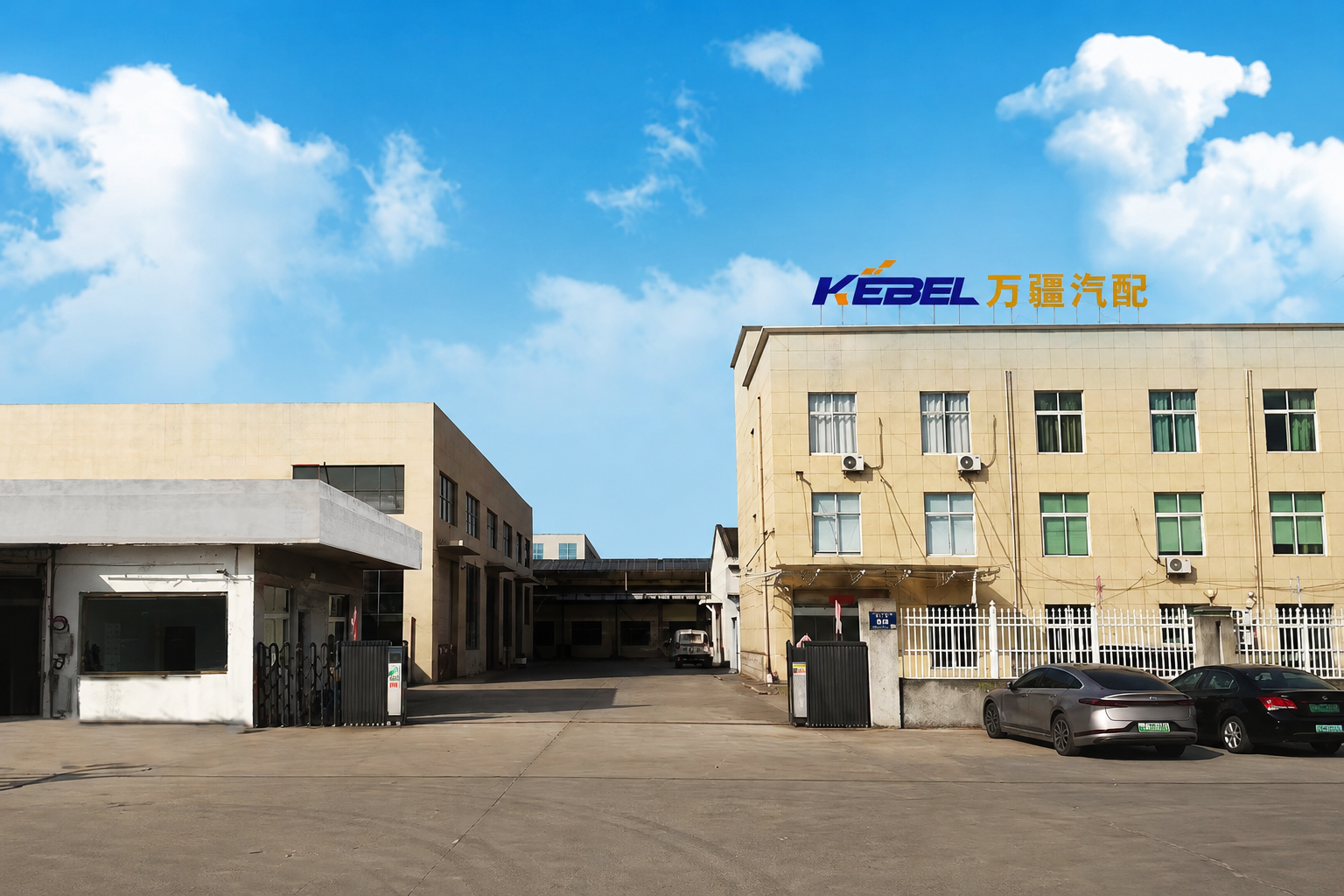
The key question is not only whether the sample meets expectations, but whether it was produced under conditions that can be repeated for every lot. Ask the supplier to confirm that mass production will use the approved mold, the same grade of raw materials, and the same inspection criteria applied to the sample.
Mold precision has a direct influence on vehicle compatibility. Changes in tooling condition, mold maintenance, molding parameters, or trimming operations can create variations in mounting alignment and overall shape. Therefore, controlled molds and monitored molding processes should be part of the production plan.
Danyang Wanjiang Auto Parts Co., Ltd. describes a production-control approach for auto body parts that includes material verification, mold and molding-process monitoring, and final inspection before loading. Buyers can request production records and pre-shipment photos or videos to confirm that finished goods meet the agreed standard.
Set Inspection Requirements Before the Production Order
Lot-level inspection requirements should be agreed before mass production begins. This prevents disagreements after goods are completed or loaded. The inspection plan should identify what will be checked, how frequently checks will occur, what defects are unacceptable, and what evidence the supplier must provide before shipment.
Recommended Production Verification Checklist
| Control Area | Sample Approval Review | Mass-Production Requirement |
|---|---|---|
| Vehicle fitment | Verify contours, mounting holes, tabs, clips, and alignment with the specified vehicle application. | Use controlled tooling and monitor molding consistency to maintain repeatable compatibility. |
| Material performance | Confirm the agreed resin or material requirement and inspect for weak areas or visible defects. | Perform incoming material checks for strength and impact-resistance requirements. |
| Surface and trimming | Inspect finish quality, edges, texture, and visible damage on the approved part. | Carry out final finished-product inspection before goods are loaded. |
| Inspection documentation | Define acceptance standards during the sample-approval stage. | Provide inspection confirmation, photos, or videos when remote verification is requested. |
| Supply flexibility | Confirm the sample quantity, order quantity, and customization requirements. | The stated model supports stock wholesale and OEM/ODM customization, with an MOQ of 1–5 pieces for the listed model. |
Use Certificates as Supporting Evidence, Not as a Substitute for Inspection
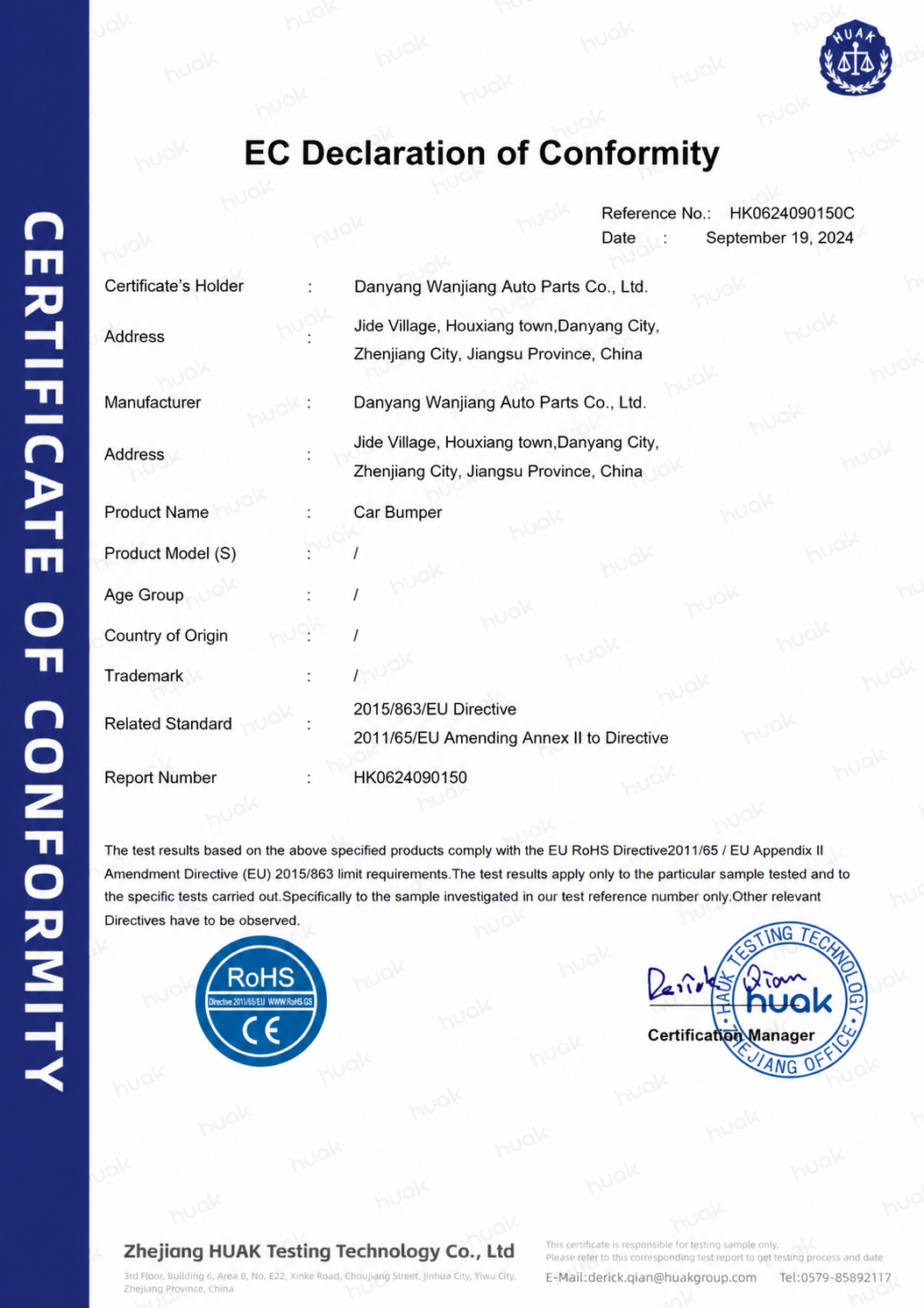
Compliance documentation can support supplier evaluation, but it does not prove that every bumper upper will match the approved sample. The company lists a CE certificate for car bumpers, certificate number HK0624090150C, applicable in Europe. It also lists EPR certificate number DE1123252940071 for car bumpers and other body parts in Europe.
These documents should be reviewed together with the buyer's own technical requirements, vehicle-fitment checks, and production inspection plan. Certification cannot replace verification of the specific mold, material, finish, and mounting performance of the part being ordered.
Why Consistency Matters for Aftermarket Supply
Aftermarket bumper uppers are used in collision repair, exterior restoration, retail replacement, and inventory distribution. For wholesalers, repair chains, distributors, and international sellers, a single acceptable sample has limited value unless later shipments maintain the same installation accuracy and cosmetic condition.
Suppliers serving North American and European vehicle-series aftermarket channels should be able to consolidate orders for related body parts while applying consistent inspection standards to each shipment. This is particularly relevant when buyers purchase bumpers together with grilles, headlights, hoods, or fenders.
Frequently Asked Questions
Must production parts be made from the same mold as the approved sample?
Yes. Buyers should confirm that the approved sample is produced using the mold intended for volume production. Maintaining mold control is essential for stable fitment, shape, and mounting-point accuracy.
What proof should I request before the shipment leaves the factory?
Ask for confirmation that final inspection has been completed before loading. If an on-site inspection is not possible, request clear photos or videos of the finished products, packaging, labels, and loading condition.
Can a CE certificate replace a sample and production inspection?
No. A CE certificate can be useful for compliance review, but it does not replace checks of the actual bumper upper's vehicle application, material quality, surface finish, or consistency across a production lot.
Conclusion: Turn Sample Approval into a Repeatable Quality System
To ensure that a bumper upper sample reflects mass-production quality, approve the part only after checking fitment, mounting interfaces, material performance, trimming, and surface condition. Then convert the approved sample into a controlled production reference by specifying the same mold, material standard, process controls, and final-inspection requirements for every order.
Danyang Wanjiang supports stock wholesale, OEM/ODM customization, and shipping-agent services for auto body parts. The company also lists CE certification for car bumpers and pre-delivery inspection support. For technical details or purchasing assistance, contact sales01@cnkebel.com.
About Us
Danyang Wanjiang Auto Parts Co., Ltd. is a factory in Danyang, Jiangsu Province, supplying car bumpers and related auto body parts such as grilles, headlights, engine hoods, and fenders. With 18 years of export experience, the company states that it provides OEM/ODM development for car bumper assemblies, supported by tooling resources and a database covering American and German vehicle series.
The company operates a 10,000 square meter factory with multiple production lines and reports annual output value exceeding 50 million USD. It lists CE certification for car bumpers and car lamps, as well as EPR certification for specified body parts, and serves customers in various automotive aftermarket channels.

REPORT