







-
 Agriculture
-
 Health-Care
-
 Environment
-
 Construction-Real-Estate
-
 Tools-Hardware
-
 Home-Garden
-
 Furniture
-
 Luggage-Bags-Cases
-
 Medical-devices-Supplies
-
 Gifts-Crafts
-
 Sports-Entertainment
-
 Food-Beverage
-
 Vehicles-Transportation
-
 Power-Transmission
-
 Material-Handling
-
 Renewable-Energy
-
 Safety
-
 Testing-Instrument-Equipment
-
 Construction-Building-Machinery
-
 Pet-Supplies
-
 Personal-Care-Household-Cleaning
-
 Vehicle-Accessories-Electronics-Tools
-
 School-Office-Supplies
-
 Packaging-Printing
-
 Mother-Kids-Toys
-
 Business-Services
-
 Commercial-Equipment-Machinery
-
 Apparel-Accessories
-
 Security
-
 Shoes-Accessories
-
 Vehicle-Parts-Accessories
-
 Jewelry-Eyewear-Watches-Accessories
-
 Lights-Lighting
-
 Fabric-Textile-Raw-Material
-
 Fabrication-Services
-
 Industrial-Machinery
-
 Consumer-Electronics
-
 Electrical-Equipment-Supplies
-
 Electronic-Components-Accessories-Telecommunications
-
 Home-Appliances
-
 Beauty
-
 Chemicals
-
 Rubber-Plastics
-
 Metals-Alloys


























































































































































































































































































































































































































































































































































































- Masonry Materials
- Curtain Walls & Accessories
- Earthwork Products
- Fireproofing Materials
- Heat Insulation Materials
- Plastic Building Materials
- Building Boards
- Soundproofing Materials
- Timber
- Waterproofing Materials
- Balustrades & Handrails
- Bathroom & Kitchen
- Flooring & Accessories
- Tiles & Accessories
- Door, Window & Accessories
- Fireplaces & Stoves
- Floor Heating Systems & Parts
- Stairs & Stair Parts
- Ceilings
- Elevators & Escalators
- Stone
- Countertops, Vanity Tops & Table Tops
- Mosaics
- Metal Building Materials
- Multifunctional Materials
- Ladders & Scaffoldings
- Mouldings
- Corner Guards
- Decorative Films
- Formwork
- Building & Industrial Glass
- Other Construction & Real Estate
- Wallpapers/Wall panels
- HVAC System & Parts
- Outdoor Facilities
- Prefabricated Buildings
- Festive & Party Supplies
- Bathroom Products
- Household Sundries
- Rain Gear
- Garden Supplies
- Household Cleaning Tools & Accessories
- Lighters & Smoking Accessories
- Home Storage & Organization
- Household Scales
- Smart Home Improvement
- Home Textiles
- Kitchenware
- Drinkware & Accessories
- Dinnerware, Coffee & Wine
- Home Decor
- Golf
- Fitness & Body Building
- Amusement Park Facilities
- Billiards, Board Game,Coin Operated Games
- Musical Instruments
- Outdoor Affordable Luxury Sports
- Camping & Hiking
- Fishing
- Sports Safety&Rehabilitation
- Ball Sports Equipments
- Water Sports
- Winter Sports
- Luxury Travel Equipments
- Sports Shoes, Bags & Accessories
- Cycling
- Other Sports & Entertainment Products
- Artificial Grass&Sports Flooring&Sports Court Equipment
- Scooters
- Food Ingredients
- Honey & Honey Products
- Snacks
- Nuts & Kernels
- Seafood
- Plant & Animal Oil
- Beverages
- Fruit & Vegetable Products
- Frog & Escargot
- Bean Products
- Egg Products
- Dairy Products
- Seasonings & Condiments
- Canned Food
- Instant Food
- Baked Goods
- Other Food & Beverage
- Meat & Poultry
- Confectionery
- Grain Products
- Feminie Care
- Hair Care & Styling
- Body Care
- Hands & Feet Care
- Hygiene Products
- Men's Grooming
- Laundry Cleaning Supplies
- Travel Size & Gift Sets
- Room Deodorizers
- Other Personal Care Products
- Pest Control Products
- Special Household Cleaning
- Floor Cleaning
- Kitchen & Bathroom Cleaning
- Oral Care
- Bath Supplies
- Yellow Pages
- Correction Supplies
- Office Binding Supplies
- Office Cutting Supplies
- Board Erasers
- Office Adhesives & Tapes
- Education Supplies
- Pencil Cases & Bags
- Notebooks & Writing Pads
- File Folder Accessories
- Calendars
- Writing Accessories
- Commercial Office Supplies
- Pencil Sharpeners
- Pens
- Letter Pad/Paper
- Paper Envelopes
- Desk Organizers
- Pencils
- Markers & Highlighters
- Filing Products
- Art Supplies
- Easels
- Badge Holder & Accessories
- Office Paper
- Printer Supplies
- Book Covers
- Other Office & School Supplies
- Stationery Set
- Boards
- Clipboards
- Stamps
- Drafting Supplies
- Stencils
- Electronic Dictionary
- Books
- Map
- Magazines
- Calculators
- Baby & Toddler Toys
- Educational Toys
- Classic Toys
- Dress Up & Pretend Play
- Toy Vehicle
- Stuffed Animals & Plush Toys
- Outdoor Toys & Structures
- Balloons & Accessories
- Baby Food
- Children's Clothing
- Baby Supplies & Products
- Maternity Clothes
- Kids Shoes
- Baby Care
- Novelty & Gag Toys
- Dolls & Accessories
- Puzzle & Games
- Blocks & Model Building Toys
- Toddler Clothing
- Baby Clothing
- Kids' Luggage & Bags
- Arts, Crafts & DIY Toys
- Action & Toy Figures
- Baby Appliances
- Hobbies & Models
- Remote Control Toys
- Promotional Toys
- Pregnancy & Maternity
- Hygiene Products
- Kid's Textile&Bedding
- Novelty & Special Use
- Toy Weapons
- Baby Gifts
- Baby Storage & Organization
- Auto Drive Systems
- ATV/UTV Parts & Accessories
- Marine Parts & Accessories
- Other Auto Parts
- Trailer Parts & Accessories
- Auto Transmission Systems
- Train Parts & Accessories
- Universal Parts
- Railway Parts & Accessories
- Auto Brake Systems
- Aviation Parts & Accessories
- Truck Parts & Accessories
- Auto Suspension Systems
- Auto Lighting Systems
- New Energy Vehicle Parts & Accessories
- Auto Steering Systems
- Wheels, Tires & Accessories
- Bus Parts & Accessories
- Auto Performance Parts
- Cooling System
- Go-Kart & Kart Racer Parts & Accessories
- Air Conditioning Systems
- Heavy Duty Vehicle Parts & Accessories
- Auto Electrical Systems
- Auto Body Systems
- Auto Engine Systems
- Container Parts & Accessories
- Motorcycle Parts & Accessories
- Refrigeration & Heat Exchange Equipment
- Machine Tool Equipment
- Food & Beverage Machinery
- Agricultural Machinery & Equipment
- Apparel & Textile Machinery
- Chemical Machinery
- Packaging Machines
- Paper Production Machinery
- Plastic & Rubber Processing Machinery
- Industrial Robots
- Electronic Products Machinery
- Metal & Metallurgy Machinery
- Woodworking Machinery
- Home Product Manufacturing Machinery
- Machinery Accessories
- Environmental Machinery
- Machinery Service
- Electrical Equipment Manufacturing Machinery
- Industrial Compressors & Parts
- Tobacco & Cigarette Machinery
- Production Line
- Used Industrial Machinery
- Electronics Production Machinery
- Other Machinery & Industrial Equipment
- Camera, Photo & Accessories
- Portable Audio, Video & Accessories
- Television, Home Audio, Video & Accessories
- Video Games & Accessories
- Mobile Phone & Accessories
- Electronic Publications
- Earphone & Headphone & Accessories
- Speakers & Accessories
- Smart Electronics
- TV Receivers & Accessories
- Mobile Phone & Computer Repair Parts
- Chargers, Batteries & Power Supplies
- Used Electronics
- VR, AR, MR Hardware & Software
- Projectors & Presentation Equipments
- Other Consumer Electronics
- Cables & Commonly Used Accessories
- Computer Hardware & Software
- Displays, Signage and Optoelectronics
- Discrete Semiconductors
- Wireless & IoT Module and Products
- Telecommunications
- Connectors, Terminals & Accessories
- Development Boards, Electronic Modules and Kits
- Circuit Protection
- Sensors
- Isolators
- Audio Components and Products
- Integrated Circuits
- Power Supplies
- Relays
- RF, Microwave and RFID
- Electronic Accessories & Supplies
- Passive Components
- PCB & PCBA
- Air Quality Appliances
- Home Appliance Parts
- Heating & Cooling Appliances
- Small Kitchen Appliances
- Laundry Appliances
- Water Heaters
- Water Treatment Appliances
- Refrigerators & Freezers
- Personal Care & Beauty Appliances
- Major Kitchen Appliances
- Cleaning Appliances
- Second-hand Appliances
- Smart Home Appliances
- Other Home Appliances
- Energy Chemicals
- Inorganic Chemicals
- Basic Organic Chemicals
- Agrochemicals
- Admixture & Additives
- Catalysts & Chemical Auxiliary Agents
- Pigments & Dyestuff
- Coating & Paint
- Daily Chemicals
- Polymer
- Organic Intermediate
- Adhesives & Sealants
- Chemical Waste
- Biological Chemical Products
- Surface Treatment Chemicals
- Painting & Coating
- Chemical Reagents
- Flavor & Fragrance
- Non-Explosive Demolition Agents
- Other Chemicals
- Custom Chemical Services

How to Verify a Rectangular Clinching Gun Is Suitable for Your Panel Assembly
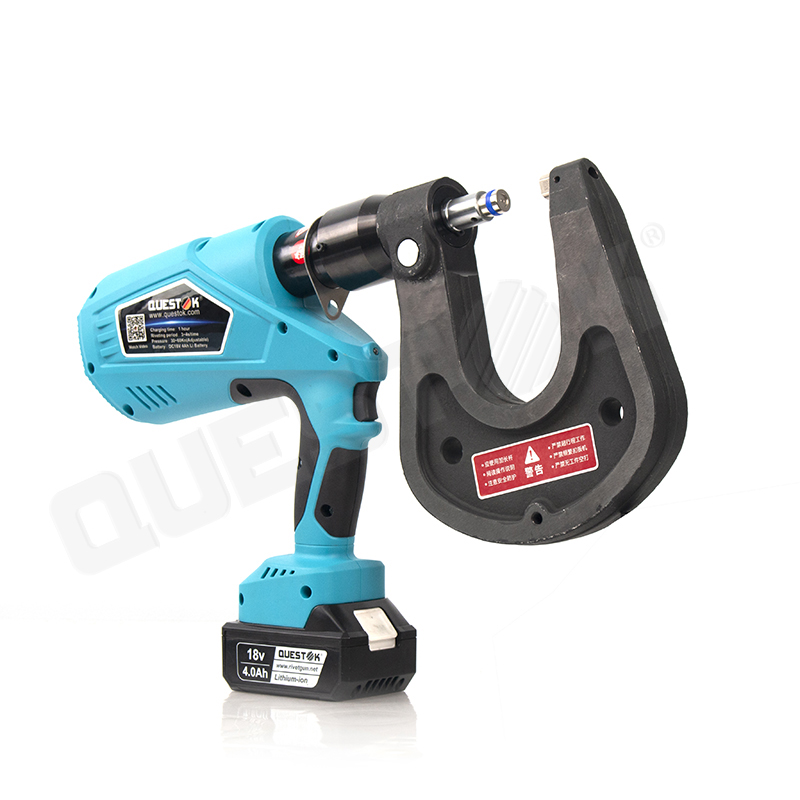
Selecting a rectangular clinching gun for sheet metal panels requires a technical fit assessment, not just a comparison of panel shape and tool appearance. Confirm the panel materials, total thickness stack, required joint profile, operating access, and production target before finalizing the process. For elevator cabin applications, the Questok rectangular clinching gun offers 30-60 kN output pressure, but production suitability should be confirmed through representative joining trials.
Key Checks for Panel Compatibility
- Identify the end application and every material in the panel stack-up.
- Evaluate whether the required forming force falls within the tool's 30-60 kN output range.
- Verify that the gun body, throat, and tooling can access each intended joining location.
- Confirm that the resulting joint meets visual, structural, and functional requirements.
- Run sample tests before applying the process to serial production.
What Determines Whether the Tool Will Fit
A rectangular clinching gun creates a mechanical connection by locally forming sheet metal layers together. Its suitability is influenced by material grade, coating, thickness combination, joint position, die arrangement, clearance around the workpiece, and the joint strength needed in service. A panel can appear compatible while still requiring a different die design, access configuration, or force setting.
The Questok rectangular clinching gun is designed for elevator cabin panels and provides 30-60 kN output pressure. This range is an important starting point for process selection, but it does not independently establish compatibility. Available product information does not specify allowable sheet thickness ranges, throat depth, die dimensions, or final joint geometry. These parameters should therefore be reviewed with the actual panel drawings and validated through testing.
Assess Access and Joint Position
Tool access is often as important as material selection. Review edge distances, flange shapes, corners, reinforcements, and internal obstructions around each joint point. The clinching gun must be able to reach the joining area with sufficient clearance for stable operation and repeatable forming.
The required joint finish should also be defined early. Depending on the visible side of the panel and the assembly standard, the application may require a particular joint location, appearance, strength level, or corrosion performance. These factors affect the tooling and process configuration.
Relevant Sheet Metal Applications
Questok provides sheet metal joining solutions for HVAC ductwork, air fans, dampers, filters, and flanges. Its rectangular clinching equipment is also applicable to stainless steel assemblies used in white goods, commercial kitchens, and commercial freezers. These examples demonstrate where this joining method can be relevant, although each project must still be evaluated according to its own material stack, geometry, and operating conditions.
Why Sample Testing Is Essential
Joining trials provide the most reliable answer to compatibility questions. Test samples should use the same materials, thicknesses, coatings, panel forms, and joining positions planned for production. The trial can then verify joint formation, accessibility, repeatability, appearance, and performance against the project requirement.
Questok's development capabilities include mechanical engineering, hydraulic system design, structural analysis, electrical control, fastening process development, prototype testing, reliability evaluation, and application engineering. This enables the joining process to be reviewed against practical manufacturing conditions rather than relying on nominal tool specifications alone.
In a reported Midea control cabinet project, Questok supplied a clinching process intended to increase efficiency and lower cost compared with welding. The process was described as a single joining step that required no consumables, polishing, or repainting. However, results from that case should not be used as direct proof for an elevator cabin assembly, because panel materials, layouts, and access conditions may differ.
Compatibility Review Summary
| Assessment Area | Available Product or Company Information |
|---|---|
| Primary application | Elevator cabin panels, with related sheet metal use cases in HVAC, white goods, commercial kitchens, and commercial freezers. |
| Available output pressure | 30-60 kN |
| Details requiring confirmation | Material stack, sheet thickness range, die size, throat depth, access space, and final joint geometry. |
| Product inspection | Full inspection is stated, and completed products are function-tested before delivery. |
| Customization | Customization is available, with a stated 15-day customization lead time. |
Frequently Asked Questions
What information is needed for a panel fit assessment?
Provide panel drawings, material types, thickness combinations, coating details, joining positions, available access space, target joint requirements, and expected production volume. This information allows the clinching tool and process to be assessed accurately.
Does 30-60 kN work for every sheet metal panel?
No. The stated force range cannot confirm every application by itself. Suitability depends on material properties, total thickness, joint design, tooling configuration, and forming conditions. A sample joining test is required before production approval.
Can this rectangular clinching gun be customized?
Yes. Customization is supported, and the listed customization period is 15 days. The minimum order quantity is 1 set. Tooling, dimensions, and technical requirements should be confirmed before manufacturing begins.
Recommendation
Evaluate the complete panel assembly before selecting a rectangular clinching gun. Review the material combination, thickness stack, joint locations, access constraints, required joint result, and force demand, then verify the proposed solution through production-representative samples. The Questok model provides 30-60 kN output pressure and full inspection support. Questok also supports ODM and OBM arrangements, with a minimum order quantity of 1 set. For detailed technical solutions or support, please contact jane@questok.com.
About Us
PHOTON TECHNOLOGY KUNSHAN CO., LTD, also known as Questok, is an industrial technology company focused on fastening, joining, and assembly systems for manufacturing. Founded in 2011, the company operates a 5,000 sqm factory and supplies equipment for automotive, electric vehicle, transportation, sheet metal, appliance, electronics, construction, and general industrial sectors. Its development work includes clinching equipment, clinching guns, SPR riveting systems, fastener pressing tools, process engineering, testing, and production integration. The company holds CE and MSDS certifications and serves customers across multiple industries.

REPORT