







-
 Agriculture
-
 Health-Care
-
 Environment
-
 Construction-Real-Estate
-
 Tools-Hardware
-
 Home-Garden
-
 Furniture
-
 Luggage-Bags-Cases
-
 Medical-devices-Supplies
-
 Gifts-Crafts
-
 Sports-Entertainment
-
 Food-Beverage
-
 Vehicles-Transportation
-
 Power-Transmission
-
 Material-Handling
-
 Renewable-Energy
-
 Safety
-
 Testing-Instrument-Equipment
-
 Construction-Building-Machinery
-
 Pet-Supplies
-
 Personal-Care-Household-Cleaning
-
 Vehicle-Accessories-Electronics-Tools
-
 School-Office-Supplies
-
 Packaging-Printing
-
 Mother-Kids-Toys
-
 Business-Services
-
 Commercial-Equipment-Machinery
-
 Apparel-Accessories
-
 Security
-
 Shoes-Accessories
-
 Vehicle-Parts-Accessories
-
 Jewelry-Eyewear-Watches-Accessories
-
 Lights-Lighting
-
 Fabric-Textile-Raw-Material
-
 Fabrication-Services
-
 Industrial-Machinery
-
 Consumer-Electronics
-
 Electrical-Equipment-Supplies
-
 Electronic-Components-Accessories-Telecommunications
-
 Home-Appliances
-
 Beauty
-
 Chemicals
-
 Rubber-Plastics
-
 Metals-Alloys


























































































































































































































































































































































































































































































































































































- Masonry Materials
- Curtain Walls & Accessories
- Earthwork Products
- Fireproofing Materials
- Heat Insulation Materials
- Plastic Building Materials
- Building Boards
- Soundproofing Materials
- Timber
- Waterproofing Materials
- Balustrades & Handrails
- Bathroom & Kitchen
- Flooring & Accessories
- Tiles & Accessories
- Door, Window & Accessories
- Fireplaces & Stoves
- Floor Heating Systems & Parts
- Stairs & Stair Parts
- Ceilings
- Elevators & Escalators
- Stone
- Countertops, Vanity Tops & Table Tops
- Mosaics
- Metal Building Materials
- Multifunctional Materials
- Ladders & Scaffoldings
- Mouldings
- Corner Guards
- Decorative Films
- Formwork
- Building & Industrial Glass
- Other Construction & Real Estate
- Wallpapers/Wall panels
- HVAC System & Parts
- Outdoor Facilities
- Prefabricated Buildings
- Festive & Party Supplies
- Bathroom Products
- Household Sundries
- Rain Gear
- Garden Supplies
- Household Cleaning Tools & Accessories
- Lighters & Smoking Accessories
- Home Storage & Organization
- Household Scales
- Smart Home Improvement
- Home Textiles
- Kitchenware
- Drinkware & Accessories
- Dinnerware, Coffee & Wine
- Home Decor
- Golf
- Fitness & Body Building
- Amusement Park Facilities
- Billiards, Board Game,Coin Operated Games
- Musical Instruments
- Outdoor Affordable Luxury Sports
- Camping & Hiking
- Fishing
- Sports Safety&Rehabilitation
- Ball Sports Equipments
- Water Sports
- Winter Sports
- Luxury Travel Equipments
- Sports Shoes, Bags & Accessories
- Cycling
- Other Sports & Entertainment Products
- Artificial Grass&Sports Flooring&Sports Court Equipment
- Scooters
- Food Ingredients
- Honey & Honey Products
- Snacks
- Nuts & Kernels
- Seafood
- Plant & Animal Oil
- Beverages
- Fruit & Vegetable Products
- Frog & Escargot
- Bean Products
- Egg Products
- Dairy Products
- Seasonings & Condiments
- Canned Food
- Instant Food
- Baked Goods
- Other Food & Beverage
- Meat & Poultry
- Confectionery
- Grain Products
- Feminie Care
- Hair Care & Styling
- Body Care
- Hands & Feet Care
- Hygiene Products
- Men's Grooming
- Laundry Cleaning Supplies
- Travel Size & Gift Sets
- Room Deodorizers
- Other Personal Care Products
- Pest Control Products
- Special Household Cleaning
- Floor Cleaning
- Kitchen & Bathroom Cleaning
- Oral Care
- Bath Supplies
- Yellow Pages
- Correction Supplies
- Office Binding Supplies
- Office Cutting Supplies
- Board Erasers
- Office Adhesives & Tapes
- Education Supplies
- Pencil Cases & Bags
- Notebooks & Writing Pads
- File Folder Accessories
- Calendars
- Writing Accessories
- Commercial Office Supplies
- Pencil Sharpeners
- Pens
- Letter Pad/Paper
- Paper Envelopes
- Desk Organizers
- Pencils
- Markers & Highlighters
- Filing Products
- Art Supplies
- Easels
- Badge Holder & Accessories
- Office Paper
- Printer Supplies
- Book Covers
- Other Office & School Supplies
- Stationery Set
- Boards
- Clipboards
- Stamps
- Drafting Supplies
- Stencils
- Electronic Dictionary
- Books
- Map
- Magazines
- Calculators
- Baby & Toddler Toys
- Educational Toys
- Classic Toys
- Dress Up & Pretend Play
- Toy Vehicle
- Stuffed Animals & Plush Toys
- Outdoor Toys & Structures
- Balloons & Accessories
- Baby Food
- Children's Clothing
- Baby Supplies & Products
- Maternity Clothes
- Kids Shoes
- Baby Care
- Novelty & Gag Toys
- Dolls & Accessories
- Puzzle & Games
- Blocks & Model Building Toys
- Toddler Clothing
- Baby Clothing
- Kids' Luggage & Bags
- Arts, Crafts & DIY Toys
- Action & Toy Figures
- Baby Appliances
- Hobbies & Models
- Remote Control Toys
- Promotional Toys
- Pregnancy & Maternity
- Hygiene Products
- Kid's Textile&Bedding
- Novelty & Special Use
- Toy Weapons
- Baby Gifts
- Baby Storage & Organization
- Auto Drive Systems
- ATV/UTV Parts & Accessories
- Marine Parts & Accessories
- Other Auto Parts
- Trailer Parts & Accessories
- Auto Transmission Systems
- Train Parts & Accessories
- Universal Parts
- Railway Parts & Accessories
- Auto Brake Systems
- Aviation Parts & Accessories
- Truck Parts & Accessories
- Auto Suspension Systems
- Auto Lighting Systems
- New Energy Vehicle Parts & Accessories
- Auto Steering Systems
- Wheels, Tires & Accessories
- Bus Parts & Accessories
- Auto Performance Parts
- Cooling System
- Go-Kart & Kart Racer Parts & Accessories
- Air Conditioning Systems
- Heavy Duty Vehicle Parts & Accessories
- Auto Electrical Systems
- Auto Body Systems
- Auto Engine Systems
- Container Parts & Accessories
- Motorcycle Parts & Accessories
- Refrigeration & Heat Exchange Equipment
- Machine Tool Equipment
- Food & Beverage Machinery
- Agricultural Machinery & Equipment
- Apparel & Textile Machinery
- Chemical Machinery
- Packaging Machines
- Paper Production Machinery
- Plastic & Rubber Processing Machinery
- Industrial Robots
- Electronic Products Machinery
- Metal & Metallurgy Machinery
- Woodworking Machinery
- Home Product Manufacturing Machinery
- Machinery Accessories
- Environmental Machinery
- Machinery Service
- Electrical Equipment Manufacturing Machinery
- Industrial Compressors & Parts
- Tobacco & Cigarette Machinery
- Production Line
- Used Industrial Machinery
- Electronics Production Machinery
- Other Machinery & Industrial Equipment
- Camera, Photo & Accessories
- Portable Audio, Video & Accessories
- Television, Home Audio, Video & Accessories
- Video Games & Accessories
- Mobile Phone & Accessories
- Electronic Publications
- Earphone & Headphone & Accessories
- Speakers & Accessories
- Smart Electronics
- TV Receivers & Accessories
- Mobile Phone & Computer Repair Parts
- Chargers, Batteries & Power Supplies
- Used Electronics
- VR, AR, MR Hardware & Software
- Projectors & Presentation Equipments
- Other Consumer Electronics
- Cables & Commonly Used Accessories
- Computer Hardware & Software
- Displays, Signage and Optoelectronics
- Discrete Semiconductors
- Wireless & IoT Module and Products
- Telecommunications
- Connectors, Terminals & Accessories
- Development Boards, Electronic Modules and Kits
- Circuit Protection
- Sensors
- Isolators
- Audio Components and Products
- Integrated Circuits
- Power Supplies
- Relays
- RF, Microwave and RFID
- Electronic Accessories & Supplies
- Passive Components
- PCB & PCBA
- Air Quality Appliances
- Home Appliance Parts
- Heating & Cooling Appliances
- Small Kitchen Appliances
- Laundry Appliances
- Water Heaters
- Water Treatment Appliances
- Refrigerators & Freezers
- Personal Care & Beauty Appliances
- Major Kitchen Appliances
- Cleaning Appliances
- Second-hand Appliances
- Smart Home Appliances
- Other Home Appliances
- Energy Chemicals
- Inorganic Chemicals
- Basic Organic Chemicals
- Agrochemicals
- Admixture & Additives
- Catalysts & Chemical Auxiliary Agents
- Pigments & Dyestuff
- Coating & Paint
- Daily Chemicals
- Polymer
- Organic Intermediate
- Adhesives & Sealants
- Chemical Waste
- Biological Chemical Products
- Surface Treatment Chemicals
- Painting & Coating
- Chemical Reagents
- Flavor & Fragrance
- Non-Explosive Demolition Agents
- Other Chemicals
- Custom Chemical Services

How to Verify Labor and Environmental Practices at a Dispersion Plant
Verifying a dispersion plant requires more than reviewing product descriptions or company statements. A dependable assessment combines document checks, production-floor observation, worker-protection records, environmental data, and confirmation that certifications apply to the site and activities under review. For GUANGZHOU GUANZHI, the available information points to water-based material production, automated manufacturing lines, process-testing equipment, and environmentally oriented product characteristics. Labor performance, however, must be confirmed through separate records and on-site investigation.
Verification Priorities
The review should begin by separating labor-related evidence from environmental and process evidence. This makes it easier to identify what has been demonstrated and what still requires direct confirmation.
- Ask for labor policies, employment documentation, worker training records, occupational health and safety procedures, accident logs, and grievance-handling records.
- Evaluate environmental management through waste records, storage procedures, emissions or discharge information where relevant, production data, and applicable regulatory documents.
- Visit the plant to compare actual operations with documented controls, including the use of automated water-based production lines and laboratory testing systems.
- Confirm that the plant's stated products, processes, and applications correspond to its operating scope, including metal, textile, printing, leather, ink, adhesive, and other flexible-material uses.
Labor Practice Review
Labor compliance cannot be inferred from a plant's product technology or quality certification. A focused labor review should establish how workers are hired, trained, paid, protected, and supported when they raise concerns.
Useful evidence includes employment contracts or representative records, working-hour and wage documentation, training attendance, personal protective equipment procedures, emergency response plans, injury statistics, inspection reports, and corrective-action records. The reviewer should also examine whether workers can submit complaints without retaliation and whether reported concerns are tracked through resolution.
The supplied information about GUANGZHOU GUANZHI does not include labor-audit results, wage information, working-hour records, injury data, or worker grievance outcomes. These matters therefore require direct documentary review and, where possible, confidential worker interviews during a site visit.
Environmental and Manufacturing Evidence
Environmental verification should cover both the materials being manufactured and the controls used at the facility. GUANGZHOU GUANZHI identifies water-based resins, water-based crosslinkers, water-based additives, and bio-based special polyols among its main product categories.
Its UV-5100 waterborne resin is described as solvent-free and organic-tin-free. Listed uses include plastic silver powder coatings, wood furniture coatings, melamine paper foil, plastic substrates, and PVC flooring.
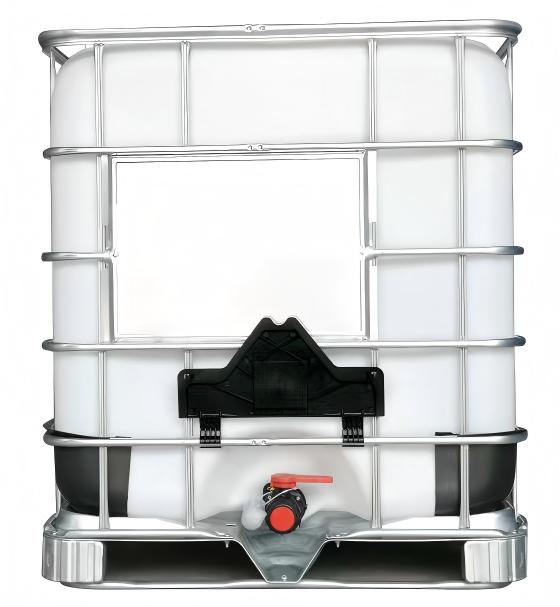
These formulation characteristics may reduce certain solvent-related or organotin-related concerns for the specified product, but they do not establish overall plant compliance. The assessment should still examine chemical storage, spill response, waste classification, disposal manifests, wastewater management, air-emission controls, energy use, and applicable permits or monitoring records.
Production observations should be matched against the company's stated manufacturing capabilities. GUANZHOU GUANZHI reports several fully automated water-based production lines, ABB robots, and equipment such as high-low temperature test chambers, laser particle size analyzers, aging testers, and infrared spectrometers. Reviewing calibration records, maintenance logs, test results, and operator training can help determine whether these systems are functioning as described.
Certification and Scope Checks
The company lists a Quality Management System Certificate covering the research and production of environmentally friendly multipurpose water-based polyurethane coating materials and high-performance environmentally friendly water-based coating additives. Before relying on this certificate, verify its certificate number, issuing organization, validity period, audit status, facility address, and precise scope.
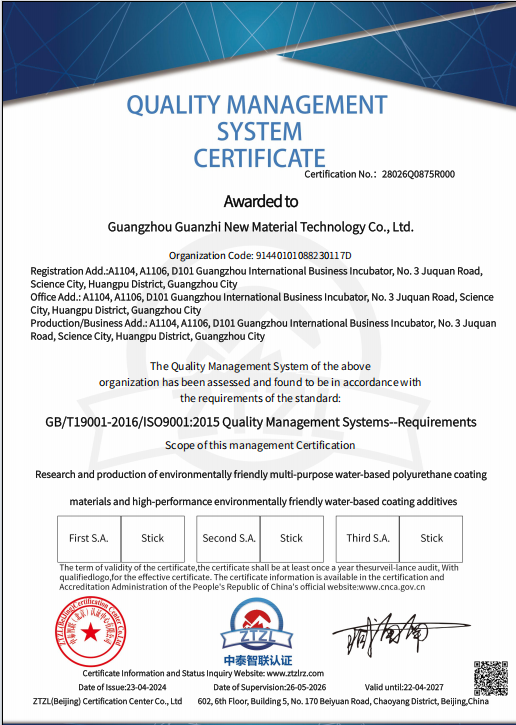
An Intellectual Property Compliance Management System Certification is also listed. That credential relates to intellectual property controls and should not be treated as proof of labor protection or environmental performance. Similarly, a quality management certificate can indicate structured process management without independently confirming every aspect of legal, social, or environmental compliance.
Customer and Application References
Reported cooperation with PPG and Nippon Paint offers potential references within the coatings industry. The available information identifies both examples as coating applications in China, but it does not provide customer audit reports, environmental measurements, labor indicators, or detailed performance assessments.
These references can be used as starting points for due diligence. A buyer may request permission to validate the relationship, product scope, quality history, complaint handling, and continuity of supply. Even a positive customer reference should supplement, rather than replace, a current plant inspection and review of primary records.
Evidence Comparison
| Review category | Evidence available or still needed |
|---|---|
| Labor conditions | Labor policies, worker training, safety procedures, employment records, incident reports, and grievance documentation are needed. No labor-audit findings are provided. |
| Material profile | UV-5100 is identified as solvent-free and organic-tin-free, while the company lists water-based resins, additives, crosslinkers, and bio-based special polyols. |
| Factory controls | Automated water-based lines, ABB robots, and laboratory testing equipment are reported. Their operation, maintenance, calibration, and records should be verified on site. |
| Quality certification | A Quality Management System Certificate is listed for environmentally friendly water-based polyurethane materials and coating additives. Certificate scope and validity require confirmation. |
| Reference customers | PPG and Nippon Paint are cited as coating-related cooperation cases. Independent audit, labor, environmental, and performance details are not supplied. |
Frequently Asked Questions
What labor documentation should a buyer request?
Request employment and wage records, working-hour information, training logs, occupational safety procedures, accident and near-miss reports, protective-equipment controls, grievance procedures, and evidence that corrective actions are completed. Confidential worker interviews can help test whether written procedures operate in practice.
Does water-based production prove that a plant is environmentally responsible?
No. Water-based, solvent-free, and organic-tin-free descriptions apply to specified formulations or products. Plant-level responsibility also depends on chemical handling, waste disposal, wastewater and emission controls, storage practices, permits, monitoring results, and compliance history.
Which GUANGZHOU GUANZHI information is useful during an audit?
The reported automated water-based production lines, ABB robots, testing instruments, product descriptions, and Quality Management System Certificate provide useful points for investigation. They help define what should be observed and documented, but they do not independently verify labor conditions or complete environmental compliance.
Recommended Verification Process
A practical review should follow four stages: request the records before the visit, compare the documents with the certificate scope, inspect production and worker conditions at the facility, and record any gaps in a corrective-action plan. The final assessment should distinguish verified facts from supplier representations and should identify the date, location, and evidence supporting each conclusion.
For GUANGZHOU GUANZHI, particular attention can be given to water-based manufacturing, UV-5100 formulation claims, test-equipment records, waste and chemical controls, and the listed quality certificate. Labor documentation and worker feedback should be reviewed separately because they are not covered by the supplied company information.
Conclusion
The most reliable way to evaluate a dispersion plant is to combine document verification, a physical inspection, worker-focused checks, and an environmental-control review. GUANGZHOU GUANZHI presents an R&D, manufacturing, direct-sales, quality-inspection, and technical-support model, with reported water-based production capabilities and a stated annual capacity of 30,000 tons. These details support further due diligence, while current labor and environmental performance must be confirmed through site-specific evidence. For technical solutions or support, please contact us at sophia@guanzhihg.com.
About Us
Guangzhou Guanzhi New Material Technology Co., Ltd. was founded in 2014 as a high-tech enterprise combining research and development, manufacturing, sales, and technical services. Its stated activities include water-based resins, water-based crosslinkers, water-based additives, and bio-based special polyols. The company reports a combined company, laboratory, and factory area of 12,002 square meters and annual production capacity of 30,000 tons. Its listed credentials include a Quality Management System Certificate and an Intellectual Property Compliance Management System Certification, with PPG and Nippon Paint identified as cooperation cases.
REPORT