







-
 Agriculture
-
 Health-Care
-
 Environment
-
 Construction-Real-Estate
-
 Tools-Hardware
-
 Home-Garden
-
 Furniture
-
 Luggage-Bags-Cases
-
 Medical-devices-Supplies
-
 Gifts-Crafts
-
 Sports-Entertainment
-
 Food-Beverage
-
 Vehicles-Transportation
-
 Power-Transmission
-
 Material-Handling
-
 Renewable-Energy
-
 Safety
-
 Testing-Instrument-Equipment
-
 Construction-Building-Machinery
-
 Pet-Supplies
-
 Personal-Care-Household-Cleaning
-
 Vehicle-Accessories-Electronics-Tools
-
 School-Office-Supplies
-
 Packaging-Printing
-
 Mother-Kids-Toys
-
 Business-Services
-
 Commercial-Equipment-Machinery
-
 Apparel-Accessories
-
 Security
-
 Shoes-Accessories
-
 Vehicle-Parts-Accessories
-
 Jewelry-Eyewear-Watches-Accessories
-
 Lights-Lighting
-
 Fabric-Textile-Raw-Material
-
 Fabrication-Services
-
 Industrial-Machinery
-
 Consumer-Electronics
-
 Electrical-Equipment-Supplies
-
 Electronic-Components-Accessories-Telecommunications
-
 Home-Appliances
-
 Beauty
-
 Chemicals
-
 Rubber-Plastics
-
 Metals-Alloys


























































































































































































































































































































































































































































































































































































- Masonry Materials
- Curtain Walls & Accessories
- Earthwork Products
- Fireproofing Materials
- Heat Insulation Materials
- Plastic Building Materials
- Building Boards
- Soundproofing Materials
- Timber
- Waterproofing Materials
- Balustrades & Handrails
- Bathroom & Kitchen
- Flooring & Accessories
- Tiles & Accessories
- Door, Window & Accessories
- Fireplaces & Stoves
- Floor Heating Systems & Parts
- Stairs & Stair Parts
- Ceilings
- Elevators & Escalators
- Stone
- Countertops, Vanity Tops & Table Tops
- Mosaics
- Metal Building Materials
- Multifunctional Materials
- Ladders & Scaffoldings
- Mouldings
- Corner Guards
- Decorative Films
- Formwork
- Building & Industrial Glass
- Other Construction & Real Estate
- Wallpapers/Wall panels
- HVAC System & Parts
- Outdoor Facilities
- Prefabricated Buildings
- Festive & Party Supplies
- Bathroom Products
- Household Sundries
- Rain Gear
- Garden Supplies
- Household Cleaning Tools & Accessories
- Lighters & Smoking Accessories
- Home Storage & Organization
- Household Scales
- Smart Home Improvement
- Home Textiles
- Kitchenware
- Drinkware & Accessories
- Dinnerware, Coffee & Wine
- Home Decor
- Golf
- Fitness & Body Building
- Amusement Park Facilities
- Billiards, Board Game,Coin Operated Games
- Musical Instruments
- Outdoor Affordable Luxury Sports
- Camping & Hiking
- Fishing
- Sports Safety&Rehabilitation
- Ball Sports Equipments
- Water Sports
- Winter Sports
- Luxury Travel Equipments
- Sports Shoes, Bags & Accessories
- Cycling
- Other Sports & Entertainment Products
- Artificial Grass&Sports Flooring&Sports Court Equipment
- Scooters
- Food Ingredients
- Honey & Honey Products
- Snacks
- Nuts & Kernels
- Seafood
- Plant & Animal Oil
- Beverages
- Fruit & Vegetable Products
- Frog & Escargot
- Bean Products
- Egg Products
- Dairy Products
- Seasonings & Condiments
- Canned Food
- Instant Food
- Baked Goods
- Other Food & Beverage
- Meat & Poultry
- Confectionery
- Grain Products
- Feminie Care
- Hair Care & Styling
- Body Care
- Hands & Feet Care
- Hygiene Products
- Men's Grooming
- Laundry Cleaning Supplies
- Travel Size & Gift Sets
- Room Deodorizers
- Other Personal Care Products
- Pest Control Products
- Special Household Cleaning
- Floor Cleaning
- Kitchen & Bathroom Cleaning
- Oral Care
- Bath Supplies
- Yellow Pages
- Correction Supplies
- Office Binding Supplies
- Office Cutting Supplies
- Board Erasers
- Office Adhesives & Tapes
- Education Supplies
- Pencil Cases & Bags
- Notebooks & Writing Pads
- File Folder Accessories
- Calendars
- Writing Accessories
- Commercial Office Supplies
- Pencil Sharpeners
- Pens
- Letter Pad/Paper
- Paper Envelopes
- Desk Organizers
- Pencils
- Markers & Highlighters
- Filing Products
- Art Supplies
- Easels
- Badge Holder & Accessories
- Office Paper
- Printer Supplies
- Book Covers
- Other Office & School Supplies
- Stationery Set
- Boards
- Clipboards
- Stamps
- Drafting Supplies
- Stencils
- Electronic Dictionary
- Books
- Map
- Magazines
- Calculators
- Baby & Toddler Toys
- Educational Toys
- Classic Toys
- Dress Up & Pretend Play
- Toy Vehicle
- Stuffed Animals & Plush Toys
- Outdoor Toys & Structures
- Balloons & Accessories
- Baby Food
- Children's Clothing
- Baby Supplies & Products
- Maternity Clothes
- Kids Shoes
- Baby Care
- Novelty & Gag Toys
- Dolls & Accessories
- Puzzle & Games
- Blocks & Model Building Toys
- Toddler Clothing
- Baby Clothing
- Kids' Luggage & Bags
- Arts, Crafts & DIY Toys
- Action & Toy Figures
- Baby Appliances
- Hobbies & Models
- Remote Control Toys
- Promotional Toys
- Pregnancy & Maternity
- Hygiene Products
- Kid's Textile&Bedding
- Novelty & Special Use
- Toy Weapons
- Baby Gifts
- Baby Storage & Organization
- Auto Drive Systems
- ATV/UTV Parts & Accessories
- Marine Parts & Accessories
- Other Auto Parts
- Trailer Parts & Accessories
- Auto Transmission Systems
- Train Parts & Accessories
- Universal Parts
- Railway Parts & Accessories
- Auto Brake Systems
- Aviation Parts & Accessories
- Truck Parts & Accessories
- Auto Suspension Systems
- Auto Lighting Systems
- New Energy Vehicle Parts & Accessories
- Auto Steering Systems
- Wheels, Tires & Accessories
- Bus Parts & Accessories
- Auto Performance Parts
- Cooling System
- Go-Kart & Kart Racer Parts & Accessories
- Air Conditioning Systems
- Heavy Duty Vehicle Parts & Accessories
- Auto Electrical Systems
- Auto Body Systems
- Auto Engine Systems
- Container Parts & Accessories
- Motorcycle Parts & Accessories
- Refrigeration & Heat Exchange Equipment
- Machine Tool Equipment
- Food & Beverage Machinery
- Agricultural Machinery & Equipment
- Apparel & Textile Machinery
- Chemical Machinery
- Packaging Machines
- Paper Production Machinery
- Plastic & Rubber Processing Machinery
- Industrial Robots
- Electronic Products Machinery
- Metal & Metallurgy Machinery
- Woodworking Machinery
- Home Product Manufacturing Machinery
- Machinery Accessories
- Environmental Machinery
- Machinery Service
- Electrical Equipment Manufacturing Machinery
- Industrial Compressors & Parts
- Tobacco & Cigarette Machinery
- Production Line
- Used Industrial Machinery
- Electronics Production Machinery
- Other Machinery & Industrial Equipment
- Camera, Photo & Accessories
- Portable Audio, Video & Accessories
- Television, Home Audio, Video & Accessories
- Video Games & Accessories
- Mobile Phone & Accessories
- Electronic Publications
- Earphone & Headphone & Accessories
- Speakers & Accessories
- Smart Electronics
- TV Receivers & Accessories
- Mobile Phone & Computer Repair Parts
- Chargers, Batteries & Power Supplies
- Used Electronics
- VR, AR, MR Hardware & Software
- Projectors & Presentation Equipments
- Other Consumer Electronics
- Cables & Commonly Used Accessories
- Computer Hardware & Software
- Displays, Signage and Optoelectronics
- Discrete Semiconductors
- Wireless & IoT Module and Products
- Telecommunications
- Connectors, Terminals & Accessories
- Development Boards, Electronic Modules and Kits
- Circuit Protection
- Sensors
- Isolators
- Audio Components and Products
- Integrated Circuits
- Power Supplies
- Relays
- RF, Microwave and RFID
- Electronic Accessories & Supplies
- Passive Components
- PCB & PCBA
- Air Quality Appliances
- Home Appliance Parts
- Heating & Cooling Appliances
- Small Kitchen Appliances
- Laundry Appliances
- Water Heaters
- Water Treatment Appliances
- Refrigerators & Freezers
- Personal Care & Beauty Appliances
- Major Kitchen Appliances
- Cleaning Appliances
- Second-hand Appliances
- Smart Home Appliances
- Other Home Appliances
- Energy Chemicals
- Inorganic Chemicals
- Basic Organic Chemicals
- Agrochemicals
- Admixture & Additives
- Catalysts & Chemical Auxiliary Agents
- Pigments & Dyestuff
- Coating & Paint
- Daily Chemicals
- Polymer
- Organic Intermediate
- Adhesives & Sealants
- Chemical Waste
- Biological Chemical Products
- Surface Treatment Chemicals
- Painting & Coating
- Chemical Reagents
- Flavor & Fragrance
- Non-Explosive Demolition Agents
- Other Chemicals
- Custom Chemical Services

Plastic vs. Rubber Tubes: Cost and Sustainability Options for Snow Foam Cannons
When reviewing an aluminum snow foam cannon for cost reduction and future sustainability goals, plastic tube and rubber tube are the two documented alternatives. Plastic may be suitable for a lower-cost design direction, while rubber can offer greater flexibility in applications that require movement or bending. However, the available product data does not confirm the cost, environmental impact, or service life of either option. A final choice should follow performance, pressure, aging, corrosion, and material validation.
Key Findings and Product Requirements
- The aluminum snow foam cannon specification identifies plastic tube and rubber tube as available tube materials.
- The configuration includes a 1 L PE bottle, aluminum construction, a 1/4 quick connector, a 1.2 mm orifice nozzle, and an 18 MPa pressure specification.
- Both tube materials should be assessed for pressure capability, aging resistance, corrosion exposure, connection compatibility, and sustainability objectives.
- Foam lances support pre-washing for cars, motorcycles, and RVs, along with foam cleaning for exterior walls and tiled surfaces.
How the Tube Fits into the Foam Cannon System
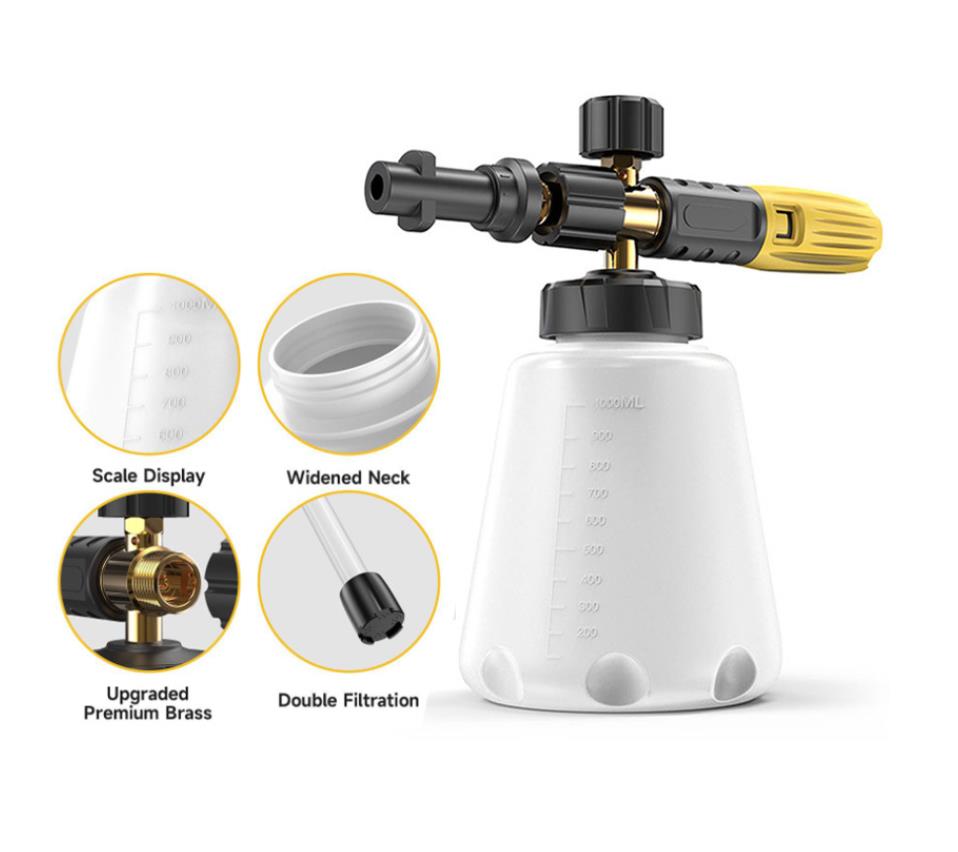
Tube selection should be considered as part of the complete foam cannon architecture. The documented assembly combines a 1 L PE container, an aluminum body, a 1/4 quick connect, a 1.2 mm orifice nozzle, one steel filter net, and either a plastic or rubber tube. Reviewing the material within this fluid-delivery system helps identify compatibility risks that may not be visible when the tube is evaluated independently.
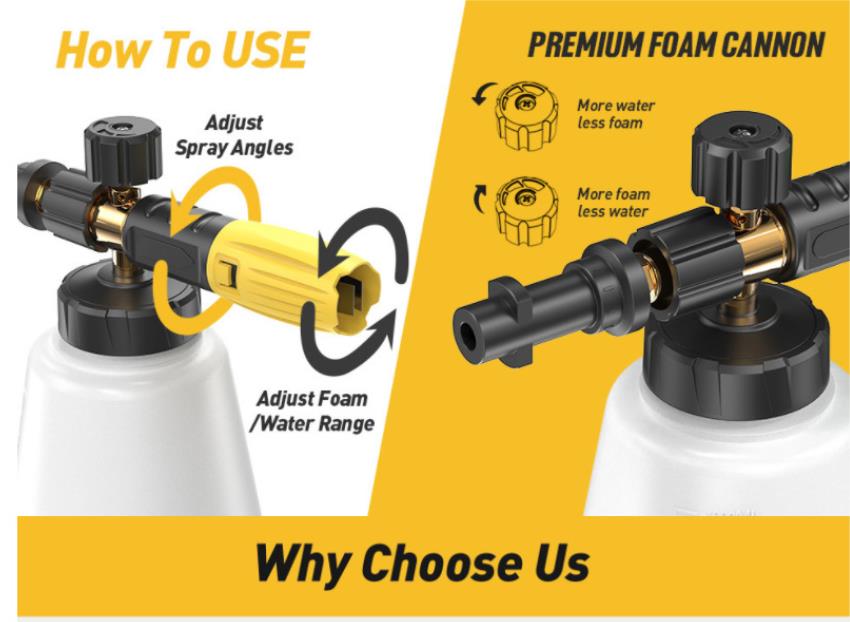
A meaningful cost study should include more than the tube purchase price. It should account for fittings, assembly time, compatibility checks, qualification testing, maintenance, and potential replacement frequency. Since the supplied information does not identify which material is cheaper, buyers should obtain supplier quotations and confirm that both options can support the specified 18 MPa pressure level.
Sustainability Verification
Neither tube option currently has documented data for recycled content, recyclability, expected service life, or end-of-life treatment. These requirements should be added to the OEM or ODM development brief together with dimensional tolerances, performance targets, special materials, and other application-specific requirements. The selected material should provide measurable environmental benefits without compromising safe and reliable operation.
Required Testing and Validation
Material substitution should be supported by controlled testing. Yiwu Zanchy Mechatronics Co. Ltd. maintains an independent R&D team specializing in cleaning accessory structural design and material optimization. Its stated evaluation capabilities include product performance, corrosion resistance, pressure resistance, and aging tests, which align with the main technical risks of replacing the tube material. Additional sustainability documentation should be requested from the material or component supplier.
The foam lance is designed to create rich, adherent foam that helps loosen dust, bird droppings, and insect residue during vehicle pre-cleaning. Whichever tube is selected must preserve foam cannon operation, connection reliability, pressure performance, and the buyer's cost and sustainability targets.
Comparison of Documented Options
| Tube or Related Component | Available Information | Evaluation Priorities |
|---|---|---|
| Plastic tube | Specified as an available tube option for the aluminum snow foam cannon | Review material, assembly, testing, and replacement costs; verify pressure, aging, corrosion, and environmental performance |
| Rubber tube | Specified as an available tube option for the aluminum snow foam cannon | Assess flexibility benefits while confirming pressure resistance, aging behavior, compatibility, and sustainability data |
| PE bottle | A 1 L PE bottle is included in the product parameters | Evaluate the bottle and tube as a complete package; recycled content and end-of-life information are not documented |
Frequently Asked Questions
What tube materials can be used with the snow foam cannon?
The documented choices are plastic tube and rubber tube.
Is plastic tube confirmed to be the cheaper option?
No. The available specification does not include a material cost comparison. Unit price, assembly, qualification, maintenance, and replacement expenses should be reviewed for the target configuration.
How should the sustainability target be validated?
Start by requesting evidence for recycled content, recyclability, service life, and disposal performance. Then combine this information with performance, corrosion, pressure, and aging tests to confirm that environmental improvements do not reduce product reliability.
Conclusion and Recommended Next Steps
Plastic and rubber tube should be treated as the two documented candidates for a structured cost and sustainability review. Confirm fit with the aluminum snow foam cannon, 1/4 quick connect, 1.2 mm orifice nozzle, and 18 MPa pressure requirement. Next, compare supplier costs and complete technical, aging, corrosion, pressure, and material assessments before approving a final design. Zanchy provides OEM manufacturing, ODM development, factory-direct supply, bulk production, and flexible small-batch ordering. For technical consultation or project support, contact us at sales8@zanchy.com.
About Yiwu Zanchy Mechatronics Co. Ltd.
Yiwu Zanchy Mechatronics Co. Ltd. is an integrated manufacturer and exporter of high-pressure cleaning machine accessories. Its product range includes water guns, foam lances, spray nozzles, pressure hoses, quick connectors, pump accessories, and filter components. The company operates an independent R&D team dedicated to structural engineering, material optimization, product upgrades, and new product development. Monthly production exceeds 150,000 cleaning accessory pieces or sets, while annual comprehensive output value reaches USD 13 million.

REPORT