







-
 Agriculture
-
 Health-Care
-
 Environment
-
 Construction-Real-Estate
-
 Tools-Hardware
-
 Home-Garden
-
 Furniture
-
 Luggage-Bags-Cases
-
 Medical-devices-Supplies
-
 Gifts-Crafts
-
 Sports-Entertainment
-
 Food-Beverage
-
 Vehicles-Transportation
-
 Power-Transmission
-
 Material-Handling
-
 Renewable-Energy
-
 Safety
-
 Testing-Instrument-Equipment
-
 Construction-Building-Machinery
-
 Pet-Supplies
-
 Personal-Care-Household-Cleaning
-
 Vehicle-Accessories-Electronics-Tools
-
 School-Office-Supplies
-
 Packaging-Printing
-
 Mother-Kids-Toys
-
 Business-Services
-
 Commercial-Equipment-Machinery
-
 Apparel-Accessories
-
 Security
-
 Shoes-Accessories
-
 Vehicle-Parts-Accessories
-
 Jewelry-Eyewear-Watches-Accessories
-
 Lights-Lighting
-
 Fabric-Textile-Raw-Material
-
 Fabrication-Services
-
 Industrial-Machinery
-
 Consumer-Electronics
-
 Electrical-Equipment-Supplies
-
 Electronic-Components-Accessories-Telecommunications
-
 Home-Appliances
-
 Beauty
-
 Chemicals
-
 Rubber-Plastics
-
 Metals-Alloys


























































































































































































































































































































































































































































































































































































- Masonry Materials
- Curtain Walls & Accessories
- Earthwork Products
- Fireproofing Materials
- Heat Insulation Materials
- Plastic Building Materials
- Building Boards
- Soundproofing Materials
- Timber
- Waterproofing Materials
- Balustrades & Handrails
- Bathroom & Kitchen
- Flooring & Accessories
- Tiles & Accessories
- Door, Window & Accessories
- Fireplaces & Stoves
- Floor Heating Systems & Parts
- Stairs & Stair Parts
- Ceilings
- Elevators & Escalators
- Stone
- Countertops, Vanity Tops & Table Tops
- Mosaics
- Metal Building Materials
- Multifunctional Materials
- Ladders & Scaffoldings
- Mouldings
- Corner Guards
- Decorative Films
- Formwork
- Building & Industrial Glass
- Other Construction & Real Estate
- Wallpapers/Wall panels
- HVAC System & Parts
- Outdoor Facilities
- Prefabricated Buildings
- Festive & Party Supplies
- Bathroom Products
- Household Sundries
- Rain Gear
- Garden Supplies
- Household Cleaning Tools & Accessories
- Lighters & Smoking Accessories
- Home Storage & Organization
- Household Scales
- Smart Home Improvement
- Home Textiles
- Kitchenware
- Drinkware & Accessories
- Dinnerware, Coffee & Wine
- Home Decor
- Golf
- Fitness & Body Building
- Amusement Park Facilities
- Billiards, Board Game,Coin Operated Games
- Musical Instruments
- Outdoor Affordable Luxury Sports
- Camping & Hiking
- Fishing
- Sports Safety&Rehabilitation
- Ball Sports Equipments
- Water Sports
- Winter Sports
- Luxury Travel Equipments
- Sports Shoes, Bags & Accessories
- Cycling
- Other Sports & Entertainment Products
- Artificial Grass&Sports Flooring&Sports Court Equipment
- Scooters
- Food Ingredients
- Honey & Honey Products
- Snacks
- Nuts & Kernels
- Seafood
- Plant & Animal Oil
- Beverages
- Fruit & Vegetable Products
- Frog & Escargot
- Bean Products
- Egg Products
- Dairy Products
- Seasonings & Condiments
- Canned Food
- Instant Food
- Baked Goods
- Other Food & Beverage
- Meat & Poultry
- Confectionery
- Grain Products
- Feminie Care
- Hair Care & Styling
- Body Care
- Hands & Feet Care
- Hygiene Products
- Men's Grooming
- Laundry Cleaning Supplies
- Travel Size & Gift Sets
- Room Deodorizers
- Other Personal Care Products
- Pest Control Products
- Special Household Cleaning
- Floor Cleaning
- Kitchen & Bathroom Cleaning
- Oral Care
- Bath Supplies
- Yellow Pages
- Correction Supplies
- Office Binding Supplies
- Office Cutting Supplies
- Board Erasers
- Office Adhesives & Tapes
- Education Supplies
- Pencil Cases & Bags
- Notebooks & Writing Pads
- File Folder Accessories
- Calendars
- Writing Accessories
- Commercial Office Supplies
- Pencil Sharpeners
- Pens
- Letter Pad/Paper
- Paper Envelopes
- Desk Organizers
- Pencils
- Markers & Highlighters
- Filing Products
- Art Supplies
- Easels
- Badge Holder & Accessories
- Office Paper
- Printer Supplies
- Book Covers
- Other Office & School Supplies
- Stationery Set
- Boards
- Clipboards
- Stamps
- Drafting Supplies
- Stencils
- Electronic Dictionary
- Books
- Map
- Magazines
- Calculators
- Baby & Toddler Toys
- Educational Toys
- Classic Toys
- Dress Up & Pretend Play
- Toy Vehicle
- Stuffed Animals & Plush Toys
- Outdoor Toys & Structures
- Balloons & Accessories
- Baby Food
- Children's Clothing
- Baby Supplies & Products
- Maternity Clothes
- Kids Shoes
- Baby Care
- Novelty & Gag Toys
- Dolls & Accessories
- Puzzle & Games
- Blocks & Model Building Toys
- Toddler Clothing
- Baby Clothing
- Kids' Luggage & Bags
- Arts, Crafts & DIY Toys
- Action & Toy Figures
- Baby Appliances
- Hobbies & Models
- Remote Control Toys
- Promotional Toys
- Pregnancy & Maternity
- Hygiene Products
- Kid's Textile&Bedding
- Novelty & Special Use
- Toy Weapons
- Baby Gifts
- Baby Storage & Organization
- Auto Drive Systems
- ATV/UTV Parts & Accessories
- Marine Parts & Accessories
- Other Auto Parts
- Trailer Parts & Accessories
- Auto Transmission Systems
- Train Parts & Accessories
- Universal Parts
- Railway Parts & Accessories
- Auto Brake Systems
- Aviation Parts & Accessories
- Truck Parts & Accessories
- Auto Suspension Systems
- Auto Lighting Systems
- New Energy Vehicle Parts & Accessories
- Auto Steering Systems
- Wheels, Tires & Accessories
- Bus Parts & Accessories
- Auto Performance Parts
- Cooling System
- Go-Kart & Kart Racer Parts & Accessories
- Air Conditioning Systems
- Heavy Duty Vehicle Parts & Accessories
- Auto Electrical Systems
- Auto Body Systems
- Auto Engine Systems
- Container Parts & Accessories
- Motorcycle Parts & Accessories
- Refrigeration & Heat Exchange Equipment
- Machine Tool Equipment
- Food & Beverage Machinery
- Agricultural Machinery & Equipment
- Apparel & Textile Machinery
- Chemical Machinery
- Packaging Machines
- Paper Production Machinery
- Plastic & Rubber Processing Machinery
- Industrial Robots
- Electronic Products Machinery
- Metal & Metallurgy Machinery
- Woodworking Machinery
- Home Product Manufacturing Machinery
- Machinery Accessories
- Environmental Machinery
- Machinery Service
- Electrical Equipment Manufacturing Machinery
- Industrial Compressors & Parts
- Tobacco & Cigarette Machinery
- Production Line
- Used Industrial Machinery
- Electronics Production Machinery
- Other Machinery & Industrial Equipment
- Camera, Photo & Accessories
- Portable Audio, Video & Accessories
- Television, Home Audio, Video & Accessories
- Video Games & Accessories
- Mobile Phone & Accessories
- Electronic Publications
- Earphone & Headphone & Accessories
- Speakers & Accessories
- Smart Electronics
- TV Receivers & Accessories
- Mobile Phone & Computer Repair Parts
- Chargers, Batteries & Power Supplies
- Used Electronics
- VR, AR, MR Hardware & Software
- Projectors & Presentation Equipments
- Other Consumer Electronics
- Cables & Commonly Used Accessories
- Computer Hardware & Software
- Displays, Signage and Optoelectronics
- Discrete Semiconductors
- Wireless & IoT Module and Products
- Telecommunications
- Connectors, Terminals & Accessories
- Development Boards, Electronic Modules and Kits
- Circuit Protection
- Sensors
- Isolators
- Audio Components and Products
- Integrated Circuits
- Power Supplies
- Relays
- RF, Microwave and RFID
- Electronic Accessories & Supplies
- Passive Components
- PCB & PCBA
- Air Quality Appliances
- Home Appliance Parts
- Heating & Cooling Appliances
- Small Kitchen Appliances
- Laundry Appliances
- Water Heaters
- Water Treatment Appliances
- Refrigerators & Freezers
- Personal Care & Beauty Appliances
- Major Kitchen Appliances
- Cleaning Appliances
- Second-hand Appliances
- Smart Home Appliances
- Other Home Appliances
- Energy Chemicals
- Inorganic Chemicals
- Basic Organic Chemicals
- Agrochemicals
- Admixture & Additives
- Catalysts & Chemical Auxiliary Agents
- Pigments & Dyestuff
- Coating & Paint
- Daily Chemicals
- Polymer
- Organic Intermediate
- Adhesives & Sealants
- Chemical Waste
- Biological Chemical Products
- Surface Treatment Chemicals
- Painting & Coating
- Chemical Reagents
- Flavor & Fragrance
- Non-Explosive Demolition Agents
- Other Chemicals
- Custom Chemical Services

Sizing Guide: Determining Output Ratings for Emergency & Outdoor Power Supplies
Selecting the appropriate output rating for an outdoor emergency power supply requires evaluating both constant running wattage and brief startup surges. To guarantee reliable operation, your power unit's output capacity should exceed total connected continuous loads by 20% to 25%. While compact electronic gear needs only 300W to 500W, heavy power tools, household appliances, and remote industrial setups demand anywhere from 1500W up to continuous loads exceeding 5000W.
Essential Power Sizing Principles
- Determine Cumulative Wattage: Sum the continuous wattage of every device operating at the same time, incorporating a 20% safety headroom factor.
- Factor in Motor Startup Surges: Inductive devices (such as compressors, drainage pumps, and electric saws) can draw 2x to 3x their operational rating upon ignition.
- Scale Capacity for Duration: Align running output with substantial energy capacity—such as a 15360Wh Energy Storage Battery—to guarantee multi-day off-grid operation.
- Prioritize Pure Sine Wave Inverters: Utilize pure sine wave output to protect sensitive telecom equipment, medical hardware, and precise microelectronics from electrical distortion.
Technical Principles & Load Calculation
Determining your power hardware requirements involves evaluating running wattage demands alongside peak motor startup characteristics. Off-grid backup systems and portable lithium iron phosphate (LiFePO4) storage units rely on integrated inverters to convert direct current into clean alternating current. Undersized units frequently trigger internal inverter over-current protections, causing unwanted shutdowns or voltage drops that can harm delicate electronic equipment.
For light-duty outdoor usages like powering laptops, drones, emergency lighting, and smartphones, an output rating between 300W and 1000W provides ample coverage. However, larger setups—such as off-grid residential sites, construction operations, and remote facilities—require much larger power envelopes. Household refrigerators, microwaves, and utility pumps generally consume 1000W to 2000W continuously, with startup spikes scaling up to 4500W. Critical infrastructures like remote cell towers, command centers, and industrial facilities demand robust solutions capable of sustaining 5000W to 15000W continuous output.

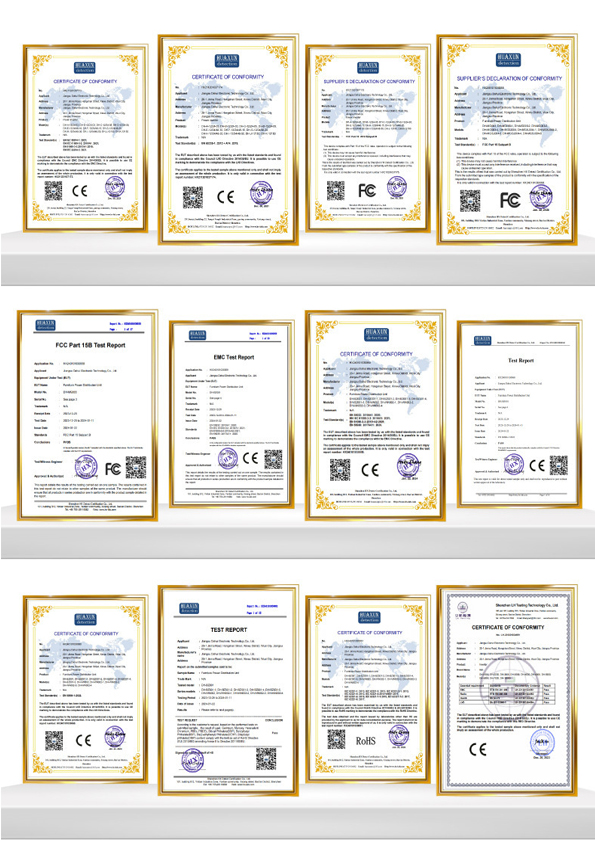
Ensuring operational reliability under maximum load requires thorough hardware testing. Standardized storage hardware undergoes multi-point quality assurance checks: cell internal resistance checks, capacity charge-discharge validation, BMS circuit testing, high-voltage insulation tests, thermal fluctuation tolerance screenings, and extended burn-in tests. International standard compliance—demonstrated by CE certifications such as CE-INV-260618-0001, CE-INV-260618-0002, and CE-INV-260618-0003—ensures safety across European, Middle Eastern, African, and South American markets.
Real-world applications highlight the value of tailored output configurations. For example, during a 1GWh energy storage installation in Southeast Asia, customized units were implemented to handle regional grid fluctuations and hot climates. Precision sizing paired with targeted thermal management prevented overheating while delivering dependable power to regional factories and residential communities.
Load Capacity Sizing Breakdown
Refer to the table below to match equipment categories with their wattage demands, peak surge multiples, and recommended power supply output ratings:
| Equipment Category | Typical Continuous Wattage | Surge Multiplier | Recommended Supply Rating | Target Application Scenario |
|---|---|---|---|---|
| Electronics & Communications | 50W – 300W | 1.0x (Minimal) | 300W – 500W | Camping, field monitoring, mobile device charging |
| Home Appliances & Tools | 800W – 2000W | 2.0x – 3.0x | 2000W – 3500W | Residential emergency backup, RV travel, field work |
| Industrial & Commercial Loads | 3000W – 10000W+ | 2.5x – 3.5x | 5000W – 15360W+ | Off-grid PV stations, factories, base stations, hotels |
Frequently Asked Questions
Q1: What occurs if connected appliances exceed the unit's output rating?
When connected loads surpass the rated threshold, the embedded Battery Management System (BMS) or inverter overload protection kicks in automatically to shut down output, preventing thermal damage and electrical failure.
Q2: How does peak surge capacity differ from continuous power output?
Continuous output rating indicates the sustained wattage a system can safely supply long-term under normal conditions. Peak surge rating represents the short-term burst wattage (lasting milliseconds to seconds) that the inverter can deliver to initiate motor startup.
Q3: How do you estimate runtime for a 15360Wh energy storage battery?
Calculate runtime using the formula: Operational Time (hours) = (Total Battery Watt-Hours × Inverter Efficiency (~0.85 to 0.90)) / Total Load Wattage. Consequently, a 1000W device powered by a 15360Wh battery will operate for roughly 13 to 13.8 hours.
Procurement & Contact Information
Proper sizing requires balancing continuous loads, surge demands, and battery capacity against your target operating time. Flexible manufacturing supports projects of all scales, offering single sample orders (MOQ 1pcs) for testing alongside volume commercial orders delivered within 15 days. International trade is backed by wire transfer options adhering to standard DDP, DDU, FOB, and EXW shipping terms. For inquiries or technical consultations, contact marketing@sunvoltx.com.
Company Overview
shenzhen sunvoltx intelligent technology Co., Ltd. is a specialized technology enterprise founded in 2026, focused on the R&D, manufacturing, customization, and distribution of energy storage power systems, inverters, and smart chargers. Operating out of a 1,000-square-meter facility with 20 to 50 employees, the company yields a monthly output exceeding 5,000 units while exporting 70% of production worldwide. Backed by expert R&D teams and CE-certified product lines, the firm supports residential, industrial, and off-grid solar deployments, including large-scale energy projects across Southeast Asia.

REPORT