







-
 Agriculture
-
 Health-Care
-
 Environment
-
 Construction-Real-Estate
-
 Tools-Hardware
-
 Home-Garden
-
 Furniture
-
 Luggage-Bags-Cases
-
 Medical-devices-Supplies
-
 Gifts-Crafts
-
 Sports-Entertainment
-
 Food-Beverage
-
 Vehicles-Transportation
-
 Power-Transmission
-
 Material-Handling
-
 Renewable-Energy
-
 Safety
-
 Testing-Instrument-Equipment
-
 Construction-Building-Machinery
-
 Pet-Supplies
-
 Personal-Care-Household-Cleaning
-
 Vehicle-Accessories-Electronics-Tools
-
 School-Office-Supplies
-
 Packaging-Printing
-
 Mother-Kids-Toys
-
 Business-Services
-
 Commercial-Equipment-Machinery
-
 Apparel-Accessories
-
 Security
-
 Shoes-Accessories
-
 Vehicle-Parts-Accessories
-
 Jewelry-Eyewear-Watches-Accessories
-
 Lights-Lighting
-
 Fabric-Textile-Raw-Material
-
 Fabrication-Services
-
 Industrial-Machinery
-
 Consumer-Electronics
-
 Electrical-Equipment-Supplies
-
 Electronic-Components-Accessories-Telecommunications
-
 Home-Appliances
-
 Beauty
-
 Chemicals
-
 Rubber-Plastics
-
 Metals-Alloys


























































































































































































































































































































































































































































































































































































- Masonry Materials
- Curtain Walls & Accessories
- Earthwork Products
- Fireproofing Materials
- Heat Insulation Materials
- Plastic Building Materials
- Building Boards
- Soundproofing Materials
- Timber
- Waterproofing Materials
- Balustrades & Handrails
- Bathroom & Kitchen
- Flooring & Accessories
- Tiles & Accessories
- Door, Window & Accessories
- Fireplaces & Stoves
- Floor Heating Systems & Parts
- Stairs & Stair Parts
- Ceilings
- Elevators & Escalators
- Stone
- Countertops, Vanity Tops & Table Tops
- Mosaics
- Metal Building Materials
- Multifunctional Materials
- Ladders & Scaffoldings
- Mouldings
- Corner Guards
- Decorative Films
- Formwork
- Building & Industrial Glass
- Other Construction & Real Estate
- Wallpapers/Wall panels
- HVAC System & Parts
- Outdoor Facilities
- Prefabricated Buildings
- Festive & Party Supplies
- Bathroom Products
- Household Sundries
- Rain Gear
- Garden Supplies
- Household Cleaning Tools & Accessories
- Lighters & Smoking Accessories
- Home Storage & Organization
- Household Scales
- Smart Home Improvement
- Home Textiles
- Kitchenware
- Drinkware & Accessories
- Dinnerware, Coffee & Wine
- Home Decor
- Golf
- Fitness & Body Building
- Amusement Park Facilities
- Billiards, Board Game,Coin Operated Games
- Musical Instruments
- Outdoor Affordable Luxury Sports
- Camping & Hiking
- Fishing
- Sports Safety&Rehabilitation
- Ball Sports Equipments
- Water Sports
- Winter Sports
- Luxury Travel Equipments
- Sports Shoes, Bags & Accessories
- Cycling
- Other Sports & Entertainment Products
- Artificial Grass&Sports Flooring&Sports Court Equipment
- Scooters
- Food Ingredients
- Honey & Honey Products
- Snacks
- Nuts & Kernels
- Seafood
- Plant & Animal Oil
- Beverages
- Fruit & Vegetable Products
- Frog & Escargot
- Bean Products
- Egg Products
- Dairy Products
- Seasonings & Condiments
- Canned Food
- Instant Food
- Baked Goods
- Other Food & Beverage
- Meat & Poultry
- Confectionery
- Grain Products
- Feminie Care
- Hair Care & Styling
- Body Care
- Hands & Feet Care
- Hygiene Products
- Men's Grooming
- Laundry Cleaning Supplies
- Travel Size & Gift Sets
- Room Deodorizers
- Other Personal Care Products
- Pest Control Products
- Special Household Cleaning
- Floor Cleaning
- Kitchen & Bathroom Cleaning
- Oral Care
- Bath Supplies
- Yellow Pages
- Correction Supplies
- Office Binding Supplies
- Office Cutting Supplies
- Board Erasers
- Office Adhesives & Tapes
- Education Supplies
- Pencil Cases & Bags
- Notebooks & Writing Pads
- File Folder Accessories
- Calendars
- Writing Accessories
- Commercial Office Supplies
- Pencil Sharpeners
- Pens
- Letter Pad/Paper
- Paper Envelopes
- Desk Organizers
- Pencils
- Markers & Highlighters
- Filing Products
- Art Supplies
- Easels
- Badge Holder & Accessories
- Office Paper
- Printer Supplies
- Book Covers
- Other Office & School Supplies
- Stationery Set
- Boards
- Clipboards
- Stamps
- Drafting Supplies
- Stencils
- Electronic Dictionary
- Books
- Map
- Magazines
- Calculators
- Baby & Toddler Toys
- Educational Toys
- Classic Toys
- Dress Up & Pretend Play
- Toy Vehicle
- Stuffed Animals & Plush Toys
- Outdoor Toys & Structures
- Balloons & Accessories
- Baby Food
- Children's Clothing
- Baby Supplies & Products
- Maternity Clothes
- Kids Shoes
- Baby Care
- Novelty & Gag Toys
- Dolls & Accessories
- Puzzle & Games
- Blocks & Model Building Toys
- Toddler Clothing
- Baby Clothing
- Kids' Luggage & Bags
- Arts, Crafts & DIY Toys
- Action & Toy Figures
- Baby Appliances
- Hobbies & Models
- Remote Control Toys
- Promotional Toys
- Pregnancy & Maternity
- Hygiene Products
- Kid's Textile&Bedding
- Novelty & Special Use
- Toy Weapons
- Baby Gifts
- Baby Storage & Organization
- Auto Drive Systems
- ATV/UTV Parts & Accessories
- Marine Parts & Accessories
- Other Auto Parts
- Trailer Parts & Accessories
- Auto Transmission Systems
- Train Parts & Accessories
- Universal Parts
- Railway Parts & Accessories
- Auto Brake Systems
- Aviation Parts & Accessories
- Truck Parts & Accessories
- Auto Suspension Systems
- Auto Lighting Systems
- New Energy Vehicle Parts & Accessories
- Auto Steering Systems
- Wheels, Tires & Accessories
- Bus Parts & Accessories
- Auto Performance Parts
- Cooling System
- Go-Kart & Kart Racer Parts & Accessories
- Air Conditioning Systems
- Heavy Duty Vehicle Parts & Accessories
- Auto Electrical Systems
- Auto Body Systems
- Auto Engine Systems
- Container Parts & Accessories
- Motorcycle Parts & Accessories
- Refrigeration & Heat Exchange Equipment
- Machine Tool Equipment
- Food & Beverage Machinery
- Agricultural Machinery & Equipment
- Apparel & Textile Machinery
- Chemical Machinery
- Packaging Machines
- Paper Production Machinery
- Plastic & Rubber Processing Machinery
- Industrial Robots
- Electronic Products Machinery
- Metal & Metallurgy Machinery
- Woodworking Machinery
- Home Product Manufacturing Machinery
- Machinery Accessories
- Environmental Machinery
- Machinery Service
- Electrical Equipment Manufacturing Machinery
- Industrial Compressors & Parts
- Tobacco & Cigarette Machinery
- Production Line
- Used Industrial Machinery
- Electronics Production Machinery
- Other Machinery & Industrial Equipment
- Camera, Photo & Accessories
- Portable Audio, Video & Accessories
- Television, Home Audio, Video & Accessories
- Video Games & Accessories
- Mobile Phone & Accessories
- Electronic Publications
- Earphone & Headphone & Accessories
- Speakers & Accessories
- Smart Electronics
- TV Receivers & Accessories
- Mobile Phone & Computer Repair Parts
- Chargers, Batteries & Power Supplies
- Used Electronics
- VR, AR, MR Hardware & Software
- Projectors & Presentation Equipments
- Other Consumer Electronics
- Cables & Commonly Used Accessories
- Computer Hardware & Software
- Displays, Signage and Optoelectronics
- Discrete Semiconductors
- Wireless & IoT Module and Products
- Telecommunications
- Connectors, Terminals & Accessories
- Development Boards, Electronic Modules and Kits
- Circuit Protection
- Sensors
- Isolators
- Audio Components and Products
- Integrated Circuits
- Power Supplies
- Relays
- RF, Microwave and RFID
- Electronic Accessories & Supplies
- Passive Components
- PCB & PCBA
- Air Quality Appliances
- Home Appliance Parts
- Heating & Cooling Appliances
- Small Kitchen Appliances
- Laundry Appliances
- Water Heaters
- Water Treatment Appliances
- Refrigerators & Freezers
- Personal Care & Beauty Appliances
- Major Kitchen Appliances
- Cleaning Appliances
- Second-hand Appliances
- Smart Home Appliances
- Other Home Appliances
- Energy Chemicals
- Inorganic Chemicals
- Basic Organic Chemicals
- Agrochemicals
- Admixture & Additives
- Catalysts & Chemical Auxiliary Agents
- Pigments & Dyestuff
- Coating & Paint
- Daily Chemicals
- Polymer
- Organic Intermediate
- Adhesives & Sealants
- Chemical Waste
- Biological Chemical Products
- Surface Treatment Chemicals
- Painting & Coating
- Chemical Reagents
- Flavor & Fragrance
- Non-Explosive Demolition Agents
- Other Chemicals
- Custom Chemical Services

Sustainable Mattress Innovation: Eco-Friendly Alternatives to Petroleum Polyurethane Foam
Transitioning Beyond Petroleum-Based Polyurethane Foam
The global bedding industry is undergoing a significant transition away from synthetic petroleum polyurethane foam toward ecologically responsible materials. Modern eco-friendly mattress construction utilizes natural botanical latex, plant-derived polyols, organic cotton, flame-resistant wool, and recyclable steel spring arrays. These advanced material choices eliminate harmful off-gassing and lower total carbon footprints while delivering superior ergonomic support for both commercial hotel projects and home bedding applications.
Key Sustainable Alternatives & Material Innovations
- Botanical Dunlop & Talalay Latex: Processed directly from natural rubber tree sap, botanical latex creates an open-cell, breathable core that provides resilient ergonomic support without releasing volatile organic compounds (VOCs).
- Plant-Based Bio-Polyol Foams: By replacing 10% to 30% of petrochemical components with renewable plant oils like soybean or castor oil, manufacturers reduce fossil fuel consumption while preserving pressure-relieving memory properties.
- Organic Wool & Cotton Fire Barriers: Functioning as natural temperature regulators and flame retardants, these pure natural fibers allow mattresses to conform to global safety standards (BS 7177 and CFR 1633) without chemical treatments.
- Recyclable Pocketed Coils: Replacing thick synthetic foam bases with independently wrapped steel springs enclosed in non-toxic textiles enables complete component recycling at the end of the mattress lifecycle.
Technical Principles and Environmental Compliance
Engineered sustainable mattresses pair core resilience with strict environmental safety. Natural latex undergoes a vulcanization process of raw sap, resulting in a cellular structure that prevents bodily sinkage while promoting continuous air circulation. Concurrently, bio-foams integrate plant-based polyols into polyurethane formulation, reducing manufacturing carbon emissions while maintaining mechanical durability.

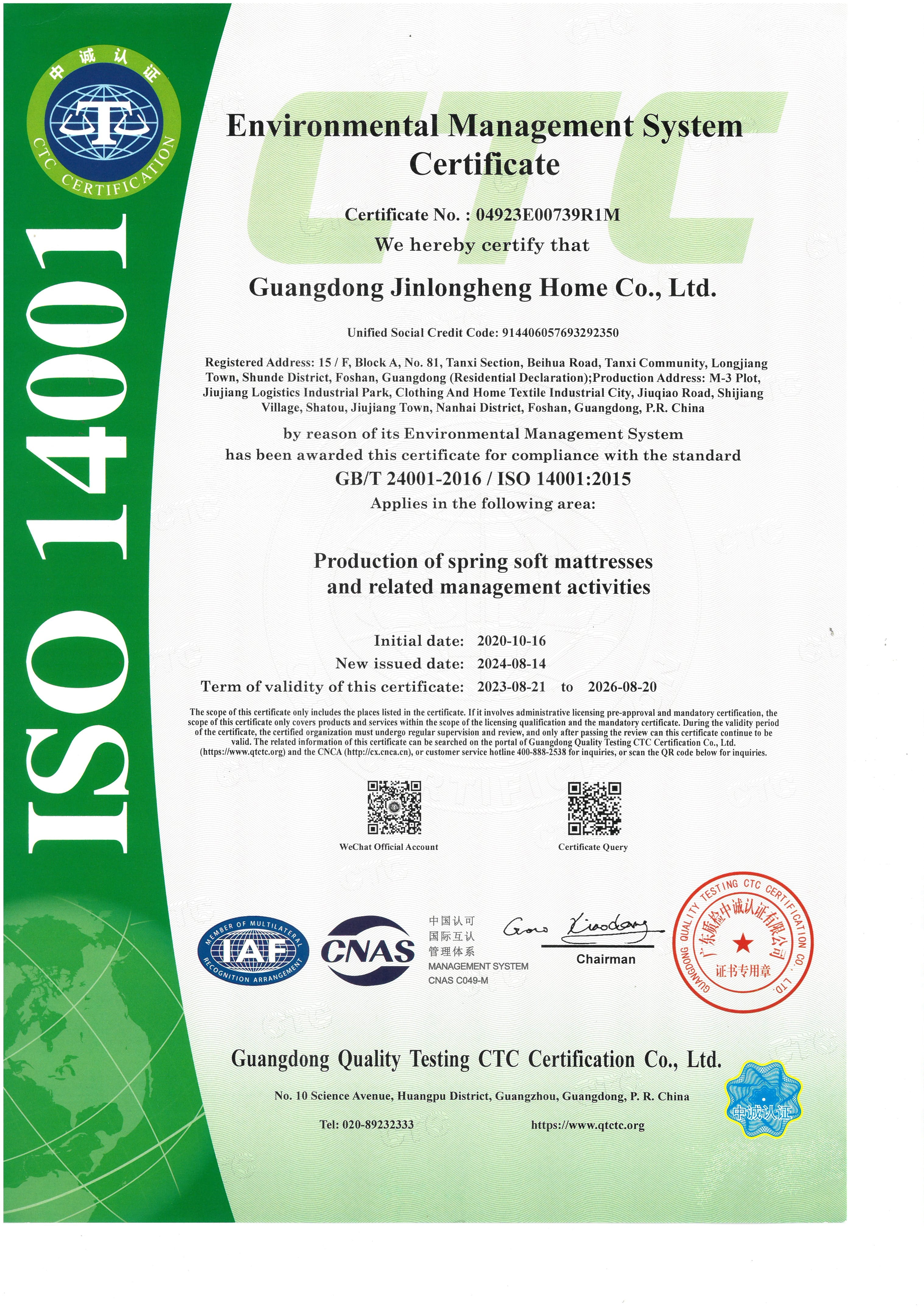
For commercial hospitality environments, combining bio-foams with natural wool insulation layers delivers long-lasting comfort alongside halogen-free fire protection. Standardized evaluation in CNAS-accredited laboratories guarantees full alignment with ISO 14001, CertiPUR-US, and OEKO-TEX environmental standards. Leading manufacturers such as Jinlongheng Furniture Co., Ltd. manage dedicated in-house foam, spring, and textile workshops to ensure every component adheres to strict global ecological criteria.

Commercial Durability & Logistics Optimization
High-end hospitality partners, including Poland's Hotel Gołębiewski Mikołajki and the Beijing Financial Street Ritz-Carlton Hotel, mandate durable, eco-compliant bedding. Modern compression technology allows eco-friendly foam and latex mattresses to be vacuum-rolled, cutting packaging volume by up to 75% and decreasing freight emissions by up to 60% during global transport.
Material Comparison: Conventional vs. Sustainable Options
The matrix below compares conventional synthetic polyurethane against leading sustainable mattress materials across key performance indicators:
| Material Type | Renewable Content | Off-gassing / VOC Level | Lifespan & Resilience | Recyclability | Fire Safety Compliance |
|---|---|---|---|---|---|
| Petroleum Polyurethane Foam | 0% | High (Off-gassing present) | 5 - 7 Years | Low (Complex recycling) | Requires Chemical Additives |
| Natural Dunlop/Talalay Latex | 95% - 98% | Negligible | 10 - 15 Years | High (Biodegradable) | Inherent Flame Resistance |
| Plant-Based Bio-Foam | 10% - 30% | Low | 7 - 10 Years | Moderate | Meets Standard Retardancy |
| Wool & Organic Cotton Padding | 100% | Zero VOCs | 8 - 12 Years | 100% Biodegradable | Passes BS 7177 / CFR 1633 Naturally |
Frequently Asked Questions
Q1: Are plant-based bio-foams 100% free of petroleum?
A1: No. Bio-foams currently replace 10% to 30% of petrochemical polyols with botanical oils like castor or soybean. While not completely petroleum-free, they significantly reduce reliance on non-renewable fossil fuels and curb VOC emissions.
Q2: How do natural materials pass hospitality fire safety codes?
A2: Organic wool and dense cotton possess natural flame-resistant properties. Integrated properly into mattress construction, they pass strict standards such as UK BS 7177 and US CFR 1633 without requiring chemical flame retardants.
Q3: Can natural latex handle vacuum-rolled shipping?
A3: Yes. High-density natural latex and quality bio-foams possess high elasticity, allowing them to undergo vacuum compression and rolling without structural damage, restoring fully to original dimensions upon unpacking.
Conclusion & Procurement Support
Replacing standard petroleum foam with natural latex, plant-based polyol foam, and organic fiber layers delivers high-performance sleep solutions aligned with modern environmental standards. For hotel developers, distributors, and retail procurement teams, custom OEM/ODM solutions are available across standard dimensions (single, double, queen, king). Minimum orders start at one mixed container, with typical delivery within 15 to 35 days under flexible T/T or L/C payment options. For technical specifications and inquiry support, contact sales15@jlhmattress.cn.
About the Manufacturer
Jinlongheng Furniture Co., Ltd. operates a 630,000-square-meter production complex in Guangdong, employing over 800 skilled workers with a monthly production capacity of 120,000 mattresses. Founded in 1992, the enterprise maintains self-owned spring, foam, and textile workshops alongside a CNAS-accredited testing center. Certified under ISO 9001, ISO 14001, ISO 45001, BSCI, and ISPA, the company supplies major hospitality groups including Ritz-Carlton, Sheraton, and Wyndham across 125 countries worldwide.

REPORT