







-
 Agriculture
-
 Health-Care
-
 Environment
-
 Construction-Real-Estate
-
 Tools-Hardware
-
 Home-Garden
-
 Furniture
-
 Luggage-Bags-Cases
-
 Medical-devices-Supplies
-
 Gifts-Crafts
-
 Sports-Entertainment
-
 Food-Beverage
-
 Vehicles-Transportation
-
 Power-Transmission
-
 Material-Handling
-
 Renewable-Energy
-
 Safety
-
 Testing-Instrument-Equipment
-
 Construction-Building-Machinery
-
 Pet-Supplies
-
 Personal-Care-Household-Cleaning
-
 Vehicle-Accessories-Electronics-Tools
-
 School-Office-Supplies
-
 Packaging-Printing
-
 Mother-Kids-Toys
-
 Business-Services
-
 Commercial-Equipment-Machinery
-
 Apparel-Accessories
-
 Security
-
 Shoes-Accessories
-
 Vehicle-Parts-Accessories
-
 Jewelry-Eyewear-Watches-Accessories
-
 Lights-Lighting
-
 Fabric-Textile-Raw-Material
-
 Fabrication-Services
-
 Industrial-Machinery
-
 Consumer-Electronics
-
 Electrical-Equipment-Supplies
-
 Electronic-Components-Accessories-Telecommunications
-
 Home-Appliances
-
 Beauty
-
 Chemicals
-
 Rubber-Plastics
-
 Metals-Alloys


























































































































































































































































































































































































































































































































































































- Masonry Materials
- Curtain Walls & Accessories
- Earthwork Products
- Fireproofing Materials
- Heat Insulation Materials
- Plastic Building Materials
- Building Boards
- Soundproofing Materials
- Timber
- Waterproofing Materials
- Balustrades & Handrails
- Bathroom & Kitchen
- Flooring & Accessories
- Tiles & Accessories
- Door, Window & Accessories
- Fireplaces & Stoves
- Floor Heating Systems & Parts
- Stairs & Stair Parts
- Ceilings
- Elevators & Escalators
- Stone
- Countertops, Vanity Tops & Table Tops
- Mosaics
- Metal Building Materials
- Multifunctional Materials
- Ladders & Scaffoldings
- Mouldings
- Corner Guards
- Decorative Films
- Formwork
- Building & Industrial Glass
- Other Construction & Real Estate
- Wallpapers/Wall panels
- HVAC System & Parts
- Outdoor Facilities
- Prefabricated Buildings
- Festive & Party Supplies
- Bathroom Products
- Household Sundries
- Rain Gear
- Garden Supplies
- Household Cleaning Tools & Accessories
- Lighters & Smoking Accessories
- Home Storage & Organization
- Household Scales
- Smart Home Improvement
- Home Textiles
- Kitchenware
- Drinkware & Accessories
- Dinnerware, Coffee & Wine
- Home Decor
- Golf
- Fitness & Body Building
- Amusement Park Facilities
- Billiards, Board Game,Coin Operated Games
- Musical Instruments
- Outdoor Affordable Luxury Sports
- Camping & Hiking
- Fishing
- Sports Safety&Rehabilitation
- Ball Sports Equipments
- Water Sports
- Winter Sports
- Luxury Travel Equipments
- Sports Shoes, Bags & Accessories
- Cycling
- Other Sports & Entertainment Products
- Artificial Grass&Sports Flooring&Sports Court Equipment
- Scooters
- Food Ingredients
- Honey & Honey Products
- Snacks
- Nuts & Kernels
- Seafood
- Plant & Animal Oil
- Beverages
- Fruit & Vegetable Products
- Frog & Escargot
- Bean Products
- Egg Products
- Dairy Products
- Seasonings & Condiments
- Canned Food
- Instant Food
- Baked Goods
- Other Food & Beverage
- Meat & Poultry
- Confectionery
- Grain Products
- Feminie Care
- Hair Care & Styling
- Body Care
- Hands & Feet Care
- Hygiene Products
- Men's Grooming
- Laundry Cleaning Supplies
- Travel Size & Gift Sets
- Room Deodorizers
- Other Personal Care Products
- Pest Control Products
- Special Household Cleaning
- Floor Cleaning
- Kitchen & Bathroom Cleaning
- Oral Care
- Bath Supplies
- Yellow Pages
- Correction Supplies
- Office Binding Supplies
- Office Cutting Supplies
- Board Erasers
- Office Adhesives & Tapes
- Education Supplies
- Pencil Cases & Bags
- Notebooks & Writing Pads
- File Folder Accessories
- Calendars
- Writing Accessories
- Commercial Office Supplies
- Pencil Sharpeners
- Pens
- Letter Pad/Paper
- Paper Envelopes
- Desk Organizers
- Pencils
- Markers & Highlighters
- Filing Products
- Art Supplies
- Easels
- Badge Holder & Accessories
- Office Paper
- Printer Supplies
- Book Covers
- Other Office & School Supplies
- Stationery Set
- Boards
- Clipboards
- Stamps
- Drafting Supplies
- Stencils
- Electronic Dictionary
- Books
- Map
- Magazines
- Calculators
- Baby & Toddler Toys
- Educational Toys
- Classic Toys
- Dress Up & Pretend Play
- Toy Vehicle
- Stuffed Animals & Plush Toys
- Outdoor Toys & Structures
- Balloons & Accessories
- Baby Food
- Children's Clothing
- Baby Supplies & Products
- Maternity Clothes
- Kids Shoes
- Baby Care
- Novelty & Gag Toys
- Dolls & Accessories
- Puzzle & Games
- Blocks & Model Building Toys
- Toddler Clothing
- Baby Clothing
- Kids' Luggage & Bags
- Arts, Crafts & DIY Toys
- Action & Toy Figures
- Baby Appliances
- Hobbies & Models
- Remote Control Toys
- Promotional Toys
- Pregnancy & Maternity
- Hygiene Products
- Kid's Textile&Bedding
- Novelty & Special Use
- Toy Weapons
- Baby Gifts
- Baby Storage & Organization
- Auto Drive Systems
- ATV/UTV Parts & Accessories
- Marine Parts & Accessories
- Other Auto Parts
- Trailer Parts & Accessories
- Auto Transmission Systems
- Train Parts & Accessories
- Universal Parts
- Railway Parts & Accessories
- Auto Brake Systems
- Aviation Parts & Accessories
- Truck Parts & Accessories
- Auto Suspension Systems
- Auto Lighting Systems
- New Energy Vehicle Parts & Accessories
- Auto Steering Systems
- Wheels, Tires & Accessories
- Bus Parts & Accessories
- Auto Performance Parts
- Cooling System
- Go-Kart & Kart Racer Parts & Accessories
- Air Conditioning Systems
- Heavy Duty Vehicle Parts & Accessories
- Auto Electrical Systems
- Auto Body Systems
- Auto Engine Systems
- Container Parts & Accessories
- Motorcycle Parts & Accessories
- Refrigeration & Heat Exchange Equipment
- Machine Tool Equipment
- Food & Beverage Machinery
- Agricultural Machinery & Equipment
- Apparel & Textile Machinery
- Chemical Machinery
- Packaging Machines
- Paper Production Machinery
- Plastic & Rubber Processing Machinery
- Industrial Robots
- Electronic Products Machinery
- Metal & Metallurgy Machinery
- Woodworking Machinery
- Home Product Manufacturing Machinery
- Machinery Accessories
- Environmental Machinery
- Machinery Service
- Electrical Equipment Manufacturing Machinery
- Industrial Compressors & Parts
- Tobacco & Cigarette Machinery
- Production Line
- Used Industrial Machinery
- Electronics Production Machinery
- Other Machinery & Industrial Equipment
- Camera, Photo & Accessories
- Portable Audio, Video & Accessories
- Television, Home Audio, Video & Accessories
- Video Games & Accessories
- Mobile Phone & Accessories
- Electronic Publications
- Earphone & Headphone & Accessories
- Speakers & Accessories
- Smart Electronics
- TV Receivers & Accessories
- Mobile Phone & Computer Repair Parts
- Chargers, Batteries & Power Supplies
- Used Electronics
- VR, AR, MR Hardware & Software
- Projectors & Presentation Equipments
- Other Consumer Electronics
- Cables & Commonly Used Accessories
- Computer Hardware & Software
- Displays, Signage and Optoelectronics
- Discrete Semiconductors
- Wireless & IoT Module and Products
- Telecommunications
- Connectors, Terminals & Accessories
- Development Boards, Electronic Modules and Kits
- Circuit Protection
- Sensors
- Isolators
- Audio Components and Products
- Integrated Circuits
- Power Supplies
- Relays
- RF, Microwave and RFID
- Electronic Accessories & Supplies
- Passive Components
- PCB & PCBA
- Air Quality Appliances
- Home Appliance Parts
- Heating & Cooling Appliances
- Small Kitchen Appliances
- Laundry Appliances
- Water Heaters
- Water Treatment Appliances
- Refrigerators & Freezers
- Personal Care & Beauty Appliances
- Major Kitchen Appliances
- Cleaning Appliances
- Second-hand Appliances
- Smart Home Appliances
- Other Home Appliances
- Energy Chemicals
- Inorganic Chemicals
- Basic Organic Chemicals
- Agrochemicals
- Admixture & Additives
- Catalysts & Chemical Auxiliary Agents
- Pigments & Dyestuff
- Coating & Paint
- Daily Chemicals
- Polymer
- Organic Intermediate
- Adhesives & Sealants
- Chemical Waste
- Biological Chemical Products
- Surface Treatment Chemicals
- Painting & Coating
- Chemical Reagents
- Flavor & Fragrance
- Non-Explosive Demolition Agents
- Other Chemicals
- Custom Chemical Services

What Documentation Is Needed to Report a Defective UV/LED Lash Lamp?
To report a faulty UV/LED eyelash curing lamp, prepare purchase details, photos showing any visible damage, a short operating video, and the lamp's model or batch information. Complete evidence helps technical support confirm the problem, determine warranty eligibility, and arrange troubleshooting, replacement parts, or a replacement unit efficiently.
Essential Evidence for a Defect Claim
- Purchase Confirmation: Include the order number, invoice, delivery record, or other proof of purchase. These details help verify the warranty period and locate the relevant production and shipping records.
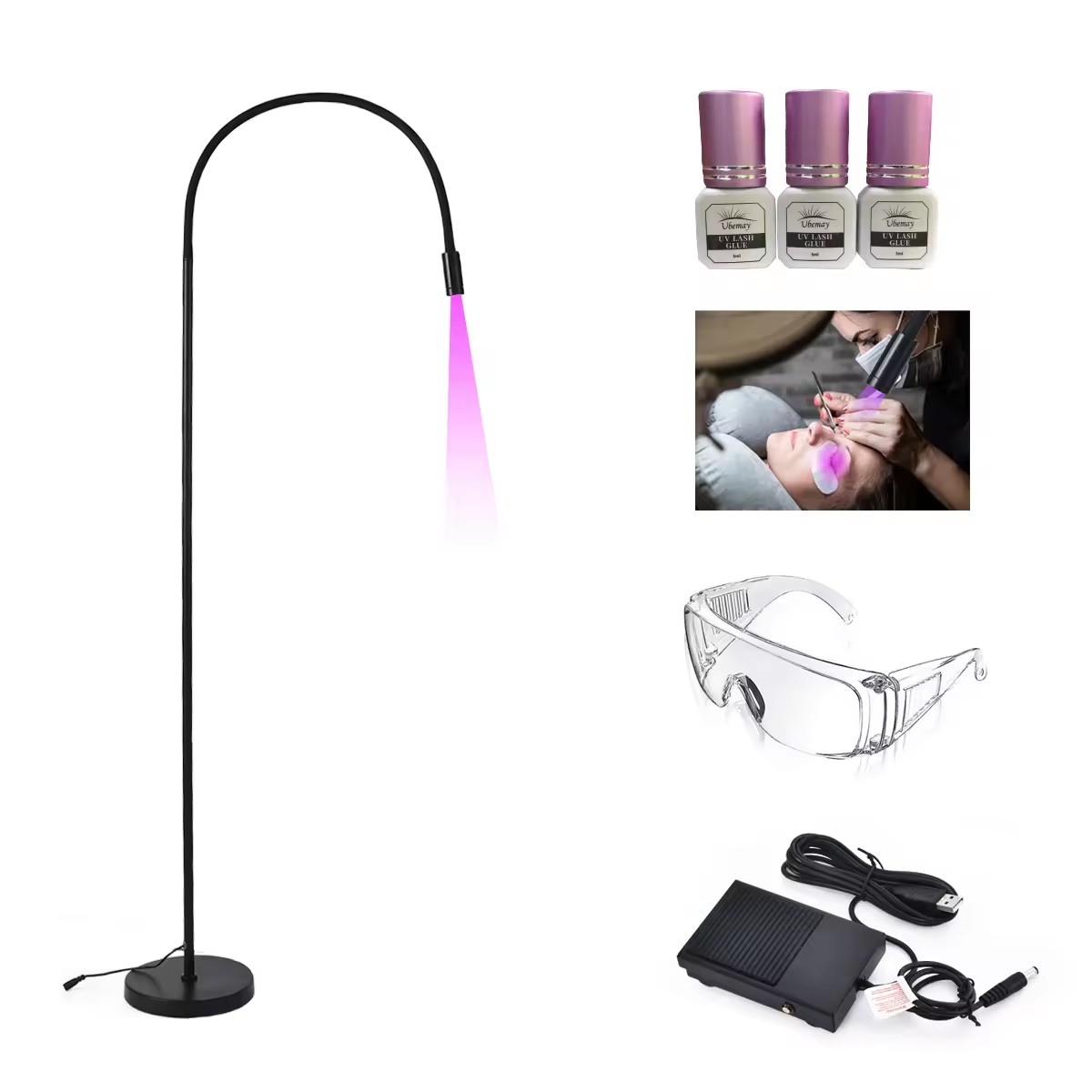
- Detailed Photos: Take well-lit photographs of cracked housings, broken clamps, loose goosenecks, damaged stands, missing parts, or other physical problems. Include both close-up views and wider images showing the complete lamp.
- Functional Video: Record the lamp while the issue occurs. Useful examples include failure to start, intermittent or flickering UV/LED output, unstable brightness, an ineffective spot-size adjustment, or incomplete curing of UV lash adhesive.
- Product Identification: State the lamp model, batch number, and configuration, such as single-head, dual-head, clamp-mounted, modular, or floor-standing versions.
How the Evidence Supports Technical Diagnosis
A structured report gives technical engineers enough information to compare the field problem with factory inspection results. UV/LED lash lamps are normally evaluated through incoming material checks, electrical and functional testing, finished-product inspection, packaging review, and testing before shipment. Photos and operating footage can show whether the reported problem is related to assembly, transportation, electrical performance, or normal product use.
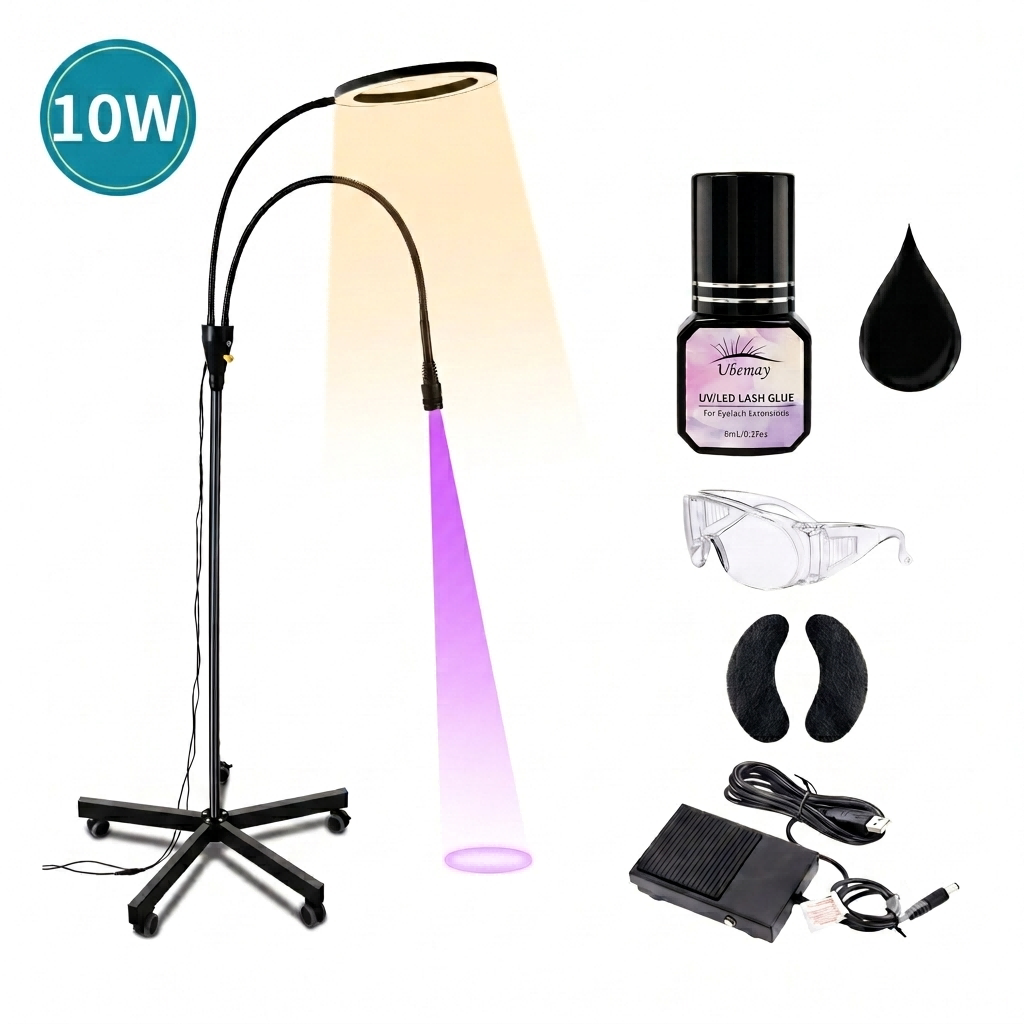
When describing the failure, identify the affected function as precisely as possible. For example, note whether the low-voltage power connection is unstable, the gooseneck cannot hold its position, one head produces weaker light than the other, or the optical spot adjustment does not respond. The lamp's model and batch details also help support teams select compatible components and assess related production records.
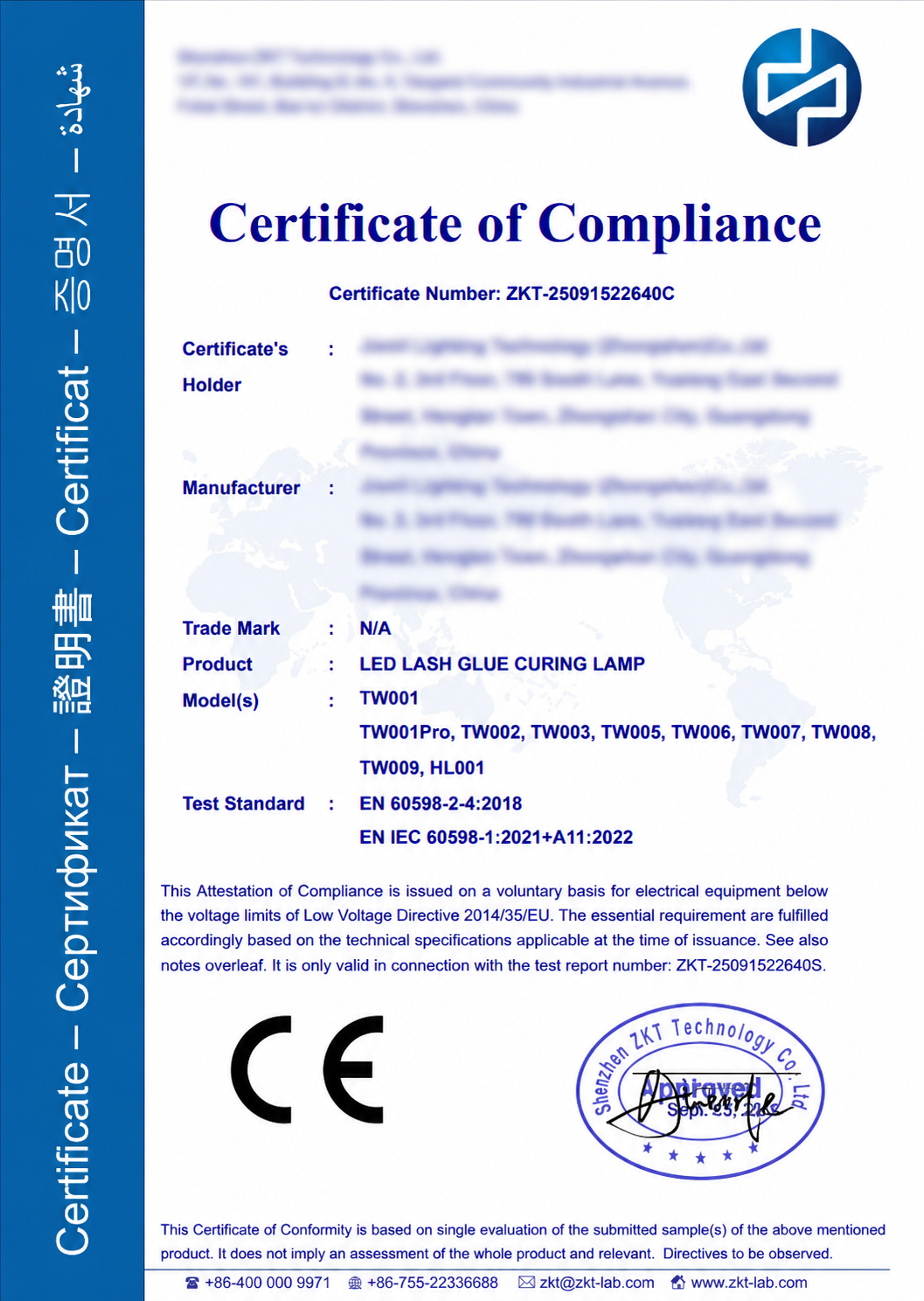
These products are designed with electrical safety and electromagnetic compatibility requirements in mind, including CE (LVD) Certificate ZKT-25091522640C and CE (EMC) Certificate ZKT-25091522641C. Clear evidence allows the team to investigate potential driver, LED, switch, wiring, or mechanical assembly issues without unnecessary delays.
Recommended Reporting Process
1. Record the order information
Start with the order ID, purchase date, invoice, tracking number, and delivery details. This establishes the product source and helps determine whether the issue may be covered by warranty or shipping protection.
2. Photograph the product and packaging
For shipping-related damage, photograph the shipping carton, protective materials, labels, and damaged lamp before disposing of the packaging. Show the defect from multiple angles, and include a wider image that connects the damaged part to the complete product.
3. Demonstrate the problem safely
Use a brief video to show the power connection, switch operation, lamp output, controls, and the specific failure. If the lamp does not cure UV lash adhesive correctly, show the lamp-to-adhesive distance, selected spot size, and exposure time while following appropriate operating and safety procedures.
4. Identify the exact configuration
Confirm whether the unit is clamp-mounted or floor-standing and whether it uses a single head, dual head, or modular head assembly. Accurate identification prevents incompatible replacement parts from being supplied.
Evidence and Expected Resolution
| Report Element | What to Submit | What It Helps Confirm | Possible Resolution |
|---|---|---|---|
| Purchase and Delivery Details | Order number, invoice, receipt, tracking information | Purchase date, shipment history, and warranty status | Assistance with missing items, delivery damage, or order discrepancies |
| Physical Condition | Clear images of the lamp body, clamp, gooseneck, stand, and packaging | Breakage, deformation, loose hardware, or assembly problems | Replacement of affected components or the complete unit |
| Operating Performance | Video showing power-up, controls, light output, and curing behavior | Possible driver, LED, switch, wiring, or adjustment failure | Technical instructions, repair guidance, or product replacement |
| Model and Batch Data | Model name, batch number, head type, and mounting style | Correct product records and component compatibility | Accurate replacement dispatch, normally within standard lead times |
Frequently Asked Questions
What should I record if the lamp does not cure UV lash adhesive?
Make a video with the lamp switched on and aimed at the adhesive application. Include the working distance, spot-size setting, exposure duration, and visible light behavior. This gives the technical team useful context for evaluating output and curing performance.
What evidence is needed for damage caused during delivery?
Photograph the outside of the shipping carton, internal protective packaging, shipping labels, and damaged parts before reassembly or disposal. Add the carrier tracking number and order details so the shipment can be reviewed for a transit-damage claim.
How long does a verified defect claim usually take?
After the evidence has been reviewed, in-stock replacement items generally ship in approximately 4 to 7 days. Customized or private-label parts may require around 10 to 15 days, depending on packaging, specifications, and production requirements.
Conclusion
A complete defect report should combine purchase verification, clear physical evidence, an operational video, and precise model information. This approach allows support engineers to identify the likely cause more quickly and recommend the correct outcome, whether that is troubleshooting, a component replacement, or a new lamp. The same reporting method supports professional lash salons, training schools, mobile artists, distributors, and OEM/ODM customers while helping maintain reliable salon service and safe working conditions. For technical assistance, contact us at sales@ubemay.com.
About Us
Guangzhou Ruiju E-Commerce Co., Ltd. operates the professional lash beauty brand UBEMAY. Founded in 2014, the company has a 5000 sqm factory and a 50-person team focused on eyelash extensions, adhesives, accessories, and UV/LED lash equipment. Its products include curing lamps supported by CE (LVD) and CE (EMC) certifications, serving distributors, salons, and private-label businesses throughout North America, Europe, South America, and the Middle East.

REPORT