







-
 Agriculture
-
 Health-Care
-
 Environment
-
 Construction-Real-Estate
-
 Tools-Hardware
-
 Home-Garden
-
 Furniture
-
 Luggage-Bags-Cases
-
 Medical-devices-Supplies
-
 Gifts-Crafts
-
 Sports-Entertainment
-
 Food-Beverage
-
 Vehicles-Transportation
-
 Power-Transmission
-
 Material-Handling
-
 Renewable-Energy
-
 Safety
-
 Testing-Instrument-Equipment
-
 Construction-Building-Machinery
-
 Pet-Supplies
-
 Personal-Care-Household-Cleaning
-
 Vehicle-Accessories-Electronics-Tools
-
 School-Office-Supplies
-
 Packaging-Printing
-
 Mother-Kids-Toys
-
 Business-Services
-
 Commercial-Equipment-Machinery
-
 Apparel-Accessories
-
 Security
-
 Shoes-Accessories
-
 Vehicle-Parts-Accessories
-
 Jewelry-Eyewear-Watches-Accessories
-
 Lights-Lighting
-
 Fabric-Textile-Raw-Material
-
 Fabrication-Services
-
 Industrial-Machinery
-
 Consumer-Electronics
-
 Electrical-Equipment-Supplies
-
 Electronic-Components-Accessories-Telecommunications
-
 Home-Appliances
-
 Beauty
-
 Chemicals
-
 Rubber-Plastics
-
 Metals-Alloys


























































































































































































































































































































































































































































































































































































- Masonry Materials
- Curtain Walls & Accessories
- Earthwork Products
- Fireproofing Materials
- Heat Insulation Materials
- Plastic Building Materials
- Building Boards
- Soundproofing Materials
- Timber
- Waterproofing Materials
- Balustrades & Handrails
- Bathroom & Kitchen
- Flooring & Accessories
- Tiles & Accessories
- Door, Window & Accessories
- Fireplaces & Stoves
- Floor Heating Systems & Parts
- Stairs & Stair Parts
- Ceilings
- Elevators & Escalators
- Stone
- Countertops, Vanity Tops & Table Tops
- Mosaics
- Metal Building Materials
- Multifunctional Materials
- Ladders & Scaffoldings
- Mouldings
- Corner Guards
- Decorative Films
- Formwork
- Building & Industrial Glass
- Other Construction & Real Estate
- Wallpapers/Wall panels
- HVAC System & Parts
- Outdoor Facilities
- Prefabricated Buildings
- Festive & Party Supplies
- Bathroom Products
- Household Sundries
- Rain Gear
- Garden Supplies
- Household Cleaning Tools & Accessories
- Lighters & Smoking Accessories
- Home Storage & Organization
- Household Scales
- Smart Home Improvement
- Home Textiles
- Kitchenware
- Drinkware & Accessories
- Dinnerware, Coffee & Wine
- Home Decor
- Golf
- Fitness & Body Building
- Amusement Park Facilities
- Billiards, Board Game,Coin Operated Games
- Musical Instruments
- Outdoor Affordable Luxury Sports
- Camping & Hiking
- Fishing
- Sports Safety&Rehabilitation
- Ball Sports Equipments
- Water Sports
- Winter Sports
- Luxury Travel Equipments
- Sports Shoes, Bags & Accessories
- Cycling
- Other Sports & Entertainment Products
- Artificial Grass&Sports Flooring&Sports Court Equipment
- Scooters
- Food Ingredients
- Honey & Honey Products
- Snacks
- Nuts & Kernels
- Seafood
- Plant & Animal Oil
- Beverages
- Fruit & Vegetable Products
- Frog & Escargot
- Bean Products
- Egg Products
- Dairy Products
- Seasonings & Condiments
- Canned Food
- Instant Food
- Baked Goods
- Other Food & Beverage
- Meat & Poultry
- Confectionery
- Grain Products
- Feminie Care
- Hair Care & Styling
- Body Care
- Hands & Feet Care
- Hygiene Products
- Men's Grooming
- Laundry Cleaning Supplies
- Travel Size & Gift Sets
- Room Deodorizers
- Other Personal Care Products
- Pest Control Products
- Special Household Cleaning
- Floor Cleaning
- Kitchen & Bathroom Cleaning
- Oral Care
- Bath Supplies
- Yellow Pages
- Correction Supplies
- Office Binding Supplies
- Office Cutting Supplies
- Board Erasers
- Office Adhesives & Tapes
- Education Supplies
- Pencil Cases & Bags
- Notebooks & Writing Pads
- File Folder Accessories
- Calendars
- Writing Accessories
- Commercial Office Supplies
- Pencil Sharpeners
- Pens
- Letter Pad/Paper
- Paper Envelopes
- Desk Organizers
- Pencils
- Markers & Highlighters
- Filing Products
- Art Supplies
- Easels
- Badge Holder & Accessories
- Office Paper
- Printer Supplies
- Book Covers
- Other Office & School Supplies
- Stationery Set
- Boards
- Clipboards
- Stamps
- Drafting Supplies
- Stencils
- Electronic Dictionary
- Books
- Map
- Magazines
- Calculators
- Baby & Toddler Toys
- Educational Toys
- Classic Toys
- Dress Up & Pretend Play
- Toy Vehicle
- Stuffed Animals & Plush Toys
- Outdoor Toys & Structures
- Balloons & Accessories
- Baby Food
- Children's Clothing
- Baby Supplies & Products
- Maternity Clothes
- Kids Shoes
- Baby Care
- Novelty & Gag Toys
- Dolls & Accessories
- Puzzle & Games
- Blocks & Model Building Toys
- Toddler Clothing
- Baby Clothing
- Kids' Luggage & Bags
- Arts, Crafts & DIY Toys
- Action & Toy Figures
- Baby Appliances
- Hobbies & Models
- Remote Control Toys
- Promotional Toys
- Pregnancy & Maternity
- Hygiene Products
- Kid's Textile&Bedding
- Novelty & Special Use
- Toy Weapons
- Baby Gifts
- Baby Storage & Organization
- Auto Drive Systems
- ATV/UTV Parts & Accessories
- Marine Parts & Accessories
- Other Auto Parts
- Trailer Parts & Accessories
- Auto Transmission Systems
- Train Parts & Accessories
- Universal Parts
- Railway Parts & Accessories
- Auto Brake Systems
- Aviation Parts & Accessories
- Truck Parts & Accessories
- Auto Suspension Systems
- Auto Lighting Systems
- New Energy Vehicle Parts & Accessories
- Auto Steering Systems
- Wheels, Tires & Accessories
- Bus Parts & Accessories
- Auto Performance Parts
- Cooling System
- Go-Kart & Kart Racer Parts & Accessories
- Air Conditioning Systems
- Heavy Duty Vehicle Parts & Accessories
- Auto Electrical Systems
- Auto Body Systems
- Auto Engine Systems
- Container Parts & Accessories
- Motorcycle Parts & Accessories
- Refrigeration & Heat Exchange Equipment
- Machine Tool Equipment
- Food & Beverage Machinery
- Agricultural Machinery & Equipment
- Apparel & Textile Machinery
- Chemical Machinery
- Packaging Machines
- Paper Production Machinery
- Plastic & Rubber Processing Machinery
- Industrial Robots
- Electronic Products Machinery
- Metal & Metallurgy Machinery
- Woodworking Machinery
- Home Product Manufacturing Machinery
- Machinery Accessories
- Environmental Machinery
- Machinery Service
- Electrical Equipment Manufacturing Machinery
- Industrial Compressors & Parts
- Tobacco & Cigarette Machinery
- Production Line
- Used Industrial Machinery
- Electronics Production Machinery
- Other Machinery & Industrial Equipment
- Camera, Photo & Accessories
- Portable Audio, Video & Accessories
- Television, Home Audio, Video & Accessories
- Video Games & Accessories
- Mobile Phone & Accessories
- Electronic Publications
- Earphone & Headphone & Accessories
- Speakers & Accessories
- Smart Electronics
- TV Receivers & Accessories
- Mobile Phone & Computer Repair Parts
- Chargers, Batteries & Power Supplies
- Used Electronics
- VR, AR, MR Hardware & Software
- Projectors & Presentation Equipments
- Other Consumer Electronics
- Cables & Commonly Used Accessories
- Computer Hardware & Software
- Displays, Signage and Optoelectronics
- Discrete Semiconductors
- Wireless & IoT Module and Products
- Telecommunications
- Connectors, Terminals & Accessories
- Development Boards, Electronic Modules and Kits
- Circuit Protection
- Sensors
- Isolators
- Audio Components and Products
- Integrated Circuits
- Power Supplies
- Relays
- RF, Microwave and RFID
- Electronic Accessories & Supplies
- Passive Components
- PCB & PCBA
- Air Quality Appliances
- Home Appliance Parts
- Heating & Cooling Appliances
- Small Kitchen Appliances
- Laundry Appliances
- Water Heaters
- Water Treatment Appliances
- Refrigerators & Freezers
- Personal Care & Beauty Appliances
- Major Kitchen Appliances
- Cleaning Appliances
- Second-hand Appliances
- Smart Home Appliances
- Other Home Appliances
- Energy Chemicals
- Inorganic Chemicals
- Basic Organic Chemicals
- Agrochemicals
- Admixture & Additives
- Catalysts & Chemical Auxiliary Agents
- Pigments & Dyestuff
- Coating & Paint
- Daily Chemicals
- Polymer
- Organic Intermediate
- Adhesives & Sealants
- Chemical Waste
- Biological Chemical Products
- Surface Treatment Chemicals
- Painting & Coating
- Chemical Reagents
- Flavor & Fragrance
- Non-Explosive Demolition Agents
- Other Chemicals
- Custom Chemical Services

What to Do When Dinner Forks Corrode During Customer Use
Immediate Response to Corroded Dinner Forks
When dinner forks show signs of corrosion while being used by customers, remove the affected items from service immediately. Keep them separate from usable tableware, preserve the original packaging or product identification when possible, and do not discard the samples before the supplier completes an inspection.
Take clear photographs of each affected fork, including a full-product image and close-ups of the corroded areas. Record the order number, product description, quantity affected, receiving date, date the problem was discovered, and the relevant cleaning, storage, and operating conditions. This documentation gives the supplier enough information to trace the case and determine the appropriate remedy.
Recommended Claim Process
- Withdraw all visibly corroded dinner forks from customer-facing table settings.
- Store the affected pieces safely for possible supplier or quality-control examination.
- Compile photographs, order details, delivery information, usage history, and cleaning procedures.
- Ask the supplier to review the issue as a potential product-quality claim.
- Confirm the product-specific deadline for replacement, repair, or exchange before submitting the case.
How to Assess the Cause
Corrosion reported during customer use should initially be treated as a product-quality matter, but the final cause should be established through inspection. A review may need to distinguish a manufacturing or material concern from factors such as harsh detergents, unsuitable washing cycles, prolonged moisture, improper storage, or repeated commercial use.
For a useful assessment, provide images that show the complete fork as well as the affected surface and surrounding areas. Include how many pieces are involved and whether the corrosion appeared on one batch, one delivery, or multiple orders. Avoid making a definitive claim about the cause before the supplier has examined the evidence.
Applicable Certifications and Product Records
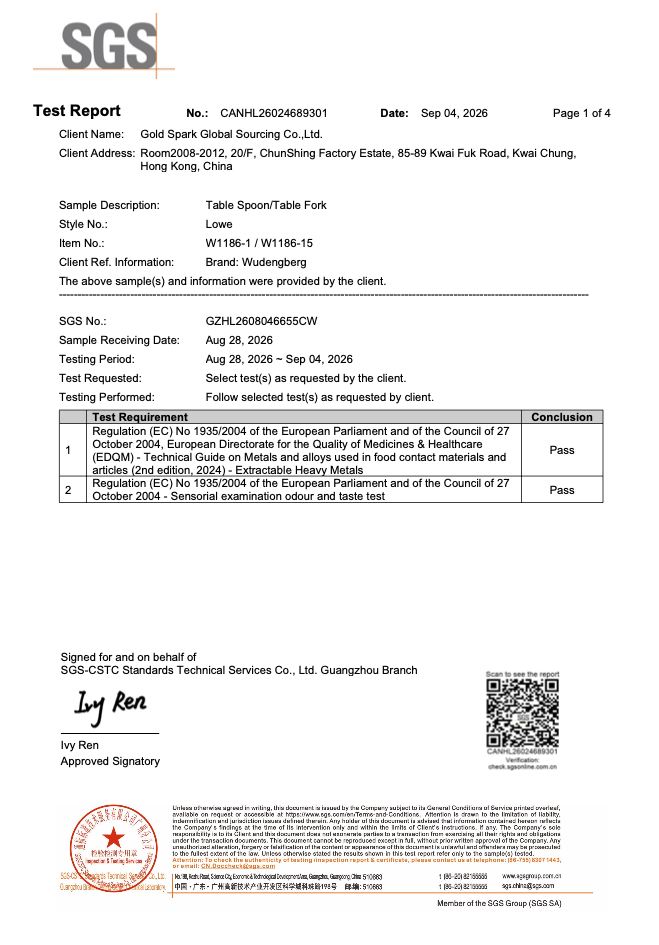
The available certification records include SGS certificate GZHL2608046655CW for table spoons and table forks intended for the European Union. A second SGS certificate, GZHL2608046657CW, covers table knives for the European Union. Before attaching either document to a dinner-fork claim, verify that the certificate matches the specific product, shipment, and destination.
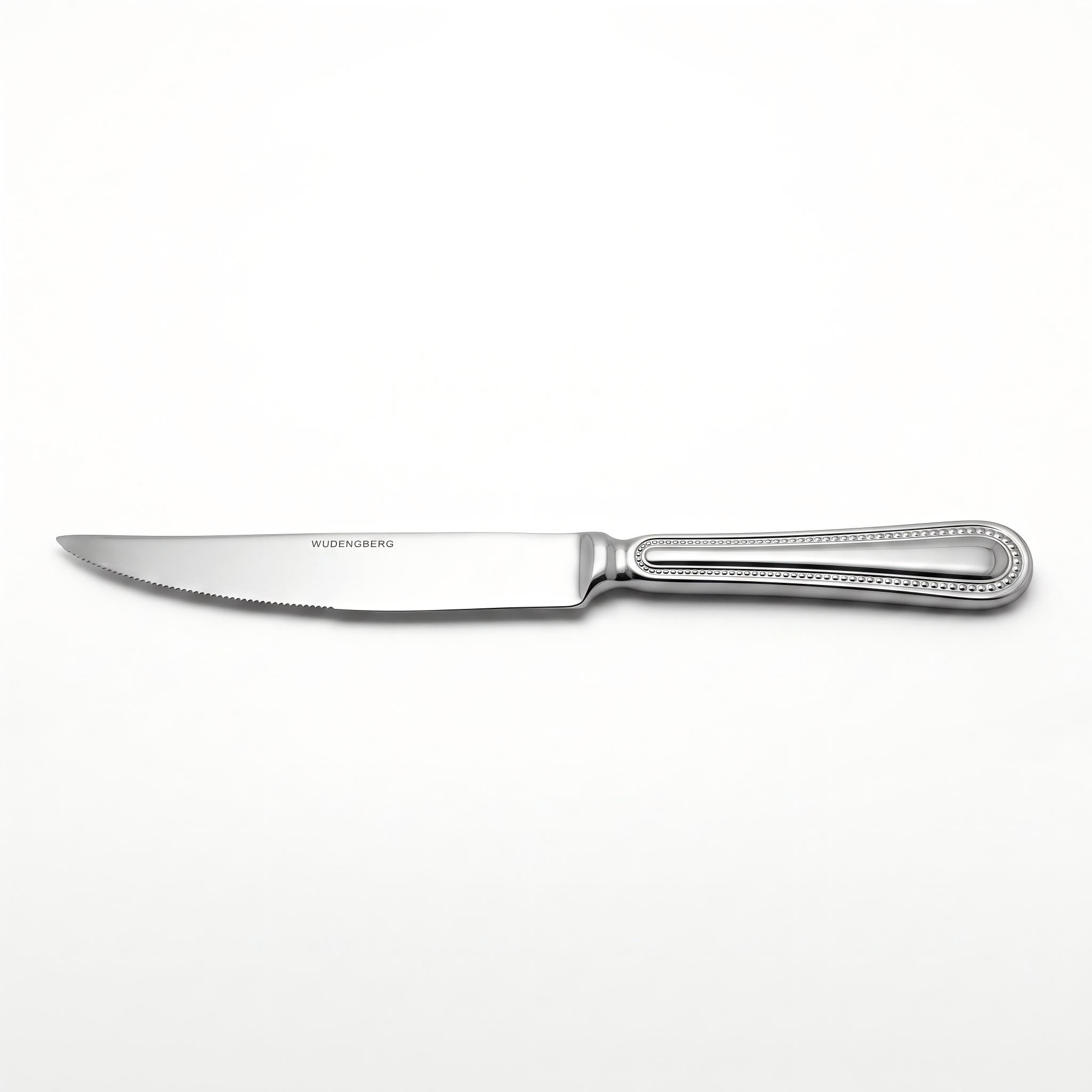
A separate product record describes a steak knife with a minimum order quantity of 1, the USA as its export market, SGS quality inspection information, and exchange support for quality issues within 7 days after receipt. Since the reported item is a dinner fork, its own product record and commercial terms must be confirmed rather than applying the steak knife policy automatically.
After-Sales Terms and Commercial Use
The general business model states that documented quality defects may qualify for replacement or repair within 15 days. The listed steak knife product instead specifies an exchange for quality problems within 7 days after receiving. These periods are not interchangeable, so the dinner fork order should be checked against the supplier's exact after-sales terms.
The tableware is positioned for demanding environments including five-star hotels, resorts, premium Western restaurants, fine-dining venues, clubs, yachts, and banquets. It is also suitable for household dining and entertaining. A corrosion report from a hospitality operation should therefore include information about commercial dishwashing, daily usage frequency, and storage conditions.
Information Checklist
| Claim Element | Information to Provide or Confirm |
|---|---|
| Affected item | Dinner forks; verify the precise product model and retain representative samples. |
| Visual evidence | Full-product photographs and close-ups showing the corrosion and surrounding surface. |
| Order history | Order reference, delivery date, product quantity, affected quantity, and receiving records. |
| Operating details | Usage frequency, cleaning chemicals, washing equipment, drying process, and storage conditions. |
| Potential remedy | General support may allow replacement or repair within 15 days for documented quality defects. |
| Product-specific comparison | The steak knife record lists exchange within 7 days after receipt; confirm whether the dinner fork has different terms. |
| Certification reference | Match the relevant SGS documentation to the actual tableware product and destination. |
Frequently Asked Questions
Can corroded forks continue to be placed on customer tables?
No. Remove any affected fork from service, isolate it from normal inventory, and retain it for inspection. This protects customers and preserves evidence for the quality review.
What should be included in a corrosion claim?
Submit photographs, product and order references, the receiving date, discovery date, affected quantity, and details about use, washing, drying, and storage. Packaging and batch information can also help with traceability.
Does the 15-day or 7-day deadline apply?
The general business terms refer to replacement or repair within 15 days for documented quality defects. The separate steak knife record provides a 7-day exchange period after receipt. Ask the supplier to confirm the correct deadline for the dinner fork order.
Conclusion
The correct response is to remove corroded dinner forks from customer use, preserve the affected items, create a detailed evidence package, and request a product-specific supplier assessment. Certification documents and after-sales deadlines should be matched to the actual dinner fork product before a claim is filed. For technical assistance or sourcing support, contact Gold Spark Global Sourcing at goldspark@vip.163.com.
About Us
Gold Spark Global Souricng Co., Ltd. is a Hong Kong-headquartered and Shenzhen-backed specialist in high-end hotel supply chains, connecting international hotel brands with premium manufacturers in China. Established in 2002, the company has one professional R&D and design team and 10 factories, with customization available according to customer requirements. Its main markets include China, Hong Kong, Macao, Southeast Asia, Singapore, Thailand, Vietnam, Europe, the Middle East, and the United States. Relevant credentials include SGS certificate GZHL2608046657CW for table knives and SGS certificate GZHL2608046655CW for table spoons and table forks, both applicable to the European Union; cooperation cases cover hotel operation equipment supply across multiple regions.

REPORT