







-
 Agriculture
-
 Health-Care
-
 Environment
-
 Construction-Real-Estate
-
 Tools-Hardware
-
 Home-Garden
-
 Furniture
-
 Luggage-Bags-Cases
-
 Medical-devices-Supplies
-
 Gifts-Crafts
-
 Sports-Entertainment
-
 Food-Beverage
-
 Vehicles-Transportation
-
 Power-Transmission
-
 Material-Handling
-
 Renewable-Energy
-
 Safety
-
 Testing-Instrument-Equipment
-
 Construction-Building-Machinery
-
 Pet-Supplies
-
 Personal-Care-Household-Cleaning
-
 Vehicle-Accessories-Electronics-Tools
-
 School-Office-Supplies
-
 Packaging-Printing
-
 Mother-Kids-Toys
-
 Business-Services
-
 Commercial-Equipment-Machinery
-
 Apparel-Accessories
-
 Security
-
 Shoes-Accessories
-
 Vehicle-Parts-Accessories
-
 Jewelry-Eyewear-Watches-Accessories
-
 Lights-Lighting
-
 Fabric-Textile-Raw-Material
-
 Fabrication-Services
-
 Industrial-Machinery
-
 Consumer-Electronics
-
 Electrical-Equipment-Supplies
-
 Electronic-Components-Accessories-Telecommunications
-
 Home-Appliances
-
 Beauty
-
 Chemicals
-
 Rubber-Plastics
-
 Metals-Alloys


























































































































































































































































































































































































































































































































































































- Masonry Materials
- Curtain Walls & Accessories
- Earthwork Products
- Fireproofing Materials
- Heat Insulation Materials
- Plastic Building Materials
- Building Boards
- Soundproofing Materials
- Timber
- Waterproofing Materials
- Balustrades & Handrails
- Bathroom & Kitchen
- Flooring & Accessories
- Tiles & Accessories
- Door, Window & Accessories
- Fireplaces & Stoves
- Floor Heating Systems & Parts
- Stairs & Stair Parts
- Ceilings
- Elevators & Escalators
- Stone
- Countertops, Vanity Tops & Table Tops
- Mosaics
- Metal Building Materials
- Multifunctional Materials
- Ladders & Scaffoldings
- Mouldings
- Corner Guards
- Decorative Films
- Formwork
- Building & Industrial Glass
- Other Construction & Real Estate
- Wallpapers/Wall panels
- HVAC System & Parts
- Outdoor Facilities
- Prefabricated Buildings
- Festive & Party Supplies
- Bathroom Products
- Household Sundries
- Rain Gear
- Garden Supplies
- Household Cleaning Tools & Accessories
- Lighters & Smoking Accessories
- Home Storage & Organization
- Household Scales
- Smart Home Improvement
- Home Textiles
- Kitchenware
- Drinkware & Accessories
- Dinnerware, Coffee & Wine
- Home Decor
- Golf
- Fitness & Body Building
- Amusement Park Facilities
- Billiards, Board Game,Coin Operated Games
- Musical Instruments
- Outdoor Affordable Luxury Sports
- Camping & Hiking
- Fishing
- Sports Safety&Rehabilitation
- Ball Sports Equipments
- Water Sports
- Winter Sports
- Luxury Travel Equipments
- Sports Shoes, Bags & Accessories
- Cycling
- Other Sports & Entertainment Products
- Artificial Grass&Sports Flooring&Sports Court Equipment
- Scooters
- Food Ingredients
- Honey & Honey Products
- Snacks
- Nuts & Kernels
- Seafood
- Plant & Animal Oil
- Beverages
- Fruit & Vegetable Products
- Frog & Escargot
- Bean Products
- Egg Products
- Dairy Products
- Seasonings & Condiments
- Canned Food
- Instant Food
- Baked Goods
- Other Food & Beverage
- Meat & Poultry
- Confectionery
- Grain Products
- Feminie Care
- Hair Care & Styling
- Body Care
- Hands & Feet Care
- Hygiene Products
- Men's Grooming
- Laundry Cleaning Supplies
- Travel Size & Gift Sets
- Room Deodorizers
- Other Personal Care Products
- Pest Control Products
- Special Household Cleaning
- Floor Cleaning
- Kitchen & Bathroom Cleaning
- Oral Care
- Bath Supplies
- Yellow Pages
- Correction Supplies
- Office Binding Supplies
- Office Cutting Supplies
- Board Erasers
- Office Adhesives & Tapes
- Education Supplies
- Pencil Cases & Bags
- Notebooks & Writing Pads
- File Folder Accessories
- Calendars
- Writing Accessories
- Commercial Office Supplies
- Pencil Sharpeners
- Pens
- Letter Pad/Paper
- Paper Envelopes
- Desk Organizers
- Pencils
- Markers & Highlighters
- Filing Products
- Art Supplies
- Easels
- Badge Holder & Accessories
- Office Paper
- Printer Supplies
- Book Covers
- Other Office & School Supplies
- Stationery Set
- Boards
- Clipboards
- Stamps
- Drafting Supplies
- Stencils
- Electronic Dictionary
- Books
- Map
- Magazines
- Calculators
- Baby & Toddler Toys
- Educational Toys
- Classic Toys
- Dress Up & Pretend Play
- Toy Vehicle
- Stuffed Animals & Plush Toys
- Outdoor Toys & Structures
- Balloons & Accessories
- Baby Food
- Children's Clothing
- Baby Supplies & Products
- Maternity Clothes
- Kids Shoes
- Baby Care
- Novelty & Gag Toys
- Dolls & Accessories
- Puzzle & Games
- Blocks & Model Building Toys
- Toddler Clothing
- Baby Clothing
- Kids' Luggage & Bags
- Arts, Crafts & DIY Toys
- Action & Toy Figures
- Baby Appliances
- Hobbies & Models
- Remote Control Toys
- Promotional Toys
- Pregnancy & Maternity
- Hygiene Products
- Kid's Textile&Bedding
- Novelty & Special Use
- Toy Weapons
- Baby Gifts
- Baby Storage & Organization
- Auto Drive Systems
- ATV/UTV Parts & Accessories
- Marine Parts & Accessories
- Other Auto Parts
- Trailer Parts & Accessories
- Auto Transmission Systems
- Train Parts & Accessories
- Universal Parts
- Railway Parts & Accessories
- Auto Brake Systems
- Aviation Parts & Accessories
- Truck Parts & Accessories
- Auto Suspension Systems
- Auto Lighting Systems
- New Energy Vehicle Parts & Accessories
- Auto Steering Systems
- Wheels, Tires & Accessories
- Bus Parts & Accessories
- Auto Performance Parts
- Cooling System
- Go-Kart & Kart Racer Parts & Accessories
- Air Conditioning Systems
- Heavy Duty Vehicle Parts & Accessories
- Auto Electrical Systems
- Auto Body Systems
- Auto Engine Systems
- Container Parts & Accessories
- Motorcycle Parts & Accessories
- Refrigeration & Heat Exchange Equipment
- Machine Tool Equipment
- Food & Beverage Machinery
- Agricultural Machinery & Equipment
- Apparel & Textile Machinery
- Chemical Machinery
- Packaging Machines
- Paper Production Machinery
- Plastic & Rubber Processing Machinery
- Industrial Robots
- Electronic Products Machinery
- Metal & Metallurgy Machinery
- Woodworking Machinery
- Home Product Manufacturing Machinery
- Machinery Accessories
- Environmental Machinery
- Machinery Service
- Electrical Equipment Manufacturing Machinery
- Industrial Compressors & Parts
- Tobacco & Cigarette Machinery
- Production Line
- Used Industrial Machinery
- Electronics Production Machinery
- Other Machinery & Industrial Equipment
- Camera, Photo & Accessories
- Portable Audio, Video & Accessories
- Television, Home Audio, Video & Accessories
- Video Games & Accessories
- Mobile Phone & Accessories
- Electronic Publications
- Earphone & Headphone & Accessories
- Speakers & Accessories
- Smart Electronics
- TV Receivers & Accessories
- Mobile Phone & Computer Repair Parts
- Chargers, Batteries & Power Supplies
- Used Electronics
- VR, AR, MR Hardware & Software
- Projectors & Presentation Equipments
- Other Consumer Electronics
- Cables & Commonly Used Accessories
- Computer Hardware & Software
- Displays, Signage and Optoelectronics
- Discrete Semiconductors
- Wireless & IoT Module and Products
- Telecommunications
- Connectors, Terminals & Accessories
- Development Boards, Electronic Modules and Kits
- Circuit Protection
- Sensors
- Isolators
- Audio Components and Products
- Integrated Circuits
- Power Supplies
- Relays
- RF, Microwave and RFID
- Electronic Accessories & Supplies
- Passive Components
- PCB & PCBA
- Air Quality Appliances
- Home Appliance Parts
- Heating & Cooling Appliances
- Small Kitchen Appliances
- Laundry Appliances
- Water Heaters
- Water Treatment Appliances
- Refrigerators & Freezers
- Personal Care & Beauty Appliances
- Major Kitchen Appliances
- Cleaning Appliances
- Second-hand Appliances
- Smart Home Appliances
- Other Home Appliances
- Energy Chemicals
- Inorganic Chemicals
- Basic Organic Chemicals
- Agrochemicals
- Admixture & Additives
- Catalysts & Chemical Auxiliary Agents
- Pigments & Dyestuff
- Coating & Paint
- Daily Chemicals
- Polymer
- Organic Intermediate
- Adhesives & Sealants
- Chemical Waste
- Biological Chemical Products
- Surface Treatment Chemicals
- Painting & Coating
- Chemical Reagents
- Flavor & Fragrance
- Non-Explosive Demolition Agents
- Other Chemicals
- Custom Chemical Services

Which Contract Terms Protect Buyers from Folding Container House Quality Problems?
Start with a Product-Specific Contract Schedule
The strongest protection against quality disputes is a contract that describes the exact folding container house being purchased. It should identify the model, quantity, drawings, dimensions, approved materials, accessories, finishes, electrical standard, packing method, and installation scope. Every drawing or technical document incorporated into the agreement should include a revision number, so any later material or design change can be reviewed and approved in writing.
The available product information describes a K-House configuration with galvanized steel components, sandwich panels that may use EPS, rock wool, or PU cores, cement fiber floor boards, doors, windows, and a pre-installed electrical system. These details should not automatically be treated as the specifications for a folding container house. The supplier should separately confirm the folding frame, hinges or joints, locking points, panel construction, load requirements, electrical layout, and weather-resistance measures for the contracted model.
Essential Quality Protection Clauses
1. Approved specifications and materials
Attach a complete technical schedule to the sales contract. It should state the structural system, steel treatment, panel thickness and core, floor structure, door and window specifications, electrical fittings, dimensions after folding and deployment, surface finishes, accessories, and required performance standards. The schedule should also define the folding mechanism and operating requirements, including the number of locking points, permitted movement, and any safety provisions.
A general description such as high quality is difficult to enforce. Measurable requirements, approved drawings, sample confirmation, and documented revision control give the buyer a clear basis for rejecting substitutions or workmanship that does not match the order.
2. Factory inspection before shipment
The agreement should require a documented pre-shipment inspection. Although factory self-inspection is listed in the available product information, the contract should explain what will be inspected and what evidence the supplier must provide. Useful requirements include dimensional checks, material verification, welding and surface-finish checks, electrical testing, operation of the folding system, review of accessories, and confirmation of the packing list.
The supplier can be required to provide inspection reports, photographs or videos of the completed units, test results, and a written list of any nonconformities. Shipment should be delayed or corrective work should be completed when an agreed inspection item fails. The contract should also state whether the buyer or an independent inspector may attend the factory inspection.
3. Site delivery and acceptance
Factory inspection does not replace acceptance after delivery and installation. Site acceptance should cover the delivered quantity, transport condition, dimensions, visible workmanship, missing parts, installation quality, electrical operation, and proper opening and closing of the folding structure. Acceptance should be based on the approved specification and inspection checklist rather than on a broad commercial description.
Set a specific inspection period after delivery or installation, together with a written process for recording defects. The contract should explain whether a rejected unit may be repaired on site, returned, replaced, or held pending correction. It should also clarify whether partial acceptance is possible and whether payment remains due when material nonconformities are unresolved.
Warranty, Defects, and Supplier Remedies
The warranty clause should address both visible and hidden defects. It should cover, where applicable, nonconforming materials, structural problems, folding-joint failures, water leakage, electrical faults, missing components, installation errors, and damage caused by inadequate packing. The notification procedure should identify the required evidence, contact method, supplier response time, and deadline for completing corrective work.
The available product record states a one-year warranty excluding man-made damage. This can be used only as a reference unless it is expressly applied to the contracted folding container house. The contract should define what counts as man-made damage, who must prove the exclusion, and how normal use, incorrect installation, improper relocation, weather exposure, or transport damage will be evaluated.
Remedies should include repair, replacement of defective components or units, reimbursement of reasonable labor and transportation costs, or another agreed remedy. If the supplier does not correct a confirmed defect within the specified period, the buyer should have a clearly stated right to obtain a replacement, arrange corrective work and recover the cost, withhold the affected payment, or pursue the other remedies allowed by the agreement.
Certification, Installation, and Intended Use
The company lists CE certification for several modular container house products, including detachable containers, flat pack containers, slide folding containers, folding containers, expandable containers, Apple Cabins, Space Capsules, and Shipping Containers. The stated coverage includes the EU, Australia, North America, South America, Southeast Asia, and the Middle East. The contract should identify the certificate number and confirm that it covers the exact folding container house configuration, materials, electrical system, and intended market.
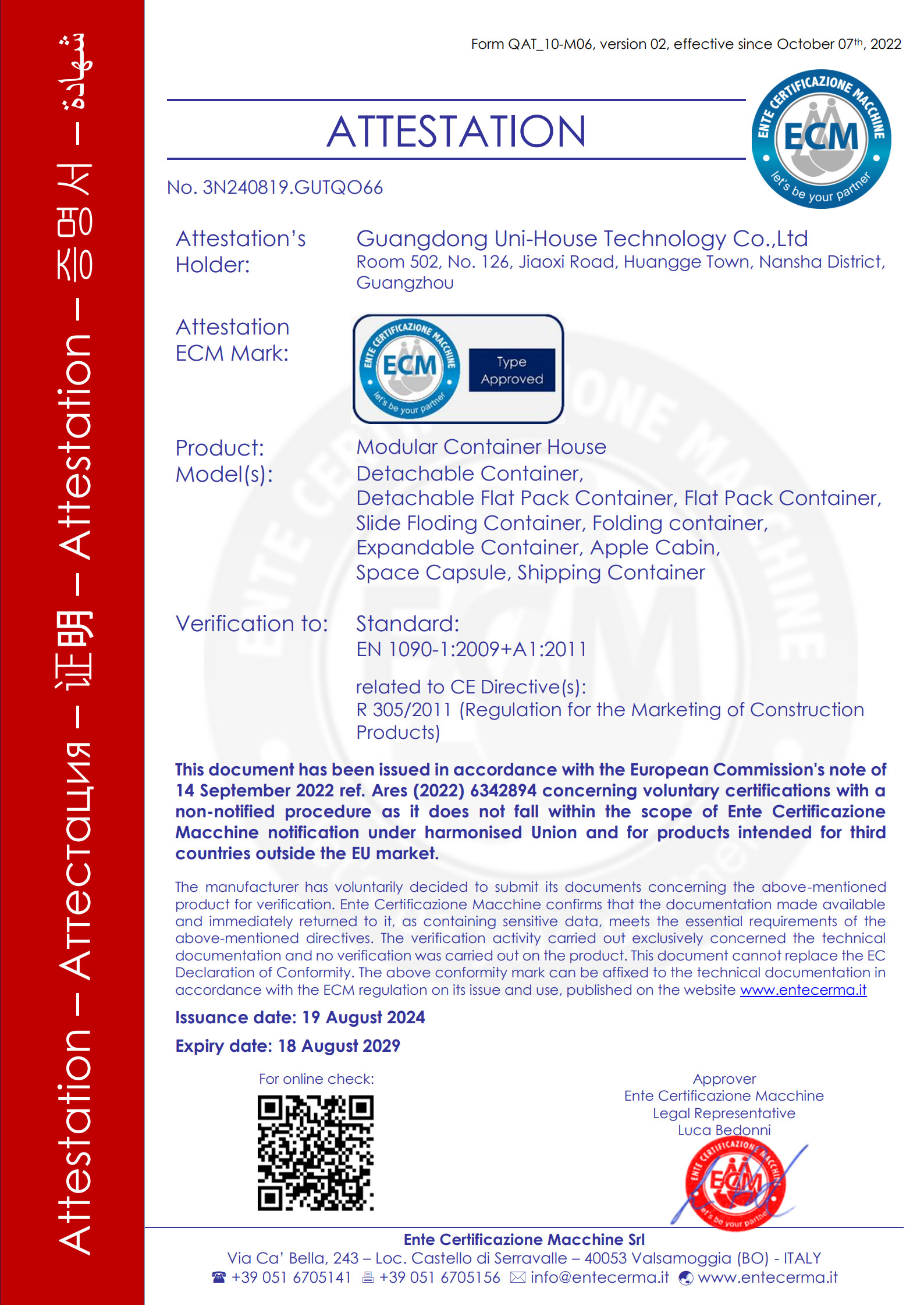
The parties should also record the intended application and installation conditions. The company identifies construction camps, temporary housing after natural disasters, cultural and tourism commercial areas, and new rural villas as prefabricated-housing applications. The contract should specify site preparation, foundation requirements, utilities, unloading, assembly, commissioning, relocation, and responsibility for damage caused by unsuitable site conditions or unauthorized modification.
A cooperation record refers to prefabricated housing used for worker accommodation in an Indonesian coal mine living area project. The supplier also reports support for design, installation, and commissioning in other applications. These references may help a buyer assess experience and after-sales capacity, but they do not replace project-specific technical, inspection, and remedy clauses.
Commercial Terms That Support Quality Control
| Protection area | Recommended contract provision | Relevant available information |
|---|---|---|
| Product conformity | Approved drawings, materials, dimensions, folding components, accessories, performance requirements, and revision control | K-House information contains detailed specifications, but the folding-house configuration requires separate written confirmation |
| Factory quality control | Inspection scope, test records, photographs, nonconformity reports, and correction before shipment | Factory self-inspection is identified for the listed product |
| Warranty and remedies | Warranty period, covered defects, exclusions, claim evidence, response time, repair or replacement duties, and cost allocation | A one-year warranty excluding man-made damage is listed for the product |
| Certification | Certificate identification and written confirmation that it applies to the exact contracted configuration and destination market | The listed CE certification includes folding containers among the applicable products |
| Delivery and payment | Delivery date, packing duties, shipping documents, transport responsibility, deposit, balance, and the relationship between acceptance and payment | The stated commercial information includes 50% paid in advance and 50% before shipment, with ocean transport in 40HQ or 20FT containers |
The payment schedule deserves particular attention. If the buyer pays the full balance before shipment, the contract should still require completion of the factory inspection and delivery of the agreed documents before funds are released. The agreement should also assign responsibility for packing, loading, freight, insurance, customs documents, unloading, and damage discovered during transport.
The available information contains different commercial references: the company-level cooperation model states a minimum order quantity of one set and a delivery time of 15 days, while the product record states a minimum order of 100 square meters and a delivery time of 7 days. The signed contract should specify which figures govern the particular folding container house order.
Frequently Asked Questions
What technical documents should be attached to the contract?
Include the final product name, approved drawings, dimensions, steel and panel materials, panel core, floor system, folding mechanism, doors and windows, electrical configuration, accessories, packing list, installation scope, performance requirements, and document revision number. K-House parameters should not be applied to a folding house unless the supplier confirms their applicability in writing.
How should factory inspection differ from final acceptance?
Factory inspection takes place before shipment and verifies production quality, dimensions, materials, functions, and packing. Site acceptance takes place after delivery or installation and checks quantity, transport condition, workmanship, installation, utilities, and operation of the folding system. The contract should provide separate checklists, deadlines, rejection rules, and correction procedures for both stages.
What warranty wording helps prevent disputes?
State the warranty duration, covered defects, exclusions, evidence requirements, supplier response time, repair or replacement obligation, and responsibility for labor, transport, and installation costs. If man-made damage is excluded, define the term and specify how the supplier must demonstrate that the exclusion applies.
Conclusion
A buyer can reduce folding container house quality risks by combining a product-specific technical schedule with measurable inspection criteria, documented factory and site acceptance, a practical warranty, defined defect remedies, certification confirmation, and clear delivery and payment responsibilities. Contract terms should also identify the governing minimum order, lead time, packing method, installation scope, and payment milestones because the available company and product records contain different commercial figures.
For detailed technical solutions or project support, please contact guizugroup@outlook.com.
About Us
Guangdong Uni-House Technology Co., Ltd. is a foreign trade company established under the Guizu Group. It provides design, research and development, production, installation, and after-sales services through multiple factories. Established in 2008, the company reports 30 professional R&D engineers and designers, more than 10 advanced production lines, over 200 sets of molds, and 150 utility model patents. Its stated capabilities include structural optimization, efficient installation, weather resistance, and product testing.
The company reports a 100% export ratio, with principal markets in Australia, the Middle East, North America, and Southeast Asia. It lists CE certification for applicable modular container house products, including folding containers, and reports experience serving customers in several industries.

REPORT