







-
 Agriculture
-
 Health-Care
-
 Environment
-
 Construction-Real-Estate
-
 Tools-Hardware
-
 Home-Garden
-
 Furniture
-
 Luggage-Bags-Cases
-
 Medical-devices-Supplies
-
 Gifts-Crafts
-
 Sports-Entertainment
-
 Food-Beverage
-
 Vehicles-Transportation
-
 Power-Transmission
-
 Material-Handling
-
 Renewable-Energy
-
 Safety
-
 Testing-Instrument-Equipment
-
 Construction-Building-Machinery
-
 Pet-Supplies
-
 Personal-Care-Household-Cleaning
-
 Vehicle-Accessories-Electronics-Tools
-
 School-Office-Supplies
-
 Packaging-Printing
-
 Mother-Kids-Toys
-
 Business-Services
-
 Commercial-Equipment-Machinery
-
 Apparel-Accessories
-
 Security
-
 Shoes-Accessories
-
 Vehicle-Parts-Accessories
-
 Jewelry-Eyewear-Watches-Accessories
-
 Lights-Lighting
-
 Fabric-Textile-Raw-Material
-
 Fabrication-Services
-
 Industrial-Machinery
-
 Consumer-Electronics
-
 Electrical-Equipment-Supplies
-
 Electronic-Components-Accessories-Telecommunications
-
 Home-Appliances
-
 Beauty
-
 Chemicals
-
 Rubber-Plastics
-
 Metals-Alloys


























































































































































































































































































































































































































































































































































































- Masonry Materials
- Curtain Walls & Accessories
- Earthwork Products
- Fireproofing Materials
- Heat Insulation Materials
- Plastic Building Materials
- Building Boards
- Soundproofing Materials
- Timber
- Waterproofing Materials
- Balustrades & Handrails
- Bathroom & Kitchen
- Flooring & Accessories
- Tiles & Accessories
- Door, Window & Accessories
- Fireplaces & Stoves
- Floor Heating Systems & Parts
- Stairs & Stair Parts
- Ceilings
- Elevators & Escalators
- Stone
- Countertops, Vanity Tops & Table Tops
- Mosaics
- Metal Building Materials
- Multifunctional Materials
- Ladders & Scaffoldings
- Mouldings
- Corner Guards
- Decorative Films
- Formwork
- Building & Industrial Glass
- Other Construction & Real Estate
- Wallpapers/Wall panels
- HVAC System & Parts
- Outdoor Facilities
- Prefabricated Buildings
- Festive & Party Supplies
- Bathroom Products
- Household Sundries
- Rain Gear
- Garden Supplies
- Household Cleaning Tools & Accessories
- Lighters & Smoking Accessories
- Home Storage & Organization
- Household Scales
- Smart Home Improvement
- Home Textiles
- Kitchenware
- Drinkware & Accessories
- Dinnerware, Coffee & Wine
- Home Decor
- Golf
- Fitness & Body Building
- Amusement Park Facilities
- Billiards, Board Game,Coin Operated Games
- Musical Instruments
- Outdoor Affordable Luxury Sports
- Camping & Hiking
- Fishing
- Sports Safety&Rehabilitation
- Ball Sports Equipments
- Water Sports
- Winter Sports
- Luxury Travel Equipments
- Sports Shoes, Bags & Accessories
- Cycling
- Other Sports & Entertainment Products
- Artificial Grass&Sports Flooring&Sports Court Equipment
- Scooters
- Food Ingredients
- Honey & Honey Products
- Snacks
- Nuts & Kernels
- Seafood
- Plant & Animal Oil
- Beverages
- Fruit & Vegetable Products
- Frog & Escargot
- Bean Products
- Egg Products
- Dairy Products
- Seasonings & Condiments
- Canned Food
- Instant Food
- Baked Goods
- Other Food & Beverage
- Meat & Poultry
- Confectionery
- Grain Products
- Feminie Care
- Hair Care & Styling
- Body Care
- Hands & Feet Care
- Hygiene Products
- Men's Grooming
- Laundry Cleaning Supplies
- Travel Size & Gift Sets
- Room Deodorizers
- Other Personal Care Products
- Pest Control Products
- Special Household Cleaning
- Floor Cleaning
- Kitchen & Bathroom Cleaning
- Oral Care
- Bath Supplies
- Yellow Pages
- Correction Supplies
- Office Binding Supplies
- Office Cutting Supplies
- Board Erasers
- Office Adhesives & Tapes
- Education Supplies
- Pencil Cases & Bags
- Notebooks & Writing Pads
- File Folder Accessories
- Calendars
- Writing Accessories
- Commercial Office Supplies
- Pencil Sharpeners
- Pens
- Letter Pad/Paper
- Paper Envelopes
- Desk Organizers
- Pencils
- Markers & Highlighters
- Filing Products
- Art Supplies
- Easels
- Badge Holder & Accessories
- Office Paper
- Printer Supplies
- Book Covers
- Other Office & School Supplies
- Stationery Set
- Boards
- Clipboards
- Stamps
- Drafting Supplies
- Stencils
- Electronic Dictionary
- Books
- Map
- Magazines
- Calculators
- Baby & Toddler Toys
- Educational Toys
- Classic Toys
- Dress Up & Pretend Play
- Toy Vehicle
- Stuffed Animals & Plush Toys
- Outdoor Toys & Structures
- Balloons & Accessories
- Baby Food
- Children's Clothing
- Baby Supplies & Products
- Maternity Clothes
- Kids Shoes
- Baby Care
- Novelty & Gag Toys
- Dolls & Accessories
- Puzzle & Games
- Blocks & Model Building Toys
- Toddler Clothing
- Baby Clothing
- Kids' Luggage & Bags
- Arts, Crafts & DIY Toys
- Action & Toy Figures
- Baby Appliances
- Hobbies & Models
- Remote Control Toys
- Promotional Toys
- Pregnancy & Maternity
- Hygiene Products
- Kid's Textile&Bedding
- Novelty & Special Use
- Toy Weapons
- Baby Gifts
- Baby Storage & Organization
- Auto Drive Systems
- ATV/UTV Parts & Accessories
- Marine Parts & Accessories
- Other Auto Parts
- Trailer Parts & Accessories
- Auto Transmission Systems
- Train Parts & Accessories
- Universal Parts
- Railway Parts & Accessories
- Auto Brake Systems
- Aviation Parts & Accessories
- Truck Parts & Accessories
- Auto Suspension Systems
- Auto Lighting Systems
- New Energy Vehicle Parts & Accessories
- Auto Steering Systems
- Wheels, Tires & Accessories
- Bus Parts & Accessories
- Auto Performance Parts
- Cooling System
- Go-Kart & Kart Racer Parts & Accessories
- Air Conditioning Systems
- Heavy Duty Vehicle Parts & Accessories
- Auto Electrical Systems
- Auto Body Systems
- Auto Engine Systems
- Container Parts & Accessories
- Motorcycle Parts & Accessories
- Refrigeration & Heat Exchange Equipment
- Machine Tool Equipment
- Food & Beverage Machinery
- Agricultural Machinery & Equipment
- Apparel & Textile Machinery
- Chemical Machinery
- Packaging Machines
- Paper Production Machinery
- Plastic & Rubber Processing Machinery
- Industrial Robots
- Electronic Products Machinery
- Metal & Metallurgy Machinery
- Woodworking Machinery
- Home Product Manufacturing Machinery
- Machinery Accessories
- Environmental Machinery
- Machinery Service
- Electrical Equipment Manufacturing Machinery
- Industrial Compressors & Parts
- Tobacco & Cigarette Machinery
- Production Line
- Used Industrial Machinery
- Electronics Production Machinery
- Other Machinery & Industrial Equipment
- Camera, Photo & Accessories
- Portable Audio, Video & Accessories
- Television, Home Audio, Video & Accessories
- Video Games & Accessories
- Mobile Phone & Accessories
- Electronic Publications
- Earphone & Headphone & Accessories
- Speakers & Accessories
- Smart Electronics
- TV Receivers & Accessories
- Mobile Phone & Computer Repair Parts
- Chargers, Batteries & Power Supplies
- Used Electronics
- VR, AR, MR Hardware & Software
- Projectors & Presentation Equipments
- Other Consumer Electronics
- Cables & Commonly Used Accessories
- Computer Hardware & Software
- Displays, Signage and Optoelectronics
- Discrete Semiconductors
- Wireless & IoT Module and Products
- Telecommunications
- Connectors, Terminals & Accessories
- Development Boards, Electronic Modules and Kits
- Circuit Protection
- Sensors
- Isolators
- Audio Components and Products
- Integrated Circuits
- Power Supplies
- Relays
- RF, Microwave and RFID
- Electronic Accessories & Supplies
- Passive Components
- PCB & PCBA
- Air Quality Appliances
- Home Appliance Parts
- Heating & Cooling Appliances
- Small Kitchen Appliances
- Laundry Appliances
- Water Heaters
- Water Treatment Appliances
- Refrigerators & Freezers
- Personal Care & Beauty Appliances
- Major Kitchen Appliances
- Cleaning Appliances
- Second-hand Appliances
- Smart Home Appliances
- Other Home Appliances
- Energy Chemicals
- Inorganic Chemicals
- Basic Organic Chemicals
- Agrochemicals
- Admixture & Additives
- Catalysts & Chemical Auxiliary Agents
- Pigments & Dyestuff
- Coating & Paint
- Daily Chemicals
- Polymer
- Organic Intermediate
- Adhesives & Sealants
- Chemical Waste
- Biological Chemical Products
- Surface Treatment Chemicals
- Painting & Coating
- Chemical Reagents
- Flavor & Fragrance
- Non-Explosive Demolition Agents
- Other Chemicals
- Custom Chemical Services

Can AI Process Monitoring Increase Soldering Station Productivity?
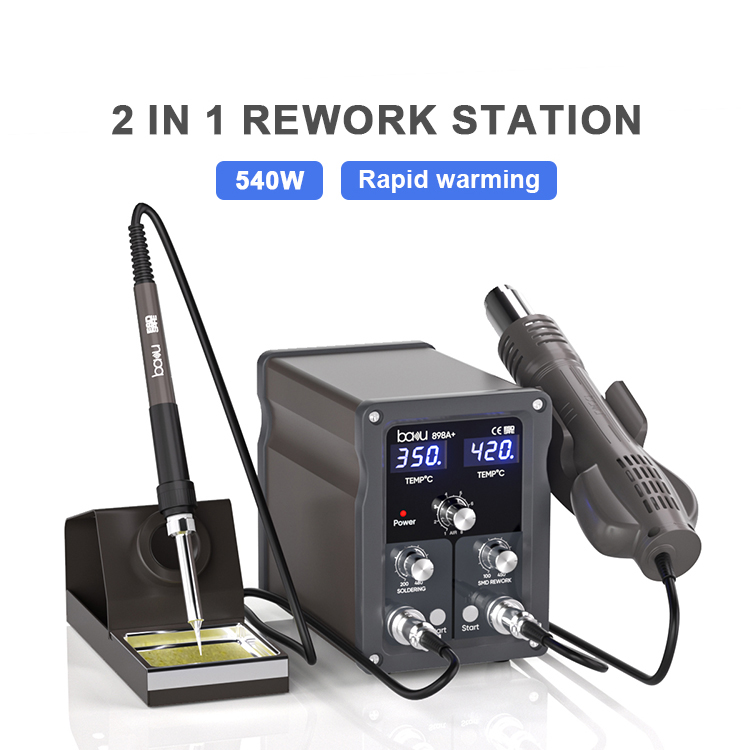
AI-assisted process monitoring can contribute to higher soldering productivity by detecting operating abnormalities, shortening troubleshooting time, and helping technicians maintain stable working conditions. The BAKU BA-898A+ hot air soldering and desoldering station provides defined temperature controls, including 100–480°C for hot air and 200–480°C for the soldering iron. However, the available product information does not confirm that AI monitoring is built into the station.
Product Overview and Main Findings
The BA-898A+ combines hot air rework and soldering functions in one workstation. It has a maximum power rating of 540W and supports a hot air temperature range of 100–480°C alongside a soldering iron range of 200–480°C. These specifications establish useful operating parameters for technicians and can also provide reference points for an external monitoring system.
- Process monitoring can help identify temperature changes and other deviations during soldering when compatible sensors, software, and data connections are available.
- The BA-898A+ is designed for hot air desoldering, soldering, motherboard repair, and component rework.
- Typical applications include mobile phone and tablet motherboard service, laptop and computer circuit board repair, BGA rework, and electronics education.
- BAKU provides own-brand wholesale, OEM, and ODM cooperation. The stated MOQ is 50 units, with an estimated delivery period of 7–15 days.
How Monitoring Can Support Soldering Productivity
Process monitoring adds value by turning operating conditions into information that technicians can review and act upon. In a soldering environment, a monitoring solution may track temperature stability, identify departures from a selected range, and provide alerts or records for follow-up. AI can further assist by recognizing repeated patterns, grouping similar faults, and helping teams determine corrective actions more quickly.
These benefits depend on the availability of suitable measurement hardware, reliable data collection, and integration with the repair workflow. The supplied BA-898A+ information does not list an AI processor, monitoring software, built-in sensors, communication protocol, or data interface. Therefore, AI functionality should be considered an external or customized solution rather than a confirmed standard feature of this model.
BA-898A+ Operating Capabilities
The BA-898A+ is specified as a combined hot air soldering and desoldering station. Its hot air section operates from 100–480°C, while the soldering iron can be adjusted from 200–480°C. With a maximum power of 540W, the station is suited to a range of repair and rework tasks. The package includes one soldering iron tip, and the listed warranty period is one year.
In mobile phone and tablet servicing, the equipment can support motherboard chip repair, screen separation, solder cleaning, and component replacement. In laptop and computer board repair, it can be used for soldering, component removal, fault correction, and BGA chip rework. A monitoring layer could help workshops document abnormal temperatures or recurring process problems, making later diagnosis more systematic.
Engineering and Commercial Support
BAKU reports that its independent R&D laboratory includes structural, hardware, and testing engineers. The company states that the laboratory supports industrial design, structural development, PCB debugging, and reliability evaluation. It also reports ownership of 25 design patents and access to aging, temperature-control, and ESD testing platforms. These resources may support discussions about customized process-control requirements, but they do not prove that AI monitoring is included in the BA-898A+.
Reported customer projects include an order of about 500 mixed tool kits for an electronic repair store in the Philippines, equipment supplied for a Malaysian vocational training project, a mixed full-container order for a Saudi Arabian wholesaler, and approximately 200 units delivered to a computer repair workshop in Mexico. The stated applications included motherboard servicing, practical student training, product distribution, BGA rework, and circuit-board troubleshooting.
For applicable products, BAKU lists CE certification for the European Union, FCC certification for the United States, and ROHS certification for the European Union. MSDS documents are also listed for products such as solder paste, solder flux, UV-curable solder mask, and adhesive.
Comparison of Soldering Process Approaches
| Approach | Function or expected benefit | Information status |
|---|---|---|
| Manual operation | The technician adjusts the station and manages the soldering process through temperature settings and practical experience. | Supported by the product specifications |
| External monitoring | Additional equipment may record operating conditions and identify deviations for technician assessment. | Possible improvement; no integration details are specified |
| AI-assisted monitoring | Pattern recognition can help classify repeated deviations and support quicker troubleshooting when adequate data is available. | Not confirmed as an integrated BA-898A+ function |
| BA-898A+ specifications | Hot air temperature of 100–480°C, soldering iron temperature of 200–480°C, and maximum power of 540W. | Documented product data |
| Business and service options | Own-brand wholesale, OEM, ODM, and online after-sales support are available. | Supported by the supplied company information |
Frequently Asked Questions
Is AI monitoring included with the BA-898A+?
The available product data does not identify an integrated AI module, monitoring application, sensor system, or data interface. Buyers should confirm whether an external monitoring setup or customized configuration can be supplied.
What productivity gains can monitoring provide?
Monitoring may reveal temperature instability, encourage repeatable operating methods, and create records for fault analysis. The actual productivity improvement will depend on the monitoring hardware, data quality, software integration, and the technician’s response to detected issues.
Can the BA-898A+ be used in repair shops and training facilities?
Yes. Its listed applications cover mobile phone and tablet repair, laptop and computer circuit board servicing, and electronics training or laboratory instruction. The product information states a one-year warranty and a minimum order quantity of 50 units.
Conclusion and Purchasing Recommendations
AI-based monitoring can improve soldering productivity when it is connected to a clearly defined process and used to detect deviations, review performance, and guide corrective action. The BA-898A+ offers documented hot air and soldering iron temperature ranges, 540W maximum power, and broad application coverage for repair and training environments. Nevertheless, the available specifications do not confirm built-in AI monitoring.
Before placing an order, buyers should ask BAKU about sensor compatibility, data access, monitoring software, communication interfaces, and customization requirements. BAKU supports own-brand wholesale, OEM, and ODM projects, performs full-function testing before shipment, and lists CE, FCC, ROHS, and MSDS documentation for applicable products. For technical consultation or solution support, contact hanker002@bakutool.com.
About BAKU
Guangdong BAKU Technology Development Co., Ltd. was founded in 2003 and focuses on professional tools for electronic device repair, including soldering stations, solder flux, solder paste, screwdrivers, and ultrasonic cleaners. Its independent R&D laboratory includes structural, hardware, and testing engineers and supports industrial design, structural engineering, PCB debugging, and reliability testing. BAKU states that it owns 25 design patents, serves South America, Europe, and Southeast Asia, and has an export ratio of 90%.
The company lists CE, FCC, ROHS, and MSDS credentials for applicable products. Its reported customers include electronic repair stores, vocational education organizations, tool wholesalers, and computer repair workshops in several international markets.

REPORT