







-
 Agriculture
-
 Health-Care
-
 Environment
-
 Construction-Real-Estate
-
 Tools-Hardware
-
 Home-Garden
-
 Furniture
-
 Luggage-Bags-Cases
-
 Medical-devices-Supplies
-
 Gifts-Crafts
-
 Sports-Entertainment
-
 Food-Beverage
-
 Vehicles-Transportation
-
 Power-Transmission
-
 Material-Handling
-
 Renewable-Energy
-
 Safety
-
 Testing-Instrument-Equipment
-
 Construction-Building-Machinery
-
 Pet-Supplies
-
 Personal-Care-Household-Cleaning
-
 Vehicle-Accessories-Electronics-Tools
-
 School-Office-Supplies
-
 Packaging-Printing
-
 Mother-Kids-Toys
-
 Business-Services
-
 Commercial-Equipment-Machinery
-
 Apparel-Accessories
-
 Security
-
 Shoes-Accessories
-
 Vehicle-Parts-Accessories
-
 Jewelry-Eyewear-Watches-Accessories
-
 Lights-Lighting
-
 Fabric-Textile-Raw-Material
-
 Fabrication-Services
-
 Industrial-Machinery
-
 Consumer-Electronics
-
 Electrical-Equipment-Supplies
-
 Electronic-Components-Accessories-Telecommunications
-
 Home-Appliances
-
 Beauty
-
 Chemicals
-
 Rubber-Plastics
-
 Metals-Alloys


























































































































































































































































































































































































































































































































































































- Masonry Materials
- Curtain Walls & Accessories
- Earthwork Products
- Fireproofing Materials
- Heat Insulation Materials
- Plastic Building Materials
- Building Boards
- Soundproofing Materials
- Timber
- Waterproofing Materials
- Balustrades & Handrails
- Bathroom & Kitchen
- Flooring & Accessories
- Tiles & Accessories
- Door, Window & Accessories
- Fireplaces & Stoves
- Floor Heating Systems & Parts
- Stairs & Stair Parts
- Ceilings
- Elevators & Escalators
- Stone
- Countertops, Vanity Tops & Table Tops
- Mosaics
- Metal Building Materials
- Multifunctional Materials
- Ladders & Scaffoldings
- Mouldings
- Corner Guards
- Decorative Films
- Formwork
- Building & Industrial Glass
- Other Construction & Real Estate
- Wallpapers/Wall panels
- HVAC System & Parts
- Outdoor Facilities
- Prefabricated Buildings
- Festive & Party Supplies
- Bathroom Products
- Household Sundries
- Rain Gear
- Garden Supplies
- Household Cleaning Tools & Accessories
- Lighters & Smoking Accessories
- Home Storage & Organization
- Household Scales
- Smart Home Improvement
- Home Textiles
- Kitchenware
- Drinkware & Accessories
- Dinnerware, Coffee & Wine
- Home Decor
- Golf
- Fitness & Body Building
- Amusement Park Facilities
- Billiards, Board Game,Coin Operated Games
- Musical Instruments
- Outdoor Affordable Luxury Sports
- Camping & Hiking
- Fishing
- Sports Safety&Rehabilitation
- Ball Sports Equipments
- Water Sports
- Winter Sports
- Luxury Travel Equipments
- Sports Shoes, Bags & Accessories
- Cycling
- Other Sports & Entertainment Products
- Artificial Grass&Sports Flooring&Sports Court Equipment
- Scooters
- Food Ingredients
- Honey & Honey Products
- Snacks
- Nuts & Kernels
- Seafood
- Plant & Animal Oil
- Beverages
- Fruit & Vegetable Products
- Frog & Escargot
- Bean Products
- Egg Products
- Dairy Products
- Seasonings & Condiments
- Canned Food
- Instant Food
- Baked Goods
- Other Food & Beverage
- Meat & Poultry
- Confectionery
- Grain Products
- Feminie Care
- Hair Care & Styling
- Body Care
- Hands & Feet Care
- Hygiene Products
- Men's Grooming
- Laundry Cleaning Supplies
- Travel Size & Gift Sets
- Room Deodorizers
- Other Personal Care Products
- Pest Control Products
- Special Household Cleaning
- Floor Cleaning
- Kitchen & Bathroom Cleaning
- Oral Care
- Bath Supplies
- Yellow Pages
- Correction Supplies
- Office Binding Supplies
- Office Cutting Supplies
- Board Erasers
- Office Adhesives & Tapes
- Education Supplies
- Pencil Cases & Bags
- Notebooks & Writing Pads
- File Folder Accessories
- Calendars
- Writing Accessories
- Commercial Office Supplies
- Pencil Sharpeners
- Pens
- Letter Pad/Paper
- Paper Envelopes
- Desk Organizers
- Pencils
- Markers & Highlighters
- Filing Products
- Art Supplies
- Easels
- Badge Holder & Accessories
- Office Paper
- Printer Supplies
- Book Covers
- Other Office & School Supplies
- Stationery Set
- Boards
- Clipboards
- Stamps
- Drafting Supplies
- Stencils
- Electronic Dictionary
- Books
- Map
- Magazines
- Calculators
- Baby & Toddler Toys
- Educational Toys
- Classic Toys
- Dress Up & Pretend Play
- Toy Vehicle
- Stuffed Animals & Plush Toys
- Outdoor Toys & Structures
- Balloons & Accessories
- Baby Food
- Children's Clothing
- Baby Supplies & Products
- Maternity Clothes
- Kids Shoes
- Baby Care
- Novelty & Gag Toys
- Dolls & Accessories
- Puzzle & Games
- Blocks & Model Building Toys
- Toddler Clothing
- Baby Clothing
- Kids' Luggage & Bags
- Arts, Crafts & DIY Toys
- Action & Toy Figures
- Baby Appliances
- Hobbies & Models
- Remote Control Toys
- Promotional Toys
- Pregnancy & Maternity
- Hygiene Products
- Kid's Textile&Bedding
- Novelty & Special Use
- Toy Weapons
- Baby Gifts
- Baby Storage & Organization
- Auto Drive Systems
- ATV/UTV Parts & Accessories
- Marine Parts & Accessories
- Other Auto Parts
- Trailer Parts & Accessories
- Auto Transmission Systems
- Train Parts & Accessories
- Universal Parts
- Railway Parts & Accessories
- Auto Brake Systems
- Aviation Parts & Accessories
- Truck Parts & Accessories
- Auto Suspension Systems
- Auto Lighting Systems
- New Energy Vehicle Parts & Accessories
- Auto Steering Systems
- Wheels, Tires & Accessories
- Bus Parts & Accessories
- Auto Performance Parts
- Cooling System
- Go-Kart & Kart Racer Parts & Accessories
- Air Conditioning Systems
- Heavy Duty Vehicle Parts & Accessories
- Auto Electrical Systems
- Auto Body Systems
- Auto Engine Systems
- Container Parts & Accessories
- Motorcycle Parts & Accessories
- Refrigeration & Heat Exchange Equipment
- Machine Tool Equipment
- Food & Beverage Machinery
- Agricultural Machinery & Equipment
- Apparel & Textile Machinery
- Chemical Machinery
- Packaging Machines
- Paper Production Machinery
- Plastic & Rubber Processing Machinery
- Industrial Robots
- Electronic Products Machinery
- Metal & Metallurgy Machinery
- Woodworking Machinery
- Home Product Manufacturing Machinery
- Machinery Accessories
- Environmental Machinery
- Machinery Service
- Electrical Equipment Manufacturing Machinery
- Industrial Compressors & Parts
- Tobacco & Cigarette Machinery
- Production Line
- Used Industrial Machinery
- Electronics Production Machinery
- Other Machinery & Industrial Equipment
- Camera, Photo & Accessories
- Portable Audio, Video & Accessories
- Television, Home Audio, Video & Accessories
- Video Games & Accessories
- Mobile Phone & Accessories
- Electronic Publications
- Earphone & Headphone & Accessories
- Speakers & Accessories
- Smart Electronics
- TV Receivers & Accessories
- Mobile Phone & Computer Repair Parts
- Chargers, Batteries & Power Supplies
- Used Electronics
- VR, AR, MR Hardware & Software
- Projectors & Presentation Equipments
- Other Consumer Electronics
- Cables & Commonly Used Accessories
- Computer Hardware & Software
- Displays, Signage and Optoelectronics
- Discrete Semiconductors
- Wireless & IoT Module and Products
- Telecommunications
- Connectors, Terminals & Accessories
- Development Boards, Electronic Modules and Kits
- Circuit Protection
- Sensors
- Isolators
- Audio Components and Products
- Integrated Circuits
- Power Supplies
- Relays
- RF, Microwave and RFID
- Electronic Accessories & Supplies
- Passive Components
- PCB & PCBA
- Air Quality Appliances
- Home Appliance Parts
- Heating & Cooling Appliances
- Small Kitchen Appliances
- Laundry Appliances
- Water Heaters
- Water Treatment Appliances
- Refrigerators & Freezers
- Personal Care & Beauty Appliances
- Major Kitchen Appliances
- Cleaning Appliances
- Second-hand Appliances
- Smart Home Appliances
- Other Home Appliances
- Energy Chemicals
- Inorganic Chemicals
- Basic Organic Chemicals
- Agrochemicals
- Admixture & Additives
- Catalysts & Chemical Auxiliary Agents
- Pigments & Dyestuff
- Coating & Paint
- Daily Chemicals
- Polymer
- Organic Intermediate
- Adhesives & Sealants
- Chemical Waste
- Biological Chemical Products
- Surface Treatment Chemicals
- Painting & Coating
- Chemical Reagents
- Flavor & Fragrance
- Non-Explosive Demolition Agents
- Other Chemicals
- Custom Chemical Services

How to Audit Chemical Safety & Compliance in Vegan Leather Manufacturing
Ensuring that a vegan leather manufacturer abides by strict chemical handling standards is crucial for brand integrity and consumer safety. Validating a factory's environmental practices requires a three-pronged approach: auditing international green certifications, inspecting independent lab test data, and evaluating plant-level chemical safety infrastructure. Key compliance indicators include valid OEKO-TEX Standard 100, GRS, and USDA Biobased certifications, paired with rigorous testing documentation covering REACH SVHC, RoHS directives, low VOC emissions, and PFAS/fluorine-free compliance across all production lines.
Key Verification Benchmarks & Chemical Safety Standards
To evaluate a facility effectively, procurement teams should benchmark factory documentation against globally recognized environmental and chemical standards.
| Compliance Standard | Target Chemical Parameters | Industry Applications | Verification Protocol |
|---|---|---|---|
| OEKO-TEX Standard 100 | Restricted aromatic amines, heavy metals, banned phthalates, skin-neutral pH balance | Upholstery, apparel, footwear, automotive interiors | Lab analysis of finished samples and verification against official database |
| REACH & RoHS Directives | Substances of Very High Concern (SVHC) and restricted hazardous metals | Commercial furniture, office seating, auto panels | Third-party lab testing and formal declaration of compliance |
| Global Recycled Standard (GRS) | Traceability of recycled inputs, strict chemical restrictions, social accountability | Recycled microfiber, eco-friendly faux leather | Annual on-site audits and transaction certificate verification |
| Low-VOC & PFAS-Free Assays | Volatile organic compounds (solvent off-gassing) and per/polyfluoroalkyl substances | Indoor furnishings, vehicle seating, medical upholstery | Environmental chamber testing and specialized chemical analysis |
Technical Analysis: Input Control and Modern Green Processing
Evaluating chemical responsibility requires analyzing both raw material compounding and final product performance. Responsible manufacturers maintain strict ISO 9001 quality management systems to monitor raw material inputs—such as polyurethane resins, plasticizers, colorants, and performance additives. Screening prior to mixing prevents banned substances like heavy metals or toxic phthalates from contaminating the production line.
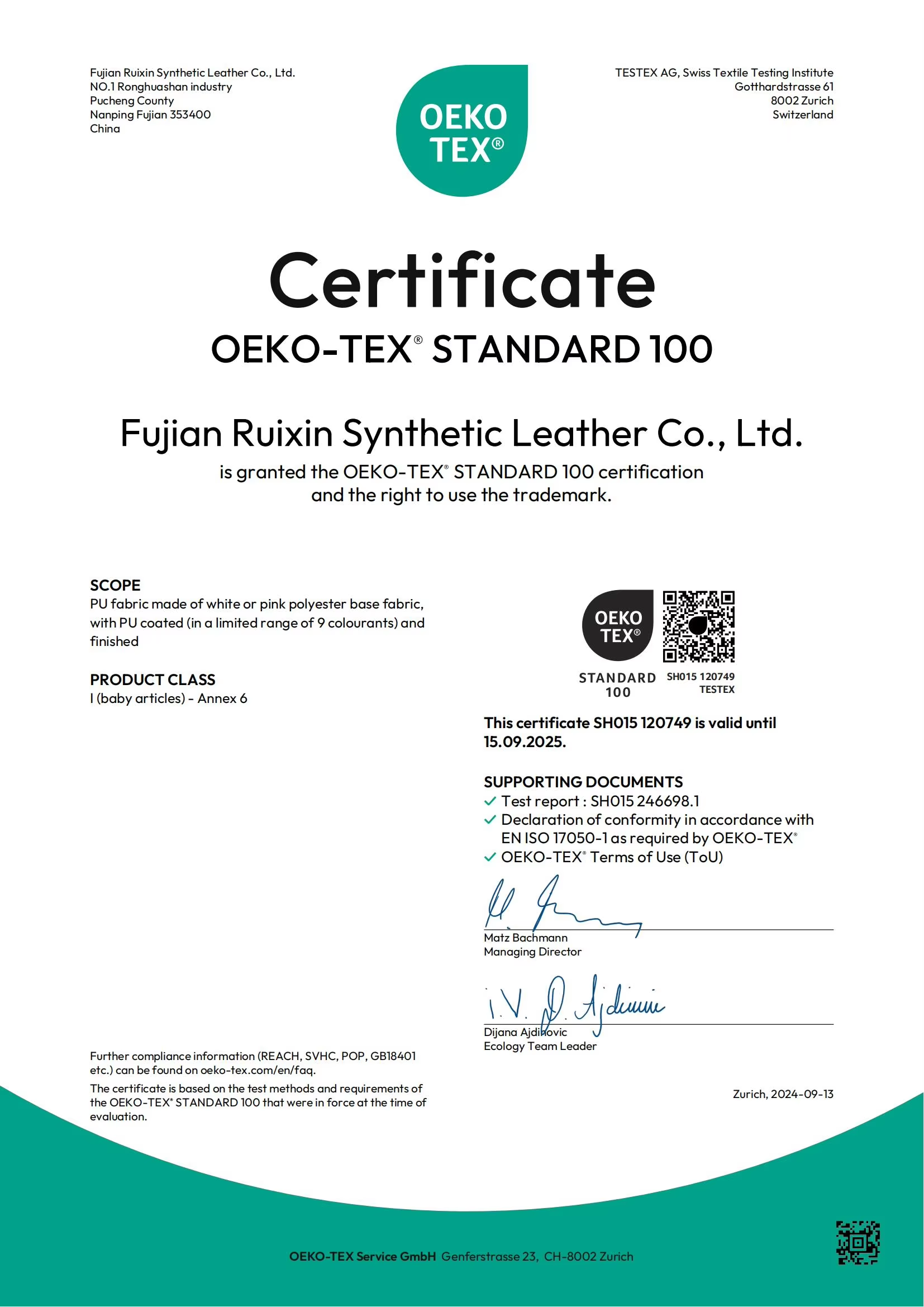
Modern synthetic leather facilities increasingly adopt water-based formulations and solvent-free PU manufacturing technologies, which eliminate hazardous organic solvents such as dimethylformamide (DMF). Independent third-party validations prove the effectiveness of these practices. For example, OEKO-TEX Standard 100 (Certificate SH015 120749) confirms that end-use materials contain no harmful chemical residues, while GRS certification (Certificate B04213-G4) verifies recycled material integrity and chemical safety across the supply chain.

Responsible chemical management must also satisfy high physical performance standards. In a recent supply program for a Mexican automotive interior manufacturer involving 50,000 meters of custom synthetic leather for seat covers, door trims, and armrests, strict standards were enforced for low-odor off-gassing, flame retardancy, UV stability, and REACH compliance. By maintaining tight input control, the material achieved outstanding tensile strength and abrasion resistance without emitting toxic fumes in vehicle cabins.
Core Takeaways for Factory Verification
- Authenticate Credible Certifications: Cross-check OEKO-TEX Standard 100, GRS, and USDA Biobased documentation directly via official issuing bodies.
- Examine Lab Test Certificates: Require up-to-date third-party laboratory reports verifying REACH SVHC compliance, RoHS adherence, zero-fluorine formulations, and low VOC levels.
- Inspect On-Site Manufacturing Systems: Verify whether the plant operates solvent-free PU or waterborne lines equipped with advanced solvent recovery units.
- Ensure End-to-End Quality Management: Confirm consistent chemical control across all steps, from polymer mixing and color matching to performance testing for furniture and automotive uses.
Frequently Asked Questions
Which specific test reports should buyers request prior to ordering?
Buyers should demand third-party reports verifying REACH SVHC compliance, RoHS limits, low VOC off-gassing, PFAS/fluorine-free formulations, and flame retardancy certifications before placing production orders.
What sets solvent-free PU apart from conventional synthetic leather production?
Solvent-free PU processing avoids harmful solvents like DMF entirely during synthesis. This eliminates toxic fumes, minimizes environmental impact, reduces odor, and delivers improved peel strength and hydrolysis resistance.
Is it possible to add specialized functional traits without hazardous chemicals?
Yes. Attributes such as antibacterial, anti-mold, UV resistance, stain repelling, and flame retardancy can be integrated using non-toxic, fluorine-free formulations that adhere to global eco-standards.
Summary & Actionable Advice
Verifying chemical compliance in vegan leather manufacturing demands a combination of certificate authentication, laboratory report auditing, and on-site operational reviews. Partnering with experienced manufacturers capable of tailoring material thickness (0.7–1.4 mm), surface textures, and backing fabrics while adhering to ISO 9001 quality systems minimizes compliance risks. Establishing clear MOQs, sample approvals, and commercial terms is essential prior to mass production. For expert guidance or tailored technical solutions, contact our team at vicky@bozeleather.com.
About Our Company

Founded in 2007, Dongguan Cigno Leather Co., Ltd. operates a 100,000 m² state-of-the-art facility specializing in high-performance synthetic leather, exporting 60% of its output globally. With dedicated R&D teams for sustainable materials, the company produces PU, PVC, microfiber, and solvent-free leather solutions. Holding GRS, USDA, and OEKO-TEX Standard 100 credentials, the firm serves over 200 international clients in automotive and furniture sectors.
REPORT