







-
 Agriculture
-
 Health-Care
-
 Environment
-
 Construction-Real-Estate
-
 Tools-Hardware
-
 Home-Garden
-
 Furniture
-
 Luggage-Bags-Cases
-
 Medical-devices-Supplies
-
 Gifts-Crafts
-
 Sports-Entertainment
-
 Food-Beverage
-
 Vehicles-Transportation
-
 Power-Transmission
-
 Material-Handling
-
 Renewable-Energy
-
 Safety
-
 Testing-Instrument-Equipment
-
 Construction-Building-Machinery
-
 Pet-Supplies
-
 Personal-Care-Household-Cleaning
-
 Vehicle-Accessories-Electronics-Tools
-
 School-Office-Supplies
-
 Packaging-Printing
-
 Mother-Kids-Toys
-
 Business-Services
-
 Commercial-Equipment-Machinery
-
 Apparel-Accessories
-
 Security
-
 Shoes-Accessories
-
 Vehicle-Parts-Accessories
-
 Jewelry-Eyewear-Watches-Accessories
-
 Lights-Lighting
-
 Fabric-Textile-Raw-Material
-
 Fabrication-Services
-
 Industrial-Machinery
-
 Consumer-Electronics
-
 Electrical-Equipment-Supplies
-
 Electronic-Components-Accessories-Telecommunications
-
 Home-Appliances
-
 Beauty
-
 Chemicals
-
 Rubber-Plastics
-
 Metals-Alloys


























































































































































































































































































































































































































































































































































































- Masonry Materials
- Curtain Walls & Accessories
- Earthwork Products
- Fireproofing Materials
- Heat Insulation Materials
- Plastic Building Materials
- Building Boards
- Soundproofing Materials
- Timber
- Waterproofing Materials
- Balustrades & Handrails
- Bathroom & Kitchen
- Flooring & Accessories
- Tiles & Accessories
- Door, Window & Accessories
- Fireplaces & Stoves
- Floor Heating Systems & Parts
- Stairs & Stair Parts
- Ceilings
- Elevators & Escalators
- Stone
- Countertops, Vanity Tops & Table Tops
- Mosaics
- Metal Building Materials
- Multifunctional Materials
- Ladders & Scaffoldings
- Mouldings
- Corner Guards
- Decorative Films
- Formwork
- Building & Industrial Glass
- Other Construction & Real Estate
- Wallpapers/Wall panels
- HVAC System & Parts
- Outdoor Facilities
- Prefabricated Buildings
- Festive & Party Supplies
- Bathroom Products
- Household Sundries
- Rain Gear
- Garden Supplies
- Household Cleaning Tools & Accessories
- Lighters & Smoking Accessories
- Home Storage & Organization
- Household Scales
- Smart Home Improvement
- Home Textiles
- Kitchenware
- Drinkware & Accessories
- Dinnerware, Coffee & Wine
- Home Decor
- Golf
- Fitness & Body Building
- Amusement Park Facilities
- Billiards, Board Game,Coin Operated Games
- Musical Instruments
- Outdoor Affordable Luxury Sports
- Camping & Hiking
- Fishing
- Sports Safety&Rehabilitation
- Ball Sports Equipments
- Water Sports
- Winter Sports
- Luxury Travel Equipments
- Sports Shoes, Bags & Accessories
- Cycling
- Other Sports & Entertainment Products
- Artificial Grass&Sports Flooring&Sports Court Equipment
- Scooters
- Food Ingredients
- Honey & Honey Products
- Snacks
- Nuts & Kernels
- Seafood
- Plant & Animal Oil
- Beverages
- Fruit & Vegetable Products
- Frog & Escargot
- Bean Products
- Egg Products
- Dairy Products
- Seasonings & Condiments
- Canned Food
- Instant Food
- Baked Goods
- Other Food & Beverage
- Meat & Poultry
- Confectionery
- Grain Products
- Feminie Care
- Hair Care & Styling
- Body Care
- Hands & Feet Care
- Hygiene Products
- Men's Grooming
- Laundry Cleaning Supplies
- Travel Size & Gift Sets
- Room Deodorizers
- Other Personal Care Products
- Pest Control Products
- Special Household Cleaning
- Floor Cleaning
- Kitchen & Bathroom Cleaning
- Oral Care
- Bath Supplies
- Yellow Pages
- Correction Supplies
- Office Binding Supplies
- Office Cutting Supplies
- Board Erasers
- Office Adhesives & Tapes
- Education Supplies
- Pencil Cases & Bags
- Notebooks & Writing Pads
- File Folder Accessories
- Calendars
- Writing Accessories
- Commercial Office Supplies
- Pencil Sharpeners
- Pens
- Letter Pad/Paper
- Paper Envelopes
- Desk Organizers
- Pencils
- Markers & Highlighters
- Filing Products
- Art Supplies
- Easels
- Badge Holder & Accessories
- Office Paper
- Printer Supplies
- Book Covers
- Other Office & School Supplies
- Stationery Set
- Boards
- Clipboards
- Stamps
- Drafting Supplies
- Stencils
- Electronic Dictionary
- Books
- Map
- Magazines
- Calculators
- Baby & Toddler Toys
- Educational Toys
- Classic Toys
- Dress Up & Pretend Play
- Toy Vehicle
- Stuffed Animals & Plush Toys
- Outdoor Toys & Structures
- Balloons & Accessories
- Baby Food
- Children's Clothing
- Baby Supplies & Products
- Maternity Clothes
- Kids Shoes
- Baby Care
- Novelty & Gag Toys
- Dolls & Accessories
- Puzzle & Games
- Blocks & Model Building Toys
- Toddler Clothing
- Baby Clothing
- Kids' Luggage & Bags
- Arts, Crafts & DIY Toys
- Action & Toy Figures
- Baby Appliances
- Hobbies & Models
- Remote Control Toys
- Promotional Toys
- Pregnancy & Maternity
- Hygiene Products
- Kid's Textile&Bedding
- Novelty & Special Use
- Toy Weapons
- Baby Gifts
- Baby Storage & Organization
- Auto Drive Systems
- ATV/UTV Parts & Accessories
- Marine Parts & Accessories
- Other Auto Parts
- Trailer Parts & Accessories
- Auto Transmission Systems
- Train Parts & Accessories
- Universal Parts
- Railway Parts & Accessories
- Auto Brake Systems
- Aviation Parts & Accessories
- Truck Parts & Accessories
- Auto Suspension Systems
- Auto Lighting Systems
- New Energy Vehicle Parts & Accessories
- Auto Steering Systems
- Wheels, Tires & Accessories
- Bus Parts & Accessories
- Auto Performance Parts
- Cooling System
- Go-Kart & Kart Racer Parts & Accessories
- Air Conditioning Systems
- Heavy Duty Vehicle Parts & Accessories
- Auto Electrical Systems
- Auto Body Systems
- Auto Engine Systems
- Container Parts & Accessories
- Motorcycle Parts & Accessories
- Refrigeration & Heat Exchange Equipment
- Machine Tool Equipment
- Food & Beverage Machinery
- Agricultural Machinery & Equipment
- Apparel & Textile Machinery
- Chemical Machinery
- Packaging Machines
- Paper Production Machinery
- Plastic & Rubber Processing Machinery
- Industrial Robots
- Electronic Products Machinery
- Metal & Metallurgy Machinery
- Woodworking Machinery
- Home Product Manufacturing Machinery
- Machinery Accessories
- Environmental Machinery
- Machinery Service
- Electrical Equipment Manufacturing Machinery
- Industrial Compressors & Parts
- Tobacco & Cigarette Machinery
- Production Line
- Used Industrial Machinery
- Electronics Production Machinery
- Other Machinery & Industrial Equipment
- Camera, Photo & Accessories
- Portable Audio, Video & Accessories
- Television, Home Audio, Video & Accessories
- Video Games & Accessories
- Mobile Phone & Accessories
- Electronic Publications
- Earphone & Headphone & Accessories
- Speakers & Accessories
- Smart Electronics
- TV Receivers & Accessories
- Mobile Phone & Computer Repair Parts
- Chargers, Batteries & Power Supplies
- Used Electronics
- VR, AR, MR Hardware & Software
- Projectors & Presentation Equipments
- Other Consumer Electronics
- Cables & Commonly Used Accessories
- Computer Hardware & Software
- Displays, Signage and Optoelectronics
- Discrete Semiconductors
- Wireless & IoT Module and Products
- Telecommunications
- Connectors, Terminals & Accessories
- Development Boards, Electronic Modules and Kits
- Circuit Protection
- Sensors
- Isolators
- Audio Components and Products
- Integrated Circuits
- Power Supplies
- Relays
- RF, Microwave and RFID
- Electronic Accessories & Supplies
- Passive Components
- PCB & PCBA
- Air Quality Appliances
- Home Appliance Parts
- Heating & Cooling Appliances
- Small Kitchen Appliances
- Laundry Appliances
- Water Heaters
- Water Treatment Appliances
- Refrigerators & Freezers
- Personal Care & Beauty Appliances
- Major Kitchen Appliances
- Cleaning Appliances
- Second-hand Appliances
- Smart Home Appliances
- Other Home Appliances
- Energy Chemicals
- Inorganic Chemicals
- Basic Organic Chemicals
- Agrochemicals
- Admixture & Additives
- Catalysts & Chemical Auxiliary Agents
- Pigments & Dyestuff
- Coating & Paint
- Daily Chemicals
- Polymer
- Organic Intermediate
- Adhesives & Sealants
- Chemical Waste
- Biological Chemical Products
- Surface Treatment Chemicals
- Painting & Coating
- Chemical Reagents
- Flavor & Fragrance
- Non-Explosive Demolition Agents
- Other Chemicals
- Custom Chemical Services

How to Compare LED Moving Head Lights for Output, Throw Distance, and Reliability
Selecting the right LED moving head light requires more than comparing LED wattage or product prices. Professional buyers should examine actual optical performance, beam control, color quality, control compatibility, environmental protection, and the manufacturer’s quality-assurance process. A fixture that performs well in a short demonstration may not necessarily deliver the required throw, consistency, or durability in a long-term installation.
Key Factors When Comparing LED Moving Head Fixtures
The most effective comparison begins with the lighting application. Concert stages, television studios, nightclubs, touring productions, outdoor events, and architectural projects each place different demands on brightness, beam shape, movement, color rendering, weather resistance, and control systems.
- Use verified optical output data instead of relying only on LED engine wattage.
- Match beam angle and field angle to the required projection distance and coverage area.
- Review zoom, focus, dimming, strobe, color mixing, and flicker-free performance for the intended use.
- Assess long-term dependability through cooling design, IP protection, electrical safeguards, testing records, and service support.
- Confirm that DMX, RDM, networking, and mounting options fit the venue’s lighting-control system.
Brightness: Look Beyond LED Power Ratings
LED wattage does not directly indicate how bright a moving head will appear on stage or at a target surface. The useful comparison is declared optical output measured under stated test conditions, together with lens efficiency, beam concentration, color system, and fixture optics. Two products with similar LED source power can produce very different projected results because of differences in optical design and light losses.
When manufacturers provide output figures, ask whether the measurements were made with comparable beam settings, color conditions, and distances. If photometric information is not available, request test reports or practical projection data rather than assuming that a larger LED engine will automatically create a brighter beam.
Beam Angle, Field Angle, and Throw Distance
Beam range is determined primarily by the relationship between the fixture’s beam angle and the distance to the illuminated area. Narrow angles keep the light concentrated, making them suitable for long throws, aerial effects, and sharply defined beams. Wider beam and field angles spread illumination across a larger area, which is more appropriate for wash lighting, close-range coverage, and broad scenic applications.
Fixtures equipped with zoom and focus functions can adapt to changing stage layouts. However, buyers should compare the usable zoom range, focus accuracy, and brightness performance at both narrow and wide settings. A broad zoom specification is valuable only when the fixture still provides adequate output and even coverage throughout that range.
Color, Effects, and Control Integration
For live entertainment, studio, and event use, color performance is an important part of the evaluation. Review the color-mixing system, white-light adjustment, color consistency between fixtures, dimming smoothness, and any specific color-rendering needs. Camera-facing applications should also verify flicker-free operation, particularly when high-speed recording or broadcast production is involved.
Control functions should be evaluated as part of the complete system rather than as isolated product features. Check available DMX channel modes, DMX512 compatibility, RDM support, signal protection, wireless-control options, onboard programs, and network requirements. Dimming curves, strobe performance, pan-and-tilt response, and effect programming can significantly affect how well a moving head works in a professional lighting design.
Reliability Indicators for Long-Term Use
A reliable LED moving head depends on more than its initial light output. Heat management, fan operation, component protection, electrical stability, operating-temperature limits, and service access all influence its long-term performance. Fixtures installed in demanding venues or used for frequent touring should be assessed for cooling efficiency, sensor protection, connector durability, firmware support, replacement parts, and repair availability.
Outdoor and exposed installations require additional attention to ingress protection. The IP rating should match the environmental risks of the location, including rain, dust, humidity, and temperature fluctuations. Protected connectors and suitable operating-temperature specifications are also essential when fixtures are installed outside or in challenging architectural environments.
Reference Example: SMARTPAR 720EP Specifications
The SMARTPAR 720EP is an IP65 outdoor LED flat PAR fixture, not an LED moving head. Nevertheless, its published details demonstrate the type of technical information buyers should request when comparing professional lighting products. Its design includes an integrated aluminum heat sink, self-adjusting low-noise fan cooling, constant-temperature management, over-temperature protection, and a stated ambient operating range of -25 to 45 degrees C.
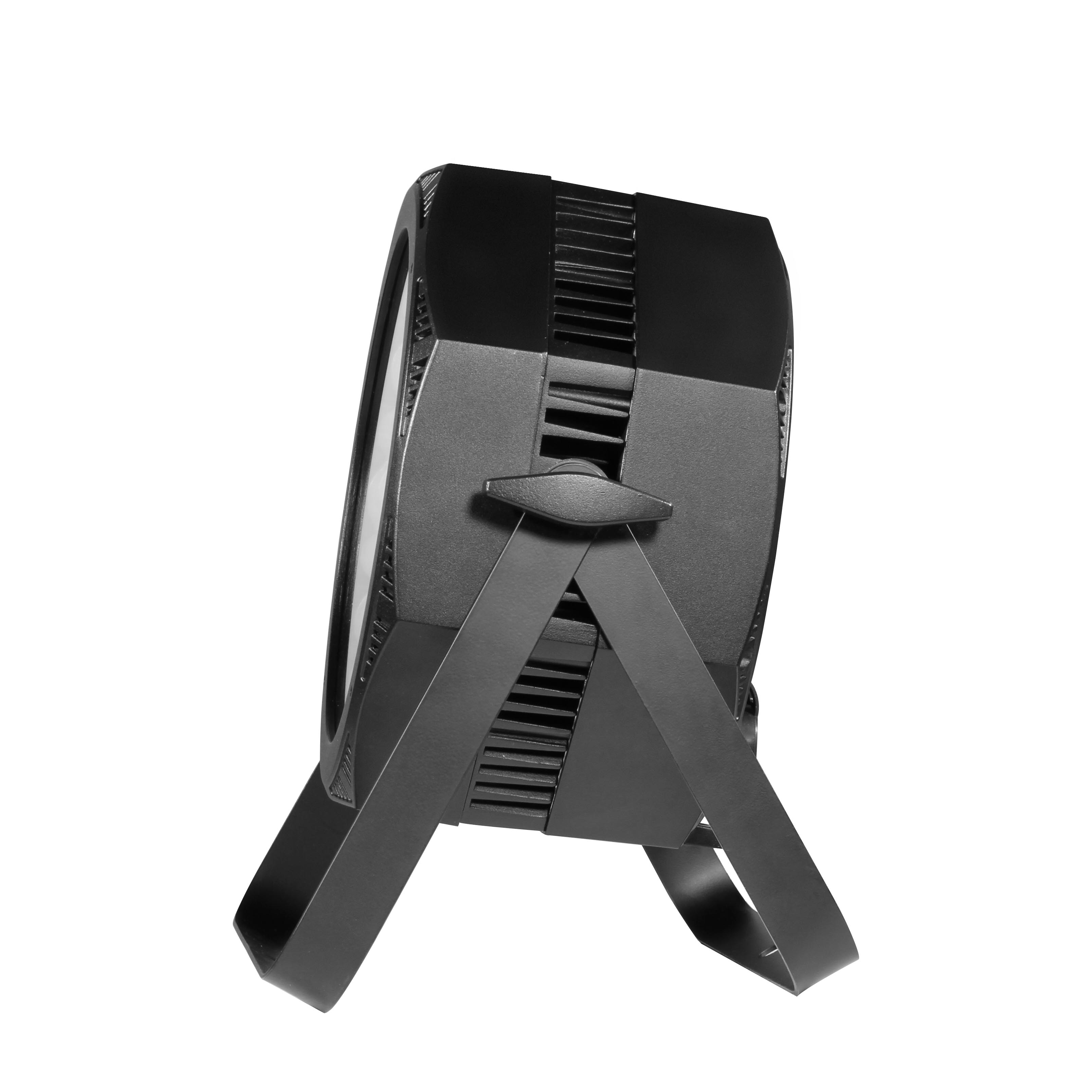
The fixture uses 7 x 20 W RGBWA+UV LEDs as its primary source and 60 x 0.2 W RGB LEDs for auxiliary lighting. Its listed optical and effect parameters include a 25-degree beam angle, 35-degree field angle, adjustable color temperature from 2800 K to 5600 K, 0 to 100 percent linear dimming, and strobe operation from 0 to 25 Hz. These figures should not be interpreted as moving-head specifications, but they provide a useful benchmark for the depth of information that should be available from a lighting supplier.
For system control, the SMARTPAR 720EP offers 10, 12, and 17 DMX channel modes, DMX512, master-slave, sound, and auto modes. RDM is available, and wireless control is optional. Its flicker-free operation can be relevant for television, film, and broadcast lighting environments.
Comparison Checklist for LED Moving Head Lights
| Evaluation area | What to compare | SMARTPAR 720EP reference data | Why it matters |
|---|---|---|---|
| Optical performance | Measured output, beam angle, field angle, zoom range, focus quality, and optical efficiency | 25-degree beam angle; 35-degree field angle; high-efficiency optical system | Optical data helps estimate coverage, while moving-head output and zoom capabilities must be verified separately. |
| Color capabilities | Color mixing, white adjustment, color consistency, and application-specific rendering needs | RGBWA+UV main light; RGB auxiliary light; 2800 K to 5600 K adjustment | Accurate color control is important for stages, studios, events, and architectural lighting. |
| Control and effects | DMX modes, RDM, network compatibility, dimming, strobe, and programmed functions | 10/12/17 DMX channels; DMX512; RDM available; 0 to 100 percent dimming; 0 to 25 Hz strobe | Flexible control enables better integration with professional consoles and programmed shows. |
| Environmental suitability | IP rating, temperature limits, connector protection, and outdoor installation requirements | IP65 rating; -25 to 45 degrees C; IP65-rated 3-pin XLR and TRUE1 powerCON connectors | Appropriate protection is necessary for outdoor, humid, dusty, or exposed locations. |
| Thermal management and support | Heat dissipation, fan control, temperature protection, inspection processes, parts supply, and technical service | Aluminum heat sink; self-adjusting fan cooling; temperature management; over-temperature protection | Effective cooling and documented quality checks support stable operation and maintenance planning. |
Testing, Compliance, and Manufacturer Support
Performance claims should be supported by a documented inspection process. Color Imagination states that each fixture undergoes functional testing, burn-in testing, safety inspection, and final quality checks before shipment. The company also lists CE certificates and ISO certificates related to stage-light assembly and management activities.
Project experience may provide additional context when evaluating a supplier’s capabilities. In a nightclub project in Yunnan, China, Color Imagination supplied 3,500 stage lighting fixtures, including beam, wash, effect, and pixel products, for synchronized lighting effects throughout the venue.
Frequently Asked Questions
How can I compare brightness between moving heads with different LED engines?
Compare declared optical output under similar test conditions, then assess beam angle, field angle, lens efficiency, color system, and intended throw distance. LED wattage by itself is not a dependable measure of projected brightness.
What beam angle should I choose for long-distance lighting?
A narrow beam is generally better for long-throw applications because it concentrates light over a smaller area. The final choice should reflect the projection distance, target size, venue geometry, and whether wash coverage is also required.
What specifications suggest stronger long-term reliability?
Look for effective cooling, operating-temperature limits, over-temperature protection, suitable IP ratings, protected connectors, electrical safeguards, burn-in testing, safety inspections, spare-parts availability, firmware support, and responsive repair services.
Conclusion
The best LED moving head light is not simply the fixture with the highest stated wattage. A sound purchasing decision compares verified output, beam control, color and effect functions, control integration, environmental suitability, and the supplier’s quality-management evidence. For demanding entertainment, broadcast, architectural, and outdoor projects, prioritize products that offer clear specifications and dependable technical support.
Color Imagination provides R&D, production, sales, technical services, OEM/ODM manufacturing, and project-based lighting solutions. Its stated pre-shipment process includes 100 percent functional testing, burn-in testing, safety inspection, and final checks. The company lists CE and ISO certificates in its records. For technical recommendations or project support, contact jack@color-imagination.com.
About Us
Guangzhou Color Imagination LED Lighting Limited is a Guangzhou-based manufacturer of professional stage, entertainment, studio, broadcast, and architectural lighting equipment, providing standard products and customized OEM/ODM services. Established in 2010, the company has 130 employees and a 6,000 SQM factory. Its R&D work covers optical, mechanical, electronic, thermal, and embedded software development for complete lighting fixtures. The company lists CE and ISO certificates and has served clients across multiple industries.

REPORT