







-
 Agriculture
-
 Health-Care
-
 Environment
-
 Construction-Real-Estate
-
 Tools-Hardware
-
 Home-Garden
-
 Furniture
-
 Luggage-Bags-Cases
-
 Medical-devices-Supplies
-
 Gifts-Crafts
-
 Sports-Entertainment
-
 Food-Beverage
-
 Vehicles-Transportation
-
 Power-Transmission
-
 Material-Handling
-
 Renewable-Energy
-
 Safety
-
 Testing-Instrument-Equipment
-
 Construction-Building-Machinery
-
 Pet-Supplies
-
 Personal-Care-Household-Cleaning
-
 Vehicle-Accessories-Electronics-Tools
-
 School-Office-Supplies
-
 Packaging-Printing
-
 Mother-Kids-Toys
-
 Business-Services
-
 Commercial-Equipment-Machinery
-
 Apparel-Accessories
-
 Security
-
 Shoes-Accessories
-
 Vehicle-Parts-Accessories
-
 Jewelry-Eyewear-Watches-Accessories
-
 Lights-Lighting
-
 Fabric-Textile-Raw-Material
-
 Fabrication-Services
-
 Industrial-Machinery
-
 Consumer-Electronics
-
 Electrical-Equipment-Supplies
-
 Electronic-Components-Accessories-Telecommunications
-
 Home-Appliances
-
 Beauty
-
 Chemicals
-
 Rubber-Plastics
-
 Metals-Alloys


























































































































































































































































































































































































































































































































































































- Masonry Materials
- Curtain Walls & Accessories
- Earthwork Products
- Fireproofing Materials
- Heat Insulation Materials
- Plastic Building Materials
- Building Boards
- Soundproofing Materials
- Timber
- Waterproofing Materials
- Balustrades & Handrails
- Bathroom & Kitchen
- Flooring & Accessories
- Tiles & Accessories
- Door, Window & Accessories
- Fireplaces & Stoves
- Floor Heating Systems & Parts
- Stairs & Stair Parts
- Ceilings
- Elevators & Escalators
- Stone
- Countertops, Vanity Tops & Table Tops
- Mosaics
- Metal Building Materials
- Multifunctional Materials
- Ladders & Scaffoldings
- Mouldings
- Corner Guards
- Decorative Films
- Formwork
- Building & Industrial Glass
- Other Construction & Real Estate
- Wallpapers/Wall panels
- HVAC System & Parts
- Outdoor Facilities
- Prefabricated Buildings
- Festive & Party Supplies
- Bathroom Products
- Household Sundries
- Rain Gear
- Garden Supplies
- Household Cleaning Tools & Accessories
- Lighters & Smoking Accessories
- Home Storage & Organization
- Household Scales
- Smart Home Improvement
- Home Textiles
- Kitchenware
- Drinkware & Accessories
- Dinnerware, Coffee & Wine
- Home Decor
- Golf
- Fitness & Body Building
- Amusement Park Facilities
- Billiards, Board Game,Coin Operated Games
- Musical Instruments
- Outdoor Affordable Luxury Sports
- Camping & Hiking
- Fishing
- Sports Safety&Rehabilitation
- Ball Sports Equipments
- Water Sports
- Winter Sports
- Luxury Travel Equipments
- Sports Shoes, Bags & Accessories
- Cycling
- Other Sports & Entertainment Products
- Artificial Grass&Sports Flooring&Sports Court Equipment
- Scooters
- Food Ingredients
- Honey & Honey Products
- Snacks
- Nuts & Kernels
- Seafood
- Plant & Animal Oil
- Beverages
- Fruit & Vegetable Products
- Frog & Escargot
- Bean Products
- Egg Products
- Dairy Products
- Seasonings & Condiments
- Canned Food
- Instant Food
- Baked Goods
- Other Food & Beverage
- Meat & Poultry
- Confectionery
- Grain Products
- Feminie Care
- Hair Care & Styling
- Body Care
- Hands & Feet Care
- Hygiene Products
- Men's Grooming
- Laundry Cleaning Supplies
- Travel Size & Gift Sets
- Room Deodorizers
- Other Personal Care Products
- Pest Control Products
- Special Household Cleaning
- Floor Cleaning
- Kitchen & Bathroom Cleaning
- Oral Care
- Bath Supplies
- Yellow Pages
- Correction Supplies
- Office Binding Supplies
- Office Cutting Supplies
- Board Erasers
- Office Adhesives & Tapes
- Education Supplies
- Pencil Cases & Bags
- Notebooks & Writing Pads
- File Folder Accessories
- Calendars
- Writing Accessories
- Commercial Office Supplies
- Pencil Sharpeners
- Pens
- Letter Pad/Paper
- Paper Envelopes
- Desk Organizers
- Pencils
- Markers & Highlighters
- Filing Products
- Art Supplies
- Easels
- Badge Holder & Accessories
- Office Paper
- Printer Supplies
- Book Covers
- Other Office & School Supplies
- Stationery Set
- Boards
- Clipboards
- Stamps
- Drafting Supplies
- Stencils
- Electronic Dictionary
- Books
- Map
- Magazines
- Calculators
- Baby & Toddler Toys
- Educational Toys
- Classic Toys
- Dress Up & Pretend Play
- Toy Vehicle
- Stuffed Animals & Plush Toys
- Outdoor Toys & Structures
- Balloons & Accessories
- Baby Food
- Children's Clothing
- Baby Supplies & Products
- Maternity Clothes
- Kids Shoes
- Baby Care
- Novelty & Gag Toys
- Dolls & Accessories
- Puzzle & Games
- Blocks & Model Building Toys
- Toddler Clothing
- Baby Clothing
- Kids' Luggage & Bags
- Arts, Crafts & DIY Toys
- Action & Toy Figures
- Baby Appliances
- Hobbies & Models
- Remote Control Toys
- Promotional Toys
- Pregnancy & Maternity
- Hygiene Products
- Kid's Textile&Bedding
- Novelty & Special Use
- Toy Weapons
- Baby Gifts
- Baby Storage & Organization
- Auto Drive Systems
- ATV/UTV Parts & Accessories
- Marine Parts & Accessories
- Other Auto Parts
- Trailer Parts & Accessories
- Auto Transmission Systems
- Train Parts & Accessories
- Universal Parts
- Railway Parts & Accessories
- Auto Brake Systems
- Aviation Parts & Accessories
- Truck Parts & Accessories
- Auto Suspension Systems
- Auto Lighting Systems
- New Energy Vehicle Parts & Accessories
- Auto Steering Systems
- Wheels, Tires & Accessories
- Bus Parts & Accessories
- Auto Performance Parts
- Cooling System
- Go-Kart & Kart Racer Parts & Accessories
- Air Conditioning Systems
- Heavy Duty Vehicle Parts & Accessories
- Auto Electrical Systems
- Auto Body Systems
- Auto Engine Systems
- Container Parts & Accessories
- Motorcycle Parts & Accessories
- Refrigeration & Heat Exchange Equipment
- Machine Tool Equipment
- Food & Beverage Machinery
- Agricultural Machinery & Equipment
- Apparel & Textile Machinery
- Chemical Machinery
- Packaging Machines
- Paper Production Machinery
- Plastic & Rubber Processing Machinery
- Industrial Robots
- Electronic Products Machinery
- Metal & Metallurgy Machinery
- Woodworking Machinery
- Home Product Manufacturing Machinery
- Machinery Accessories
- Environmental Machinery
- Machinery Service
- Electrical Equipment Manufacturing Machinery
- Industrial Compressors & Parts
- Tobacco & Cigarette Machinery
- Production Line
- Used Industrial Machinery
- Electronics Production Machinery
- Other Machinery & Industrial Equipment
- Camera, Photo & Accessories
- Portable Audio, Video & Accessories
- Television, Home Audio, Video & Accessories
- Video Games & Accessories
- Mobile Phone & Accessories
- Electronic Publications
- Earphone & Headphone & Accessories
- Speakers & Accessories
- Smart Electronics
- TV Receivers & Accessories
- Mobile Phone & Computer Repair Parts
- Chargers, Batteries & Power Supplies
- Used Electronics
- VR, AR, MR Hardware & Software
- Projectors & Presentation Equipments
- Other Consumer Electronics
- Cables & Commonly Used Accessories
- Computer Hardware & Software
- Displays, Signage and Optoelectronics
- Discrete Semiconductors
- Wireless & IoT Module and Products
- Telecommunications
- Connectors, Terminals & Accessories
- Development Boards, Electronic Modules and Kits
- Circuit Protection
- Sensors
- Isolators
- Audio Components and Products
- Integrated Circuits
- Power Supplies
- Relays
- RF, Microwave and RFID
- Electronic Accessories & Supplies
- Passive Components
- PCB & PCBA
- Air Quality Appliances
- Home Appliance Parts
- Heating & Cooling Appliances
- Small Kitchen Appliances
- Laundry Appliances
- Water Heaters
- Water Treatment Appliances
- Refrigerators & Freezers
- Personal Care & Beauty Appliances
- Major Kitchen Appliances
- Cleaning Appliances
- Second-hand Appliances
- Smart Home Appliances
- Other Home Appliances
- Energy Chemicals
- Inorganic Chemicals
- Basic Organic Chemicals
- Agrochemicals
- Admixture & Additives
- Catalysts & Chemical Auxiliary Agents
- Pigments & Dyestuff
- Coating & Paint
- Daily Chemicals
- Polymer
- Organic Intermediate
- Adhesives & Sealants
- Chemical Waste
- Biological Chemical Products
- Surface Treatment Chemicals
- Painting & Coating
- Chemical Reagents
- Flavor & Fragrance
- Non-Explosive Demolition Agents
- Other Chemicals
- Custom Chemical Services

How to Verify Origin Claims for Human Hair Crochet Extensions from Multiple Suppliers
Verifying origin claims for human hair crochet extensions sourced from multiple suppliers requires more than reviewing vendor statements. Buyers should examine raw material intake records, confirm batch-level specifications, and conduct inspections throughout production. Key checks include human hair authenticity, curl retention, length and weight accuracy, color uniformity, and the strength of the installation loops. This process helps ensure that every shipment meets the expected quality standard.
Essential Audit Priorities
- Inspect Multiple Physical Attributes: Assess raw hair condition, texture stability after washing, dimensional accuracy, and the security of each crochet loop.
- Confirm Hair Classification: Use supplier records and structural analysis to distinguish standard human hair from regional classifications such as SDD Vietnamese human hair.
- Match Documentation to Product Features: Compare origin records with the specified color, length, density, and texture, including Deep Wave, Burmese Curly, Deep Curly, Italian Curly, and Loose Deep Wave.
- Review the Supplier's QC System: Prioritize manufacturers with documented pre-shipment inspections, traceable stock, low minimum order quantities from 1 pc, and clearly defined delivery schedules.
- Assess the Intended Use: Confirm that the product is appropriate for braiding salons, wig retailers, distributors, and online stores that need consistent protective hairstyle products.
A Practical Verification Framework
A reliable multi-source audit should follow the product from raw hair receipt through final packing. Differences in donor sourcing, processing methods, grading, and fiber composition can create noticeable variation between suppliers or even between batches from the same supplier. Buyers should therefore establish a repeatable inspection sequence covering raw hair, color, length and weight, texture, loop or weft construction, and final pre-shipment quality control.
1. Authenticate the Material
Confirm that the supplied hair is genuinely 100% human hair and that no synthetic or animal fibers have been blended into the batch. Documentation should identify the material category, processing route, and batch reference. Cuticle direction, heat response, styling behavior, and other physical tests can support the supplier's declaration, although testing should be performed under controlled conditions.
2. Evaluate Texture and Color Stability
Texture verification should be performed on representative samples rather than relying only on product photographs. Check whether patterns remain consistent after washing and whether the selected curl formation matches the approved sample. Relevant styles may include Deep Wave, Burmese Curly, Deep Curly, Loose Deep Wave, Straight, Loose Wave, Kinky Straight, Kinky Curly, Italian Curly, and Body Wave. Color should also be compared across bundles and against the documented specification.
3. Check Dimensions and Attachment Construction
Measure the actual length and weight of samples from each production lot. Examine the crochet loop or weft structure for even stitching, sufficient strength, and reliable anchoring during installation. Weak or uneven loops can cause shedding, slippage, and wasted labor for professional braiders, making this inspection particularly important for salon and wholesale orders.
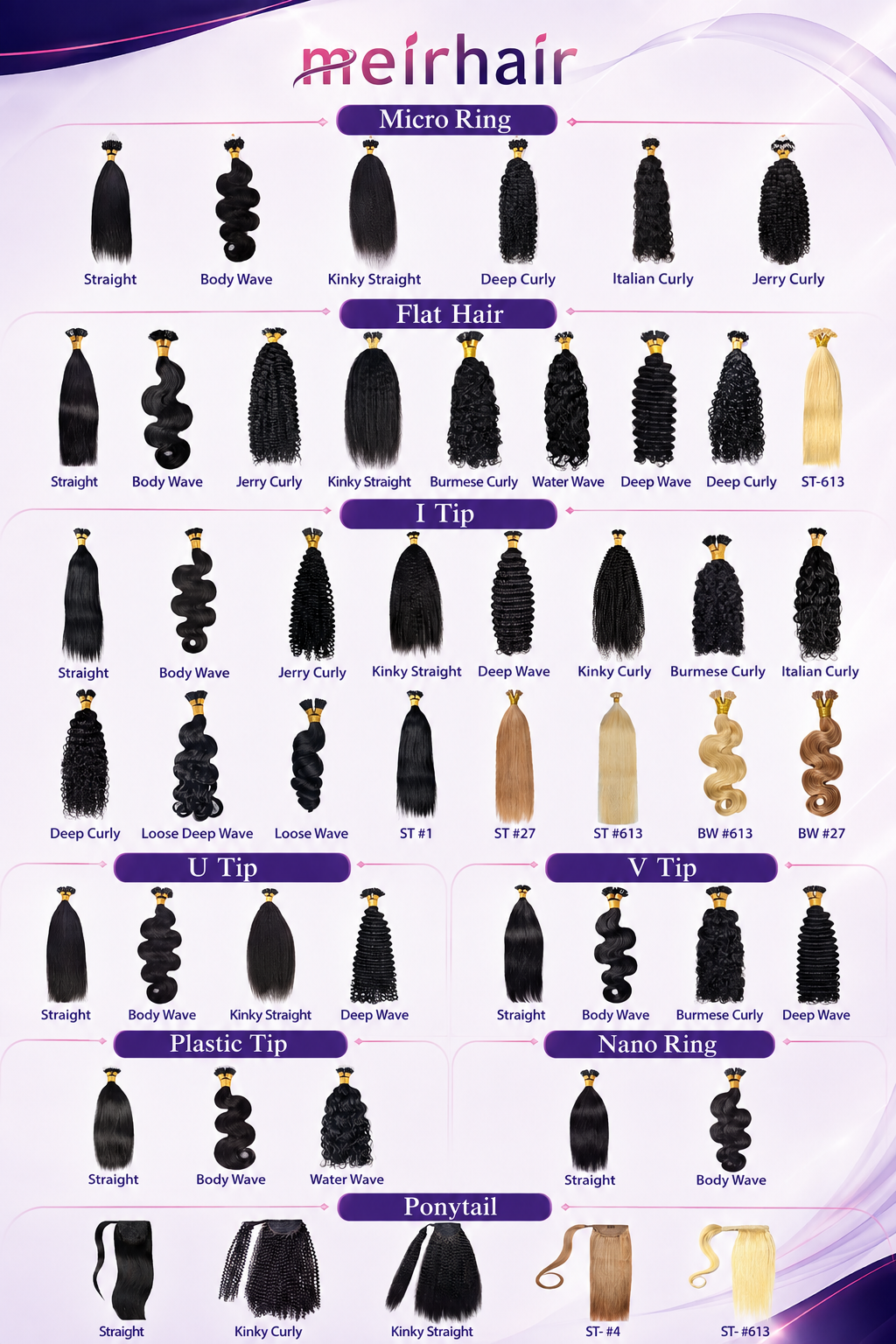
Traceability becomes more important when products are purchased from several origins or production partners. A complete vendor file should connect each batch to its material records, inspection results, approved texture, color code, and shipment documentation. Practical export experience also demonstrates the value of final loop and texture checks. For example, supplying 400 pcs of human hair crochet extensions to beauty distributors in France required consistent inspection before shipment to reduce installation problems and support professional protective styling services.
Comparison of Sourcing Approaches
The following comparison shows how an undocumented purchasing process differs from a structured audit program:
| Audit Area | Unverified Multi-Supplier Purchasing | Documented Audited Supply Program |
|---|---|---|
| Material Authentication | Origin is unclear, with possible synthetic or animal fiber blending | Batch records and testing support 100% human hair verification |
| Quality Inspection | Occasional visual checks with no consistent inspection record | Defined checks for raw hair, texture, color, loop strength, dimensions, and pre-shipment quality |
| Texture Availability | Limited patterns or inconsistent curl formation between shipments | Controlled specifications across 10+ textures, including Deep Wave, Burmese Curly, and Kinky Straight |
| Order and Delivery Flexibility | Large minimum quantities and unpredictable lead times | Orders from 1 pc, ready-stock dispatch in about 7 days, and customized production in approximately 15-30 days |
| Supply Chain Visibility | Limited information about donor processing, grading, and production routing | Traceable documentation suitable for OEM, ODM, wholesale, and private-label programs |
Frequently Asked Questions
Q1: Which tests can help verify that crochet extensions contain human hair?
A1: A controlled burn test may provide an initial indication: human hair generally burns to ash and produces a sulfur-like odor, while many synthetic fibers melt and form a hard bead. Cuticle inspection and heat-styling behavior can provide additional evidence. Buyers should combine physical testing with supplier documentation and batch records.
Q2: Why should buyers inspect the crochet loops?
A2: The loop is responsible for securing the extension to the client's braided base. Consistent stitching and adequate tensile strength reduce the risk of slipping, shedding, and early product failure during salon installation and daily wear.
Q3: What is the typical lead time for stocked and customized orders?
A3: Ready-stock products can generally be dispatched within 7 days. Orders requiring special colors, textures, densities, labels, or packaging usually take 15 to 30 days, depending on the order size and production requirements.
Conclusion
Origin claims for human hair crochet extensions should be evaluated through material authentication, batch traceability, physical inspection, and supplier process verification. Buyers should create an audit checklist that covers raw hair intake, texture and color performance, dimensions, loop construction, and final shipment approval. A supplier able to support OEM/ODM manufacturing, wholesale purchasing, and private-label development can also adapt specifications to the needs of salons, retailers, distributors, and e-commerce businesses. For technical assistance or sourcing support, contact us at sales@brazilianhairtop.com.
About Us
Guangzhou Ruiju E-Commerce Co., Ltd. operates MEIRHAIR, a professional human hair brand providing wigs, hair bundles, extensions, crochet hair, and customized hair solutions for international beauty markets. Founded in 2014, the company operates a 5000 sqm facility with 50 employees and supports product customization across different textures, lengths, colors, densities, and attachment methods. Its products are exported to customers in North America, Europe, Africa, the Middle East, South America, and Southeast Asia.

REPORT