







-
 Agriculture
-
 Health-Care
-
 Environment
-
 Construction-Real-Estate
-
 Tools-Hardware
-
 Home-Garden
-
 Furniture
-
 Luggage-Bags-Cases
-
 Medical-devices-Supplies
-
 Gifts-Crafts
-
 Sports-Entertainment
-
 Food-Beverage
-
 Vehicles-Transportation
-
 Power-Transmission
-
 Material-Handling
-
 Renewable-Energy
-
 Safety
-
 Testing-Instrument-Equipment
-
 Construction-Building-Machinery
-
 Pet-Supplies
-
 Personal-Care-Household-Cleaning
-
 Vehicle-Accessories-Electronics-Tools
-
 School-Office-Supplies
-
 Packaging-Printing
-
 Mother-Kids-Toys
-
 Business-Services
-
 Commercial-Equipment-Machinery
-
 Apparel-Accessories
-
 Security
-
 Shoes-Accessories
-
 Vehicle-Parts-Accessories
-
 Jewelry-Eyewear-Watches-Accessories
-
 Lights-Lighting
-
 Fabric-Textile-Raw-Material
-
 Fabrication-Services
-
 Industrial-Machinery
-
 Consumer-Electronics
-
 Electrical-Equipment-Supplies
-
 Electronic-Components-Accessories-Telecommunications
-
 Home-Appliances
-
 Beauty
-
 Chemicals
-
 Rubber-Plastics
-
 Metals-Alloys


























































































































































































































































































































































































































































































































































































- Masonry Materials
- Curtain Walls & Accessories
- Earthwork Products
- Fireproofing Materials
- Heat Insulation Materials
- Plastic Building Materials
- Building Boards
- Soundproofing Materials
- Timber
- Waterproofing Materials
- Balustrades & Handrails
- Bathroom & Kitchen
- Flooring & Accessories
- Tiles & Accessories
- Door, Window & Accessories
- Fireplaces & Stoves
- Floor Heating Systems & Parts
- Stairs & Stair Parts
- Ceilings
- Elevators & Escalators
- Stone
- Countertops, Vanity Tops & Table Tops
- Mosaics
- Metal Building Materials
- Multifunctional Materials
- Ladders & Scaffoldings
- Mouldings
- Corner Guards
- Decorative Films
- Formwork
- Building & Industrial Glass
- Other Construction & Real Estate
- Wallpapers/Wall panels
- HVAC System & Parts
- Outdoor Facilities
- Prefabricated Buildings
- Festive & Party Supplies
- Bathroom Products
- Household Sundries
- Rain Gear
- Garden Supplies
- Household Cleaning Tools & Accessories
- Lighters & Smoking Accessories
- Home Storage & Organization
- Household Scales
- Smart Home Improvement
- Home Textiles
- Kitchenware
- Drinkware & Accessories
- Dinnerware, Coffee & Wine
- Home Decor
- Golf
- Fitness & Body Building
- Amusement Park Facilities
- Billiards, Board Game,Coin Operated Games
- Musical Instruments
- Outdoor Affordable Luxury Sports
- Camping & Hiking
- Fishing
- Sports Safety&Rehabilitation
- Ball Sports Equipments
- Water Sports
- Winter Sports
- Luxury Travel Equipments
- Sports Shoes, Bags & Accessories
- Cycling
- Other Sports & Entertainment Products
- Artificial Grass&Sports Flooring&Sports Court Equipment
- Scooters
- Food Ingredients
- Honey & Honey Products
- Snacks
- Nuts & Kernels
- Seafood
- Plant & Animal Oil
- Beverages
- Fruit & Vegetable Products
- Frog & Escargot
- Bean Products
- Egg Products
- Dairy Products
- Seasonings & Condiments
- Canned Food
- Instant Food
- Baked Goods
- Other Food & Beverage
- Meat & Poultry
- Confectionery
- Grain Products
- Feminie Care
- Hair Care & Styling
- Body Care
- Hands & Feet Care
- Hygiene Products
- Men's Grooming
- Laundry Cleaning Supplies
- Travel Size & Gift Sets
- Room Deodorizers
- Other Personal Care Products
- Pest Control Products
- Special Household Cleaning
- Floor Cleaning
- Kitchen & Bathroom Cleaning
- Oral Care
- Bath Supplies
- Yellow Pages
- Correction Supplies
- Office Binding Supplies
- Office Cutting Supplies
- Board Erasers
- Office Adhesives & Tapes
- Education Supplies
- Pencil Cases & Bags
- Notebooks & Writing Pads
- File Folder Accessories
- Calendars
- Writing Accessories
- Commercial Office Supplies
- Pencil Sharpeners
- Pens
- Letter Pad/Paper
- Paper Envelopes
- Desk Organizers
- Pencils
- Markers & Highlighters
- Filing Products
- Art Supplies
- Easels
- Badge Holder & Accessories
- Office Paper
- Printer Supplies
- Book Covers
- Other Office & School Supplies
- Stationery Set
- Boards
- Clipboards
- Stamps
- Drafting Supplies
- Stencils
- Electronic Dictionary
- Books
- Map
- Magazines
- Calculators
- Baby & Toddler Toys
- Educational Toys
- Classic Toys
- Dress Up & Pretend Play
- Toy Vehicle
- Stuffed Animals & Plush Toys
- Outdoor Toys & Structures
- Balloons & Accessories
- Baby Food
- Children's Clothing
- Baby Supplies & Products
- Maternity Clothes
- Kids Shoes
- Baby Care
- Novelty & Gag Toys
- Dolls & Accessories
- Puzzle & Games
- Blocks & Model Building Toys
- Toddler Clothing
- Baby Clothing
- Kids' Luggage & Bags
- Arts, Crafts & DIY Toys
- Action & Toy Figures
- Baby Appliances
- Hobbies & Models
- Remote Control Toys
- Promotional Toys
- Pregnancy & Maternity
- Hygiene Products
- Kid's Textile&Bedding
- Novelty & Special Use
- Toy Weapons
- Baby Gifts
- Baby Storage & Organization
- Auto Drive Systems
- ATV/UTV Parts & Accessories
- Marine Parts & Accessories
- Other Auto Parts
- Trailer Parts & Accessories
- Auto Transmission Systems
- Train Parts & Accessories
- Universal Parts
- Railway Parts & Accessories
- Auto Brake Systems
- Aviation Parts & Accessories
- Truck Parts & Accessories
- Auto Suspension Systems
- Auto Lighting Systems
- New Energy Vehicle Parts & Accessories
- Auto Steering Systems
- Wheels, Tires & Accessories
- Bus Parts & Accessories
- Auto Performance Parts
- Cooling System
- Go-Kart & Kart Racer Parts & Accessories
- Air Conditioning Systems
- Heavy Duty Vehicle Parts & Accessories
- Auto Electrical Systems
- Auto Body Systems
- Auto Engine Systems
- Container Parts & Accessories
- Motorcycle Parts & Accessories
- Refrigeration & Heat Exchange Equipment
- Machine Tool Equipment
- Food & Beverage Machinery
- Agricultural Machinery & Equipment
- Apparel & Textile Machinery
- Chemical Machinery
- Packaging Machines
- Paper Production Machinery
- Plastic & Rubber Processing Machinery
- Industrial Robots
- Electronic Products Machinery
- Metal & Metallurgy Machinery
- Woodworking Machinery
- Home Product Manufacturing Machinery
- Machinery Accessories
- Environmental Machinery
- Machinery Service
- Electrical Equipment Manufacturing Machinery
- Industrial Compressors & Parts
- Tobacco & Cigarette Machinery
- Production Line
- Used Industrial Machinery
- Electronics Production Machinery
- Other Machinery & Industrial Equipment
- Camera, Photo & Accessories
- Portable Audio, Video & Accessories
- Television, Home Audio, Video & Accessories
- Video Games & Accessories
- Mobile Phone & Accessories
- Electronic Publications
- Earphone & Headphone & Accessories
- Speakers & Accessories
- Smart Electronics
- TV Receivers & Accessories
- Mobile Phone & Computer Repair Parts
- Chargers, Batteries & Power Supplies
- Used Electronics
- VR, AR, MR Hardware & Software
- Projectors & Presentation Equipments
- Other Consumer Electronics
- Cables & Commonly Used Accessories
- Computer Hardware & Software
- Displays, Signage and Optoelectronics
- Discrete Semiconductors
- Wireless & IoT Module and Products
- Telecommunications
- Connectors, Terminals & Accessories
- Development Boards, Electronic Modules and Kits
- Circuit Protection
- Sensors
- Isolators
- Audio Components and Products
- Integrated Circuits
- Power Supplies
- Relays
- RF, Microwave and RFID
- Electronic Accessories & Supplies
- Passive Components
- PCB & PCBA
- Air Quality Appliances
- Home Appliance Parts
- Heating & Cooling Appliances
- Small Kitchen Appliances
- Laundry Appliances
- Water Heaters
- Water Treatment Appliances
- Refrigerators & Freezers
- Personal Care & Beauty Appliances
- Major Kitchen Appliances
- Cleaning Appliances
- Second-hand Appliances
- Smart Home Appliances
- Other Home Appliances
- Energy Chemicals
- Inorganic Chemicals
- Basic Organic Chemicals
- Agrochemicals
- Admixture & Additives
- Catalysts & Chemical Auxiliary Agents
- Pigments & Dyestuff
- Coating & Paint
- Daily Chemicals
- Polymer
- Organic Intermediate
- Adhesives & Sealants
- Chemical Waste
- Biological Chemical Products
- Surface Treatment Chemicals
- Painting & Coating
- Chemical Reagents
- Flavor & Fragrance
- Non-Explosive Demolition Agents
- Other Chemicals
- Custom Chemical Services

What Should an LCD Separator Technical Support SLA Include?
A technical support service-level agreement for the BA-937C LCD Separator soldering station should establish clear rules for product assistance, response times, escalation, warranty service, spare parts, documentation, and case closure. Because the BA-937C is a 120W soldering station with a 200–500°C operating range and LED microcomputer display, the SLA should also define procedures for temperature-control, operating, and performance-related problems.
Essential SLA Requirements for BA-937C Support
A reliable agreement should connect every support request with the exact product model, purchase record, serial number when available, usage environment, and reported symptom. This avoids applying generic soldering-equipment advice to an unrelated product or operating condition.
- Cover installation, setup, operating instructions, temperature adjustment, accessory connection, and fault diagnosis.
- State the product specifications: 120W power, 200–500°C iron temperature range, LED microcomputer digital display, 225 × 194 × 105 mm dimensions, 1 kg net weight, and noise below 45 dB.
- Define one year of after-sales support and explain the online support process available after the warranty period.
- Set escalation procedures for mobile phone and tablet repair, computer and laptop motherboard work, training centers, and laboratory applications.
Product Scope and Technical Support Responsibilities
The agreement should identify the supported equipment as the BA-937C 2s Rapid Temp Soldering Station. Technical assistance should include installation checks, control-panel operation, temperature selection, soldering-iron connection, abnormal heating, unstable temperature, display errors, excessive noise, safe shutdown, and basic performance evaluation.
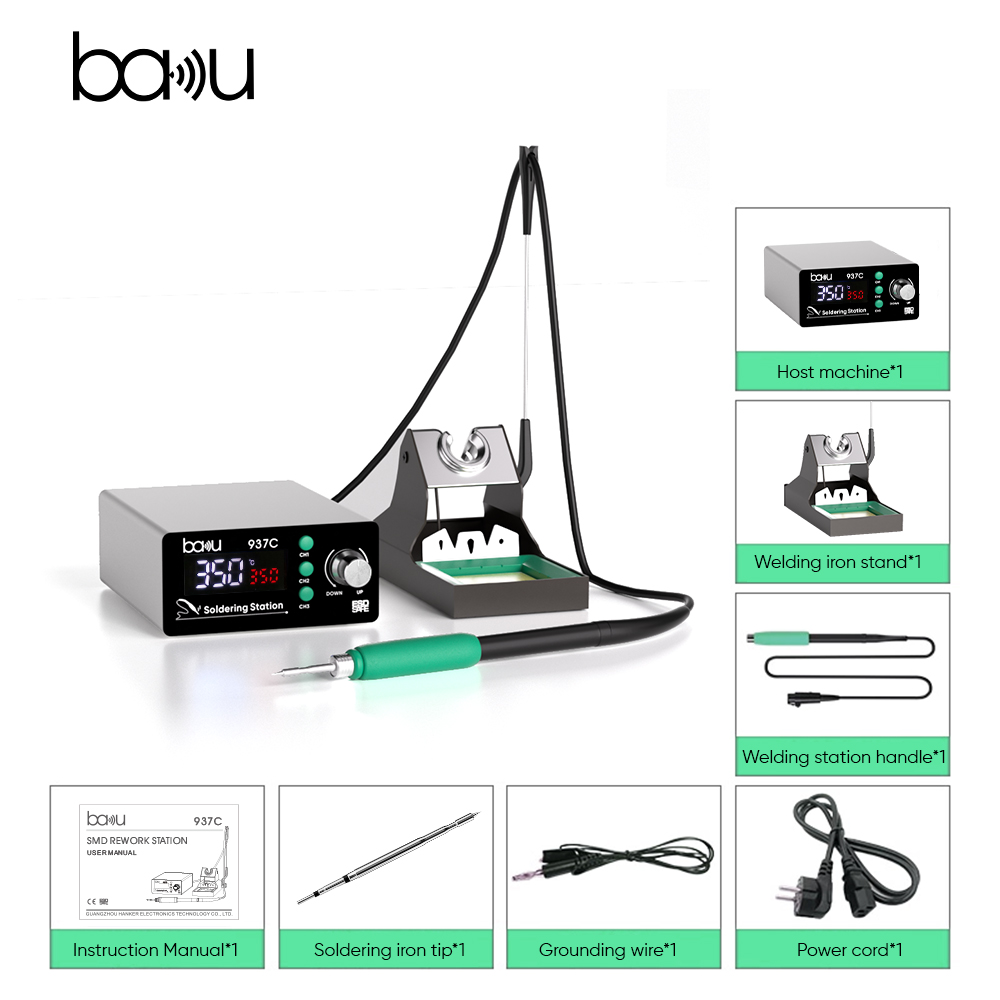
Support personnel should separate user-operation questions from suspected product defects. For example, an incorrect temperature setting or improperly connected accessory may require operating guidance, while persistent heating failure, display malfunction, or unstable temperature may require technical escalation, inspection, repair, or replacement approval.
Response Targets and Escalation Rules
The SLA should establish measurable service targets, including the time for initial acknowledgement, first diagnostic assessment, progress updates, escalation to a senior technician, and final case closure. The available product information confirms one year of online after-sales support and online assistance after the warranty period, but it does not provide fixed response times. Therefore, customer-specific response commitments must be written into the signed agreement.
Escalation may be particularly important when the BA-937C is used for motherboard chip repair, screen separation, welding cleanup, component replacement, or other precision work. Laptop and computer repair applications may involve notebook motherboards, graphics cards, and sensitive circuit boards. Training institutions and laboratories should receive repeatable operating instructions, safety guidance, and troubleshooting records for students, instructors, and technicians.
Fault Reporting, Warranty, and Parts Handling
To speed up diagnosis, customers should provide the selected temperature, displayed temperature, heating behavior, connected accessories, working environment, symptom description, and any troubleshooting already completed. Photos or video should be requested when they can clarify the fault. The support team should record the suspected cause, recommended action, party responsible for each step, approval requirements, and the conditions for closing the case.
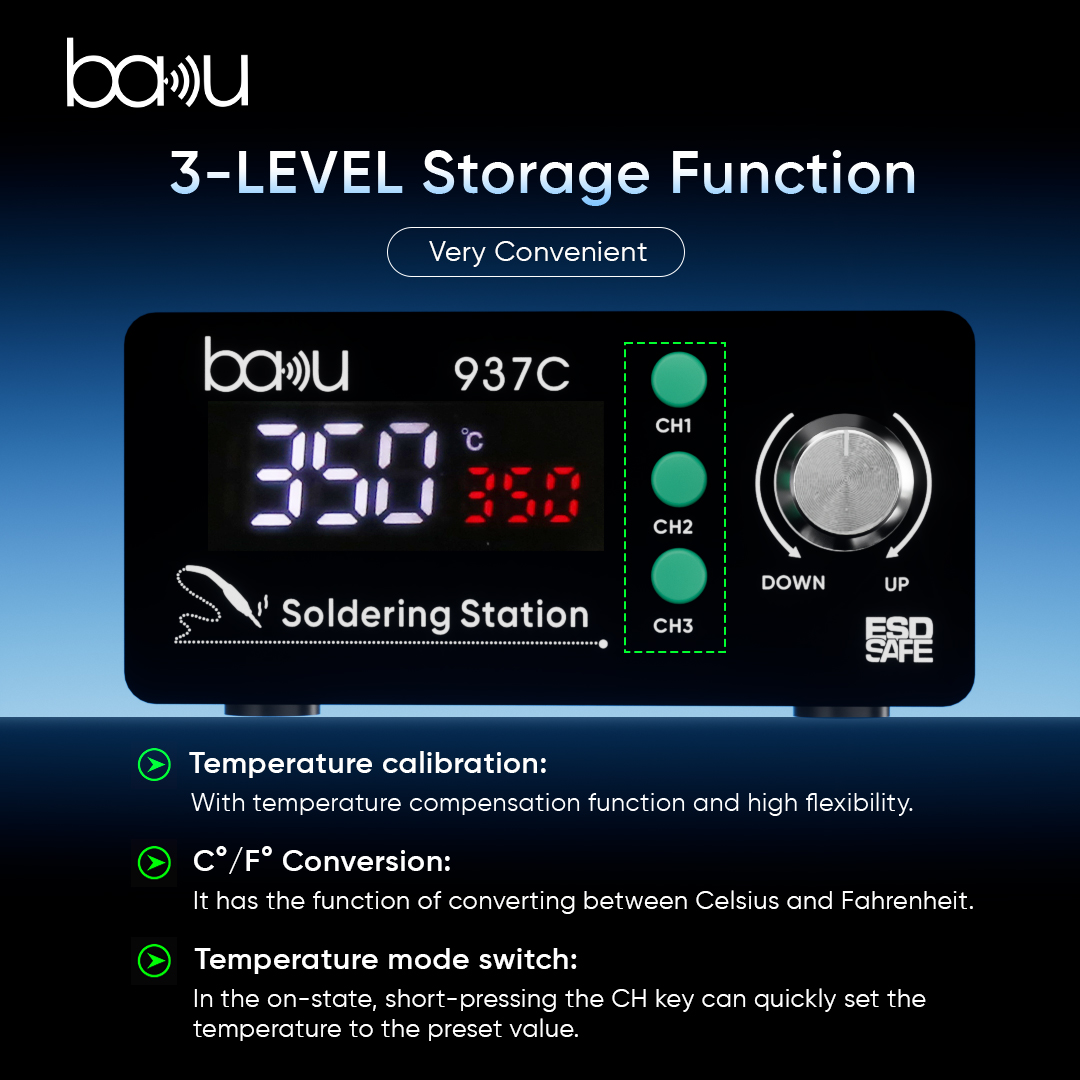
The agreement should explain warranty inclusions and exclusions, return or inspection procedures, shipping responsibilities, spare-parts availability, and replacement authorization. It should also clarify whether post-warranty online support is free, paid, or subject to a separate service arrangement. Any parts supplied should be linked to the product model and documented in the service record.
BAKU has supplied mixed tool-kit orders to an electronic repair store in the Philippines, welding and testing equipment to a vocational training institution in Malaysia, distribution orders to a wholesaler in Saudi Arabia, and soldering and rework equipment to a computer repair workshop in Mexico. These examples demonstrate experience serving repair businesses, training organizations, distributors, and computer workshops, while the final SLA should remain specific to the delivered BA-937C configuration.
Documentation and Certification Provisions
Technical documents should include operating instructions, temperature-control guidance, troubleshooting steps, safety information, and service-contact procedures. The SLA should identify the document owner and establish how revised manuals, software or control information, inspection records, and service reports will be distributed.
Relevant certification records include CE and FCC certificates for solder stations, together with RoHS certification for solder stations. The agreement should state which certification documents apply to the supplied configuration and identify the responsible party for providing current copies when requested.
SLA Coverage Comparison
| SLA Category | Recommended Terms | BA-937C Reference |
|---|---|---|
| Product and technical scope | Model identification, setup, operating guidance, temperature control, display, heating, noise, accessories, and fault diagnosis | 120W; 200–500°C; LED microcomputer digital display; noise below 45 dB |
| Warranty and service period | Warranty coverage, exclusions, post-warranty channel, paid-service rules, and renewal conditions | One-year after-sales support with online support after the warranty period |
| Response and escalation | Acknowledgement time, initial diagnosis, update frequency, escalation deadline, and closure criteria | Exact response times are not specified and should be agreed with each customer |
| Fault evidence | Required settings, symptom details, photos, video, operating conditions, and troubleshooting history | Useful for heating, temperature, display, accessory, and operating complaints |
| Commercial support | Stock supply, OEM or ODM coordination, online assistance, and order-specific responsibilities | BAKU own-brand products, OEM and ODM services, worldwide export markets, and a stated 7–15 day delivery time |
Frequently Asked Questions
What response time should be included for an LCD Separator support request?
No fixed response period is provided in the product information. The SLA should separately define acknowledgement, initial diagnosis, progress reporting, escalation, and closure targets according to the customer’s operating needs.
What information is needed to report a BA-937C problem?
The customer should provide the model, purchase details, selected and displayed temperatures, heating behavior, connected accessories, operating conditions, description of the issue, and photos or video when appropriate.
Is technical support available after the warranty ends?
The product information specifies one year of after-sales support and online assistance after the warranty period. The SLA should clarify the post-warranty channel, possible service charges, response commitments, replacement terms, and spare-parts conditions.
Conclusion and Practical Recommendations
An effective BA-937C technical support SLA should combine product-specific specifications, operating guidance, online assistance, response and escalation targets, evidence requirements, warranty boundaries, parts procedures, documentation duties, and clear case-closure standards. BAKU supplies own-brand products from stock for wholesale customers and provides OEM and ODM services for distributors, wholesalers, repair shops, and other global buyers. For technical solutions or support, please contact Joyce Ma at hanker002@bakutool.com.
About Us
Guangdong BAKU Technology Development Co., Ltd. was established in 2003 and supplies professional electronic device repair tools across more than thirty categories, including solder stations, solder flux, solder paste, screwdrivers, and ultrasonic cleaners. Its independent R&D laboratory supports ID design, structural development, PCB debugging, and reliability testing, backed by 25 design patents. The company has CE, FCC, and RoHS certification records for applicable products and has served clients across multiple industries.

REPORT