







-
 Agriculture
-
 Health-Care
-
 Environment
-
 Construction-Real-Estate
-
 Tools-Hardware
-
 Home-Garden
-
 Furniture
-
 Luggage-Bags-Cases
-
 Medical-devices-Supplies
-
 Gifts-Crafts
-
 Sports-Entertainment
-
 Food-Beverage
-
 Vehicles-Transportation
-
 Power-Transmission
-
 Material-Handling
-
 Renewable-Energy
-
 Safety
-
 Testing-Instrument-Equipment
-
 Construction-Building-Machinery
-
 Pet-Supplies
-
 Personal-Care-Household-Cleaning
-
 Vehicle-Accessories-Electronics-Tools
-
 School-Office-Supplies
-
 Packaging-Printing
-
 Mother-Kids-Toys
-
 Business-Services
-
 Commercial-Equipment-Machinery
-
 Apparel-Accessories
-
 Security
-
 Shoes-Accessories
-
 Vehicle-Parts-Accessories
-
 Jewelry-Eyewear-Watches-Accessories
-
 Lights-Lighting
-
 Fabric-Textile-Raw-Material
-
 Fabrication-Services
-
 Industrial-Machinery
-
 Consumer-Electronics
-
 Electrical-Equipment-Supplies
-
 Electronic-Components-Accessories-Telecommunications
-
 Home-Appliances
-
 Beauty
-
 Chemicals
-
 Rubber-Plastics
-
 Metals-Alloys


























































































































































































































































































































































































































































































































































































- Masonry Materials
- Curtain Walls & Accessories
- Earthwork Products
- Fireproofing Materials
- Heat Insulation Materials
- Plastic Building Materials
- Building Boards
- Soundproofing Materials
- Timber
- Waterproofing Materials
- Balustrades & Handrails
- Bathroom & Kitchen
- Flooring & Accessories
- Tiles & Accessories
- Door, Window & Accessories
- Fireplaces & Stoves
- Floor Heating Systems & Parts
- Stairs & Stair Parts
- Ceilings
- Elevators & Escalators
- Stone
- Countertops, Vanity Tops & Table Tops
- Mosaics
- Metal Building Materials
- Multifunctional Materials
- Ladders & Scaffoldings
- Mouldings
- Corner Guards
- Decorative Films
- Formwork
- Building & Industrial Glass
- Other Construction & Real Estate
- Wallpapers/Wall panels
- HVAC System & Parts
- Outdoor Facilities
- Prefabricated Buildings
- Festive & Party Supplies
- Bathroom Products
- Household Sundries
- Rain Gear
- Garden Supplies
- Household Cleaning Tools & Accessories
- Lighters & Smoking Accessories
- Home Storage & Organization
- Household Scales
- Smart Home Improvement
- Home Textiles
- Kitchenware
- Drinkware & Accessories
- Dinnerware, Coffee & Wine
- Home Decor
- Golf
- Fitness & Body Building
- Amusement Park Facilities
- Billiards, Board Game,Coin Operated Games
- Musical Instruments
- Outdoor Affordable Luxury Sports
- Camping & Hiking
- Fishing
- Sports Safety&Rehabilitation
- Ball Sports Equipments
- Water Sports
- Winter Sports
- Luxury Travel Equipments
- Sports Shoes, Bags & Accessories
- Cycling
- Other Sports & Entertainment Products
- Artificial Grass&Sports Flooring&Sports Court Equipment
- Scooters
- Food Ingredients
- Honey & Honey Products
- Snacks
- Nuts & Kernels
- Seafood
- Plant & Animal Oil
- Beverages
- Fruit & Vegetable Products
- Frog & Escargot
- Bean Products
- Egg Products
- Dairy Products
- Seasonings & Condiments
- Canned Food
- Instant Food
- Baked Goods
- Other Food & Beverage
- Meat & Poultry
- Confectionery
- Grain Products
- Feminie Care
- Hair Care & Styling
- Body Care
- Hands & Feet Care
- Hygiene Products
- Men's Grooming
- Laundry Cleaning Supplies
- Travel Size & Gift Sets
- Room Deodorizers
- Other Personal Care Products
- Pest Control Products
- Special Household Cleaning
- Floor Cleaning
- Kitchen & Bathroom Cleaning
- Oral Care
- Bath Supplies
- Yellow Pages
- Correction Supplies
- Office Binding Supplies
- Office Cutting Supplies
- Board Erasers
- Office Adhesives & Tapes
- Education Supplies
- Pencil Cases & Bags
- Notebooks & Writing Pads
- File Folder Accessories
- Calendars
- Writing Accessories
- Commercial Office Supplies
- Pencil Sharpeners
- Pens
- Letter Pad/Paper
- Paper Envelopes
- Desk Organizers
- Pencils
- Markers & Highlighters
- Filing Products
- Art Supplies
- Easels
- Badge Holder & Accessories
- Office Paper
- Printer Supplies
- Book Covers
- Other Office & School Supplies
- Stationery Set
- Boards
- Clipboards
- Stamps
- Drafting Supplies
- Stencils
- Electronic Dictionary
- Books
- Map
- Magazines
- Calculators
- Baby & Toddler Toys
- Educational Toys
- Classic Toys
- Dress Up & Pretend Play
- Toy Vehicle
- Stuffed Animals & Plush Toys
- Outdoor Toys & Structures
- Balloons & Accessories
- Baby Food
- Children's Clothing
- Baby Supplies & Products
- Maternity Clothes
- Kids Shoes
- Baby Care
- Novelty & Gag Toys
- Dolls & Accessories
- Puzzle & Games
- Blocks & Model Building Toys
- Toddler Clothing
- Baby Clothing
- Kids' Luggage & Bags
- Arts, Crafts & DIY Toys
- Action & Toy Figures
- Baby Appliances
- Hobbies & Models
- Remote Control Toys
- Promotional Toys
- Pregnancy & Maternity
- Hygiene Products
- Kid's Textile&Bedding
- Novelty & Special Use
- Toy Weapons
- Baby Gifts
- Baby Storage & Organization
- Auto Drive Systems
- ATV/UTV Parts & Accessories
- Marine Parts & Accessories
- Other Auto Parts
- Trailer Parts & Accessories
- Auto Transmission Systems
- Train Parts & Accessories
- Universal Parts
- Railway Parts & Accessories
- Auto Brake Systems
- Aviation Parts & Accessories
- Truck Parts & Accessories
- Auto Suspension Systems
- Auto Lighting Systems
- New Energy Vehicle Parts & Accessories
- Auto Steering Systems
- Wheels, Tires & Accessories
- Bus Parts & Accessories
- Auto Performance Parts
- Cooling System
- Go-Kart & Kart Racer Parts & Accessories
- Air Conditioning Systems
- Heavy Duty Vehicle Parts & Accessories
- Auto Electrical Systems
- Auto Body Systems
- Auto Engine Systems
- Container Parts & Accessories
- Motorcycle Parts & Accessories
- Refrigeration & Heat Exchange Equipment
- Machine Tool Equipment
- Food & Beverage Machinery
- Agricultural Machinery & Equipment
- Apparel & Textile Machinery
- Chemical Machinery
- Packaging Machines
- Paper Production Machinery
- Plastic & Rubber Processing Machinery
- Industrial Robots
- Electronic Products Machinery
- Metal & Metallurgy Machinery
- Woodworking Machinery
- Home Product Manufacturing Machinery
- Machinery Accessories
- Environmental Machinery
- Machinery Service
- Electrical Equipment Manufacturing Machinery
- Industrial Compressors & Parts
- Tobacco & Cigarette Machinery
- Production Line
- Used Industrial Machinery
- Electronics Production Machinery
- Other Machinery & Industrial Equipment
- Camera, Photo & Accessories
- Portable Audio, Video & Accessories
- Television, Home Audio, Video & Accessories
- Video Games & Accessories
- Mobile Phone & Accessories
- Electronic Publications
- Earphone & Headphone & Accessories
- Speakers & Accessories
- Smart Electronics
- TV Receivers & Accessories
- Mobile Phone & Computer Repair Parts
- Chargers, Batteries & Power Supplies
- Used Electronics
- VR, AR, MR Hardware & Software
- Projectors & Presentation Equipments
- Other Consumer Electronics
- Cables & Commonly Used Accessories
- Computer Hardware & Software
- Displays, Signage and Optoelectronics
- Discrete Semiconductors
- Wireless & IoT Module and Products
- Telecommunications
- Connectors, Terminals & Accessories
- Development Boards, Electronic Modules and Kits
- Circuit Protection
- Sensors
- Isolators
- Audio Components and Products
- Integrated Circuits
- Power Supplies
- Relays
- RF, Microwave and RFID
- Electronic Accessories & Supplies
- Passive Components
- PCB & PCBA
- Air Quality Appliances
- Home Appliance Parts
- Heating & Cooling Appliances
- Small Kitchen Appliances
- Laundry Appliances
- Water Heaters
- Water Treatment Appliances
- Refrigerators & Freezers
- Personal Care & Beauty Appliances
- Major Kitchen Appliances
- Cleaning Appliances
- Second-hand Appliances
- Smart Home Appliances
- Other Home Appliances
- Energy Chemicals
- Inorganic Chemicals
- Basic Organic Chemicals
- Agrochemicals
- Admixture & Additives
- Catalysts & Chemical Auxiliary Agents
- Pigments & Dyestuff
- Coating & Paint
- Daily Chemicals
- Polymer
- Organic Intermediate
- Adhesives & Sealants
- Chemical Waste
- Biological Chemical Products
- Surface Treatment Chemicals
- Painting & Coating
- Chemical Reagents
- Flavor & Fragrance
- Non-Explosive Demolition Agents
- Other Chemicals
- Custom Chemical Services

What Technical Files Are Needed for Accurate Custom CNC Machining?
Accurate CNC manufacturing starts with a complete and consistent technical data package. To produce a custom component exactly as intended, a supplier needs enough information to understand its geometry, functional requirements, material selection, finish, and inspection criteria before machining begins.
Zhejiang Dream Industry Limited accepts PDF, CAD, DWG, DXF, STEP, IGS, and STP formats for custom CNC machining and mechanical hardware production. Depending on the complexity of the part, customers can submit a 2D drawing, a 3D model, or preferably both.
Essential Files for Custom CNC Components
A 3D model is particularly useful for communicating the overall shape of a part, including curved surfaces, pockets, ribs, contours, and other complex features. However, the 2D drawing remains essential when exact manufacturing instructions must be specified.
Your drawing package should clearly identify the following items:
- Overall dimensions and critical feature sizes
- Dimensional tolerances and fit requirements
- Material grade or material category
- Threads, tapped holes, bores, keyways, and mounting interfaces
- Surface finish, coating, or appearance requirements
- Inspection standards and critical quality checkpoints
- Part revision number and any related specification sheets
When both 2D and 3D files are supplied, they should match. If a required tolerance, thread callout, or finish is missing from the model, it should be stated on the 2D drawing or in a separate written requirement document.
Define Functional Features and Installation Details
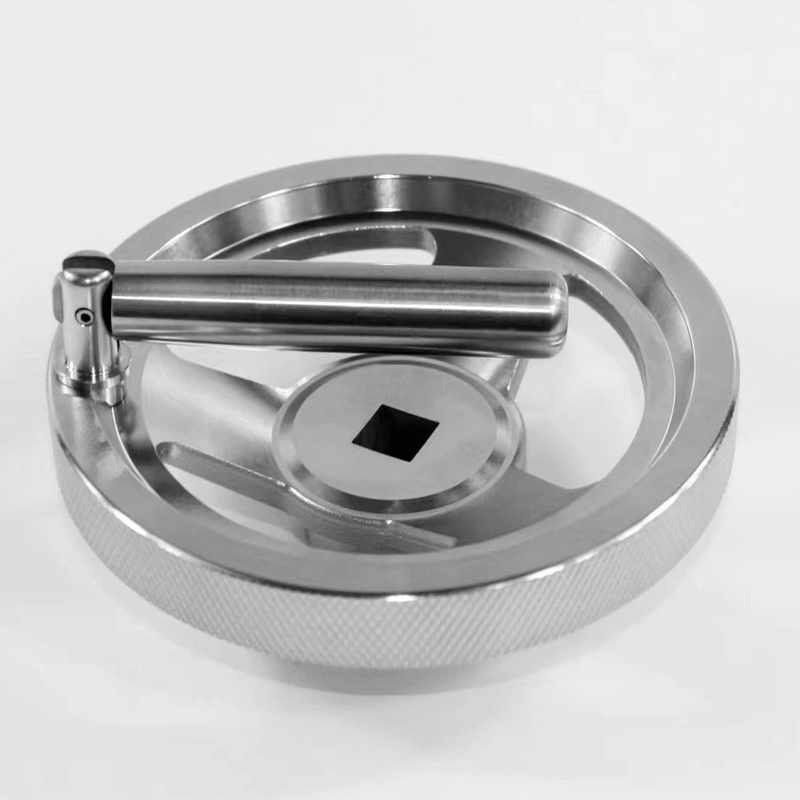
Suppliers need more than a general part outline; they need a clear definition of how the component will work and how it will be installed. For example, a spoked handwheel may require specific outside dimensions, a bore size, a threaded hub, a keyway, a square opening, a handle configuration, or additional tapped holes.
Common mounting and connection designs include threaded bores, through bores, D-bores, keyway bores, square bores, and tapped-hole arrangements. Stating these features precisely helps avoid assembly issues and ensures that the finished CNC component fits the intended equipment.
Material and Surface Finish Requirements
Material selection directly affects machinability, mechanical strength, corrosion resistance, cost, and service life. Customers should specify the requested material in the drawing or purchase specification. Available options include stainless steel, aluminum, cast iron, carbon steel, brass, copper, bakelite, phenolic materials, and other engineering plastics.
Surface treatment should also be included because it influences the final appearance and suitability of the component in its operating environment. Depending on the application, available finishing options may include polishing, brushing, sandblasting, powder coating, electroplating, chrome plating, and anodizing.
For components used in humid, corrosive, hygienic, marine, or outdoor conditions, material and finish requirements should be selected with the actual operating environment in mind.
Tolerances and Quality Inspection Instructions
Tolerances tell the machining supplier how much dimensional variation is acceptable. Standard CNC machining tolerance is generally listed at plus or minus 0.1 mm, while suitable precision-machined features can achieve tolerances up to plus or minus 0.03 mm. Critical dimensions, mating surfaces, and functional fits should be marked clearly on the drawing.
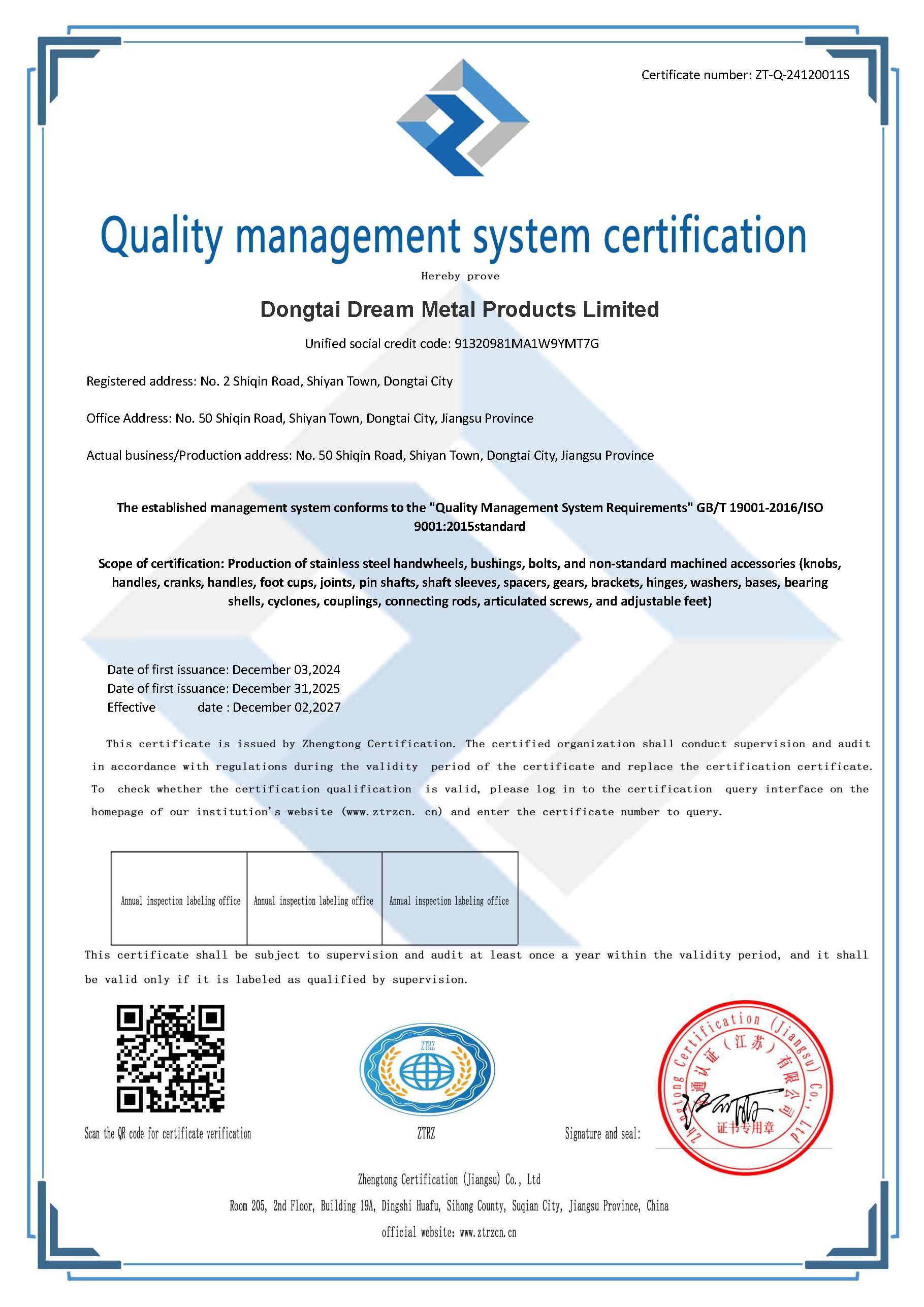
Inspection requirements should be proportionate to the component's intended use. Zhejiang Dream Industry Limited applies quality checks covering incoming raw materials, in-process production, semi-finished parts, surface treatment, assembly, finished products, and packaging. The company holds ISO certification, certificate number ZT-Q-24120011S, for the production of stainless steel handwheels, bushings, bolts, and machined non-standard parts.
Why Application Information Matters
Providing application details allows the supplier to review whether the proposed design, material, and finish are appropriate for real operating conditions. Useful information may include the equipment type, installation method, load conditions, exposure to moisture or chemicals, hygiene requirements, and expected operating frequency.
For instance, stainless steel handwheels used in food-processing machinery may require hygienic, corrosion-resistant construction. In contrast, valve handwheels for water-treatment systems or industrial pipelines may need to prioritize reliable mounting, weather resistance, and durable operation. Sharing this context helps confirm the right technical solution before production starts.
File and Requirement Checklist for CNC Production
| Required File or Detail | Purpose in CNC Manufacturing |
|---|---|
| 2D engineering drawing | Defines dimensions, tolerances, threads, bore sizes, mounting details, finishes, and inspection points. |
| 3D CAD model | Shows complete part geometry and complex structural features. STEP, IGS, and STP formats are supported. |
| PDF, CAD, DWG, or DXF file | Supports technical communication, drawing-based machining, and dimensional confirmation. |
| Material specification | Confirms the required material, such as stainless steel, aluminum, brass, copper, carbon steel, or engineering plastics. |
| Tolerance information | Sets acceptable variation for critical features, from standard plus or minus 0.1 mm to applicable precision levels of plus or minus 0.03 mm. |
| Finish and application details | Guides corrosion protection, appearance, durability, and suitability for the operating environment. |
Frequently Asked Questions
Is it necessary to provide both 2D and 3D files?
Providing both is recommended whenever possible. The 3D model helps the supplier understand the shape and machining features, while the 2D drawing provides controlled dimensions, tolerances, threads, surface finishes, and inspection notes. Zhejiang Dream Industry Limited supports PDF, CAD, DWG, DXF, STEP, IGS, and STP files.
What tolerance should be shown on a CNC drawing?
The correct tolerance depends on the function of the feature. Use plus or minus 0.1 mm for standard requirements where appropriate, and identify tighter dimensions individually when a precision tolerance of up to plus or minus 0.03 mm is required. Avoid applying unnecessarily tight tolerances to non-critical features, as this can increase manufacturing cost.
Can prototypes be made before full production?
Yes. Prototype and sample orders for CNC precision-machined parts can be arranged in quantities from 1 to 10 pieces. Sample lead time is generally stated as 3 to 7 days, while regular orders are typically listed at 7 to 15 days, subject to design complexity and order requirements.
Conclusion: Prepare a Clear, Controlled CNC File Package
The best way to reduce manufacturing uncertainty is to submit the latest controlled version of your technical files. Include the 2D drawing or 3D model, material, tolerance, mounting method, thread details, surface finish, inspection requirements, and application information. This gives the supplier a reliable basis for engineering review and production confirmation.
Zhejiang Dream Industry Limited supports OEM and ODM projects, prototype machining, small-batch production, and volume manufacturing for custom CNC components. With drawing-based file support, ISO-certified quality control, CNC turning and milling capabilities, and flexible production options, the company can support custom mechanical hardware requirements from initial sample through mass production. For technical consultation or project support, please contact 86-15868979792.
About Us
Zhejiang Dream Industry Limited specializes in the custom design and manufacture of precision CNC machined parts and assemblies. The company works with stainless steel, aluminum, brass, copper, carbon steel, and engineering plastics, offering design review, CNC turning, CNC milling, precision casting, surface treatment, and final inspection. Established in 2008, Zhejiang Dream Industry Limited supports prototype development, structural optimization, mold development, OEM production, and customized manufacturing programs for customers in a range of industrial sectors.
REPORT